Last Updated: August 12, 2026
- Why Standard Co-Parenting Advice Fails With a Narcissistic Partner
- Understanding Narcissistic Personality Disorder in Co-Parenting
- The BIFF Method for Co-Parenting Communication
- Gray Rock Method for Co-Parenting: Neutralizing Emotional Triggers
- High-Conflict Co-Parenting Communication Examples and Boundary Scripts
- Co-Parenting Apps for High-Conflict Parents: Digital Documentation Tools
- Building a Written Communication Strategy and Documentation Plan
- Managing Emotional Triggers and Protecting Your Peace
Why Standard Co-Parenting Advice Fails With a Narcissistic Partner
Most co-parenting guides assume both parents operate in good faith. They recommend open dialogue, compromise, and shared decision-making, strategies that fail when a parent with narcissistic traits weaponizes communication. A casual text about schedules becomes “evidence” of your controlling behavior. An attempt at compromise proves you’re “unreasonable.” The more you engage, the more ammunition you provide.
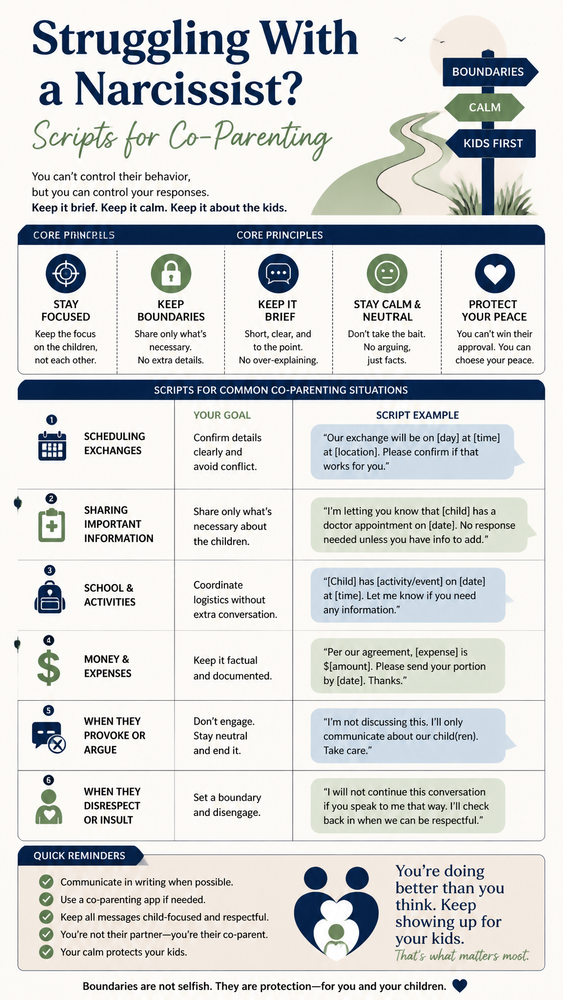
Scripts for co-parenting with a narcissist work precisely because they remove the emotional hooks a narcissistic co-parent exploits. The difference between generic advice and what actually works comes down to this: your goal isn’t to improve the relationship. Your goal is to manage interactions safely while protecting your children’s wellbeing.
Understanding Narcissistic Personality Disorder in Co-Parenting
Narcissistic Personality Disorder exists on a spectrum. What matters is recognizing behavioral patterns: a parent who prioritizes their own needs above the child’s, who uses manipulation to maintain control, who cannot tolerate being questioned, and who sees parenting as an extension of their ego.
In co-parenting situations, these traits show up consistently. The narcissistic parent may weaponize communication, use children as messengers, refuse to follow court orders, create crisis situations for attention, deny harmful behavior, or use financial control and custody threats as leverage.
Understanding these patterns isn’t about diagnosing your ex. It’s about recognizing that standard conflict resolution won’t work. You can’t negotiate with someone who views negotiation as a battle to win. This is why scripts for co-parenting with a narcissist follow entirely different principles than conventional communication.
The BIFF Method for Co-Parenting Communication
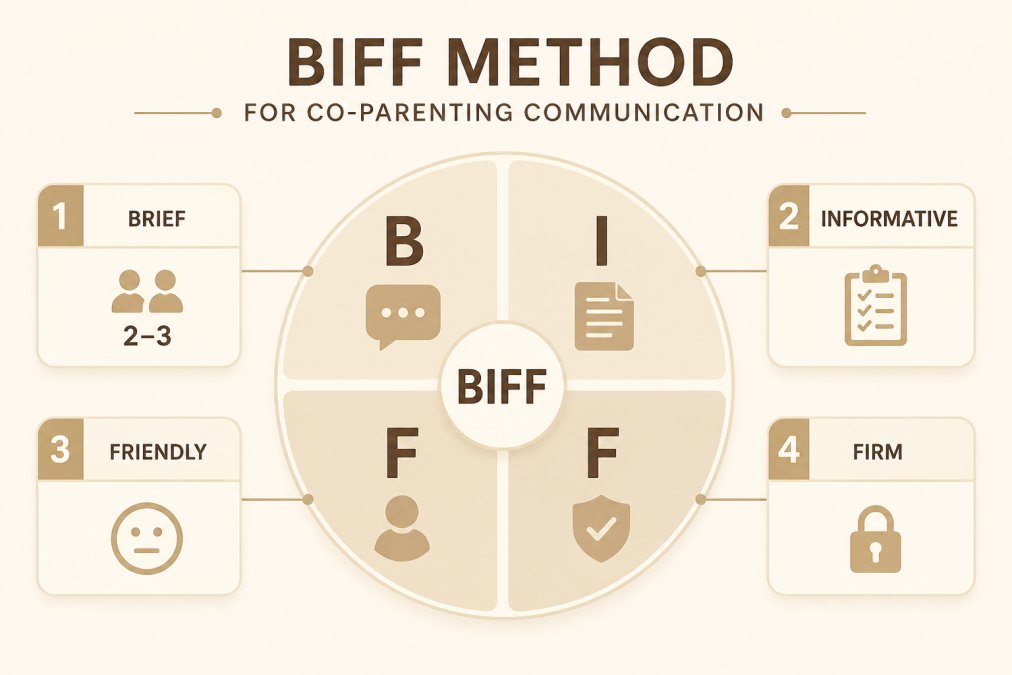
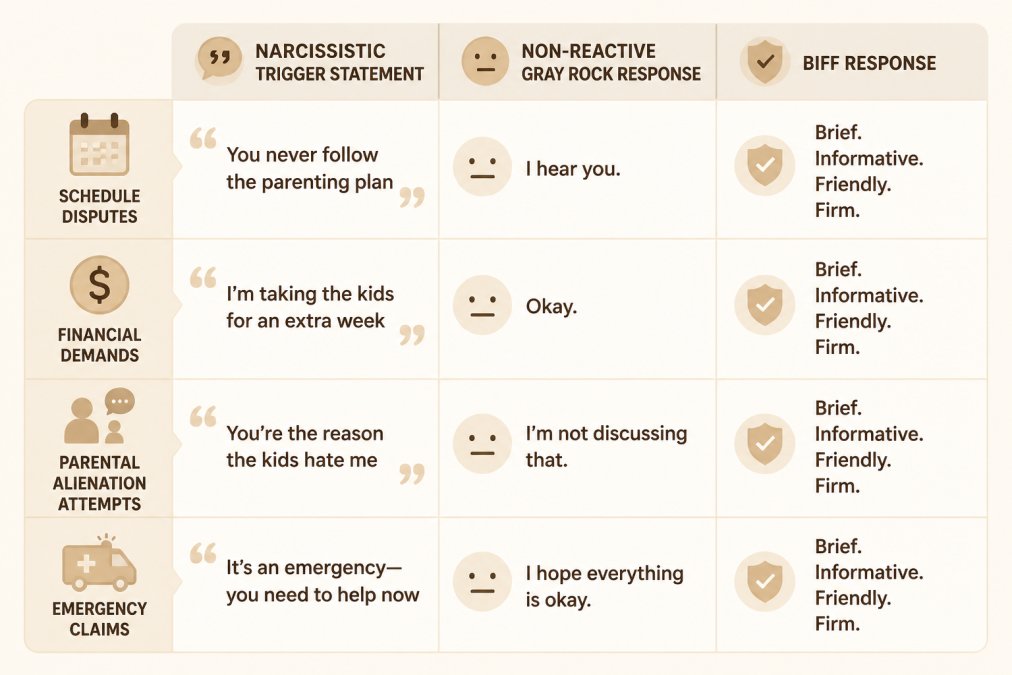
The BIFF method is a structured communication framework specifically designed for high-conflict co-parenting. BIFF stands for Brief, Informative, Friendly, and Firm. It’s not a magic formula that transforms a narcissistic co-parent into a cooperative one. It’s a shield that prevents your communication from being weaponized against you.
How to Structure a BIFF Response
When you receive a provocative message, your instinct might be to defend yourself or engage emotionally. BIFF teaches you to do neither.
Brief: Keep responses to two or three sentences maximum. Every additional sentence is an opportunity for misinterpretation.
Informative: Include only factual information relevant to the child’s care or logistics. No explanations, context, or emotional content.
Friendly: Use a neutral, professional tone, like communicating with a colleague you don’t know well. Not cold or hostile, not warm or personal.
Firm: State what will happen or what you need. No room for negotiation in the message itself.
Real-World BIFF Scripts for Common Scenarios
Scenario: Your co-parent cancels visitation last-minute and blames you
Narcissistic message: “I can’t take the kids this weekend because you didn’t prepare them properly. You’re sabotaging my relationship with them.”
BIFF Response: “The kids are ready for their scheduled time with you this Saturday at 10 a.m. Please confirm receipt. If you’re unable to take them, let me know by Friday at 5 p.m.”
Why this works: You don’t engage with the accusation or explain your preparation. You restate the fact and set a clear boundary.
Scenario: Your co-parent demands information about a medical appointment
Narcissistic message: “Why didn’t you tell me? I have a right to know everything. You’re keeping secrets from me.”
BIFF Response: “The pediatric checkup is scheduled for August 15 at 2 p.m. at Children’s Medical Center. I’ll email you the summary after the appointment.”
Why this works: You provide necessary information without defending your decision-making.
Scenario: Your co-parent criticizes your parenting in front of the children
Narcissistic behavior: “Your mom/dad is so disorganized. That’s why you’re struggling in school.”
BIFF Response (to co-parent, in writing): “Comments about my parenting in front of the kids aren’t appropriate. Keep parenting conversations between us. If you have concerns about schooling, email me and we can discuss solutions.”
Why this works: You name the specific behavior, set the boundary, and offer a constructive alternative.

Gray Rock Method for Co-Parenting: Neutralizing Emotional Triggers
The Gray Rock method makes you as uninteresting as possible to someone who thrives on drama. Become as boring and unresponsive as a gray rock. No emotional fuel means no reason to continue the attack.
In high-conflict co-parenting, this means responding to provocations with neutral, factual statements; never sharing personal information; keeping conversations strictly about the child’s needs; maintaining consistent, predictable responses; and refusing to engage with bait or insults.
The gray rock method doesn’t mean being cold or hostile. It means being so consistently neutral that the narcissistic parent gets no reward for their behavior. Over time, they often redirect their energy elsewhere.
Practical Gray Rock Scripts and Examples
When your co-parent tries to provoke you with personal attacks:
Narcissistic message: “You’ve always been selfish. That’s why this marriage failed. You’ll never be a good parent.”
Gray Rock Response: “I’m not going to discuss this. Let me know about any changes to the pickup schedule.”
Why this works: You acknowledge the message without engaging with its content and redirect to logistics.
When your co-parent shares inappropriate details with your child:
Narcissistic behavior: Tells the child about your dating life, finances, or other adult matters.
Gray Rock Response (to co-parent): “The kids need to focus on school and their relationship with both parents. Please keep conversations age-appropriate.”
Why this works: You state the boundary factually without accusing or explaining.
When your co-parent demands explanations for your parenting decisions:
Narcissistic message: “Why did you let her quit soccer? She was good at it. You’re ruining her future.”
Gray Rock Response: “That decision was made based on what’s best for her right now. Soccer isn’t a topic for discussion between us unless there’s a scheduling impact.”
Why this works: You acknowledge the comment without defending your choice and set a boundary about what’s open for discussion.
High-Conflict Co-Parenting Communication Examples and Boundary Scripts
High-conflict co-parenting requires a different approach to every conversation. Every word can be recorded, screenshotted, and used in court. Every emotional reaction can be framed as evidence of instability.
Scripts for Setting and Maintaining Firm Boundaries
Boundaries with a narcissistic co-parent are not negotiable suggestions. They’re requirements for your safety and your children’s wellbeing.
Boundary: You will not discuss adult issues with the children
Take the free 23-point assessment →
“I need to be clear: conversations between us about finances, dating, or other adult topics stay between us. The kids won’t be involved. If you need to discuss something related to their care, email me and we can address it directly.”
Boundary: You will not tolerate being spoken to disrespectfully
“I’m willing to communicate about the kids’ needs. I’m not willing to engage in conversations that include insults or accusations. If your next message contains either, I won’t respond. Stick to facts about the kids’ schedule and needs.”
Boundary: You will follow the court-ordered parenting plan
“According to the parenting plan, pickup is at 6 p.m. on Fridays. If you need to adjust the schedule, submit a request in writing at least two weeks in advance. Changes made without notice aren’t accommodated.”
Boundary: You will not use the children as messengers
“Please don’t ask the kids to relay messages to me. If you need to communicate something, send me an email or text. Using the kids as messengers puts them in an uncomfortable position.”
Age-Specific Scripts for Explaining Changes to Your Children
Children need age-appropriate context without adult explanations or details about parental conflict.
For young children (ages 5-8) about custody changes:
“Mom and Dad are living in different houses now. You’re going to spend time with both of us, and we both love you very much. The schedule shows when you’re with me and when you’re with Dad. You don’t have to worry about anything. We’re taking care of all the grown-up stuff.”
For school-age children (ages 9-12) about parental conflict:
“Sometimes parents disagree about things, and that’s normal. When we disagree, we work it out between us. Your job is to be a kid and focus on school and your friends. You’re not responsible for fixing anything between us, and you don’t have to pick sides.”
For teenagers (ages 13+) about a parent’s behavior:
“I know you’ve noticed that things are tense between your mom and me. I’m not going to put you in the middle of that. If you have questions about decisions we’ve made about your schedule, you can ask me directly. But I won’t ask you to take sides or carry messages back and forth.”
Reading this won’t change tomorrow’s message
You Know the Tactic Now. Do You Know What You’ll Actually Do When It Lands?
Understanding grey rock is not the same as doing it at 9pm when your phone buzzes. Most parents can explain the theory perfectly and still bite the bait every single time. The gap between the two is exactly what the free self-check measures.
Get Your Ex Out of Your Head ->5 scenarios, scored result, 4 minutes free
Crisis Management Scripts for Unexpected Situations
When your co-parent threatens not to return the children:
“I expect the kids to be returned at the scheduled time on [date] at [time] as outlined in the parenting plan. If there’s a legitimate emergency, contact me immediately. Otherwise, I will contact law enforcement if they are not returned on time.”
When your co-parent shows up unannounced and demands time with the children:
“Visitation happens according to the parenting plan. Your scheduled time is [day/date]. I’m not able to accommodate unscheduled visits. Please leave now, or I will contact law enforcement.”
When your co-parent sends an abusive or threatening message:
“I’m not responding to this message. If you need to discuss the children’s schedule or needs, send a respectful communication. Threats and abuse will not be engaged with.”
When your co-parent involves the children in conflict:
“I saw that you discussed [topic] with the kids. That’s not appropriate. Going forward, adult topics stay between us. If you have concerns about the children’s wellbeing, contact me directly. Using them to relay messages or discuss adult issues stops now.”
Co-Parenting Apps for High-Conflict Parents: Digital Documentation Tools
Digital communication tools create a record. Every message is documented, timestamped, and stored. In situations where conflict might escalate to legal proceedings, this documentation becomes critical evidence.
Specialized co-parenting apps are designed specifically for high-conflict situations. They limit communication to child-related topics, prevent emotionally charged language, and create an audit trail that courts recognize. Using a dedicated platform signals that communication is being documented, which often naturally de-escalates behavior.
When choosing a digital tool, prioritize automatic message filtering for inappropriate language, clear timestamps and read receipts, export capabilities for legal documentation, mobile app access, and parenting plan integration.
Noticing the pattern is not the same as proving it
You Can Feel the Pattern. Can You Prove It to a Judge?
A diary of what happened reads as emotional venting. A structured, timestamped record reads as evidence. Most parents lose that distinction until it costs them. The free checklist shows you exactly what to document today, before the evidence window closes.
Get the Free Red Flag Checklist ->3 categories, 5 minutes, free
Building a Written Communication Strategy and Documentation Plan
Written communication is your protection in high-conflict co-parenting. Every email, text, and message becomes part of the record. Your communication strategy creates evidence of your reasonable, child-focused approach if the situation reaches court.
A written communication strategy includes choosing a platform (email, dedicated app, text), setting clear guidelines about what topics are open for discussion, committing to response timeframes (typically 24-48 hours), documenting all agreements and schedule changes, and maintaining regular backups.
What to Document and How to Protect Your Records
Documentation protects you. Courts recognize patterns. When you can show a consistent history of one parent following the parenting plan and the other repeatedly violating it, that becomes evidence.
Document every missed pickup or return, violation of the parenting plan, instance of the child returning upset or injured, inappropriate conversation the child reports, demand for schedule changes, and refusal to follow court orders.
Protect your records by keeping originals and backups in multiple locations, using cloud storage with automatic backup, printing important emails and texts, creating a timeline document with dates and descriptions, noting the impact on your child, and never altering original messages.
Managing Emotional Triggers and Protecting Your Peace
High-conflict co-parenting is emotionally exhausting. Your nervous system is in constant hypervigilance. This chronic stress affects your ability to parent effectively and model emotional regulation for your children.
Managing your emotional triggers isn’t about suppressing feelings. It’s about recognizing what sets you off and creating space between the trigger and your response.
Common triggers include accusations or blame, threats about custody or legal action, criticism of your parenting, demands that violate the parenting plan, manipulation or control attempts, and dismissal of your concerns.
When triggered, pause before responding. The BIFF and Gray Rock methods work because they give you a structure to follow when emotions are activated.
Create a physical and emotional boundary by designating specific times to check messages, calling a trusted friend or therapist before responding to provocative messages, using a separate phone or email for co-parenting communication, engaging in physical activity that regulates your nervous system, and limiting what you share about the situation with your children.
Your peace is not selfish. Your emotional stability directly impacts your children’s wellbeing. Protecting it is part of your parenting responsibility.
High-conflict co-parenting with a narcissistic partner demands a fundamentally different approach than standard co-parenting advice. The scripts, frameworks, and tools that work are those designed specifically for situations where one parent prioritizes control and drama over the child’s needs. After the Affair Series provides structured communication templates, boundary-setting guidance, and documentation strategies that address your specific challenges. Rather than generic advice about compromise and open dialogue, you get tactical, scenario-based scripts you can use immediately when conflict arises. Take the free 23-point assessment to identify which frameworks align with your specific situation and get access to age-appropriate scripts for your children.
Willpower was never the problem
You’ve Said No Contact Before. What Made It Fail Last Time?
It usually isn’t willpower. It’s a loophole nobody accounted for, a second number, a mutual friend, a platform nobody thought to block. This free audit maps all 47 known workarounds so the boundary holds on its own, without relying on you to be strong enough every single time.
Get the Free Loophole Elimination Matrix ->47-point audit, instant download, free