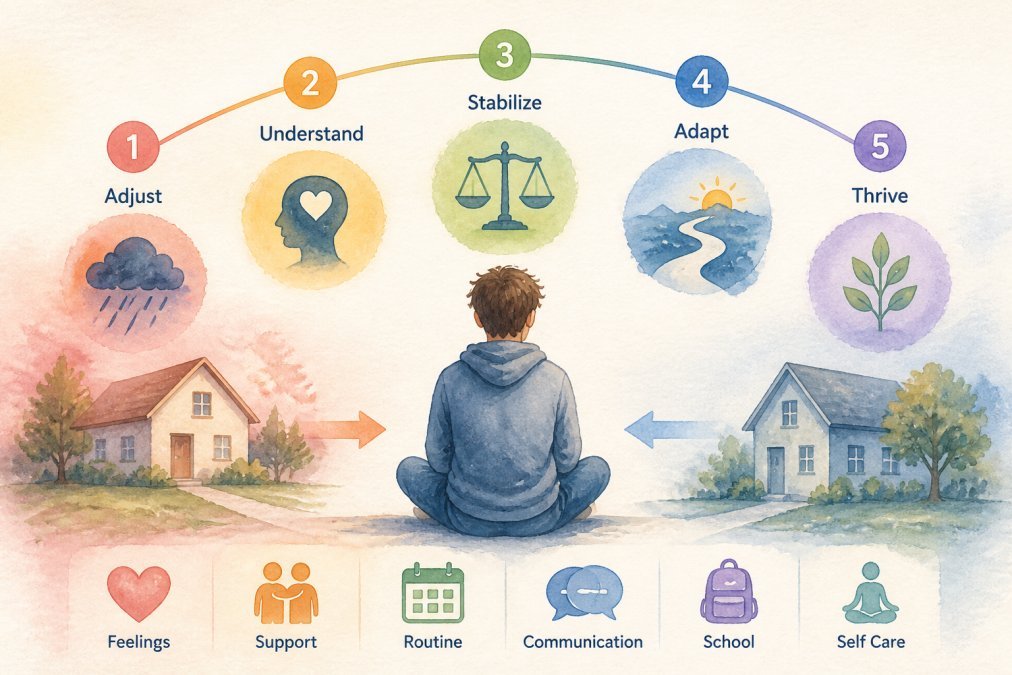
The most damaging recovery mistakes to avoid after an affair aren’t the obvious ones. They’re the well-intentioned moves that quietly extend the pain: pushing for forgiveness before safety is established, demanding every graphic detail in the name of honesty, or jumping straight into couples therapy before the injured partner has stabilized. Here’s a direct checklist of the top errors and what to do instead.
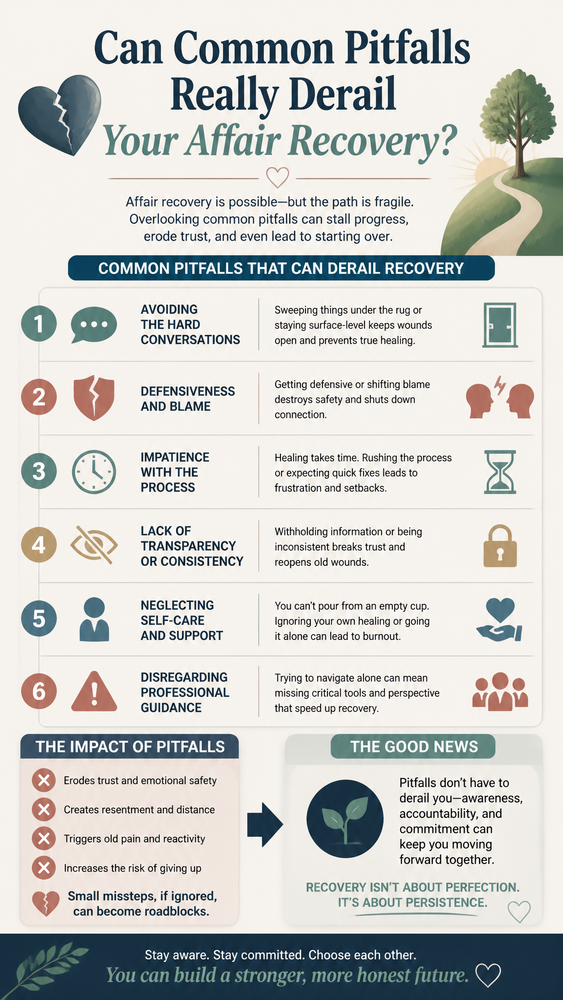
- Rushing forgiveness: Replace pressure to forgive with paced accountability and consistent behavior over time; rebuilding trust is a multi-year process, not a single conversation.
- Forcing mutuality too early: Let the injured partner stabilize before asking them to share responsibility for the relationship’s emotional tone.
- Radical transparency (demanding every detail): Structure disclosure clinically; unregulated graphic detail re-traumatizes rather than reassures.
- Trickle-truthing: Release the full truth in one managed disclosure, not in drips that force repeated recalibration.
- Minimizing or blaming the injured partner: Name the betrayal clearly and accept full accountability without deflection.
- Telling children or inappropriate third parties: Protect children from adult conflict; choose one or two trusted, neutral supports.
- Making permanent decisions in crisis: Delay major life decisions (divorce, relocation, financial restructuring) until the acute phase passes.
- Skipping individual trauma work: Start with individual therapy before couples work; betrayal often meets criteria for trauma-focused treatment.
- Avoiding necessary conversations: Neither total silence nor obsessive detail interrogation heals; paced, emotionally focused dialogue does.
- Ignoring physical self-care: Sleep deprivation and poor nutrition worsen emotional dysregulation during an already destabilizing period.
- Key Takeaways
- What are the most common recovery mistakes and why do they backfire?
- When does betrayal become trauma that needs specialized treatment?
- What practical steps should injured partners and betrayers take now?
- What session materials can therapists use with clients?
- How long does recovery take and what does therapy cost in the U.S.?
- What red flags mean reconciliation is unsafe?
- The part of recovery most people underestimate
- FAQ
Key Takeaways
Betrayal recovery fails most often not from lack of effort but from errors in sequencing: stabilization must come before repair, and accountability must precede forgiveness.
| Point | Details |
|---|---|
| Sequence before speed | Stabilization, truth, and individual therapy must precede couples work or forgiveness pressure. |
| Avoid both disclosure extremes | Trickle-truthing and radical transparency both re-traumatize; use one structured, clinically managed disclosure. |
| Expect a multi-year timeline | Recovery typically spans months to years across stabilization, processing, decision, and rebuilding phases. |
| Trauma care when symptoms persist | EMDR and trauma-focused CBT are appropriate when PTSD-like symptoms (intrusion, hypervigilance, numbing) are functionally impairing. |
| Aftertheaffair structured tools | The 7-step checklist, Partner Accountability Guide, and clinician materials map resources to each recovery stage. |
What are the most common recovery mistakes and why do they backfire?
Forcing mutuality before stabilization
The single most clinically consequential error is pushing for “we both played a role” framing while the injured partner is still in shock. Betrayal-informed care sequences stabilization and truth before any relational mutuality. Asking a destabilized person to co-regulate the relationship protects the betrayer from full accountability and deepens the injured partner’s sense of unreality.
Radical transparency and trickle-truthing
Both extremes of disclosure cause harm. Demanding every graphic detail or real-time device access floods the nervous system and worsens symptoms. Trickle-truthing — releasing information incrementally over weeks or months — is arguably worse: each new revelation resets the trauma clock and destroys any emerging sense of safety. A single, clinically managed disclosure, timed to the injured partner’s readiness, reduces ongoing destabilization.
Disclosure is not a confession booth. It’s a clinical intervention. The goal is not to transfer guilt but to give the injured partner enough truth to make an informed decision — no more, no less, and never without a therapist present.
Pro Tip: Before any disclosure conversation, agree on scope with a therapist. Define what categories of information will be shared (timeline, emotional involvement, physical contact) and what graphic details will be withheld. Titrating information to readiness is not deception — it’s nervous-system safety.
Rushing forgiveness
Immediate forgiveness is often counterproductive. Forgiveness is a process of releasing hurt while maintaining firm boundaries, not a single act of absolution. Pressuring an injured partner to forgive quickly signals that their pain is inconvenient, which compounds shame and resentment.
Crisis decisions, oversharing, and avoidance
Making sudden permanent decisions during the acute phase — filing for divorce the week of discovery, quitting a job, moving out immediately — often forecloses options that would have looked different in three months. Telling children or broadcasting the betrayal to extended family creates secondary harm that outlasts the original crisis. Equally, avoiding all conversation about the affair leaves the injured partner without the information they need to process what happened.
When does betrayal become trauma that needs specialized treatment?
Betrayal after an affair can produce a symptom cluster that closely mirrors PTSD. Research documents intrusive thoughts, hypervigilance, emotional numbing, and identity disruption as common responses. When these symptoms are persistent and functionally impairing, trauma-focused treatment is appropriate, not optional.
Hallmark symptoms warranting referral:
- Intrusive images or flashbacks of the discovery moment
- Hypervigilance (checking phones, tracking location, scanning for deception)
- Emotional numbing or dissociation during conversations about the affair
- Disrupted sense of self (“I don’t know who I am anymore”)
- Sleep disturbance, appetite changes, or inability to concentrate at work
Betrayal trauma also uniquely damages self-trust. Survivors often question their own perceptions and judgment, not just the relationship. Therapy must help them reconnect with their own reality, not only rebuild relational trust.
| Treatment | Primary mechanism | Typical use-case | Referral indicator |
|---|---|---|---|
| Trauma-focused CBT | Cognitive restructuring of trauma-related beliefs | Persistent negative cognitions, avoidance | Functional impairment, meets PTSD criteria |
| EMDR | Bilateral stimulation to reprocess traumatic memories | Intrusive images, flashbacks, hyperarousal | Discrete traumatic memories (discovery moment) |
| Individual betrayal-informed therapy | Containment, pacing, nervous-system safety | Acute destabilization, identity disruption | All betrayal trauma cases as first step |
| Group support (betrayal-specific) | Peer validation, shame reduction | Isolation, shame, secondary stabilization | After individual work is established |
Clinician referral indicators requiring urgent attention: suicidal ideation, persistent dissociation, inability to function at work or care for dependents, or a history of prior trauma that the betrayal has reactivated.
What practical steps should injured partners and betrayers take now?
For injured partners: stabilization first
- Establish nervous-system safety. Identify two or three people who can sit with you without offering opinions on what you should do. Limit crisis conversations to 20-minute windows to prevent flooding.
- Secure basic self-care. Sleep, food, and movement are not luxuries; they are the floor of emotional regulation. Coping strategies in the immediate aftermath matter more than most people expect.
- Delay major decisions. Give yourself a minimum of 90 days before making any permanent structural change to your life.
- Start individual therapy before couples therapy. A betrayal-informed therapist can help you assess trauma bonding, stabilize symptoms, and clarify what you actually want.
- Use a reality-checking journal. Write down what you know to be true each day. Betrayal distorts perception; anchoring to documented facts rebuilds self-trust.
For betrayers: accountability without performance
- Stop all contact with the affair partner. This is non-negotiable and must be verifiable, not just asserted.
- Agree to a structured disclosure conversation with a therapist present. Do not volunteer graphic details unprompted.
- Create a written accountability plan. Specify what transparency looks like (shared location, open devices, regular check-ins) and commit to a timeline for review.
- Enter individual therapy. Understanding why the affair happened is your work, not your partner’s.
- Demonstrate consistency over time. Words are cheap in the first six months. Behavior over an extended period is what rebuilds credibility.
Pro Tip: Clinicians assigning homework should use the Partner Accountability Conversation Guide to structure early accountability sessions. It provides scripted prompts that prevent the conversation from collapsing into either defensiveness or graphic detail.
What session materials can therapists use with clients?
Structured materials reduce the cognitive load on both clinician and client during a period of high emotional volatility. The following framework maps to the first six sessions post-disclosure.
Session agenda template (sessions 1–6):
- Sessions 1–2: Stabilization. Assess PTSD-like symptoms, establish safety plan, identify support contacts, psychoeducation on betrayal trauma. No couples work yet.
- Sessions 3–4: Truth assessment. Structured disclosure (if not yet completed), boundary-setting, individual work with betrayer on accountability.
- Sessions 5–6: Safety review. Assess whether couples work is appropriate; introduce trust-building exercises only when both partners are stable enough to engage without retraumatization.
Assessment checklist for clinicians:
- PTSD-like symptom screen (intrusion, avoidance, hyperarousal, negative cognitions)
- Attachment rupture indicators (withdrawal, clinging, rage cycling)
- Relational safety gaps (ongoing contact with affair partner, gaslighting, minimization)
- Functional impairment (work, parenting, physical health)
- Prior trauma history that may complicate processing
Recommended between-session assignments: reality-checking journal (daily), boundary plan worksheet, self-esteem rebuilding exercises, and behavioral experiments to test new trust-related beliefs. Track progress by reviewing journal entries at session start and noting shifts in self-trust ratings week over week.
For trauma-informed care principles that underpin this sequencing, the Kin Wellness overview provides a useful clinical primer.
How long does recovery take and what does therapy cost in the U.S.?
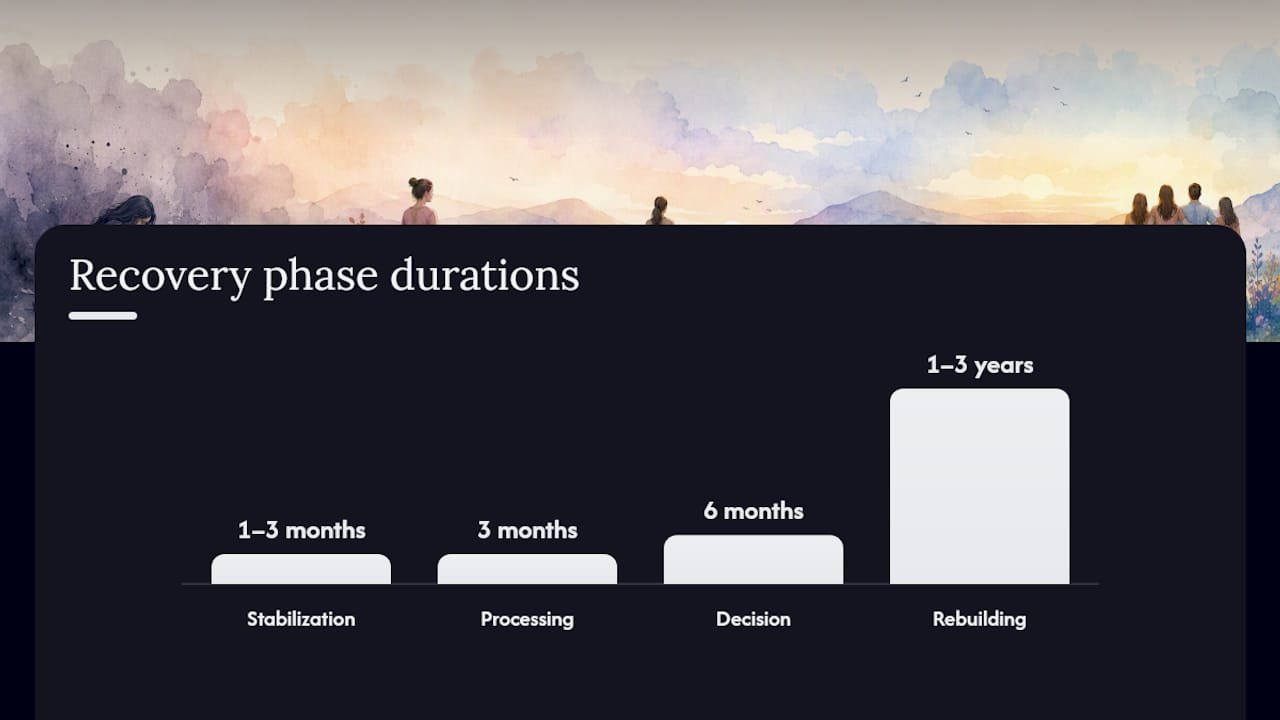
Recovery from betrayal trauma is measured in years, not weeks. The table below reflects typical phase durations; individual variation is significant.
| Phase | Focus | Typical duration |
|---|---|---|
| Stabilization | Safety, symptom management, truth | 1–3 months |
| Processing | Trauma work, grief, identity repair | 3 months |
| Decision | Repair or separation choice | 6 months |
| Rebuilding | Trust exercises, intimacy, growth | 1–3 years |
U.S. therapy costs typically range from $100 to $300 per session for individual therapy, and $150 to $350 for couples sessions, depending on location and clinician credentials. Many therapists offer sliding-scale fees; community mental health centers and training clinics often charge $20–$60 per session. Telehealth platforms have expanded access significantly, particularly for clients in rural areas.
Tips for reducing financial barriers:
- Ask about sliding-scale availability before the first session
- Consider group therapy as a lower-cost adjunct (often $40–$80 per session)
- Therapy provided by supervised graduate trainees is clinically sound and substantially cheaper
- Check whether your employer’s EAP (Employee Assistance Program) covers infidelity-related counseling
What red flags mean reconciliation is unsafe?
Some situations are not about mistakes in the recovery process. They are about safety. Reconciliation is inadvisable when:
- Intimate partner violence (physical, sexual, or coercive control) is present or has a history
- Ongoing secret contact with the affair partner continues after discovery
- Persistent gaslighting — the betrayer denies, minimizes, or rewrites the injured partner’s reality
- No accountability — the betrayer refuses to acknowledge harm, enter therapy, or change behavior
- Stalking or surveillance of the injured partner by the betrayer
- Children are being used as messengers, informants, or emotional supports
If any of these apply, prioritize individual trauma treatment over couples work. The National Domestic Violence Hotline (1-800-799-7233) provides 24/7 support and safety planning. The stages of healing look different when safety is not yet established, and a clinician should assess this explicitly before recommending any joint sessions.
A safety plan should include: a trusted contact who knows the situation, a plan for where to go if the home becomes unsafe, copies of important documents stored outside the home, and a clear agreement with the therapist about what triggers an immediate referral to crisis services.

The part of recovery most people underestimate
Recovery from betrayal is not a straight line, and the mistakes that derail it most often aren’t dramatic. They’re the quiet ones: the pressure to “get back to normal” before normal has been redefined, the disclosure that happens without a therapist in the room, the forgiveness that gets performed before it’s actually felt.
What the clinical evidence consistently shows is that sequencing matters more than speed. Stabilization before processing. Individual work before couples work. Accountability before repair. Skipping a stage doesn’t accelerate healing; it just defers the crisis to a later, often more entrenched point.
Both outcomes, repair and separation, can be healthy when they emerge from a safe, informed process. Neither is a failure. The failure is making either choice from a place of unprocessed trauma, coercion, or incomplete information.
Aftertheaffair resources mapped to each recovery stage
The most common gap in betrayal recovery isn’t motivation. It’s structure. People know they need to do something; they don’t know what to do in what order.
Aftertheaffair’s series addresses exactly that gap. The 7-step infidelity recovery checklist gives injured partners a concrete sequence for the immediate aftermath, covering stabilization through early boundary-setting. The Partner Accountability Conversation Guide is designed for the early accountability phase: it provides scripted prompts for both partners and is structured for use with or without a therapist present. For clinicians, the how to guide clients after infidelity resource maps session-by-session materials to each healing stage, including assessment templates and between-session assignments.
These tools are not a substitute for trauma-focused therapy when PTSD-like symptoms are present. They work best as structured complements to clinical care, or as a starting point for individuals who are not yet in therapy. Start with the checklist, then move to the workbooks as stabilization takes hold.
Sources
- The Surprising Truth about Betrayal-Informed Therapy – Psychotherapy Networker
- Betrayal trauma guide
- Common Marriage Reconciliation Mistakes to Avoid After Infidelity
- Mistakes People Make After Infidelity – Dr. Marty Klein
- Common Marriage Reconciliation Mistakes to Avoid After Infidelity – Family Psychology of South Bend
FAQ
What is the biggest recovery mistake to avoid after an affair?
Forcing forgiveness or mutuality before the injured partner has stabilized is the most clinically damaging error. Betrayal-informed care prioritizes stabilization and truth first, then paced repair.
How long does affair recovery realistically take?
Recovery typically spans a multi-year period across stabilization, processing, decision-making, and rebuilding phases. Rushing any stage tends to defer the crisis rather than resolve it.
When should betrayal trauma be treated as PTSD?
When intrusive thoughts, hypervigilance, emotional numbing, or identity disruption are persistent and functionally impairing, trauma-focused treatments such as EMDR or trauma-focused CBT are appropriate. A betrayal-informed therapist can assess whether criteria are met.
Should couples therapy start immediately after discovery?
No. Individual therapy for both partners should precede couples work. Starting joint sessions before the injured partner is stabilized risks retraumatization and shields the betrayer from individual accountability.
What is trickle-truthing and why is it harmful?
Trickle-truthing means releasing details of the affair incrementally over time rather than in one structured disclosure. Each new revelation resets the trauma response and prevents the injured partner’s nervous system from stabilizing, making it one of the most damaging errors during recovery.
Recommended
- Online Affair Recovery for Couples – After the Affair Series
- Why Couples Relapse After Affairs – After the Affair Series
- Does rebuilding trust prevent future affairs? Evidence & tips