There are three main types of forgiveness most clinicians teach: exoneration, forbearance, and release. UCLA psychiatrist Dr. Stephen Marmer defines them this way: exoneration is the fullest form, where you genuinely clear the offender; forbearance is a partial peace you extend when a full apology never comes; and release is an internal choice you make for yourself, regardless of what the other person does or says. If you’re not sure where to start, release is usually the most accessible, because it asks nothing of the person who hurt you.
Here’s a quick orientation:
- Exoneration: The offender has shown genuine remorse, made amends, and you’ve fully cleared the debt. Rare, but real.
- Forbearance: You’ve decided to move forward despite incomplete accountability. You’re not pretending it was fine, but you’re not letting it run your life.
- Release: A private, internal act. You let go of the resentment for your own sake. No apology required, no relationship restored.
Mayo Clinic frames forgiveness as an intentional decision to let go of resentment, one that can improve mental health without requiring reconciliation or forgetting. That framing matters: forgiveness is something you do for yourself, not a favor to the person who caused the harm.
Table of Contents
- What are the main types of forgiveness, and how do they differ?
- Why does forgiveness matter for your health and well-being?
- How do you actually practice forgiveness? The REACH method and beyond
- Does forgiving someone mean you have to reconcile with them?
- Forgiveness after betrayal and infidelity: what’s different
- What forgiveness really asks of you
- Sources
- FAQ
Key Takeaways
The most effective approach to forgiveness is matching the type you practice to your actual situation: release when no apology is coming, forbearance when accountability is partial, and exoneration only when it’s genuinely earned.
| Point | Details |
|---|---|
| Three core levels | Exoneration, forbearance, and release cover most real-life situations; release requires nothing from the offender. |
| Decisional comes first | You can decide to forgive before you feel it; emotional forgiveness follows with time and practice. |
| REACH is the method | The five-step REACH process (Recall, Empathize, Altruistic gift, Commit, Hold) moves intention into emotional change. |
| Forgiveness ≠ reconciliation | Forgiving someone privately does not require restoring contact or dropping accountability expectations. |
| Betrayal needs more support | Infidelity and betrayal trauma often require structured resources; the Infidelity Recovery Checklist is a practical starting point. |
What are the main types of forgiveness, and how do they differ?
Marmer’s three levels in practice
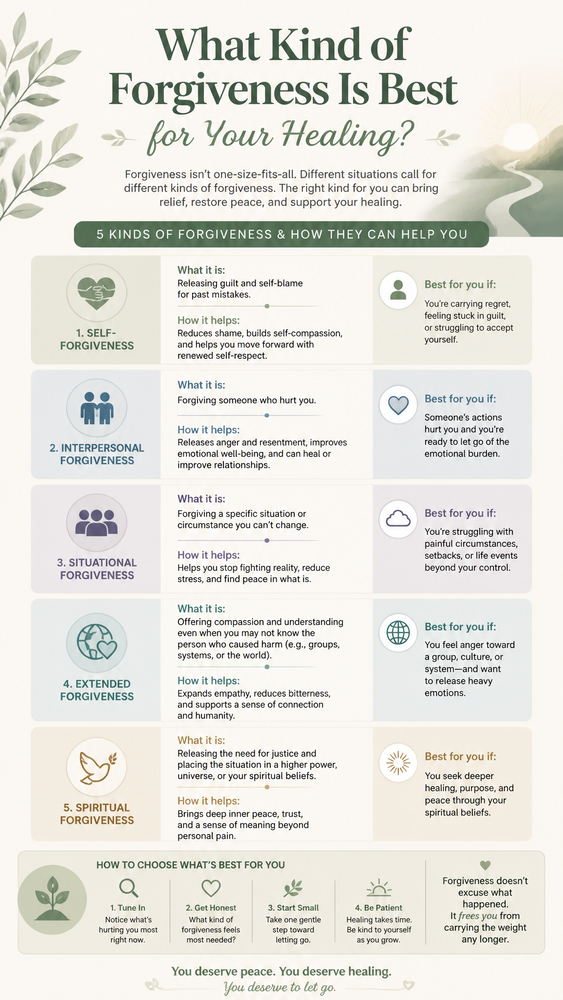
Dr. Marmer’s model is the most clinically useful starting point because it maps directly to real situations. Exoneration applies when the offender has genuinely changed, apologized, and made things right. Forbearance fits when someone has partially acknowledged the harm but not fully, and you decide that partial peace is better than ongoing bitterness. Release is the option when the offender is absent, deceased, unwilling, or simply incapable of accountability. It’s the most frequently needed level, and arguably the most powerful.
Decisional vs. emotional forgiveness
Beyond the three-level model, researchers draw a second distinction that shapes how long the process takes. Decisional forgiveness is a behavioral intention: you decide to stop seeking revenge or holding the offense against the person. Emotional forgiveness goes further, replacing negative emotions like anger and contempt with something more neutral or even positive. Research published in Frontiers in Psychology shows these are genuinely distinct processes. Emotional forgiveness more strongly changes how you remember the offense and how you assign responsibility than decisional forgiveness alone. You can make a decisional choice today. Emotional forgiveness usually takes longer.
Dr. Robert Enright and the “why” behind forgiving
Dr. Robert Enright, one of the leading academic researchers in forgiveness science, argues that understanding your personal motivation for forgiving shapes both the method you use and whether it lasts. Forgiving for self-care looks different from forgiving because of religious conviction, and both differ from forgiving to give a relationship a second chance. Knowing your “why” isn’t a soft question; it’s a practical one.
Forgiveness styles: the CFSI
The Caperton Forgiveness Style Inventory (CFSI) identifies four forgiveness styles that reflect how personality shapes forgiving behavior:
- Intrapersonal: Forgiveness is a private, internal process. These people work through it alone.
- Interpersonal: Forgiveness requires direct conversation and relational repair.
- Easy-going: Forgiveness comes relatively naturally; offense doesn’t stick long.
- Grudge-holder: Forgiveness is genuinely difficult; resentment tends to persist.
Knowing your style matters because it tells you which strategy will feel natural and which will require more deliberate effort. A grudge-holder who tries to “just let it go” without a structured method is likely to stall.
Model comparison: which framework answers which question?
| Question you’re asking | Most useful model |
|---|---|
| Did the offender earn full forgiveness? | Marmer’s exoneration |
| Can I move forward without a full apology? | Marmer’s forbearance |
| Can I heal even if they never acknowledge it? | Marmer’s release |
| Have I decided to forgive but still feel angry? | Decisional vs. emotional distinction |
| What method fits my personality? | CFSI forgiveness styles |
| How do I actually practice forgiving? | REACH method (see below) |
Why does forgiveness matter for your health and well-being?
The evidence is consistent and spans multiple disciplines. Johns Hopkins Medicine explains that holding onto resentment keeps the body in a chronic stress state, with elevated fight-or-flight responses linked to higher risks for heart disease, diabetes, and impaired immune function. The primary beneficiary of forgiveness is the person who was harmed, not the offender.
Harvard’s Global Flourishing Study, led by the Harvard Human Flourishing Program, found that participants who reported forgiving more frequently tended to report higher well-being the following year. That variation matters: cultural context shapes both how forgiveness is understood and how accessible it feels.
Richard Cowden of Harvard’s Human Flourishing Program frames forgiveness as a skill that supports other character traits like gratitude and hope, with measurable downstream effects on well-being. That framing is useful: it means forgiveness can be practiced and strengthened, not just felt or not felt.
Pro Tip: If full emotional forgiveness feels out of reach right now, start with decisional forgiveness. Making the internal commitment to stop seeking revenge protects your nervous system from the ongoing cost of resentment while you do the slower work of emotional healing. Johns Hopkins and Mayo Clinic both support this staged approach.
When forgiveness isn’t enough on its own
Forgiveness is not a substitute for accountability, safety planning, or legal action. If an offense involves ongoing abuse, criminal behavior, or a genuine threat to your safety, those concerns take priority. Forgiving someone privately does not mean returning to a dangerous situation, dropping a legal complaint, or pretending harm didn’t occur. The two tracks can run in parallel.

How do you actually practice forgiveness? The REACH method and beyond
The most evidence-supported method for moving from intention to actual emotional forgiveness is REACH, outlined by Harvard Health. It’s been used in clinical interventions across multiple countries, and a 2024 trial of a REACH-based workbook showed improvements in forgiveness, anxiety, depression, and well-being across several settings.
Here’s how to work through it:
- Recall the hurt. Write down what happened as objectively as you can. Don’t minimize it, but don’t catastrophize it either. Name the specific harm.
- Empathize with the offender. This is the hardest step. Try to understand, not excuse, what might have driven their behavior. What pressures, fears, or histories shaped them? You’re not letting them off the hook; you’re trying to see them as a full human being.
- Altruistic gift. Think of a time you were forgiven for something you did wrong. Forgiveness is a gift you give, not a transaction. Offering it altruistically, without expecting anything in return, is what makes it yours to keep.
- Commit. Write a statement of forgiveness, even a private one. Commitment makes the decision concrete and harder to quietly reverse.
- Hold the forgiveness. Memories of the offense will resurface. When they do, remind yourself of your commitment. Journaling and scheduled check-ins with yourself help here.
Everyday practices and realistic timelines
Decisional forgiveness can happen in a single session. Emotional forgiveness typically takes weeks to months, sometimes longer after serious harm. Small, daily acts help: forgiving a driver who cut you off, a colleague who was dismissive, a friend who forgot. These micro-forgiveness moments build the habit and lower the threshold for larger ones.
Journaling prompts that support the process: “What am I still holding onto, and what is it costing me?” and “What would I feel if I no longer carried this?”
Pro Tip: Schedule a weekly five-minute check-in with yourself to “hold” your forgiveness commitment. Research on habit formation suggests that brief, repeated reinforcement is more effective than occasional deep reflection for maintaining behavioral intentions.
When to get professional help
Some situations exceed what self-directed practice can address. Signs that therapy is likely necessary: the offense involved abuse or trauma and you’re experiencing signs of emotional trauma like flashbacks or hypervigilance; you’ve tried to forgive repeatedly and feel stuck; or the harm involved betrayal so significant that it has disrupted your sense of identity and safety. Therapy options for infidelity trauma include EMDR, trauma-focused CBT, and structured betrayal-trauma protocols.
Does forgiving someone mean you have to reconcile with them?
No. These are separate decisions, and conflating them is one of the most common and costly mistakes people make.
Forgiveness is an internal act of releasing resentment for your own benefit. Reconciliation is a mutual decision to restore a relationship. You can fully forgive someone and never speak to them again.
Mayo Clinic is explicit on this: forgiveness does not require reconciliation, and when safety is at risk, prioritizing boundaries over relationship restoration is the right call.
Red flags where reconciliation is harmful
- The offender continues the harmful behavior or denies it happened.
- There is a pattern of abuse, coercion, or control.
- Accountability is vague (“I’m sorry you feel that way”) rather than specific (“I understand what I did and why it was wrong”).
- Legal proceedings are ongoing and contact could compromise your case.
- You feel afraid, not just hurt, when you consider re-engaging.
What real accountability looks like
Effective accountability is specific and behavioral, not emotional performance. It names the harm clearly, takes responsibility without deflecting, describes concrete changes, and includes a realistic timeline for demonstrating those changes. Vague promises (“I’ll be better”) are not accountability. If you’re navigating this conversation, the Partner Accountability Conversation Guide from Aftertheaffair provides structured scripts and frameworks for exactly this.
A short note on legal options: pursuing legal or institutional accountability for a harm is entirely compatible with personal forgiveness. They operate on different tracks. Forgiving privately does not waive your right to seek justice.
Pro Tip: Write down what genuine accountability would need to look like before you have the conversation. Specific, written criteria protect you from accepting emotional performance as a substitute for real change.
Forgiveness after betrayal and infidelity: what’s different
Forgiveness after infidelity is possible, but it’s almost always slower and more layered than forgiveness after other kinds of harm. Betrayal by a partner activates trauma responses that can include hypervigilance, intrusive thoughts, and a shattered sense of reality. These aren’t signs of weakness; they’re predictable responses to a specific kind of harm.
The pathway typically looks like this: decide to forgive (decisional step) → establish safety and boundaries → process the trauma → rebuild or consciously separate. None of these steps can be skipped without cost, and the order matters.
Practical resources to consider at each stage:
- Early survival: The Navigating Infidelity book from Aftertheaffair covers the first months after discovery, including early forgiveness and decision-making steps.
- Structured recovery: The Infidelity Recovery Checklist gives a step-by-step framework for working through each phase.
- Rebuilding trust: If you’re considering reconciliation, Relationship Growth After Infidelity provides structured guidance for couples working on restoring trust.
- Understanding your response: Betrayal blindness explains why you may have missed warning signs and how to recalibrate your perception.
When professional betrayal-trauma support is necessary
Complex trauma indicators that suggest structured professional support: dissociation, inability to function at work or in parenting, persistent physical symptoms (insomnia, appetite disruption), or a sense that the self you knew before the betrayal no longer exists. These go beyond what self-directed forgiveness work can address alone.
Pro Tip: Forgiveness after infidelity doesn’t have to be a decision you make once. Many people find it more sustainable to treat it as a daily recommitment, especially in the first year. That’s not a failure of forgiveness; it’s how emotional forgiveness actually works.
What forgiveness really asks of you
Forgiveness is one of the most misunderstood concepts in emotional healing, and the misunderstanding usually runs in one direction: people think it asks more than it does.
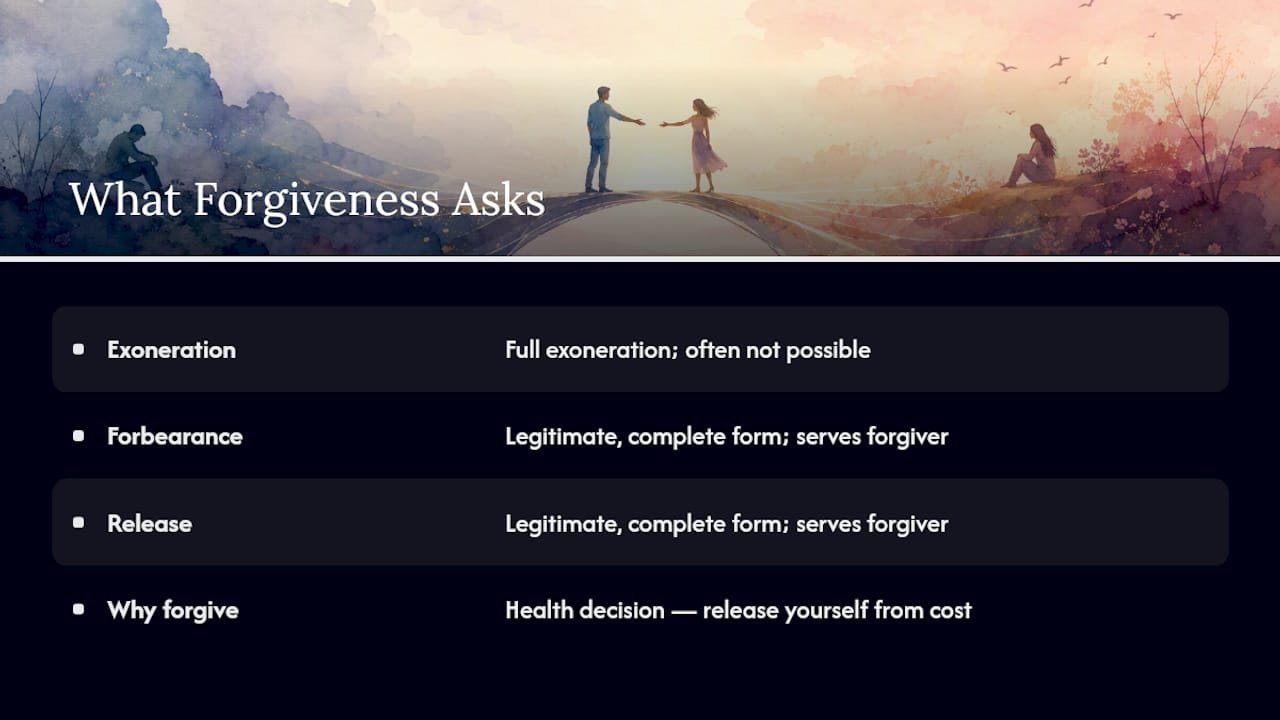
The three-level model Dr. Marmer describes is useful precisely because it gives permission to stop short of full exoneration when that’s not warranted. Most people who’ve been seriously harmed are not in a position to offer exoneration, and they shouldn’t feel pressured to. Forbearance and release are not consolation prizes. They are legitimate, complete forms of forgiveness that serve the person doing the forgiving.
What the research actually shows is that the act of forgiving, at any level, tends to benefit the forgiver more than the forgiven. Johns Hopkins and Mayo Clinic both frame it this way. The Global Flourishing Study data reinforces it at scale. And yet the cultural script around forgiveness still often frames it as something you do for the other person, which makes it feel like a capitulation.
The more useful frame: forgiveness is a health decision. You’re not clearing someone’s debt because they deserve it. You’re releasing yourself from the cost of carrying it.
That reframe changes what “types of forgiveness” even means. The question isn’t which type is most generous. It’s which type is most honest about where you actually are, and most protective of where you’re trying to go.
Sources
- The power of forgiveness – Harvard Health
- Across the globe, forgiveness is linked with well-being
- Forgiveness: Letting go of grudges and bitterness – Mayo Clinic
- The Influence of Decisional and Emotional Forgiveness on Attributions
FAQ
What are the main types of forgiveness?
The three most commonly taught types are exoneration (full clearing of the offender), forbearance (moving forward despite incomplete accountability), and release (an internal choice made for your own healing, requiring nothing from the offender). Dr. Stephen Marmer model is the most widely cited clinical framework for these distinctions.
What is the difference between decisional and emotional forgiveness?
Decisional forgiveness is the choice to stop holding the offense against someone; emotional forgiveness is the deeper replacement of anger and resentment with more neutral or positive feelings. Research in Frontiers in Psychology shows these are distinct processes, with emotional forgiveness producing stronger changes in how you remember the offense and assign responsibility.
What are the four forgiveness styles?
The Caperton Forgiveness Style Inventory identifies four styles: intrapersonal (private, internal processing), interpersonal (requires direct conversation), easy-going (forgiveness comes naturally), and grudge-holder (forgiveness is effortful and slow). Knowing your style helps you choose a method that fits rather than one that stalls.
Does forgiving someone mean you have to forget what happened?
No. Mayo Clinic is explicit that forgiveness does not require forgetting, and it does not require reconciliation. Forgiveness is an internal act of releasing resentment; what you do with the relationship afterward is a separate decision entirely.
What are the biblical types of forgiveness?
Christian theology generally distinguishes between judicial forgiveness (God’s forgiveness of sin, which is unconditional and complete) and relational forgiveness (the restoration of closeness, which typically involves repentance and accountability). Many traditions also emphasize self-forgiveness as a distinct spiritual practice. These categories broadly parallel the clinical distinction between release (unconditional) and exoneration (earned through accountability).
Recommended
- Understanding forgiveness after an affair: healing guide – After the Affair Series
- Forgiving after cheating steps: A guide to healing and trust
- Can Infidelity Be Forgiven? A Realistic Path Forward
- Choosing a Betrayal Trauma Book That Works – After the Affair Series