In-house separation under one roof can work in the short term, but only if you set boundaries and build a paper trail from day one. Without both, it drifts into a legal and emotional gray zone that hurts you later. Do these four things this week:
- Write and date a separation notice, even a short one, and keep a copy.
- Open an individual bank account and freeze or split joint credit cards.
- Agree on a written plan for children’s routines, bedtimes, and pickups.
- Start a simple log of who paid what and when.
Each step matters for a specific reason: documentation proves when separation began, separate finances stop you from being liable for a partner’s new debt, and a steady children’s routine protects them from the anxiety of an unclear situation.
- What Is In-House Separation, Exactly?
- How Do Courts View Separation Under One Roof?
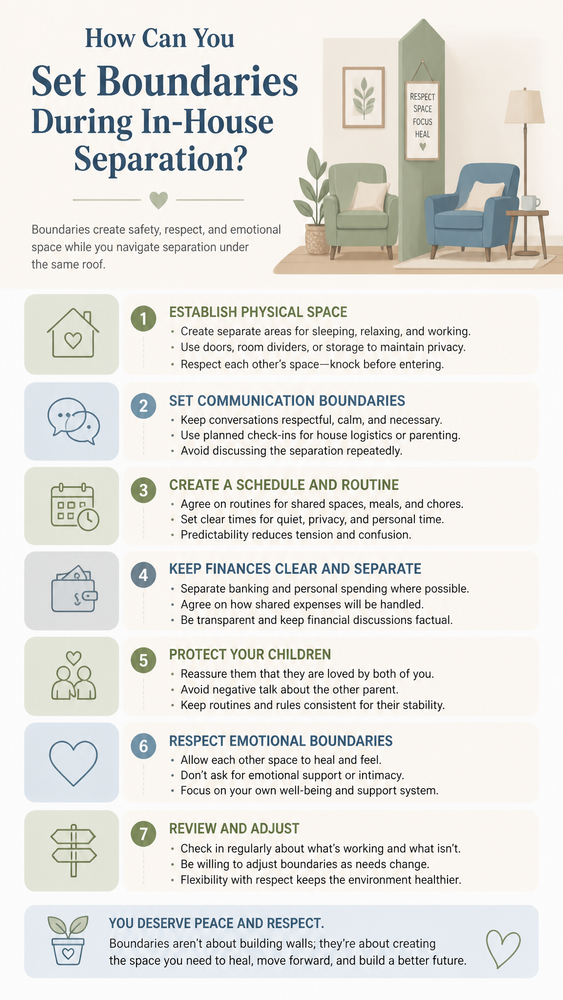
- What House Rules Should You Set Right Now?
- How Do You Protect Your Kids During This?
- What Documents Do You Actually Need?
- When Is In-House Separation the Wrong Call?
- Which Tools Help You Document and Plan the Separation?
- Key Takeaways
- FAQ
Pro Tip: Send your separation notice to yourself by email or text your solicitor a dated summary. A timestamp you didn’t create yourself carries more weight if a dispute ever lands in court.
TL;DR:
- Document your separation with a signed notice, keep witness statements, and send yourself a timestamped record to establish the official start date.
- Open individual bank accounts, freeze joint credit cards, and keep receipts for expenses to protect yourself from liabilities and demonstrate financial independence.
- Maintain consistent routines for children, set clear household rules, and use parallel parenting or structured handoffs to minimize emotional impact on kids.
- Staying in the same home can be legally stronger than moving out if you properly document behavior such as separate sleeping arrangements and independent finances.
- Use structured tools like workbooks and checklists to plan household rules, finances, and agreements, and review these with a solicitor before finalizing.
What Is In-House Separation, Exactly?
In-house separation, also called soft separation or living together while separated, means a couple has ended the relationship but continues sharing a home for practical reasons: finances, housing pressure, or wanting stability for children before a formal move. It differs from a trial separation, where the couple hasn’t decided to end things, and from legal separation, a formal court process that can happen whether or not you share an address.
The difference between a genuine separation and a temporary “pause” shows up in behavior, not intentions. Couples who are truly separated under one roof typically:
- Sleep in different rooms and stop presenting as a couple socially.
- Manage money independently rather than pooling every expense.
- Communicate about logistics, not the relationship itself.
Soft separation is increasingly common for financial, childcare, or housing reasons, but it only holds up, legally and emotionally, when both partners commit to clear rules instead of drifting along.
Noticing the pattern is not the same as proving it
You Can Feel the Pattern. Can You Prove It to a Judge?
A diary of what happened reads as emotional venting. A structured, timestamped record reads as evidence. Most parents lose that distinction until it costs them. The free checklist shows you exactly what to document today, before the evidence window closes.
Get the Free Red Flag Checklist →3 categories · 5 minutes · free
How Do Courts View Separation Under One Roof?
Family courts and tribunals need proof you’re living “separate and apart” even while sharing walls, and vague claims won’t cut it. The strongest evidence tends to include a signed separation agreement, individual bank accounts, and statements from someone who regularly sees the household, such as a neighbor or family member. Courts look at the whole pattern of daily life: separate sleeping arrangements, no shared social appearances, and consistent records all count toward a credible case.
One risk gets overlooked constantly: informal reconciliation. A single weekend of acting like a couple again, or continuing to pay every bill from a joint account, can blur the timeline and weaken your position if the separation date ever gets challenged.
Contrary to what many assume, moving out doesn’t protect your legal standing better than staying put. It can sometimes be read as abandonment or reset separation clocks that matter for divorce timelines, so staying and documenting properly is often the safer legal move, not the riskier one.
A few practical notes worth flagging early:
- Child maintenance obligations continue regardless of living arrangements; the Child Maintenance Service explains how to apply.
- Entering an in-house separation doesn’t change who owns what. After a long marriage, courts typically divide assets evenly, and a written agreement is what documents any interim split.
- Benefits and tax status can shift once you’re recognized as separated, so check your entitlements rather than assume nothing changes.
What House Rules Should You Set Right Now?
Structure beats good intentions. Here’s a starting playbook:
- Assign sleeping spaces. One person takes the spare room or a different floor, permanently, not “for now.”
- Set a kitchen and shared-space schedule. Overlapping meal times often trigger the most friction, so stagger them if the layout allows.
- Agree on guest and dating policies. Bringing a new partner into a shared home while separation is unresolved usually escalates conflict fast.
- Separate your finances. Open individual accounts, freeze joint credit cards if trust is low, and keep receipts for anything you buy solo.
- Build a shared calendar. Track parenting duties, bedtime rotations, and school runs so nobody has to renegotiate logistics daily.
Chores deserve their own conversation. Splitting cleaning, cooking, and errands by a fixed schedule, rather than “whoever gets to it,” removes a daily source of resentment that has nothing to do with the separation itself but ends up fueling it anyway.
Pro Tip: Put the calendar somewhere both of you check without talking, like a shared phone app. Reducing verbal negotiation over logistics cuts down on the small arguments that reopen bigger wounds.
Reading this won’t change tomorrow’s message
You Know the Tactic Now. Do You Know What You’ll Actually Do When It Lands?
Understanding grey rock is not the same as doing it at 9pm when your phone buzzes. Most parents can explain the theory perfectly and still bite the bait every single time. The gap between the two is exactly what the free self-check measures.
Get Your Ex Out of Your Head →5 scenarios · scored result · 4 minutes · free
How Do You Protect Your Kids During This?
Children read tension before anyone says a word, so consistency matters more than a perfect explanation. Use simple, age-appropriate language: younger kids need short, concrete reassurance (“Mom and Dad aren’t together anymore, but you’ll still see us both every day”), while teenagers usually want honesty about what’s changing practically, not the relationship history.
A few things stabilize kids fastest:
- Keep bedtime, meals, and school routines identical to before, even if parents are dividing duties differently.
- Set clear handoff rules inside the home so drop-offs and pickups don’t turn into negotiation points in front of children.
- Use parallel parenting if direct coordination triggers conflict. It limits direct contact between parents while still keeping both involved in the child’s life.
Clinical guidance on family transitions consistently points to structured planning as a way to reduce emotional harm to children during separation, and that’s truer under one roof than almost anywhere else. For more on framing the conversation itself, see how to explain parental separation to a child.
What Documents Do You Actually Need?
A separation agreement isn’t paperwork for paperwork’s sake. It’s what turns an informal arrangement into something a court, a bank, or a benefits office can recognize. An effective agreement covers:
- Financial arrangements: who pays the mortgage, bills, and how new debts are handled.
- Parenting arrangements and a dispute-resolution process if disagreements arise.
- Living arrangements inside the home, including a review date.
Beyond the agreement itself, a few habits build the evidence trail:
- Send a dated written notice, even a short email, stating the separation date.
- Keep bank statements and bill records showing separate finances.
- Ask a regular visitor, a cleaner, a family member, anyone with consistent access, for a witness statement if the situation ever needs corroborating.
An informal, verbal understanding is often not enough. Independent legal review of a written agreement measurably reduces disputes later, protecting both your credit and any benefits tied to your separation date.
When Is In-House Separation the Wrong Call?
If there’s abuse or any credible safety risk, skip the phased approach entirely and move to a safety plan or protective order immediately. No documentation strategy outweighs physical safety.
Watch for these warning signs too:
- Conflict is escalating rather than settling into a routine.
- One partner controls or hides shared finances, making your paper trail unreliable.
- You keep slipping back into couple behavior, which can unintentionally reset the separation clock a court would recognize.
Pro Tip: If you notice financial manipulation, document it in writing to a third party (a solicitor, a trusted family member) rather than confronting your partner directly first. That written record matters more than winning the argument in the moment.

Which Tools Help You Document and Plan the Separation?
Legal advice covers the “what’s enforceable” side of separation. It rarely covers the day-to-day emotional labor of actually running the plan, which is where structured, written tools do real work. Aftertheaffair’s resources are built for exactly that gap.
- A separation planning workbook helps you draft the household rules and financial checklist covered above in a format you can actually revisit.
- A step-by-step checklist keeps the sequence of actions (notice, accounts, agreement, parenting schedule) from getting lost in the emotional noise of the situation.
- A partner accountability conversation guide gives you language for the boundary conversations that otherwise turn into arguments.
None of these replace a solicitor reviewing your actual agreement. Use them alongside legal advice and, where needed, individual or couples therapy, not instead of it. Pairing structured planning with professional guidance is what separates a separation that holds together from one that quietly falls apart mid-process.
A Word From Our Editor
Separation under one roof is exhausting precisely because nothing looks different from the outside while everything inside has changed. That gap is where most couples lose their footing. Prioritize safety first, structure second, and don’t try to hold the plan in your head. Write it down.
— S.J.Howe
Where to Start Putting This Plan Into Action
Reading the rules is one thing. Writing them down in a way that actually holds up, emotionally and practically, is another. That’s the gap Aftertheaffair’s structured materials are built to close, especially when you’re managing separation and betrayal recovery at the same time.
The 7-Step Infidelity Recovery Checklist walks you through the sequence this article covers, notice, finances, children’s routines, agreement, in a format built for the exact moment you’re in, not a generic relationship guide. If your separation is tangled up with betrayal specifically, the Partner Accountability Conversation Guide gives you scripts for the boundary conversations that tend to go sideways without one. Managing daily tension while you sort out logistics also helps; practical anxiety strategies from Prism Counseling pair well with the household rules above.
Start with the checklist, work through it at your own pace, and bring your draft agreement to a solicitor once you’ve got the framework in place.

Key Takeaways
In-house separation can succeed short-term when partners document the split, separate their finances, and set explicit household rules, but it fails without all three.
| Point | Details |
|---|---|
| Documentation comes first | A dated written notice and witness statements establish when separation actually began. |
| Separate your money early | Individual accounts and frozen joint credit prevent shared liability for new debt. |
| Kids need stable routines | Consistent bedtimes, handoffs, and parallel parenting reduce children’s exposure to conflict. |
| Moving out isn’t automatically safer | Staying and documenting the separation is often the stronger legal position than leaving. |
| Structured tools fill the planning gap | Aftertheaffair’s checklist and workbooks help implement the rules a solicitor can then review. |
Official and Clinical Resources Worth Bookmarking
The Child Maintenance Service covers official maintenance and support applications. Peer-reviewed research on family transitions documents separation’s effects on children and adults. For abuse concerns, contact a domestic abuse charity or protective-order service in your area immediately.
This article is general information, not a substitute for advice from a qualified lawyer. Consult a qualified legal professional about your own circumstances before acting on anything here.
Sources
- Is moving out the biggest mistake in a divorce? — B P Collins Solicitors
- How is property divided in divorce — BarristerConnect
- In-house separation checklist — LegalClarity
- Living together after separation: What you need to know — MJP Law
FAQ
Does In-Home Separation Actually Work?
It can work short-term when both partners keep separate finances, follow written household rules, and document the arrangement, but it tends to break down without clear boundaries and legal guidance.
Is Moving Out the Biggest Mistake in a Divorce?
Moving out isn’t automatically a mistake, but it can be read as abandonment or affect separation timelines in some cases, which is why many solicitors recommend documenting an in-house separation instead of leaving abruptly.
What Is a Spouse Entitled to During Separation?
Entitlements depend on your jurisdiction and the length of the marriage, but after long marriages assets are typically divided evenly, which is why a written separation agreement matters even before divorce is finalized.
What Should You Avoid Doing During Separation?
Avoid co-mingling finances, skipping written documentation, and slipping back into couple behavior that could blur your separation date, along with any confrontation that escalates conflict rather than settling it.
Can Aftertheaffair’s Resources Replace Legal Advice?
No. Aftertheaffair’s workbooks and checklists help you plan and document boundaries, but a solicitor should still review any formal separation agreement before you rely on it.
Recommended
- Am I Trauma Bonded or Actually in Love? – After the Affair Series
- Why separation aids healing after infidelity
- Why Do Cheaters Stay? The Truth About What Your Spouse Really Wants – After the Affair Series
- Stay or Leave After Cheating – After the Affair Series
Understanding the pattern is not the same as breaking it
You Can Explain Why This Happened. Can You Explain Why You’re Still Stuck In It?
Most people in affair recovery can narrate their entire situation with total clarity, the timeline, the triggers, the whole story, and still find themselves back in the same spiral by evening. Insight was never the missing piece. This free assessment shows you exactly where the gap actually is.
Take the Free Affair Recovery Clarity Check →A few honest questions · a scored result · 4 minutes · free