Table of Contents
- What Is Co-Parenting Therapy?
- The Real Verdict: Is Co-Parenting Therapy Worth It?
- Co-Parenting Therapy Scripts for Communication
- How Long Does Co-Parenting Therapy Take?
- High-Conflict Co-Parenting Strategies That Work
- Cost, Insurance, and Alternatives
- Therapy vs. Mediation: Which Is Right for You?
- Frequently Asked Questions
Last Updated: September 3, 2026
What Is Co-Parenting Therapy?
Co-parenting therapy is a structured therapeutic intervention designed to help separated or divorced parents develop effective communication strategies, establish consistent parenting approaches, and shield their children from ongoing conflict. Unlike traditional family therapy, which aims to repair a romantic relationship, co-parenting therapy focuses exclusively on the parent-child dynamic and the parents’ ability to work together despite the relationship breakdown.
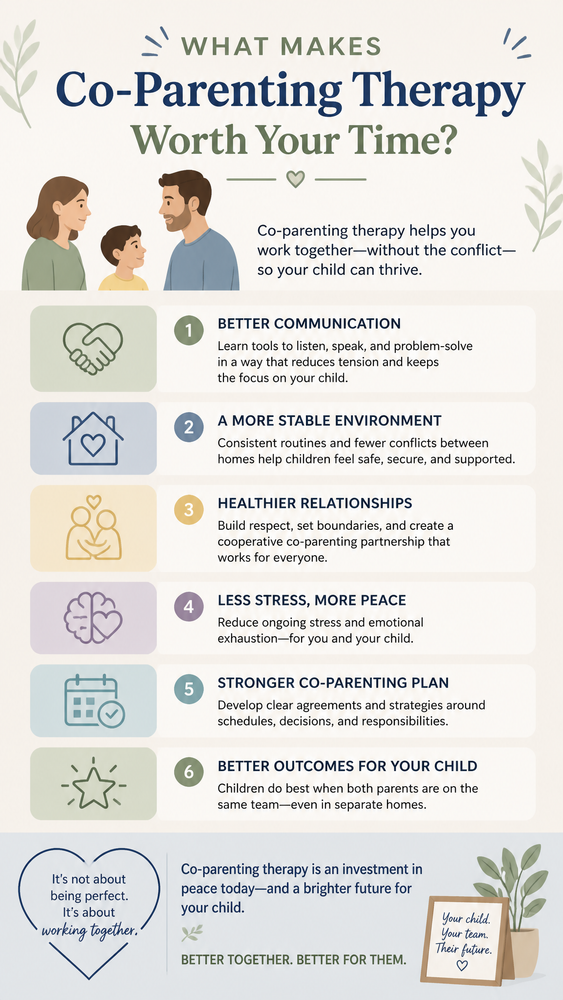
The core purpose is straightforward: create a functional parenting partnership that prioritizes the child’s emotional and psychological wellbeing. This means parents learn to compartmentalize their feelings about each other and focus on shared parenting goals. At After the Affair Series, we recognize that this shift requires specific frameworks and communication tools that parents can implement immediately, even in high-conflict situations.
Co-parenting therapy typically addresses several key areas: communication protocols that reduce triggers, boundary-setting techniques that prevent manipulation, consistency strategies across two households, and child-centered decision-making frameworks. The therapist acts as a neutral third party, teaching parents how to separate the co-parenting relationship from the romantic one.
The Real Verdict: Is Co-Parenting Therapy Worth It?
Whether co-parenting therapy is worth it depends on your specific situation, the level of conflict you’re managing, and what you’re trying to achieve.
The case for co-parenting therapy:
If you’re in a high-conflict co-parenting situation where communication consistently escalates, one parent undermines the other, or your children show behavioral or emotional distress, co-parenting therapy delivers measurable value. The therapist becomes a referee and teacher, enforcing communication rules that neither parent would maintain alone.
Therapy also works when both parents are genuinely committed to improving the co-parenting relationship, even if they dislike each other. The real benefit is operational: you learn how to schedule exchanges without conflict, discuss your child’s school performance without rehashing old grievances, and make medical decisions without power struggles. These functional improvements protect your child from constant parental tension.
The case against co-parenting therapy (or when to skip it):
If you and your co-parent already communicate respectfully, maintain separate lives, and your children show no signs of distress related to the separation, therapy may be unnecessary. Therapy also won’t help if one parent is actively hostile, refuses to participate, or uses information shared in sessions against you later. In genuinely toxic situations, documented communication platforms and formal custody agreements provide better protection.
Cost is another legitimate consideration. If you’re financially stretched, less expensive alternatives exist.
The middle ground:
Many families benefit from a limited course of co-parenting therapy, perhaps 6-8 sessions focused on specific problems like transition anxiety or managing a particular recurring conflict. This targeted approach costs less and delivers concrete tools.
Co-Parenting Therapy Scripts for Communication
The most practical benefit of co-parenting therapy is learning specific language patterns that de-escalate conflict and keep conversations focused on the child’s needs.
Therapists teach parents to recognize and interrupt automatic conflict patterns. When one parent says something accusatory, the instinct is often to defend or counter-attack. A therapist teaches you to pause, recognize the trigger, and respond with a neutral, child-focused statement instead.
The Gray Rock Method is a structured approach where you respond to your co-parent with minimal emotional content. Your answers are brief, factual, and devoid of detail that could be weaponized. If your ex asks why your child missed a dentist appointment, “He was sick” is a Gray Rock response.
Child-centered framing redirects conversations away from parental grievances toward the child’s actual needs. Instead of “You never follow the bedtime routine I set up,” try “Our daughter sleeps better when she’s in bed by 8:30. Can we both commit to that?”
Scheduled communication windows prevent reactive exchanges. Rather than texting back-and-forth in real time, you agree to discuss certain topics only during weekly phone calls or documented app messages.
The “I” statement structure reduces defensiveness: “I’ve noticed our son seems anxious before transitions. I’d like to try a 15-minute buffer between pickup and dropoff. What do you think?”
After the Affair Series provides 50+ age-appropriate scripts that parents can practice and adapt to their own situations. The key insight therapists emphasize: you don’t need to feel better about your co-parent to communicate effectively with them. You need structure, scripts, and accountability.
Reading this won’t change tomorrow’s message
You Know the Tactic Now. Do You Know What You’ll Actually Do When It Lands?
Understanding grey rock is not the same as doing it at 9pm when your phone buzzes. Most parents can explain the theory perfectly and still bite the bait every single time. The gap between the two is exactly what the free self-check measures.
Get Your Ex Out of Your Head ->5 scenarios, scored result, 4 minutes free
How Long Does Co-Parenting Therapy Take?
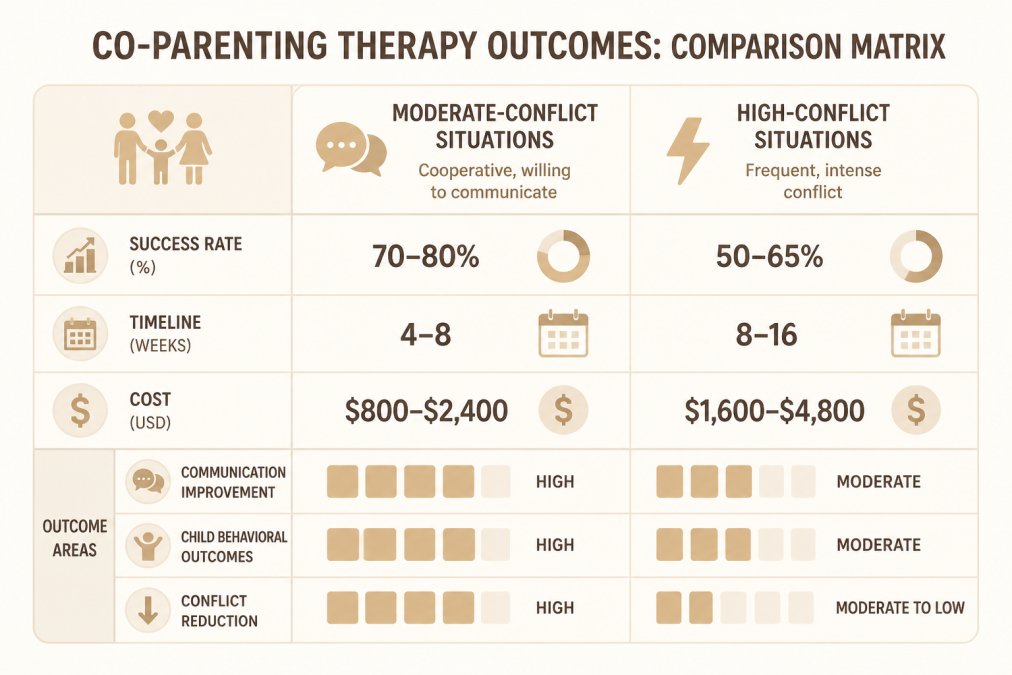
A typical course of co-parenting therapy runs 8-12 weeks, with weekly or bi-weekly sessions lasting 50-60 minutes (apa.org). Some therapists work with both parents together; others see them separately and coordinate between sessions.
For moderate-conflict situations where parents communicate but struggle with consistency or boundaries, 6-8 sessions often suffice. Parents report noticeable improvements in communication patterns within 3-4 weeks once they’ve learned and practiced the frameworks (peer-reviewed research).
High-conflict situations typically require longer engagement, 16-20 sessions or more, because entrenched patterns are deeper and emotional reactivity is higher. Some therapists recommend ongoing monthly check-ins after the intensive phase ends.
The timeline also depends on how quickly parents apply what they learn. If both parents practice the communication scripts and implement the frameworks between sessions, progress accelerates.
High-Conflict Co-Parenting Strategies That Work
High-conflict co-parenting situations require different strategies than moderate ones. When one or both parents have personality traits that fuel conflict, standard communication approaches often fail.
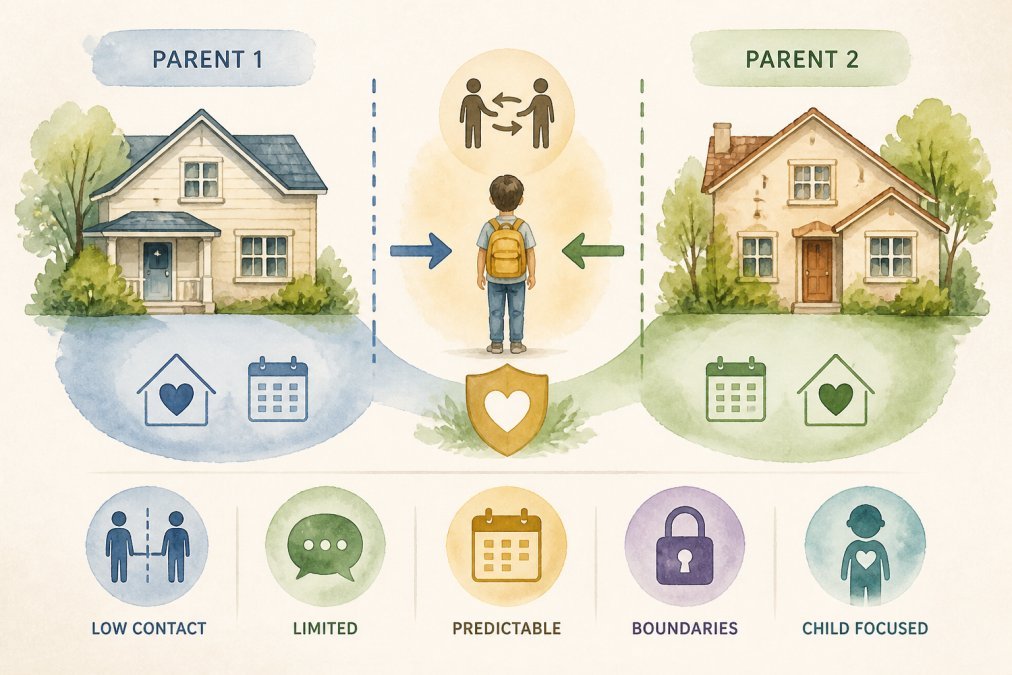
Parallel parenting is the most effective strategy for genuinely high-conflict situations. Rather than trying to co-parent, parallel parenting allows each parent to run their household independently with minimal overlap. Each parent makes decisions within their own space, and the child adapts to two different environments. This removes the constant negotiation that fuels conflict.
Parallel parenting requires clear, legally documented boundaries. Who decides on school choice? Who approves medical treatment? If these are spelled out in a custody agreement, you don’t need to negotiate them repeatedly.
Documentation becomes critical in high-conflict situations. Every communication about the child should be documented through a co-parenting app, email, or text. This creates a record that protects you legally and reduces the he-said-she-said dynamics that escalate conflict.
Minimal direct communication is another high-conflict strategy. All communication happens through documented channels, removing the emotional volatility of real-time interaction.
Setting and enforcing boundaries is non-negotiable. If your co-parent uses pickups as an opportunity to criticize you, you stop engaging in conversation during exchanges. If they text hostile messages, you wait until you’re calm and respond briefly, factually, and only about the child.
Co-parenting therapy for high-conflict situations focuses heavily on boundary-setting and self-regulation skills. The therapist teaches you to recognize your own triggers, pause before responding, and choose responses that don’t escalate.
Understanding the pattern is not the same as breaking it
You Can Explain Why This Happened. Can You Explain Why You’re Still Stuck In It?
Most people in affair recovery can narrate their entire situation with total clarity, the timeline, the triggers, the whole story, and still find themselves back in the same spiral by evening. Insight was never the missing piece. This free assessment shows you exactly where the gap actually is.
Take the Free Affair Recovery Clarity Check ->A few honest questions, a scored result, 4 minutes free
Cost, Insurance, and Alternatives
Co-parenting therapy typically costs between $100-$250 per session (apa.org). A typical 10-session course costs $1,000-$2,500 out-of-pocket. Some therapists offer sliding scale fees based on income.
Insurance coverage for co-parenting therapy is inconsistent. Some plans cover it if framed as family therapy or individual mental health treatment. Others don’t cover it because it’s considered a legal or mediation service. Check your specific plan and ask your therapist whether they bill insurance.
Alternatives to traditional co-parenting therapy:
Court-ordered parenting education programs are often cheaper than therapy. The Center for Divorce Education’s “Children in Between” program is court-approved in over 2,600 counties and costs $29.99 as a one-time purchase.
Co-parenting apps like TalkingParents ($5/month for basic features) provide structured communication platforms that reduce conflict by creating documented, neutral channels.
Mediation is another option if you and your co-parent are willing to work with a neutral third party to resolve specific disputes. Mediation typically costs $150-$300 per hour and focuses on negotiating agreements rather than teaching communication skills.
Parallel parenting doesn’t require therapy at all, it just requires a clear custody agreement and the willingness to stay out of each other’s households.
After the Affair Series offers a free 23-point assessment that helps you evaluate your specific co-parenting situation and determine what level of intervention you actually need.
Therapy vs. Mediation: Which Is Right for You?
Co-parenting therapy and mediation serve different purposes.
Mediation is a negotiation process. A neutral mediator helps you and your co-parent reach agreements on specific issues: custody schedules, financial responsibilities, holiday arrangements, and major decisions about the child. Mediation is goal-oriented and time-limited.
Mediation works best when both parents are willing to negotiate in good faith and the conflicts are primarily about logistics rather than deep communication dysfunction.
Co-parenting therapy is a skill-building and relationship-repair process. A therapist teaches you and your co-parent how to communicate effectively, manage emotions, and work together despite your history. Therapy addresses the underlying patterns that create conflict.
Therapy works best when the conflict is rooted in communication breakdown, unresolved emotions, or personality clashes.
The key difference: Mediation solves the problem. Therapy teaches you how to solve problems together.
Many families benefit from both. Mediation typically costs $150-$300 per hour and resolves issues in 3-6 sessions. Co-parenting therapy costs $100-$250 per session and typically runs 8-12 weeks. Mediation is faster and cheaper if you have specific disputes to resolve. Therapy is more comprehensive if you’re addressing ongoing communication dysfunction.

Making Your Decision
Is co-parenting therapy worth it? The answer depends on three questions:
First, is your current co-parenting situation causing harm to your child? If your children show anxiety, behavioral problems, or emotional distress related to parental conflict, therapy has direct value.
Second, are you and your co-parent willing to participate? Therapy only works if both parents commit to learning and practicing new communication patterns.
Third, what’s your budget and timeline? If you need resolution quickly and have specific disputes to negotiate, mediation is more efficient. If you have time and money to invest in building a functional co-parenting relationship, therapy delivers deeper change.
For parents navigating high-conflict situations, After the Affair Series provides structured frameworks and communication scripts that accelerate the work therapy teaches. The free 23-point assessment helps you evaluate your specific situation and identify which tools, therapy, apps, mediation, or structured scripts, will deliver the most value for your circumstances.
Frequently Asked Questions
Does co-parenting therapy actually reduce conflict between ex-partners?
Co-parenting therapy can reduce conflict when both parents actively engage and apply communication strategies. Research shows that structured therapeutic interventions help parents move from reactive hostility to planned, neutral communication. However, success depends heavily on both parents’ willingness to participate. If one parent refuses to attend or dismisses the process, outcomes are limited. Therapy works best as a framework for managing interactions, not as a tool to force cooperation from an unwilling ex.
Can co-parenting therapy scripts for communication work with a genuinely hostile ex?
Scripted communication can work even with hostile ex-partners, but the goal shifts from dialogue to boundary protection. Structured scripts, such as the Gray Rock Method, remove emotional triggers and keep responses factual and brief. This approach reduces opportunities for escalation. However, scripts are defensive tools, not bridges to cooperation. With truly hostile co-parents, therapy may be most valuable for teaching you how to respond without absorbing their hostility, protecting your emotional wellbeing and your children’s stability.
How long does co-parenting therapy take to show results?
Most parents notice shifts in their own responses within 4-6 weeks of consistent practice. Measurable changes in co-parenting dynamics typically emerge within 3-4 months if both parents are engaged. However, timeline varies based on conflict severity, how quickly you implement new strategies, and whether your ex participates. Some parents use therapy tools for crisis management immediately, while others invest in longer-term counseling (6-12 months) to rebuild trust and establish stable routines. Short-term therapy may address immediate communication breakdowns; longer engagement supports deeper family healing.
Is co-parenting therapy covered by insurance?
Many insurance plans cover family therapy or co-parenting counseling if it’s provided by a licensed therapist and coded as a mental health service. Coverage depends on your specific plan, deductible, and whether the therapist is in-network. Some plans require a referral or diagnosis related to the child’s adjustment or parental stress. Out-of-pocket costs vary widely. Before starting therapy, contact your insurance provider to confirm coverage, ask about session limits, and verify the therapist’s network status. Many therapists offer sliding scale fees or can discuss payment options if insurance doesn’t cover the full cost.
What’s the difference between co-parenting therapy and mediation?
Co-parenting therapy focuses on emotional healing, communication skills, and behavioral change within each parent individually and as a unit. It addresses trauma, attachment patterns, and long-term relationship dynamics. Mediation is a structured negotiation process where a neutral third party helps parents resolve specific disputes, custody, finances, schedules, and reach written agreements. Therapy is ongoing and exploratory; mediation is goal-focused and time-limited. Many families benefit from mediation first to establish clear agreements, then therapy to manage the emotional fallout and build sustainable communication patterns.
Noticing the pattern is not the same as proving it
You Can Feel the Pattern. Can You Prove It to a Judge?
A diary of what happened reads as emotional venting. A structured, timestamped record reads as evidence. Most parents lose that distinction until it costs them. The free checklist shows you exactly what to document today, before the evidence window closes.
Get the Free Red Flag Checklist ->3 categories, 5 minutes, free