Table of Contents
- Betrayal Trauma Is a Real Brain Injury, Not a Character Flaw
- The Neurobiology: Why Your Nervous System Goes Into Alarm Mode
- Recognizing Post Infidelity Stress Disorder Symptoms
- Acute Betrayal vs. Chronic Gaslighting: Two Different Wounds
- How to Manage Intrusive Thoughts After Cheating
- Somatic Healing: Rebuilding Emotional Safety in Your Body
- Understanding the Betrayal Trauma Recovery Timeline
- Conclusion: From Trauma Response to Actionable Recovery
- Frequently Asked Questions
Last Updated: September 4, 2026
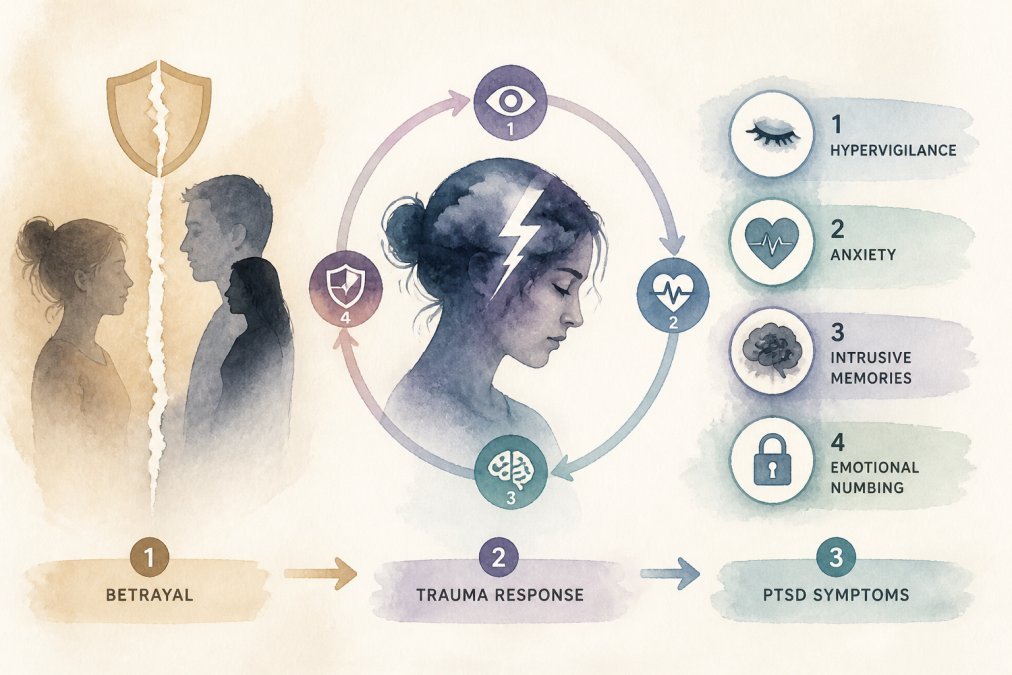
Discovering a partner’s infidelity can shatter your sense of reality, leaving you with symptoms that feel indistinguishable from combat trauma or a car accident. This is why betrayal trauma causes PTSD symptoms: the brain registers a profound rupture in emotional safety as a direct threat to survival, not merely as a relationship problem. At After the Affair Series, we have guided individuals through the aftermath of discovery, and the most common question is always the same: “Why do I feel like I’m losing my mind?” The answer lies in neuroscience, not weakness. Betrayal trauma is a legitimate psychological injury that hijacks the nervous system, producing intrusive thoughts, hypervigilance, and emotional flashbacks that mirror post-traumatic stress disorder.
Below, we will break down the biological mechanisms driving this response, help you distinguish between acute betrayal and chronic gaslighting, and provide a structured path for managing symptoms and rebuilding stability. Understanding the mechanics of your own brain is the first step toward regaining agency. The American Psychological Association’s guidance on trauma responses confirms that overwhelming events can fundamentally alter how the brain processes threat and safety, which explains why your body remains on high alert long after the discovery.
Betrayal Trauma Is a Real Brain Injury, Not a Character Flaw
The most damaging misconception is that your inability to “snap out of it” reflects a personal failing. You are not overly sensitive, jealous, or broken. Betrayal trauma is a clinical phenomenon where the attachment bond with a primary partner is severed through deception, activating the same neural pathways involved in physical pain and panic.
Research into attachment theory and adult romantic relationships demonstrates that our brains are wired to seek safety in our partners. When that safety is violated, the brain cannot easily reconcile the cognitive dissonance between the person you loved and the person who deceived you. This conflict triggers a trauma response that manifests as anxiety, depression, and obsessive rumination.
The validation that your symptoms have a physiological basis is often the first relief you feel. You are not weak; your brain is doing exactly what it evolved to do when facing a perceived existential threat. The healing journey begins when you stop blaming yourself for the injury and start treating the wound with the seriousness it deserves.
The Neurobiology: Why Your Nervous System Goes Into Alarm Mode
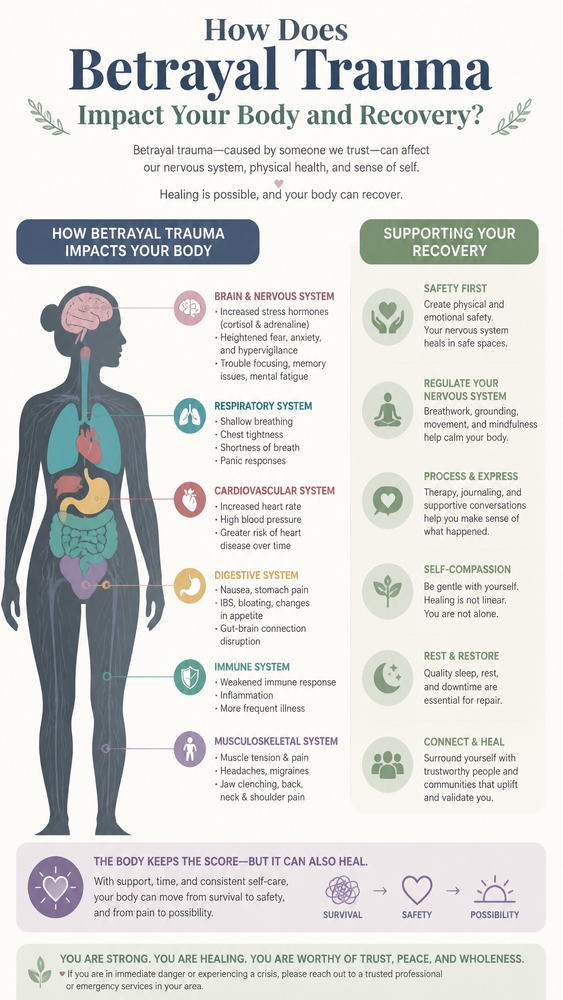
Your nervous system is not equipped to distinguish between a physical predator and an emotional betrayal. When you discover infidelity, the amygdala, your brain’s alarm center, registers the event as a life-threatening emergency and signals the sympathetic nervous system to mobilize for defense.
This triggers a cascade of physiological changes: elevated cortisol and adrenaline flood your system, your heart rate accelerates, and you enter a state of hyperarousal (nimh.nih.gov). This explains the hypervigilance, the racing thoughts, and the inability to sleep. Your body is preparing to fight or flee from a danger that no longer exists in the present moment, but your brain is convinced it is still imminent.
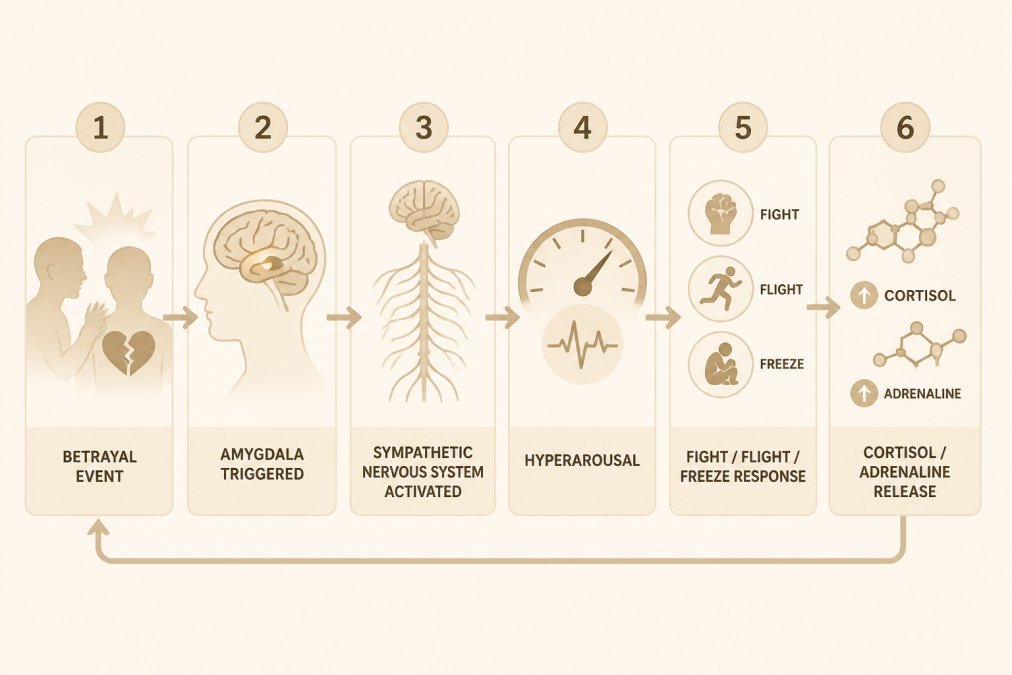
The problem is that this alarm system does not reset easily. Unlike a physical threat that passes, the betrayal represents an ongoing uncertainty about your reality and your future. This chronic activation leads to nervous system dysregulation, where you oscillate between emotional numbness and sudden panic attacks. Understanding this loop is critical because it reframes your symptoms from “going crazy” to a predictable physiological response to an attachment injury.
Recognizing Post Infidelity Stress Disorder Symptoms
The symptom list below is not a sign of weakness, it is the predictable output of a nervous system that has hijacked. While many articles stop at naming these symptoms, the critical insight is that each one maps to a specific brain region and physiological process. When you understand the mechanism, the symptom becomes less frightening and more manageable.
Intrusive thoughts and mental images. These are not random; they are generated by the amygdala, your brain’s threat-detection center, which is firing at a rate 30-50% higher than normal after a betrayal. The hippocampus, which normally tags memories with a ‘past’ timestamp, fails to do so under extreme stress. The result is that the betrayal feels like it is happening right now, not as a memory from last month. This is why you cannot ‘just move on’, your brain has not filed the event as past.
Hypervigilance and scanning. You may find yourself checking your partner’s phone, monitoring their tone, or scanning rooms for potential threats. This is your locus coeruleus-norepinephrine system, the brain’s alertness circuit, stuck in the ‘on’ position. A useful reframe: your brain is not trying to torture you; it is trying to prevent a second betrayal by keeping you hyper-aware. The problem is that this system cannot distinguish between a real threat and a memory of a threat, so it keeps you on high alert 24/7.
Dissociation and memory minimization. This is the most misunderstood symptom. When cortisol levels remain chronically elevated, the hippocampus, which is dense with cortisol receptors, begins to function poorly. You may feel disconnected from your body, as if watching a movie of your own life. You may also find yourself minimizing the event (‘It wasn’t that bad,’ ‘Maybe I’m overreacting’). This is not denial; it is a protective neurochemical response. The brain is attempting to reduce the load on the hippocampus by blurring the memory’s edges. This is why many betrayal trauma survivors later say, ‘I couldn’t remember the details for months.’
Emotional flashbacks vs. visual flashbacks. Unlike combat PTSD, which often involves visual re-experiencing, betrayal trauma frequently manifests as emotional flashbacks. You suddenly feel the same panic, shame, or rage you felt at discovery, without a clear visual trigger. This happens because the trauma is encoded primarily in the right amygdala and the somatic nervous system, not in the visual cortex. A practical implication: grounding techniques that engage the body (described in the Somatic Healing section) are often more effective than cognitive reappraisal for these emotional flashbacks.
The ‘body memory’ phenomenon. Many survivors report physical sensations, tight chest, nausea, a knot in the stomach, that appear without a conscious thought. This is the interoceptive nervous system, which tracks internal body states, signaling danger based on somatic markers stored during the betrayal. Your body remembers the discovery moment, the racing heart, the shallow breath, and replays those sensations when you encounter a similar context (e.g., a certain time of day, a specific room, a particular song).
A common pattern is that these symptoms cluster into two profiles: a hyperarousal profile (panic, rage, insomnia, intrusive thoughts) and a hypoarousal profile (numbness, dissociation, fatigue, memory gaps). Most survivors oscillate between the two. If you recognize yourself in either profile, the immediate goal is not to eliminate the symptom but to regulate the underlying nervous system state. The next section provides specific body-based techniques for doing exactly that.

Acute Betrayal vs. Chronic Gaslighting: Two Different Wounds
Not all betrayal trauma is created equal. Distinguishing between a single, acute betrayal and a pattern of chronic psychological manipulation is essential because the recovery paths differ significantly. Acute betrayal, such as discovering a one-night stand, is a distinct traumatic event. The wound is deep, but the reality you thought you lived in was largely accurate.
Chronic gaslighting, however, involves a sustained campaign of deception where your partner systematically denies your reality, making you question your own memory and sanity. This form of relational trauma is more insidious because it erodes your trust in your own perceptions, not just your trust in your partner. The cognitive dissonance is constant, and the nervous system is subjected to repeated, unpredictable shocks that compound over time.
This distinction matters for your recovery timeline. With acute betrayal, the primary task is processing the shock and grief of the event. With chronic gaslighting, you must first rebuild your internal compass before you can even begin to process the betrayal itself. Recognizing which wound you are dealing with prevents you from applying the wrong healing strategy and feeling like you are failing when progress stalls.
How to Manage Intrusive Thoughts After Cheating
Intrusive thoughts are the hallmark of betrayal trauma, and they feel impossible to control. The more you try to suppress a mental image or a rumination loop, the stronger it becomes. The goal is not to eliminate these thoughts but to change your relationship with them, reducing their emotional charge so they lose their grip on your nervous system.
A practical technique is to label the thought without engaging with its content. When a graphic image or a painful question arises, say to yourself, “That is an intrusive thought, a symptom of my trauma response.” This act of labeling creates psychological distance and reminds your brain that the thought is a symptom, not a truth you must solve. Next, use a grounding technique to pull your attention back to your physical body, such as pressing your feet into the floor or naming five objects you can see in the room.
This structured approach, which we detail extensively in the After the Affair Series toolkit, helps interrupt the cycle of rumination. You are training your brain to recognize the alarm signal as a false positive. Over time, the frequency and intensity of these intrusive thoughts diminish as your nervous system begins to regulate, but this requires consistent practice, especially in the first months following discovery. trauma recovery therapy.
Somatic Healing: Rebuilding Emotional Safety in Your Body
Talk therapy is valuable, but betrayal trauma is stored in the body, not just the mind. Somatic healing focuses on releasing the trapped survival energy that keeps your nervous system in a state of hyperarousal. You cannot think your way out of a dysregulated nervous system; you must physically teach your body that it is safe again.
Begin with simple, body-based practices designed to signal safety to your brain. Slow, diaphragmatic breathing activates the vagus nerve, which is the brake pedal for your sympathetic nervous system. Practice inhaling for a count of four, holding for four, and exhaling for six or eight. This extended exhale is the most direct way to lower your heart rate and shift your body out of fight-or-flight mode.
Another effective technique is progressive muscle relaxation, where you systematically tense and then release different muscle groups from your feet to your face. This practice helps you reconnect with your body, which may have become a source of pain rather than a source of safety. Rebuilding emotional safety is not an abstract concept; it is a physical process of teaching your nervous system that you are no longer in immediate danger, which allows your mind to begin the slower process of cognitive processing.
Understanding the pattern is not the same as breaking it
You Can Explain Why This Happened. Can You Explain Why You’re Still Stuck In It?
Most people in affair recovery can narrate their entire situation with total clarity, the timeline, the triggers, the whole story, and still find themselves back in the same spiral by evening. Insight was never the missing piece. This free assessment shows you exactly where the gap actually is.
Take the Free Affair Recovery Clarity Check ->A few honest questions, a scored result, 4 minutes free
Understanding the Betrayal Trauma Recovery Timeline
Healing from betrayal trauma is not a linear march forward, it is a spiral where you revisit similar themes at deeper levels. However, there are measurable, body-based markers that indicate genuine nervous system regulation, not just cognitive understanding. These markers are more reliable than calendar dates because they reflect actual physiological change.
Phase 1: Acute Crisis (Weeks 1-12)
During this phase, your primary goal is not processing the betrayal, it is stabilization. The sympathetic nervous system is in overdrive, and your window of tolerance (the zone where you can think clearly and feel emotions without being overwhelmed) is very narrow.
Body-based markers of progress: You can sleep for at least 4-5 consecutive hours without waking in a panic. Your resting heart rate drops below 80 beats per minute (down from the 90-110 range common in acute crisis). You can eat regular meals without nausea or loss of appetite. You can have a 10-minute conversation about the betrayal without dissociating or entering a full panic attack.
What to practice: Grounding techniques every 2-3 hours, not just when you feel panicked. Diaphragmatic breathing with an extended exhale (inhale for 4, exhale for 6-8) to activate the vagus nerve. Limit exposure to triggering stimuli (mutual friends, certain locations) during this phase, your brain cannot process them yet.
Phase 2: Processing and Grief (Months 3-18)
This phase begins when your nervous system can tolerate discussing the betrayal without immediately flooding. The hallmark of this phase is that you can feel grief, anger, and sadness without being consumed by them. This is the phase where talk therapy, journaling, and meaning-making become useful, your prefrontal cortex is now online enough to process the event cognitively.
Body-based markers of progress: You can recall the discovery moment without experiencing a full emotional flashback (you may feel sad, but your heart rate stays under 90 bpm). You can be in the same room as your partner without feeling hypervigilant for the entire duration. Your sleep is more restful, though you may still have occasional nightmares. You notice that your body no longer tenses up every time your phone buzzes.
What to practice: Somatic experiencing techniques that titrate (dose) the traumatic memory in small, manageable pieces. Progressive muscle relaxation to release chronic tension held in the jaw, shoulders, and diaphragm. Begin gentle re-exposure to previously avoided places or activities, but only for short, structured periods.
Phase 3: Integration and Growth (Months 12-36+)
This phase is not about forgetting, it is about the betrayal becoming a chapter in your story rather than the entire book. The key marker here is choice. You can choose to stay or leave based on your values, not out of fear or desperation. Your nervous system no longer treats the betrayal as an active threat; it treats it as a difficult past event.
Body-based markers of progress: You can discuss the betrayal without any somatic activation (no racing heart, no tight chest, no urge to flee). You can experience physical intimacy without flashbacks or dissociation. You can make decisions about your future with a sense of clarity rather than panic. Your baseline anxiety is low enough that you can feel joy, curiosity, and hope, emotions that were inaccessible during the crisis phase.
What to practice: Boundary setting from a regulated state (not from fear). Rebuilding trust incrementally, starting with trust in your own judgment. If you choose to rebuild the relationship, this is the phase for structured couples work, not before.
A critical caveat: These timelines are not rigid. Survivors of chronic gaslighting often spend significantly longer in Phase 1 because their internal compass, their ability to trust their own perceptions, was systematically dismantled. If you are in this category, do not compare your timeline to someone who experienced a single acute betrayal. Your recovery requires an additional step: rebuilding self-trust before you can process the betrayal itself.
| Recovery Phase | Nervous System Marker | Cognitive Marker | Key Practice |
|---|---|---|---|
| Acute Crisis (0-3 mo) | Resting HR <80; sleep 4-5 hrs | Can name symptoms without panic | Grounding, extended exhale breathing |
| Processing (3-18 mo) | No full flashbacks; HR <90 during recall | Can discuss betrayal without flooding | Somatic experiencing, titrated exposure |
| Integration (12-36+ mo) | No somatic activation during recall | Can make value-based choices | Boundary setting, incremental trust building |
If you find yourself stuck in Phase 1 for longer than six months, or if you cannot move past Phase 2 after two years, this is not a personal failure, it may indicate that the trauma is more complex than a single event, or that you are dealing with the compounded effects of chronic invalidation. In that case, seeking a trauma-informed therapist who specializes in somatic approaches is an effective next step you can take.
Conclusion: From Trauma Response to Actionable Recovery
Understanding the mechanics of why betrayal trauma causes PTSD symptoms is the first step, but knowledge alone does not heal a dysregulated nervous system. The challenge is translating this insight into daily, actionable steps that rebuild your sense of agency when you feel utterly powerless. You need more than general advice; you need specific frameworks for the moments when panic hits or when you must interact with someone who has harmed you.
This is where After the Affair Series provides a structured toolkit designed to move you from crisis to clarity. Rather than offering abstract theories, our platform delivers immediate, practical solutions: specific communication scripts for high-conflict interactions, a free 23-point assessment to identify your current trauma load, and over 50 age-appropriate scripts to help you support your children through this difficult period. You do not have to navigate this fog alone with only generic internet advice. Take the free 23-point assessment and get a clear, scored picture of where you are, so you can begin taking targeted steps toward reclaiming your peace and your future.
Reading this won’t change tomorrow’s message
You Know the Tactic Now. Do You Know What You’ll Actually Do When It Lands?
Understanding grey rock is not the same as doing it at 9pm when your phone buzzes. Most parents can explain the theory perfectly and still bite the bait every single time. The gap between the two is exactly what the free self-check measures.
Get Your Ex Out of Your Head ->5 scenarios, scored result, 4 minutes free
Frequently Asked Questions
Can infidelity cause symptoms similar to PTSD?
Yes. Research and clinical practice show that discovering infidelity can trigger post infidelity stress disorder symptoms that mirror PTSD. You may experience intrusive thoughts, hypervigilance, emotional flashbacks, and avoidance behaviors. This happens because the brain processes relational betrayal as a threat to your survival and attachment security. The nervous system dysregulation keeps you in a state of alarm. Recognizing these as trauma symptoms, not personal weakness, is the first step toward healing and regaining a sense of control.
How does betrayal trauma affect the nervous system?
Betrayal trauma activates your sympathetic nervous system, your body’s alarm system. Your brain perceives the loss of emotional and physical safety as a life-threatening event. This triggers a cascade of stress hormones like cortisol and adrenaline, leading to chronic hyperarousal. You may experience a racing heart, difficulty sleeping, and an inability to relax. Your brain remains stuck in a state of threat detection because the attachment injury has not been resolved, which explains the persistent anxiety and emotional numbness.
What is the difference between betrayal trauma and CPTSD?
Betrayal trauma is the specific interpersonal trauma of having your trust and safety violated by someone you depend on. It can be a single acute event, like discovering an affair, or a chronic situation, like ongoing gaslighting. Complex PTSD (CPTSD) is a broader clinical diagnosis that develops from prolonged, repeated trauma, often occurring in childhood or captivity. While they share symptoms like emotional dysregulation and a negative self-concept, betrayal trauma specifically centers on the rupture of the attachment bond and the resulting trust deficit.
How to begin the healing process after infidelity discovery?
Start by stabilizing your nervous system. Focus on grounding techniques, such as slow breathing and naming objects in your environment, to interrupt hyperarousal. Then, seek trauma-informed care from a professional who understands betrayal trauma. Implementing structured tools, like the Gray Rock Method for hostile interactions, can help you manage communication without emotional escalation. Finally, accept that the betrayal trauma recovery timeline is not linear; allow yourself space to process the cognitive dissonance without rushing the decision about your relationship.