Last Updated: September 8, 2026
- Why the Betrayal Trauma Recovery Timeline Is Not a Straight Line
- The 5 Stages of the Betrayal Trauma Recovery Timeline
- Factors That Influence How Long Healing Takes
- Managing Betrayal Trauma After Infidelity Discovery: Daily Coping Skills
- Individual Healing vs. Relational Repair: Two Separate Timelines
- Betrayal Trauma Recovery Scripts for Difficult Moments
- When to Seek Professional Help and How to Handle Setbacks
- Conclusion: Your Timeline Starts with the Next Right Step
- Frequently Asked Questions
Why the Betrayal Trauma Recovery Timeline Is Not a Straight Line
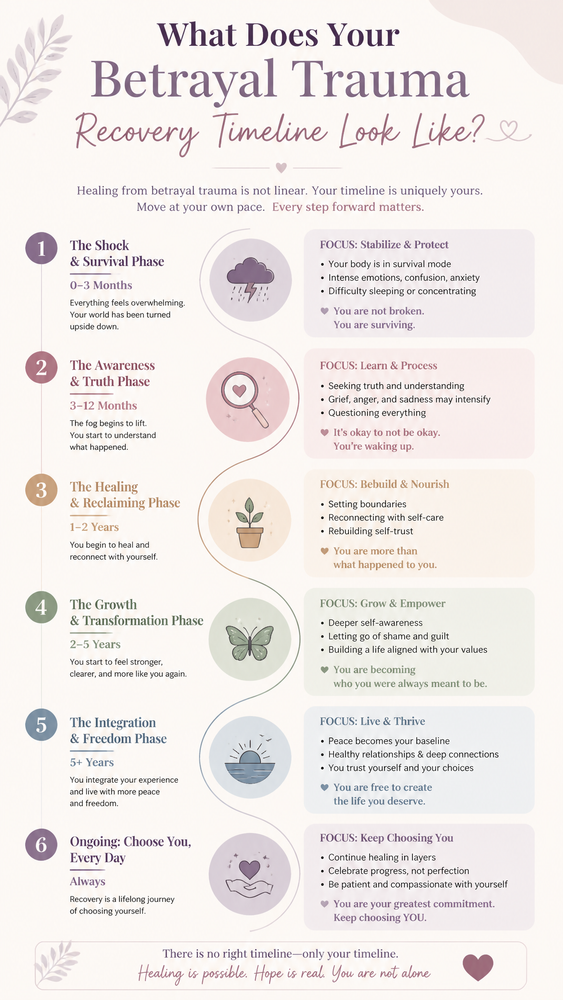
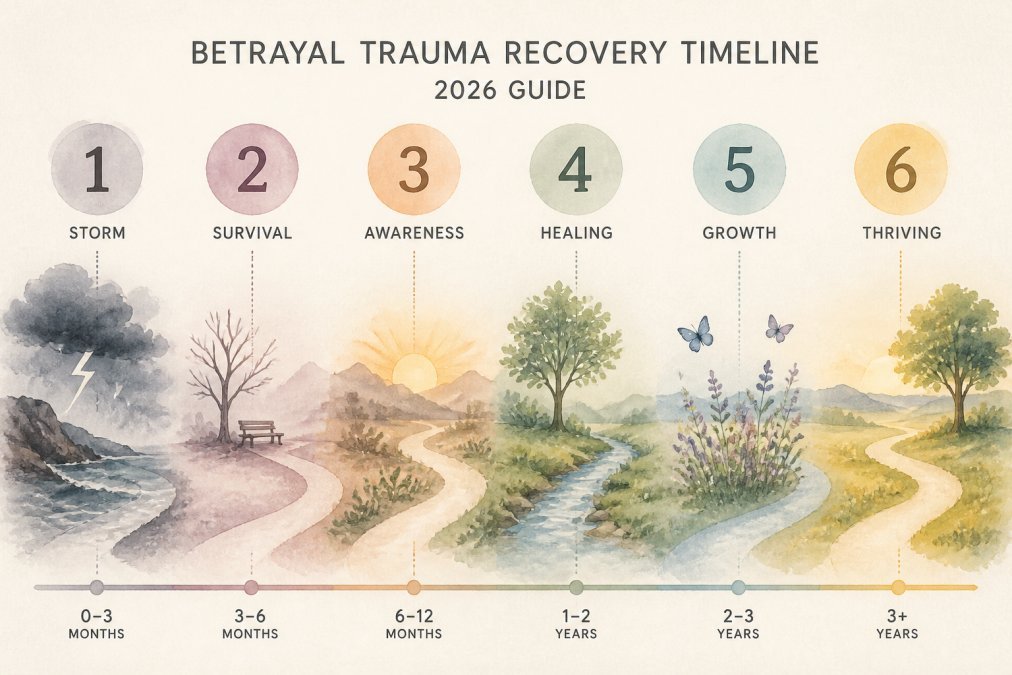
The betrayal trauma recovery timeline is the period during which an individual processes the emotional, psychological, and physiological fallout of discovering a partner’s infidelity, moving from acute crisis toward integration and growth. It is rarely a linear progression. Most survivors describe a looping pattern where progress is interrupted by triggers, anniversaries, or new disclosures, which can send them back through earlier stages before they move forward again. This non-linear healing is normal, yet it is the single biggest source of confusion for people who expect steady improvement.
At After the Affair Series, we understand the common question: “How long will this take?” The honest answer is that the timeline depends on factors like the nature of the betrayal, your attachment history, and whether you have adequate support systems in place. What most guides get wrong is treating recovery as a checklist with a finish line. In practice, the betrayal trauma recovery timeline is better understood as a spiral, where you revisit similar emotional territory at deeper levels each time.
Below, we will break down the five stages that typically appear in this process, the factors that stretch or compress the duration, and the daily coping skills that keep you grounded when the waves hit. You will also learn why individual healing and relational repair operate on two separate timelines, and when to seek professional help.
Recovery is not about reaching a finish line. It is about building the capacity to hold pain without being destroyed by it, so the timeline becomes less relevant than your resilience.
The 5 Stages of the Betrayal Trauma Recovery Timeline
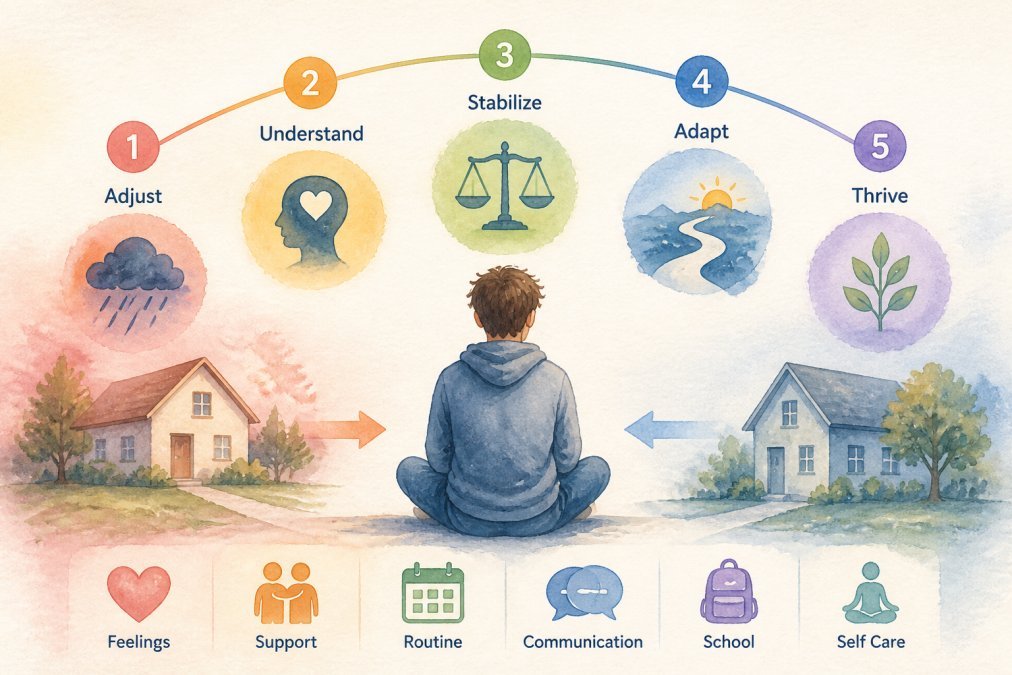
The betrayal trauma recovery timeline commonly unfolds through five overlapping stages: crisis and shock, intrusive thoughts and hypervigilance, emotional dysregulation and grief, cognitive processing and integration, and post-traumatic growth and trust restoration. These stages are not sequential milestones. Survivors frequently oscillate between them, especially in the first year after discovery, when emotional regulation is still fragile and triggers are frequent.
Stage 1: Crisis and Shock
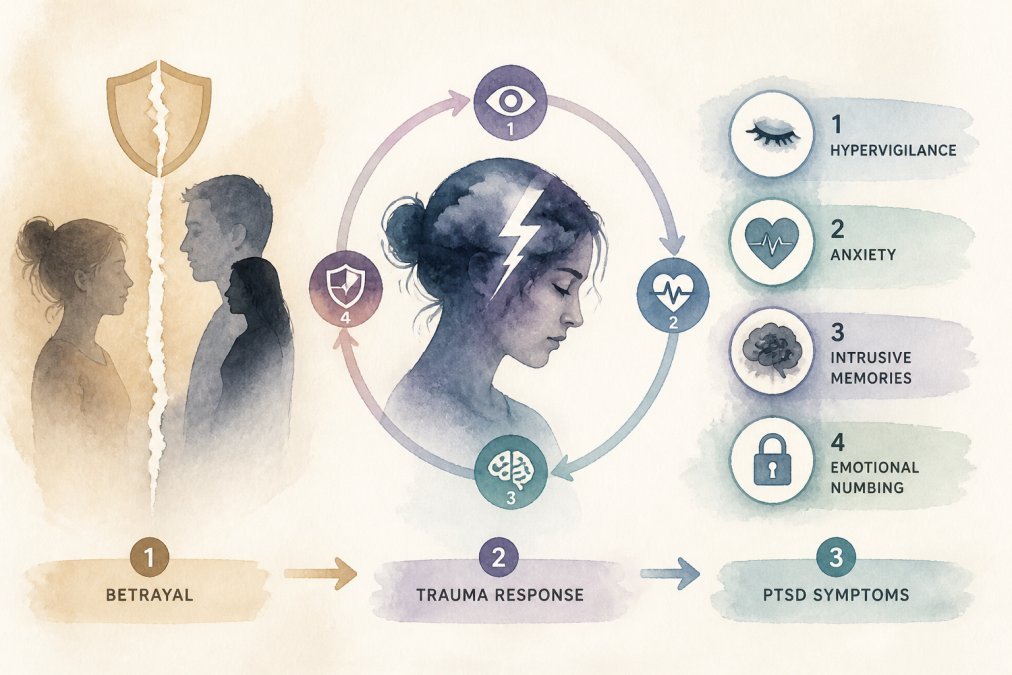
The immediate aftermath of discovery triggers a physiological crisis response. Your nervous system interprets the betrayal as a survival threat, flooding your body with cortisol and adrenaline. Many survivors describe feeling numb, dissociated, or unable to eat or sleep for days. This stage typically lasts a few days to several weeks, and your only job is stabilization: eat what you can, sleep when possible, and avoid making permanent decisions about the relationship during this window.
Stage 2: Intrusive Thoughts and Hypervigilance
As the shock wears off, intrusive thoughts about the affair and hypervigilance toward your partner’s behavior often intensify. You may find yourself checking their phone, scanning their location, or replaying conversations for hidden meaning. These symptoms are your brain’s misguided attempt to prevent future harm by staying alert. According to [trauma research from the National Institute of Mental Health(/therapy-types-for-infidelity-trauma-symptoms/) | nimh.nih.gov], intrusive thoughts are a hallmark of trauma responses and typically require active management rather than willpower to subside.
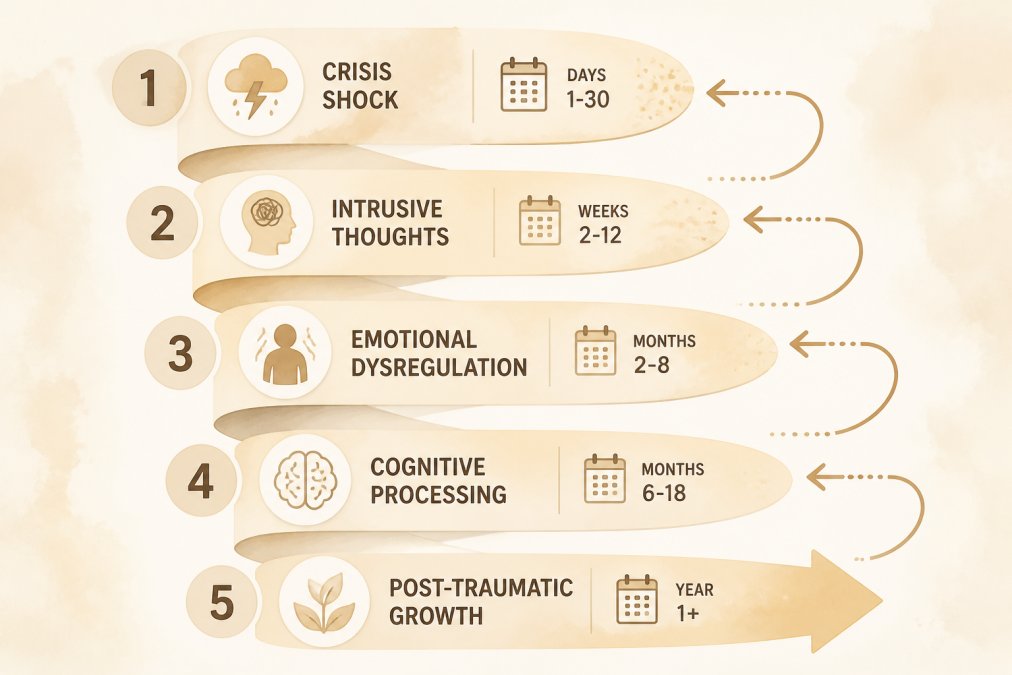
Stage 3: Emotional Dysregulation and Grief
This stage is often the longest and most difficult, involving grief over the loss of the relationship you thought you had. Emotional dysregulation manifests as sudden rage, uncontrollable crying, or profound despair. You are grieving both the betrayal and the identity you held before discovery. This is where many people feel stuck, believing they should be “over it” when the grief cycle is still active.
Stage 4: Cognitive Processing and Integration
Gradually, the intensity shifts from emotional reactivity to cognitive processing. You begin to make sense of what happened, not as a reflection of your worth, but as a failure of your partner’s integrity. Integration involves weaving the betrayal into your life story without letting it define you. This stage often includes radical acceptance: acknowledging what happened, what you lost, and what you can control.
Stage 5: Post-Traumatic Growth and Trust Restoration
The final stage is not about returning to who you were before the betrayal. Post-traumatic growth means you emerge with a deeper understanding of your own strength, clearer boundaries, and a more honest relationship with yourself. Trust restoration, whether within the relationship or with future partners, happens gradually through consistent, transparent behavior over time.
Do not rush Stage 3. Survivors who suppress grief or force forgiveness before processing the betrayal often experience delayed symptoms, including depression or somatic symptoms, months or years later. Grief cannot be skipped; it can only be postponed.
Willpower was never the problem
You’ve Said No Contact Before. What Made It Fail Last Time?
It usually isn’t willpower. It’s a loophole nobody accounted for, a second number, a mutual friend, a platform nobody thought to block. This free audit maps all 47 known workarounds so the boundary holds on its own, without relying on you to be strong enough every single time.
Get the Free Loophole Elimination Matrix ->47-point audit, instant download, free
Factors That Influence How Long Healing Takes
Several variables determine whether your betrayal trauma recovery timeline spans months or years. The length of the deception, whether there were multiple betrayals, and the degree of gaslighting during the affair all affect the depth of the relational rupture. A one-time drunken kiss with immediate confession creates a different recovery path than a multi-year affair with ongoing lies.
Your personal history matters too. Survivors with prior attachment injuries or unresolved childhood trauma often find that infidelity reactivates older wounds, extending the healing process. The quality of your support systems, including whether you have a therapist trained in trauma-informed care, also plays a significant role. Isolation reliably lengthens recovery, while structured support shortens it.
Another overlooked factor is whether you have children together. Co-parenting with the person who betrayed you means you cannot take space to heal without coordinating logistics, which keeps the wound open longer. The American Psychological Association’s guidance on infidelity recovery notes that the presence of children complicates the recovery process because ongoing contact is unavoidable.
Managing Betrayal Trauma After Infidelity Discovery: Daily Coping Skills
Managing betrayal trauma after infidelity discovery requires concrete, daily practices that regulate your nervous system and interrupt the rumination loop. The goal is not to suppress your feelings but to build enough emotional regulation that you can process them without being overwhelmed.
Start with grounding techniques. When intrusive thoughts hit, use the 5-4-3-2-1 method: name five things you can see, four you can touch, three you can hear, two you can smell, and one you can taste. This forces your brain out of the threat response and back into the present moment. Practice this several times daily, not just during crises, to strengthen the neural pathway.
Boundary setting is the second pillar. This includes limiting contact with your partner when you are dysregulated, avoiding conversations about the affair after 9 PM, and refusing to engage with details that only fuel intrusive imagery. Many survivors find that structured communication tools, such as email or messaging apps, help maintain boundaries during high-conflict exchanges.
The After the Affair Series toolkit provides specific frameworks for these moments, including the Gray Rock Method for neutralizing hostile interactions and 50+ age-appropriate scripts for explaining separation to children. Rather than offering general advice, the platform gives you exact language to use when your ex-partner provokes you or your child asks a question you are not prepared to answer.

Individual Healing vs. Relational Repair: Two Separate Timelines
A critical distinction that most resources miss is the difference between individual healing and relational repair. Your personal betrayal trauma recovery timeline operates independently of whether the relationship survives. You can heal from the betrayal and still choose to leave the marriage. Conversely, you can remain in the relationship and still be far from healed.
Individual healing focuses on restoring your sense of safety, identity, and agency. It is non-negotiable and must come first. Relational repair, if it happens at all, requires both partners to commit to transparency, accountability, and rebuilding psychological safety. The betrayed partner cannot do this work alone, and the betraying partner’s willingness to answer questions without defensiveness is a prerequisite.
Couples who try to repair the relationship before the individual has stabilized often find that couple’s therapy becomes a re-traumatizing experience. The betrayed partner is still in survival mode, unable to access the vulnerability that repair requires. A more effective sequence is individual therapy first, followed by couple’s work once the betrayed partner has sufficient emotional regulation to engage without flooding.
Betrayal Trauma Recovery Scripts for Difficult Moments
Betrayal trauma recovery scripts are pre-written responses that help you navigate high-stakes conversations without becoming dysregulated or saying something you will regret. These scripts serve two purposes: they protect you from reactive outbursts, and they communicate your boundaries clearly to your partner.
For the moment your partner asks “When are you going to be over this?”, use this script: “I am not over this because my nervous system is still processing the betrayal. That process is not on a schedule, and asking me to rush it makes me feel like my pain is inconvenient. I need you to acknowledge that without defending yourself.”
When you feel the urge to interrogate your partner for new details, try this: “I notice I am asking for details right now because I am feeling anxious. Asking for more information will not reduce my anxiety; it will feed it. I am going to pause this conversation and use a grounding exercise instead.”
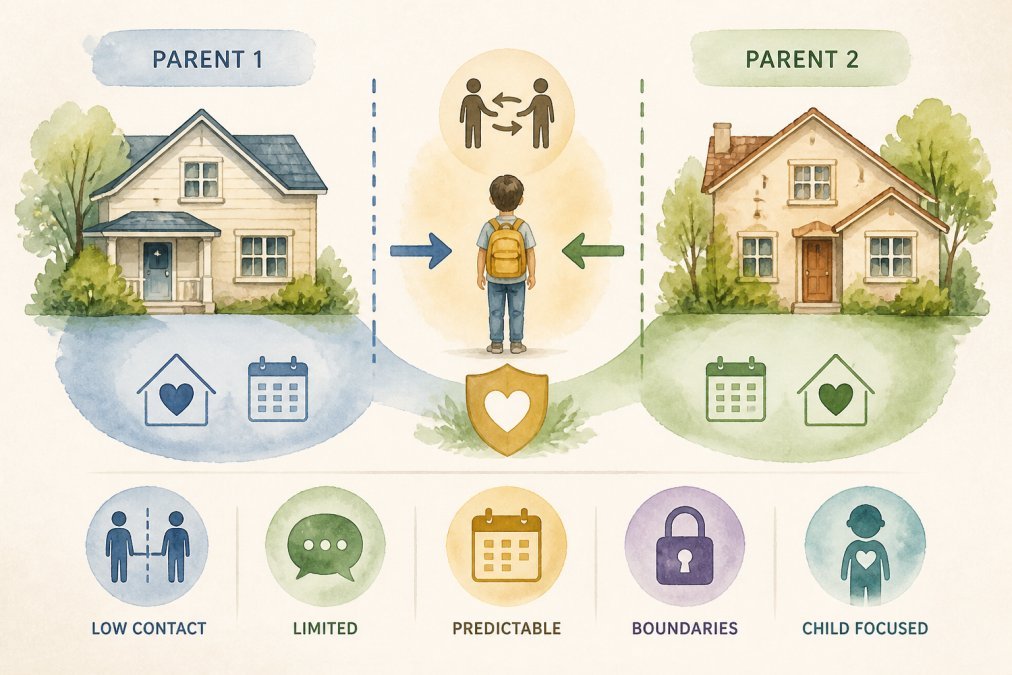
For co-parenting exchanges with a hostile ex, the After the Affair Series recommends a version of the Gray Rock Method: “I am not going to discuss that with you. This conversation is only about our child’s pickup time. If you continue to bring up other topics, I will end this conversation and we can communicate through email.”
Write your scripts down and keep them visible, whether on your phone or a sticky note. When you are dysregulated, your working memory fails. Having the exact words in front of you is the difference between holding a boundary and collapsing into an argument.
Understanding the pattern is not the same as breaking it
You Can Explain Why This Happened. Can You Explain Why You’re Still Stuck In It?
Most people in affair recovery can narrate their entire situation with total clarity, the timeline, the triggers, the whole story, and still find themselves back in the same spiral by evening. Insight was never the missing piece. This free assessment shows you exactly where the gap actually is.
Take the Free Affair Recovery Clarity Check ->A few honest questions, a scored result, 4 minutes free
When to Seek Professional Help and How to Handle Setbacks
The betrayal trauma recovery timeline often includes setbacks that feel like starting over. A new disclosure, an anniversary date, or even a song on the radio can trigger a regression into earlier stages. These setbacks are not evidence that you are failing. They are evidence that your nervous system is still processing. The key is to shorten the duration of each setback by using your coping skills rather than abandoning them.
Seek professional help if you experience symptoms that interfere with daily functioning for more than a few weeks: inability to work, significant changes in appetite or sleep, or thoughts of self-harm. A mental health professional trained in trauma-informed care can provide therapeutic intervention that accelerates the cognitive processing stage. The Substance Abuse and Mental Health Services Administration’s trauma resources offers a directory of trauma-informed providers and crisis lines.
One common mistake is waiting until you are in crisis to find a therapist. By then, your nervous system is too activated to benefit fully from the session. Instead, establish care early in your recovery, even if you feel you are managing okay. That way, when a setback hits, you already have a relationship in place and do not have to navigate the exhausting process of finding a provider while dysregulated.
Conclusion: Your Timeline Starts with the Next Right Step
The betrayal trauma recovery timeline is not a countdown to a predetermined endpoint. It is a map of the territory you must cross, with the understanding that you will sometimes walk backward before you can move forward. Your only obligation is to take the next right step, whether that is drinking water during a panic attack, using a script to end a hostile conversation, or calling a therapist for an intake appointment.
At After the Affair Series, we have built a structured toolkit for exactly these moments. The free 23-point assessment gives you a scored baseline of where you are in your recovery, and our frameworks, including the Gray Rock Method and 50+ scripts for protecting your children, provide immediate, practical language for the hardest conversations. You do not have to figure this out alone, and you do not have to do it without a plan. Take the free 23-point assessment and start your recovery with a structure that holds.
Frequently Asked Questions
How long does it take to heal from betrayal trauma?
There is no universal timeline. Research and clinical experience show that the acute crisis phase lasts 3 to 6 months, but the full betrayal trauma recovery timeline often spans 18 to 24 months or longer. Healing is non-linear, meaning you may feel significant progress and then regress when a trigger appears. The timeline depends on factors like the nature of the betrayal, your support system, and whether you engage in structured recovery work like therapy or trauma-informed programs. Focus on consistent progress rather than a calendar date.
What are the 5 stages of betrayal trauma?
The 5 stages commonly used in betrayal trauma recovery are: 1) Crisis and Shock, where you feel numb or disoriented; 2) Intrusive Thoughts and Hypervigilance, marked by obsessive rumination; 3) Emotional Dysregulation, where anger, sadness, and anxiety fluctuate; 4) Cognitive Processing and Integration, where you begin to make sense of the event; and 5) Post-Traumatic Growth, where you rebuild identity and trust. These stages are not strictly sequential. Expect to move between them throughout the betrayal trauma recovery timeline.
Is the recovery timeline for betrayal trauma linear?
No, the betrayal trauma recovery timeline is not linear. Most survivors experience a cyclical pattern: they make progress, encounter a trigger like a song or a location, and temporarily move back into earlier stages of hypervigilance or emotional dysregulation. This is a normal part of complex trauma recovery, not a sign of failure. Relapse and setbacks are expected and manageable. Tracking your patterns can help you recognize that a difficult week does not erase the progress you have already made.
What are the common symptoms of betrayal trauma during the early phases?
The early phases of betrayal trauma often include somatic symptoms like insomnia, fatigue, and loss of appetite, alongside emotional signs such as intense anxiety, rage, and profound sadness. Many people experience betrayal blindness, where they minimize the event to protect themselves. Hypervigilance is also common, where you constantly check your partner’s phone or location. These symptoms are a normal stress response to a relational rupture. Seeking trauma-informed care early can prevent these acute symptoms from becoming entrenched patterns.
How can I manage betrayal trauma after infidelity discovery?
Managing betrayal trauma after infidelity discovery requires a structured approach. Start by stabilizing your nervous system with daily grounding techniques, such as deep breathing or a short walk, to counter hypervigilance. Establish firm boundaries to create psychological safety for yourself. Name the specific emotions you feel rather than suppressing them, as this supports cognitive processing. Use written scripts to communicate your needs during difficult conversations. If you feel stuck, a mental health professional who specializes in betrayal trauma can provide a roadmap tailored to your situation.
Reading this won’t change tomorrow’s message
You Know the Tactic Now. Do You Know What You’ll Actually Do When It Lands?
Understanding grey rock is not the same as doing it at 9pm when your phone buzzes. Most parents can explain the theory perfectly and still bite the bait every single time. The gap between the two is exactly what the free self-check measures.
Get Your Ex Out of Your Head ->5 scenarios, scored result, 4 minutes free