Last Updated: September 10, 2026
- How to Recognize the Signs of Emotional Trauma in Children After Divorce
- Behavioral Changes in Children After Divorce: What to Watch For
- Age-Specific Manifestations of Childhood Trauma After Divorce
- How to Help a Child Process Divorce Trauma: Practical Steps for Parents
- Scripts for Talking to Children About Divorce
- When to See a Therapist for Child Divorce Trauma
- Long-Term Consequences and Protective Factors
- Frequently Asked Questions
How to Recognize the Signs of Emotional Trauma in Children After Divorce
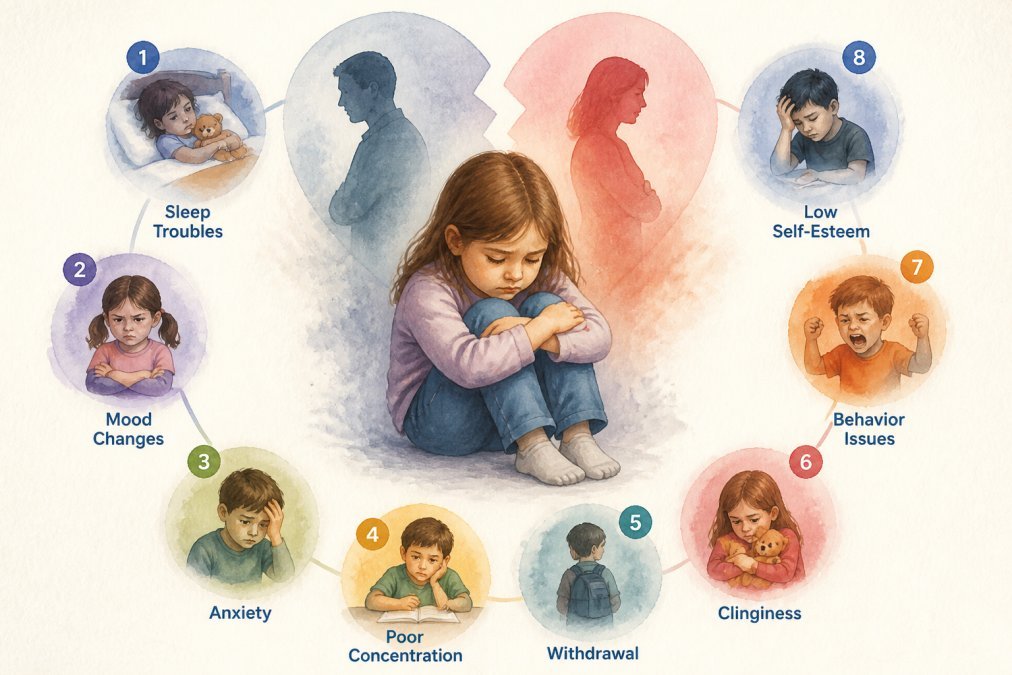
Recognizing the signs of emotional trauma in children after divorce starts with watching for shifts in behavior, sleep, and mood that persist beyond a few weeks. This guide breaks down what to look for by age, when to bring in a therapist, and what to say when your child opens up.
Most parents catch the big signals and miss the quiet ones. A child who stops asking about a favorite cousin, or suddenly needs the hallway light on, is often communicating more than a child who slams a door.
Common Emotional Reactions to Family Separation
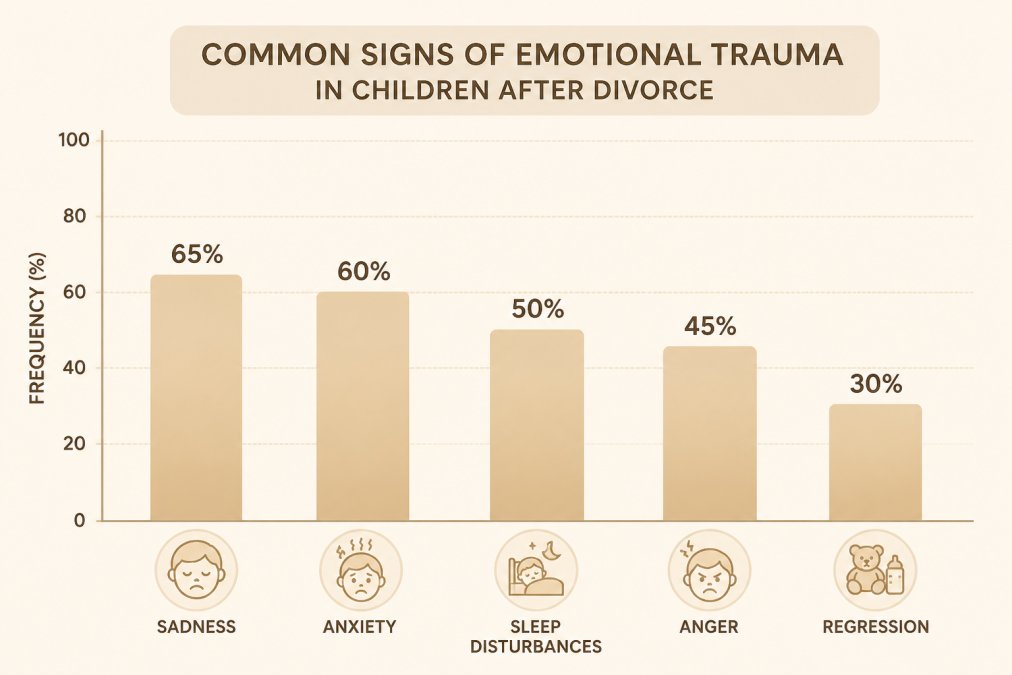
Sadness, anger, guilt, and confusion are normal in the first months after a separation. What separates adjustment from trauma is duration and intensity: a reaction that fades within weeks is grief; one that deepens or disrupts daily functioning needs support.
A common mistake is treating every outburst as evidence of damage. Watch whether your child can still enjoy friends, school, and hobbies between the hard moments.
Physical Complaints and Sleep Disturbances
Headaches, stomachaches, and trouble falling asleep are among the most overlooked signs of emotional trauma in children after divorce. These complaints rarely have a medical cause when they cluster around transitions, like the night before a custody exchange.
Sleep disturbances show up as bedtime resistance, nightmares, or a sudden need to sleep in your bed. If complaints spike on the same days each week, the schedule itself is likely the trigger.
Behavioral Changes in Children After Divorce: What to Watch For
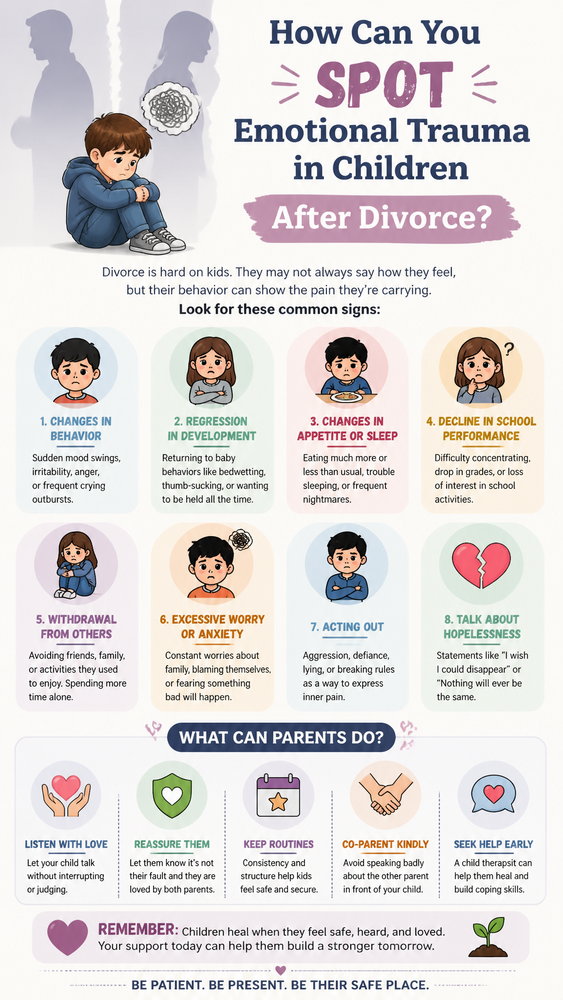
Behavioral changes in children after divorce fall into two categories, and knowing which one your child leans toward tells you what support they need. Some turn inward and go quiet; others act out. A third pattern, the child who seems perfectly fine, is most often missed.
Internalizing vs. Externalizing Behaviors
Internalizing behaviors include social withdrawal, emotional shutdown, and insisting everything is fine. Externalizing behaviors include aggression, defiance, and rule-breaking at home or school. Both are coping mechanisms, not character flaws.
Internalizing children have learned that big feelings threaten the adults around them, so they swallow the feeling and pay the cost internally. Externalizing children have learned that big feelings get a response, often the only reliable attention available, so the feeling comes out as behavior.
Internalizing behaviors are easy to miss: a quiet, well-behaved child can carry significant distress without a single visible outburst. Check in directly rather than waiting for a signal.
Reading this won’t change tomorrow’s message
You Know the Tactic Now. Do You Know What You’ll Actually Do When It Lands?
Understanding grey rock is not the same as doing it at 9pm when your phone buzzes. Most parents can explain the theory perfectly and still bite the bait every single time. The gap between the two is exactly what the free self-check measures.
Get Your Ex Out of Your Head ->5 scenarios, scored result, 4 minutes free
Connecting Behavior to Ongoing Co-Parenting Conflict
The strongest predictor of a child’s outcome is not the divorce itself, it is the level of conflict the child is exposed to afterward. The same behavior can mean very different things depending on what is happening between the parents.
A child who acts out the night before a custody exchange is often reacting to tension between the homes, not the exchange itself. A child who refuses to talk about one parent may be protecting that parent’s feelings. A child who becomes the household peacekeeper is responding to conflict they cannot stop.
Watch for these conflict-linked patterns:
- Messenger behavior: the child carries information between parents because direct communication is not happening.
- Spying or reporting: the child is asked, or feels obligated, to report on the other household.
- Loyalty freezing: the child goes silent or neutral around both parents to avoid choosing sides.
- Sudden alignment: the child rejects one parent entirely, often after hearing negative talk about that parent.
If you recognize your child in any of these, the behavior signals something about the co-parenting system, not just the child. Reducing conflict does more than any individual conversation.
Signs of Anxiety and Depression
Watch for loss of interest in activities your child used to love, persistent irritability, and comments about being a burden. In younger children, anxiety looks like clinginess and separation anxiety rather than words. In older children, it can look like perfectionism, trouble concentrating, or refusing to try anything they might fail at.
A practical threshold: if a behavior is new, has lasted more than four to six weeks, and is interfering with school, friendships, sleep, or eating, treat it as a signal worth professional attention rather than a phase to wait out (aacap.org).
Do not dismiss repeated statements like “I wish I wasn’t here” as attention-seeking. Any talk of self-harm or not wanting to exist warrants an immediate call to a licensed child therapist or your pediatrician. Waiting for it to pass carries real risk.
Understanding the pattern is not the same as breaking it
You Can Explain Why This Happened. Can You Explain Why You’re Still Stuck In It?
Most people in affair recovery can narrate their entire situation with total clarity, the timeline, the triggers, the whole story, and still find themselves back in the same spiral by evening. Insight was never the missing piece. This free assessment shows you exactly where the gap actually is.
Take the Free Affair Recovery Clarity Check ->A few honest questions, a scored result, 4 minutes free
Digital and Social Media Behavior
A teen who suddenly deletes every app, hides the screen, or posts vague sad content late at night is telling you something. Social withdrawal now happens online as much as in the school hallway.
Watch for changes in who your child talks to, not just how much time they spend. A child who stops responding to friends in group chats, or shifts to anonymous accounts, is signaling a change in their real-world support system.
Set one non-negotiable: phones out of bedrooms at night. Then watch for patterns rather than policing individual posts.
Screenshot nothing and interrogate nothing in the first conversation. Teens shut down when they feel surveilled. Ask what the app is for and who they talk to there, then listen without correcting.
A Quick Self-Assessment for Parents
Use this as a starting rubric, not a diagnosis. For each item, note whether it is new, how long it has lasted, and whether it affects daily function.
- Sleep: bedtime resistance, nightmares, or a sudden need to sleep in your bed.
- School: grades, attendance, or teacher comments about withdrawal or aggression.
- Friends: fewer invitations, more time alone, or a change in peer group.
- Body: recurring headaches or stomachaches that cluster around transitions.
- Mood: persistent irritability, flatness, or tearfulness beyond a few weeks.
- Safety: any talk of self-harm, not wanting to exist, or giving away belongings.
If three or more items are new and have lasted more than a month, that is a reasonable point to bring in a professional. If any safety item is present, act today.
Age-Specific Manifestations of Childhood Trauma After Divorce
The same distress looks different at every age. A three-year-old cannot explain loyalty conflict; a teenager can, but often won’t. What follows is a breakdown by developmental stage, including the mechanism behind each behavior and the line between normal adjustment and a trauma response.
A useful rule across every age: adjustment looks like a child who has hard moments but still returns to play, friends, and sleep. Trauma looks like a child whose functioning narrows and stays narrow. Duration and function matter more than any single behavior.
Infants and Toddlers (Ages 0-3)
At this stage the body speaks because language is not available yet. Infants may feed poorly, wake more at night, or become hard to soothe. Toddlers often show irritability, more tantrums, and a sharp increase in clinginess, especially at handoffs.
Toddlers are building object permanence and a sense of a predictable caregiver. When a parent disappears on a schedule the child cannot understand, the nervous system reads it as loss, not logistics. That is why the goodbye ritual matters more than the explanation.
Normal vs. trauma: a toddler who cries at drop-off but settles within ten or fifteen minutes is adjusting. A toddler who stays dysregulated for hours, stops eating, or loses recently gained skills is signaling something that needs attention.
What helps: keep the same comfort object, bedtime sequence, and short goodbye at every handoff. Do not sneak out to avoid tears, that teaches the child that caregivers vanish without warning.
Noticing the pattern is not the same as proving it
You Can Feel the Pattern. Can You Prove It to a Judge?
A diary of what happened reads as emotional venting. A structured, timestamped record reads as evidence. Most parents lose that distinction until it costs them. The free checklist shows you exactly what to document today, before the evidence window closes.
Get the Free Red Flag Checklist ->3 categories, 5 minutes, free
Preschool and Early Elementary (Ages 3-6)
Regression is the headline signal at this age: thumb-sucking returns, toilet training slips, and baby talk reappears. These children cannot name their feelings, so the body speaks through tantrums and clinginess. You may also see magical thinking, the belief that a wish or misbehavior caused the divorce.
Preschoolers are egocentric and naturally assume they cause events around them. Without a clear, repeated correction, that assumption hardens into guilt.
Normal vs. trauma: brief regression after a move or a new custody schedule is common and usually fades within a few weeks. Regression that persists, spreads to multiple areas, or comes with sleep collapse points toward a trauma response.
What helps: keep routines boring and predictable. The same bedtime, comfort object, and goodbye ritual at every handoff does more for a preschooler than any conversation. Answer the unasked question directly: “You did not cause this, and it is not your job to fix it.”
Middle Childhood (Ages 7-12)
School-age children often blame themselves and try to fix the family. You may see grades drop, friendships thin, and fierce loyalty to one parent paired with coldness toward the other. Stomachaches on Sunday nights and headaches before a custody exchange are common because the child has learned that emotional pain is more acceptable as a body symptom.
Children in this band are developing a sense of fairness and moral reasoning. They may broker peace, carry messages between parents, or hide their own needs to reduce tension. This is when parentification, a child taking on the emotional role of an adult, takes root.
Normal vs. trauma: a child who is sad but still engaged at school and with friends is grieving. A child who stops turning in homework, drops out of activities they used to love, or refuses to speak to one parent is showing a trauma pattern.
What helps: answer the question they are not asking, “This is not your fault, and nothing you do will change the grown-up decisions.” Say it more than once. Do not use the child as a messenger, a spy, or a confidant about the other parent.
Teens and Adolescents (Ages 13-18)
Teens tend to pull away, and it is easy to read normal adolescent distance as trauma. The difference is function: a teen who is angry but still sees friends and keeps grades steady is coping; one who quits every activity and sleeps through the day is not.
Watch for substance use, risky driving, and digital behavior that cuts off real-world connection. Teens may also take on a caretaking role for a distressed parent, which looks like maturity but delays their own development.
Adolescents are separating from the family and building an independent identity. Divorce can accelerate that separation unhealthily, pushing the teen out emotionally before they are ready, or pulling them back in as a parent’s support.
Normal vs. trauma: irritability, privacy, and questioning authority are developmentally normal. Withdrawal from all friends, a drop in grades, self-harm talk, or a sudden change in who they spend time with are not.
What helps: stay available without interrogating. Ask about their day, not about the divorce. Keep one ritual that belongs only to the two of you, a weekly meal, a drive, a show you watch together. American Academy of Child and Adolescent Psychiatry resources on divorce offers age-specific guidance worth reading alongside this section.
A Note on Siblings
Two children in the same household can show completely different responses to the same divorce. One may internalize, the other externalize. Assess each child separately against their own baseline rather than assuming that because one seems fine, the household is fine.

How to Help a Child Process Divorce Trauma: Practical Steps for Parents
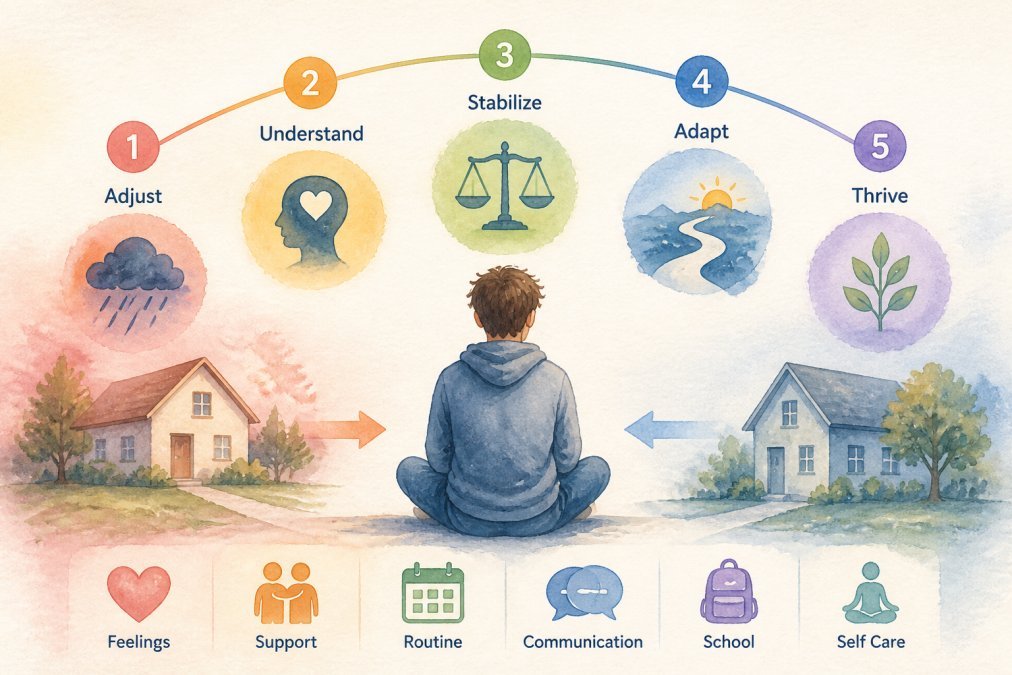
Helping a child process divorce trauma comes down to three things: emotional availability, predictable routines, and permission to feel everything without managing the adults. Here is the sequence that works.
- Name the feeling out loud so your child does not have to. “You seem really sad today. That makes sense.”
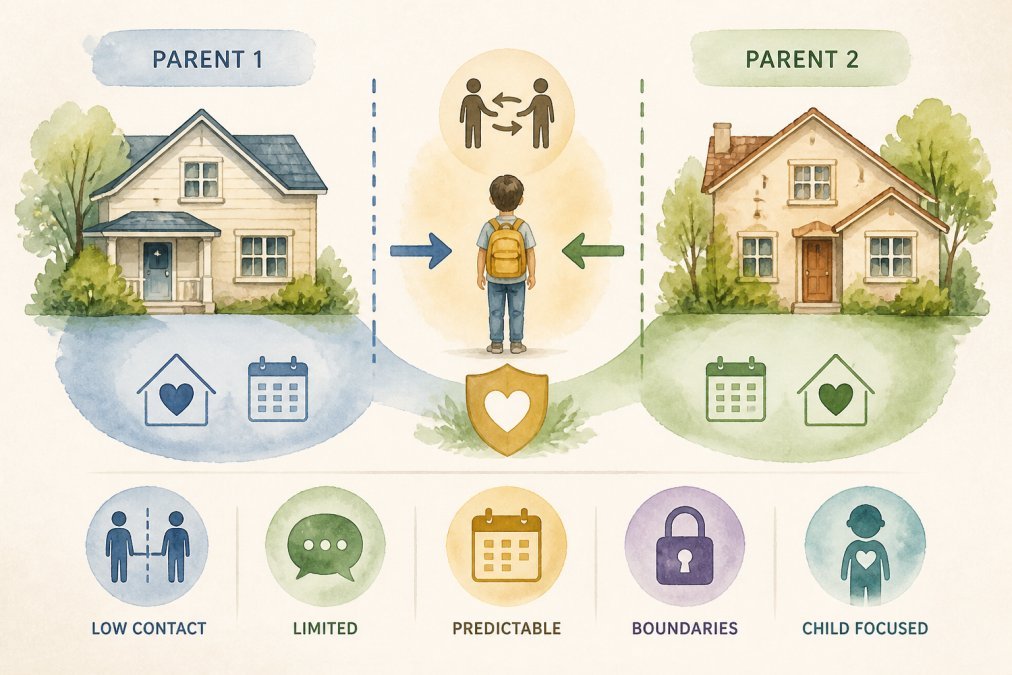
- Keep both homes predictable with shared rules for bedtime, screens, and homework.
- Shield your child from parental conflict. Never use them as a messenger or a spy.
- Answer questions honestly at their level, without adult detail.
- Protect their relationship with the other parent unless safety is at risk.
- Check in weekly, not only after a crisis.
Supporting Emotional Regulation and Resilience
Children borrow calm from the adults around them. If you are regulated, they have a template to copy. Teach simple tools: naming five things they can see when anxiety spikes, a breathing count, a journal for older kids.
Resilience is built by surviving hard feelings with a steady adult nearby, not by avoiding them.
Monitoring Digital and Social Media Behavior
A teen who suddenly deletes every app, hides the screen, or posts vague sad content at 2 a.m. is telling you something. Social withdrawal now happens online as much as in the school hallway.
Set one non-negotiable: phones out of bedrooms at night. Then watch for changes in who they talk to, not just how much time they spend.
Screenshot nothing and interrogate nothing in the first conversation. Teens shut down when they feel surveilled. Ask what the app is for and who they talk to there, then listen without correcting.
Scripts for Talking to Children About Divorce
Scripts remove the pressure of finding the perfect words in the moment. Use these as starting points and adjust for age.
- Ages 3-6: “Mommy and Daddy both love you. You did nothing wrong. You are safe.”
- Ages 7-12: “The divorce is a grown-up decision. It is not your job to fix anything.”
- Teens: “I know this is hard. You can be angry with me and still talk to me.”
After the Affair Series offers 50+ age-appropriate scripts built for exactly these conversations.
Willpower was never the problem
You’ve Said No Contact Before. What Made It Fail Last Time?
It usually isn’t willpower. It’s a loophole nobody accounted for, a second number, a mutual friend, a platform nobody thought to block. This free audit maps all 47 known workarounds so the boundary holds on its own, without relying on you to be strong enough every single time.
Get the Free Loophole Elimination Matrix ->47-point audit, instant download, free
When to See a Therapist for Child Divorce Trauma
See a therapist when symptoms last more than four to six weeks, disrupt school or friendships, or include any talk of self-harm. A licensed child therapist can run a clinical assessment and recommend intervention tailored to your child’s age.
Parents often wait for a dramatic sign while a child quietly struggles. A free 23-point assessment from After the Affair Series can help you score what you are seeing.
| Signal | Watch For | Action |
|---|---|---|
| Duration | Symptoms past 4-6 weeks | Schedule a therapist |
| Function | Grades or friendships slipping | Talk to the school |
| Safety | Any self-harm talk | Call a professional today |
| Sleep | Nightmares, bedtime refusal | Track and report |
Long-Term Consequences and Protective Factors
Long-term consequences are not inevitable. Research consistently points to parental conflict, not divorce itself, as the strongest predictor of poor outcomes. Protective factors include a warm relationship with at least one stable adult, low conflict between parents, and predictable routines.
American Psychological Association guidance on children and divorce notes that most children adjust well when conflict is contained. Your job is not to prevent every hard feeling. It is to make sure your child never carries the conflict alone.
The single most protective factor you control is the level of conflict your child witnesses. Reducing it does more than any individual conversation.
The hardest part is not knowing what to watch for. It is staying steady enough to respond while carrying your own grief. After the Affair Series provides frameworks for high-conflict co-parenting, 50+ age-appropriate scripts for talking to your children, and a free 23-point assessment. Take the free 23-point assessment and get a scored picture of what your child needs from you right now.
Frequently Asked Questions
What age is divorce most damaging to a child?
Children of any age can experience emotional trauma from divorce, but research suggests that early childhood (ages 3-6) and adolescence (13-18) may be particularly vulnerable periods. Preschoolers often show regression and separation anxiety, while teens may exhibit withdrawal, risk-taking, or academic decline. The impact depends on factors like parental conflict, emotional availability, and the child’s temperament. Age-specific support and open communication can significantly buffer the effects.
How do I know if my child has emotional trauma?
Look for persistent changes in behavior, mood, sleep, or physical health that last more than a few weeks. Signs may include developmental regression (e.g., bedwetting, thumb-sucking), emotional shutdown, acting out, social withdrawal, or frequent stomachaches. Children may also express loyalty conflict, fear of abandonment, or academic performance drops. If these signs interfere with daily life, consider a clinical assessment. A free 23-point assessment from After the Affair Series can help you track severity.
How long does it typically take children to recover from the effects of divorce?
Recovery varies widely. Some children adjust within 6-12 months, while others may show symptoms for 2-3 years or longer, especially if parental conflict continues. Protective factors like consistent routines, emotional availability, and therapeutic intervention can speed healing. Resilience is built through stable, nurturing relationships. If symptoms persist beyond a year or worsen, seek professional guidance to prevent long-term consequences.
When should you seek professional help for a child after divorce?
Seek help if your child shows severe or worsening symptoms: persistent anxiety or depression, self-harm, extreme aggression, school refusal, or psychosomatic complaints with no medical cause. Also consider therapy if symptoms last more than 6-12 months or if your child talks about wanting to hurt themselves. A therapist trained in trauma-informed care can provide child counseling and family therapy. Early intervention reduces the risk of long-term psychological distress.