Table of Contents
Last Updated: September 28, 2026
What Legal Enforcement of Parallel Parenting Boundaries Actually Looks Like
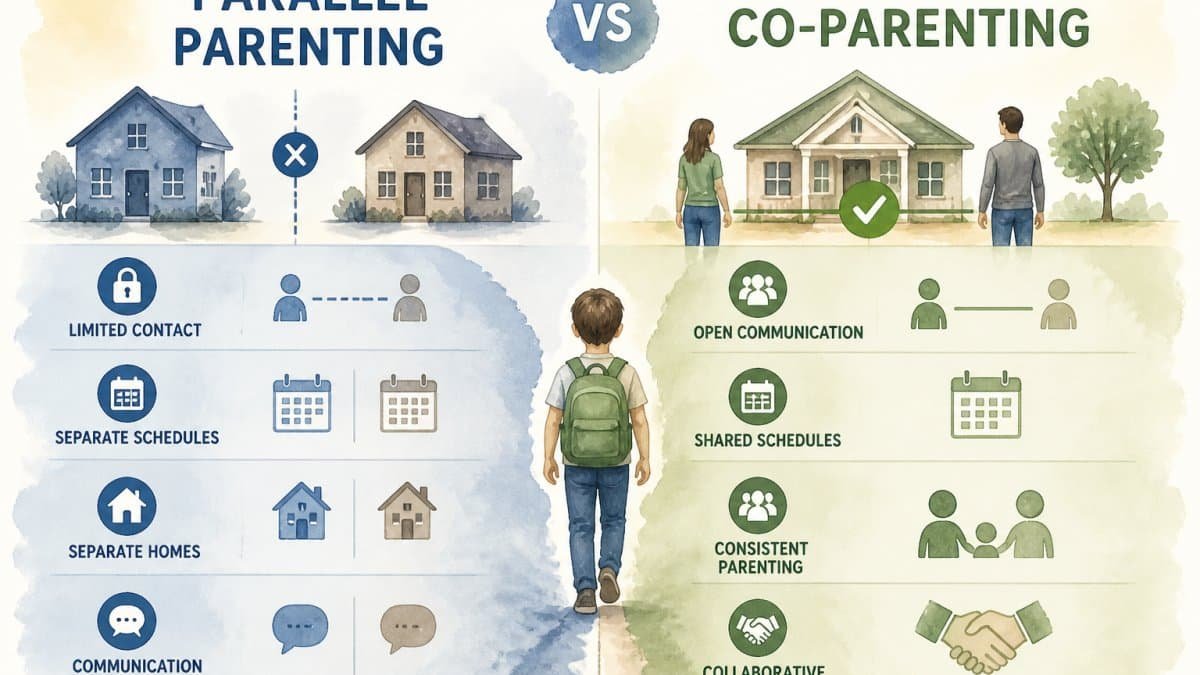
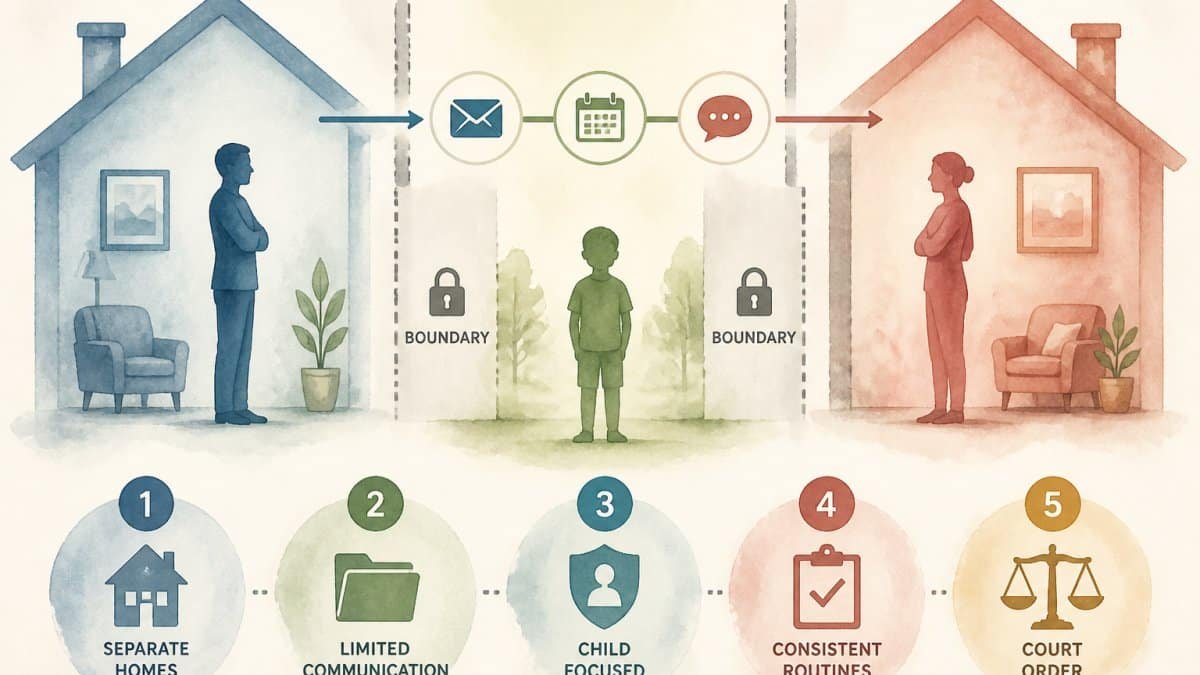
Parallel parenting is a custody arrangement where each parent makes day-to-day decisions independently during their own parenting time, with minimal direct communication. Learning how to enforce parallel parenting boundaries legally starts with one hard truth: a court order is only as strong as its enforceable provisions. This guide from After the Affair Series walks you through the steps, from reading your custody decree to filing a motion when the other parent ignores it.
Psychological Boundaries vs. Legal Boundaries: Why the Difference Matters
A psychological boundary is a rule you set for yourself, like ending a phone call when yelling starts. A legal boundary is a provision a judge can enforce, like a set exchange time.
Both matter, but they do different jobs.
- Psychological boundaries protect your peace. You control them.
- Legal boundaries protect your rights. A court controls them.
Your parenting plan is the only document a judge will read when you file. If a rule isn’t written down with specifics, it does not exist in the eyes of the court.
Step 1: Confirm Your Parallel Parenting Court Order Has Enforceable Provisions
Enforceable provisions are specific, measurable, and time-bound. Read your custody decree and flag every line using words like “reasonable,” “as agreed,” or “when possible”, these phrases give the other parent room to argue.
Compare what you have against what a judge needs:
| Vague Provision | Enforceable Version | Why It Holds Up |
|---|---|---|
| “Reasonable visitation” | “Alternating weekends, Friday 6 p.m. to Sunday 6 p.m.” | Fixed times, no interpretation |
| “Communicate as needed” | “Communication by email only, within 24 hours” | Defined channel and deadline |
| “Share school info” | “Both parents copied on all school emails within 48 hours” | Named action, named timeframe |
Filing a contempt motion against a vague order wastes your filing fee and damages your credibility with the judge. Fix the order first, then enforce it.
Parallel Parenting Communication Rules That Hold Up in Court
Communication protocols are the backbone of parallel parenting boundaries. The rules you set now become the standard a judge measures both parents against later. A workable set looks like this:
- One channel only, such as a court-approved messaging app or email
- No phone calls except in emergencies, with a written follow-up
- A 24-hour response window for non-urgent messages
- No discussion of the other parent’s personal life
- Business-like tone, no name-calling, no sarcasm
Communication Protocols That Limit Direct Contact
Third-party intermediaries can remove direct contact almost entirely: a neutral app, a co-parenting coordinator, or a trusted family member can relay logistics. High-conflict cases often escalate during unstructured contact, and each unscripted exchange is a chance for a fight. The Gray Rock Method works on the same principle: stay calm, brief, and uninteresting so hostile messages lose their fuel.
American Bar Association resources on family law
Documenting High-Conflict Co-Parenting for Court: What Judges Want to See
Documentation is where most self-represented parents win or lose. In a contempt proceeding, you carry the burden of proving the other parent violated a specific order provision, and in most jurisdictions you must also show the violation was willful rather than accidental. A judge rules on evidence tied to a written provision, not on a feeling.
What Each Entry Needs to Meet the Burden of Proof
Every entry should answer four questions a judge will ask:
- What provision was violated? Quote it verbatim and cite the paragraph or section number from your order.
- When did it happen? Date, time, and time zone if exchanges cross one.
- What actually occurred? One or two plain sentences. No adjectives, no motive, no backstory.
- What proves it? The specific exhibit, a screenshot, an email header, a message-app export, a school record, a receipt.
Evidence Types and How to Preserve Them
Different violations need different proof. Match the exhibit to the claim:
| Violation | Strongest Evidence | Preservation Step |
|---|---|---|
| Missed exchange | Message-app timestamp, doorbell or dashcam footage | Export the thread; do not delete it |
| Denied parenting time | Written denial in the court-approved app | Screenshot with visible date and sender |
| Unapproved communication | Call log, voicemail file | Save the audio; note the date received |
| Withheld school or medical info | School portal records, provider statement | Request records in writing so you have a dated request |
| Late or missed support | Payment platform history, bank statement | Download the full statement, not a single line |
Organizing the Log by Violation, Not by Date
A chronological diary forces the judge to hunt for the pattern. A violation-indexed log hands it over.
Use one page per incident:
- Heading: the order provision, quoted.
- Facts: date, time, what happened, in plain sentences.
- Exhibits: labeled A, B, C, with a one-line description of each.
- Running tally: “Violation 3 of 7 documented since [date].”
Judges do not weigh how wronged you feel. They weigh whether a specific provision was broken, whether you can prove it, and whether the other parent did it on purpose. Build every entry to answer those three questions.
What to Leave Out
Skip anything not tied to a provision: insults, speculation about motives, screenshots of arguments that broke no rule, and commentary about their personal life. Every extra page dilutes the pages that matter and gives the other side something to attack. If a message upset you but violated nothing in the order, it belongs in a personal journal, not a court filing.
USA.gov court and legal resources
Filing a Motion for Contempt of Court: Step-by-Step
A motion for contempt asks a judge to rule that the other parent violated a valid court order and to impose a remedy. Most courts treat this as a civil contempt action, so the goal is compliance, not punishment, though repeated willful violations can lead to fines, makeup parenting time, or a change in custody.
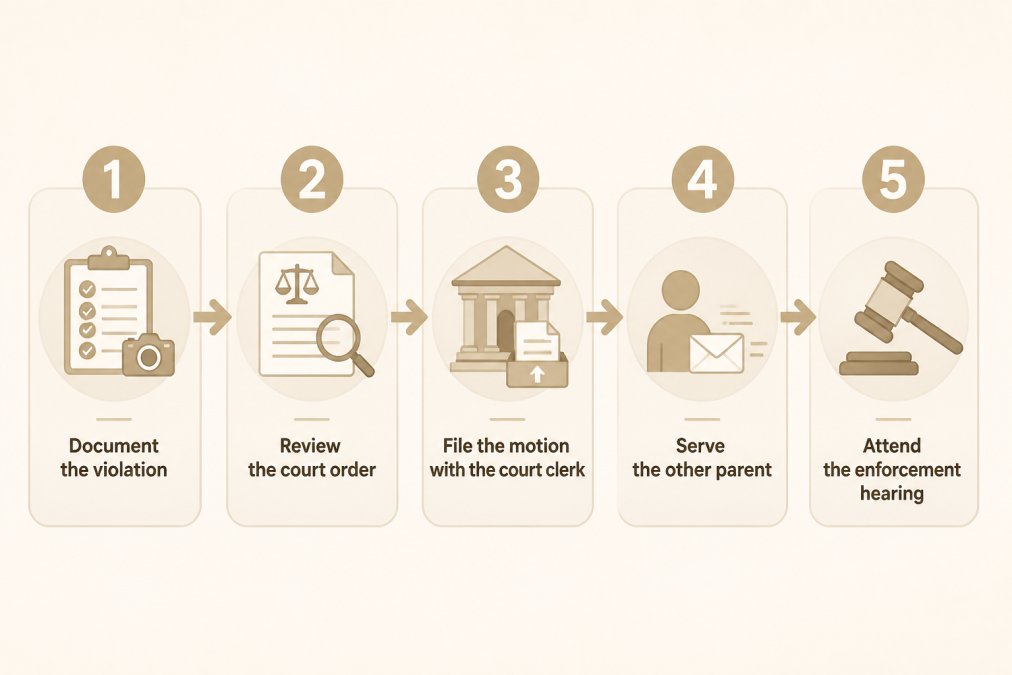
Step 1: Confirm You Have a Violation, Not a Disagreement
Contempt requires a clear, specific order and a clear violation. If the provision says “reasonable” or “as agreed,” you likely have a disagreement, not a violation. Fix the order through modification first, then enforce.
Step 2: Identify the Legal Standard in Your Jurisdiction
Civil contempt generally requires two showings: a valid order existed and was known to the other parent, and the parent violated it. Many courts also require willfulness, that the parent acted intentionally or with disregard for the order. Some jurisdictions presume willfulness once you prove the violation, shifting the burden to the other parent.
Step 3: Draft the Motion
Most courts have a fill-in-the-blank form for contempt or enforcement. Use it if one exists; a form motion is far less likely to be rejected on a technicality. If you must draft your own, include:
- The case caption with your case number, exactly as it appears on your order
- A statement that a valid order exists, with the date it was entered
- The specific provision violated, quoted
- The date, time, and facts of each violation
- A statement of willfulness, if your jurisdiction requires it
- The relief you are requesting, makeup time, attorney fees if allowed, or other remedies
- A verification or notarized signature if your court requires one
Step 4: File With the Clerk and Pay the Fee
File the original with the clerk of the court that entered your order. Ask about the filing fee and whether a fee waiver is available, most courts have an application for people who cannot afford it. Keep a stamped copy as proof of filing.
Step 5: Serve the Other Parent Correctly
Service is where self-represented motions most often fail. You cannot hand the papers to the other parent yourself in most jurisdictions. Follow your state’s rules exactly:
- Personal service through a sheriff, constable, or licensed process server is the most common method.
- Certified mail is allowed in some courts, sometimes with a return receipt.
- Electronic service through the court’s e-filing system may be permitted if the other parent is registered.
Step 6: Prepare for the Hearing
At the hearing, you will likely be sworn in and asked to explain the violation. Bring:
- Three copies of your motion and exhibits (one for the judge, one for the other parent, one for you)
- Your indexed log, organized by violation
- The original order, with the violated provisions tabbed
Possible Outcomes
Each step has a deadline set by your court’s local rules. Miss the service deadline or the filing deadline and the motion can be dismissed without a hearing on the merits. Calendar every date the moment you file.
For the legal standard that applies, see USA.gov court and legal resources.

Parallel Parenting Court Order Templates and Custody Modification
Templates give you a starting structure, but every state has its own required forms, check your court’s self-help center before drafting anything.
Self-Help Enforcement Strategies When You Cannot Afford an Attorney
Not every violation needs a courtroom. Self-help strategies can reduce conflict before it reaches a judge:
- Send one written notice citing the exact provision and the requested fix
- Use a parenting coordinator if your order allows one
- Request mediation before filing, since many courts require it
- Keep every message in one channel so your record stays clean
Before you file anything, send one calm written notice that quotes the order and asks for a specific fix by a specific date. Judges look favorably on parents who tried to resolve the issue first.
Conclusion
Enforcing parallel parenting boundaries legally comes down to three things: a specific court order, a clean documentation trail, and a willingness to file when the order is ignored. Psychological boundaries protect your peace, but only legal boundaries protect your rights. Start by reading your order for enforceable language, then build your record one incident at a time.
Frequently Asked Questions
Do courts recognize parallel parenting as a formal custody arrangement?
Yes. Courts across the United States recognize parallel parenting as a valid custody arrangement, especially in high-conflict cases. A judge can order parallel parenting in a custody decree when co-parenting communication would harm the child. The order typically specifies communication protocols, visitation schedules, and decision-making authority. Once in a judicial order, these provisions are legally enforceable. If the other parent violates them, you can file a motion for contempt of court or request custody modification.
What legal steps can I take if my co-parent violates court-ordered boundaries?
Start by documenting every violation with dates, times, and specific details. Then review your parenting plan to confirm the boundary is an enforceable provision. You can file a motion for contempt of court, which asks a judge to enforce the existing order. In some cases, you may request an enforcement hearing or seek custody modification. Many parents represent themselves pro se for these filings. A family law attorney or legal aid clinic can help you understand the process in your jurisdiction.
How do I document boundary violations for legal proceedings?
Keep a dedicated log with the date, time, location, and exact words or actions of each violation. Save all electronic communication through a co-parenting app or email rather than verbal conversations. Screenshot text messages and back them up. Note any witnesses present. Avoid editorializing; stick to facts. This documentation becomes evidence in a contempt of court filing or enforcement hearing. Courts look for patterns of non-compliance, so consistent records over weeks or months carry more weight than isolated incidents.
Can I request a modification to my custody order to mandate parallel parenting?
Yes. If your current custody decree requires co-parenting but communication consistently breaks down, you can file a motion for custody modification. You will need to show a substantial change in circumstances, such as escalating conflict or the other parent’s refusal to follow the existing plan. Courts prioritize the best interests of the child. A judge may then order parallel parenting with specific communication rules, third-party intermediaries, or a parenting coordinator. Use a parallel parenting court order template as a starting point, but have it reviewed before filing.