Table of Contents
Last Updated: September 30, 2026
Parallel Parenting vs Co-Parenting: Key Differences at a Glance
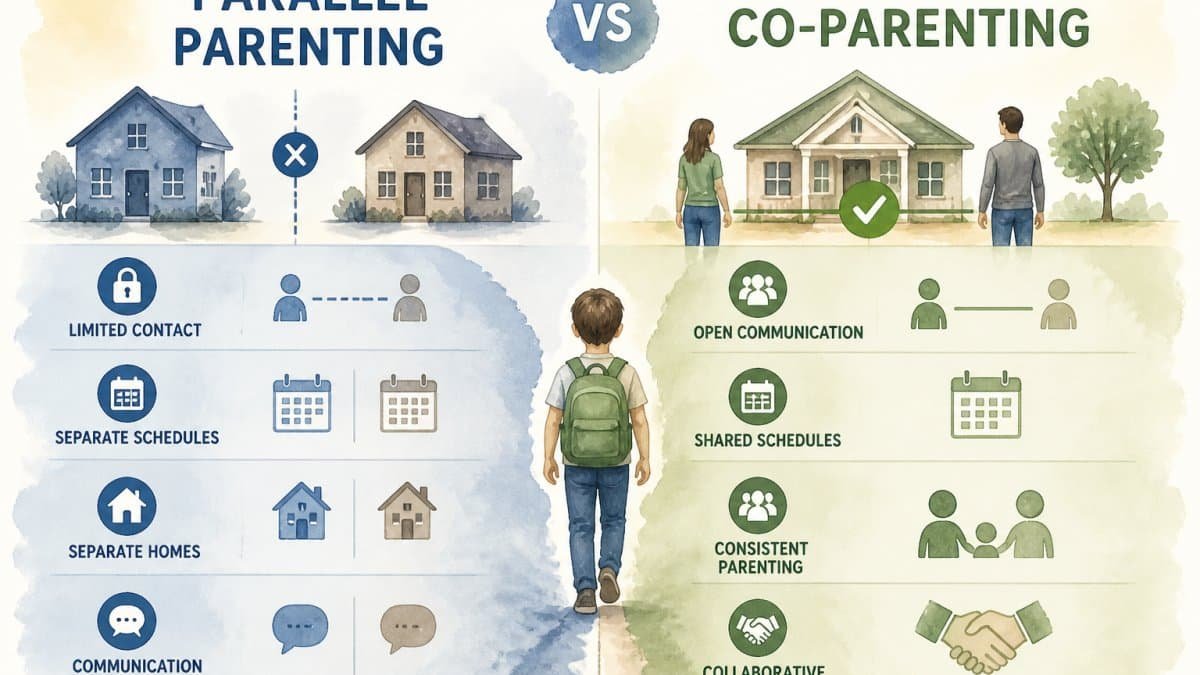
Parallel parenting vs co-parenting for custody agreements comes down to one question: how much direct contact can you and your ex realistically handle? Co-parenting is a cooperative model built on shared communication and joint decisions. Parallel parenting is a low-contact model where each parent runs their own household and conflict is managed through structure, not conversation. This guide from After the Affair Series breaks down both approaches, the scripts that make them work, and how to choose.
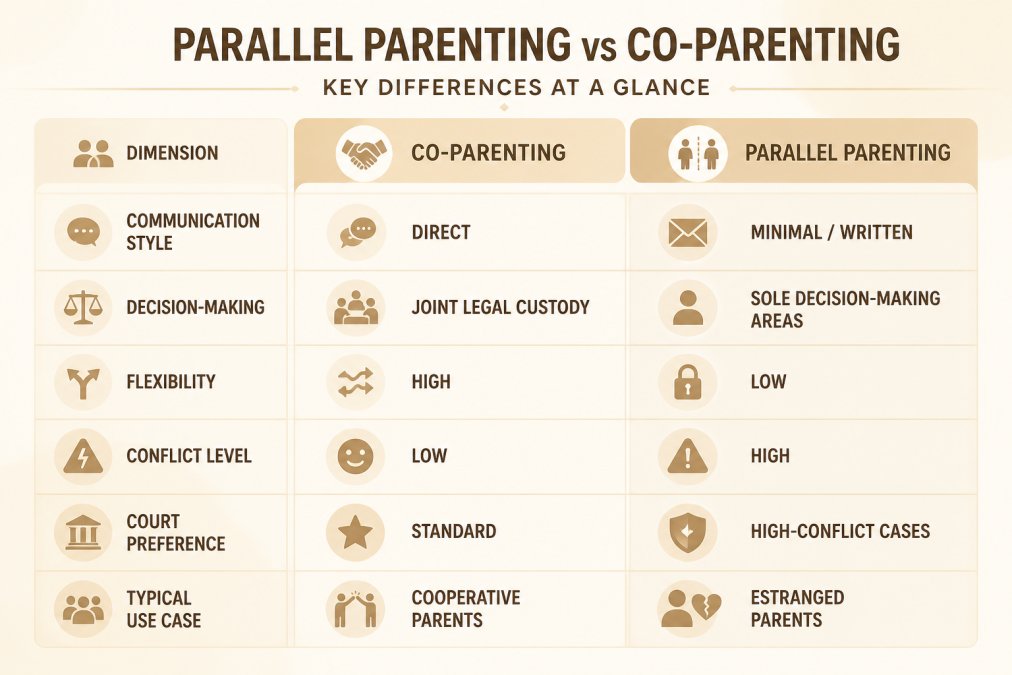
The core difference is contact level. Co-parenting requires ongoing dialogue about schedules, school, and medical care. Parallel parenting limits that dialogue to what a custody order requires, often in writing.
| Dimension | Co-Parenting | Parallel Parenting |
|---|---|---|
| Communication style | Direct, frequent, informal | Minimal, written, child-focused |
| Decision-making | Joint legal custody | Sole decision-making in defined areas |
| Flexibility | High | Low, schedule-driven |
| Conflict level | Low to moderate | High |
| Court preference | Standard custody cases | High-conflict cases |
| Typical use case | Cooperative parents | Estranged, hostile parents |
What Is Co-Parenting and When Does It Work?
Co-parenting is a custody arrangement in which both parents share decision-making and communicate regularly about their children’s daily lives. It works best when parents can separate their former relationship from their parenting roles.
Family courts generally favor cooperative parenting because it keeps both parents involved. Joint legal custody, where both parents weigh in on medical, educational, and religious decisions, is the standard outcome in most uncontested cases.
Where it falls short: co-parenting assumes a baseline of civility that many separated parents simply do not have. When communication breakdown is constant, forcing daily contact can expose children to more conflict, not less.
A common mistake is treating co-parenting as the “good” outcome and parallel parenting as the “failure.” They are tools matched to different conflict levels, not a scorecard.
What Is Parallel Parenting and Who Is It For?
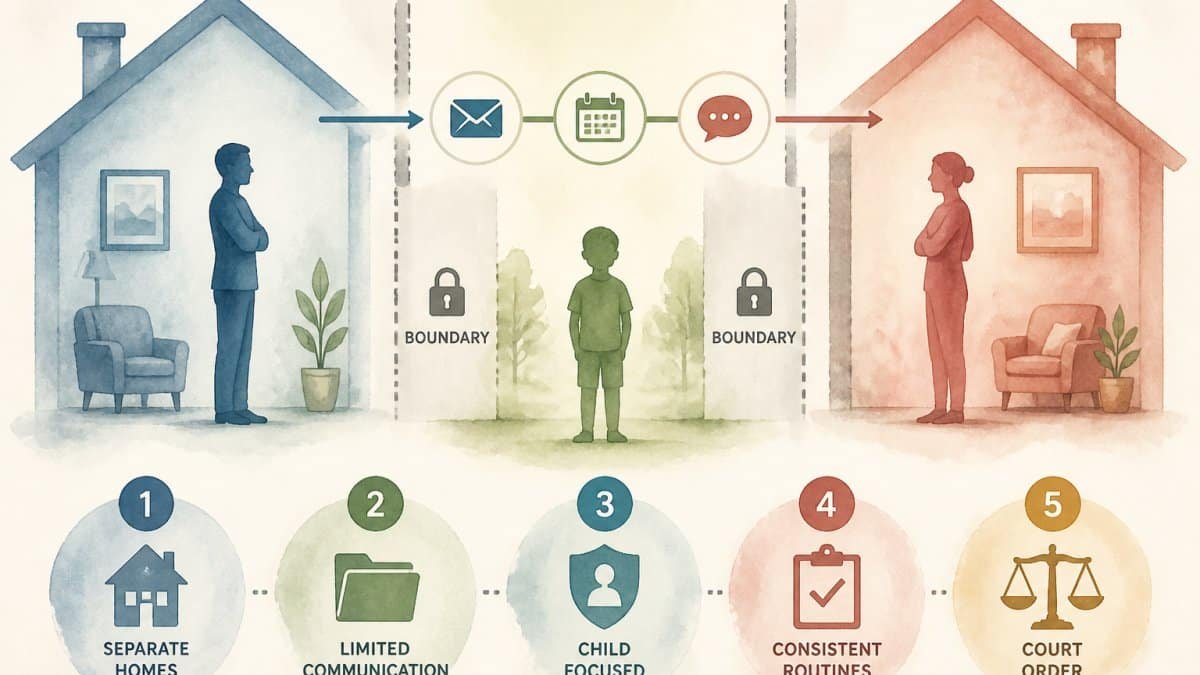
Parallel parenting is a custody structure where each parent manages their own household independently, with communication limited to logistics and handled through written channels. It is designed for high-conflict custody situations where direct contact tends to escalate.
This model suits parents dealing with hostility, unpredictable behavior, or a history of dispute resolution attempts that went nowhere. The goal is conflict reduction for the child, not reconciliation between adults.
The American Psychological Association notes that exposure to ongoing parental conflict is one of the strongest predictors of poor outcomes for children of divorce, which is why APA guidance on children and divorce emphasizes shielding kids from adult disputes. Parallel structure does exactly that by removing the daily friction points.
Parallel Parenting Communication Scripts for High-Conflict Exchanges
Written scripts work because they remove emotion from the exchange. When every message follows the same neutral format, there is less to react to and less to litigate later. The mechanism is simple: high-conflict messages tend to contain a hook, an insult, an accusation, a demand for immediate emotional response, and a scripted reply refuses to take the hook.
The BIFF framework. A widely taught approach in high-conflict co-parenting circles is BIFF: Brief, Informative, Friendly, Firm.
Brief: Two to five sentences. Anything longer reads as an argument.
Informative: Facts only, dates, times, names, dollar amounts, medical instructions.
Friendly: One neutral opener or closer. Not warmth, just civility.
Schedule change: “I need to adjust [date]. I can do [alternative date] instead. Please confirm by [day].”
Medical decision: “The pediatrician recommends [action]. I am proceeding unless you object in writing by [date].”
Behavior concern: “I observed [specific fact] on [date]. Sharing for your awareness.”
Boundary reset: “I will only respond to messages about the children. Please keep communication in writing.”
Non-response to provocation: “I will not respond to messages about [topic]. I will respond to messages about the children.”
Sending long, emotional messages gives the other parent material to use against you. Keep every written exchange short enough that it could be read aloud in court without embarrassment, and assume it will be.
Draft the reply, wait an hour, then send. The delay does more for your case than any clever phrasing, because it removes the reaction the other parent is fishing for.
High-Conflict Custody Agreement Templates: What to Include
A custody agreement template for high-conflict cases needs more detail than a standard one. Vague language creates room for disputes.
Include these clauses:
- Decision-making authority: Name which parent decides on medical, educational, and religious matters, and in what circumstances.
- Communication method: Specify the app or written channel both parents must use, and prohibit verbal-only agreements.
- Response windows: Set a deadline, such as 48 hours, for replies to time-sensitive requests.
- Exchange protocol: Define location, time, and who handles transportation for each transition.
- Modification process: State how changes get requested and confirmed in writing.
Best Practices for Parallel Parenting: Daily Routines and Boundaries
Daily routine is where parallel parenting lives or dies. Children do better when both households run predictable schedules, even if those schedules differ from each other.
What works:
- Keep bedtimes, homework rules, and screen limits similar in both homes where possible.
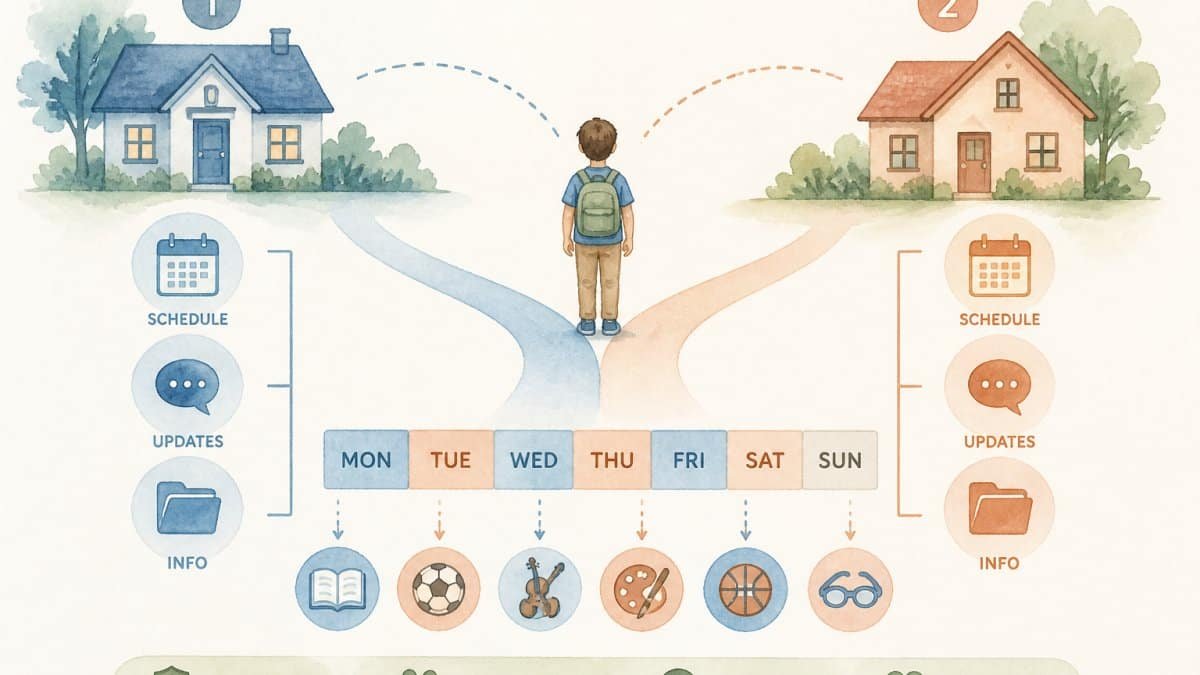
- Use a shared calendar for custody schedule transitions, appointments, and activities.
- Log all expenses in a tracking tool so reimbursement requests stay factual.
- Set one boundary rule and hold it: no discussion of the other parent in front of the children.
- Route all logistics through writing, never through a child.
The single most protective habit in parallel parenting is written-only communication. It creates a record, removes tone, and gives you time to respond instead of react.

How to Choose Between Parallel Parenting and Co-Parenting
Choose co-parenting if you and your ex can discuss logistics without conflict most of the time. Choose parallel parenting if nearly every conversation turns into a fight, if your ex is unpredictable, or if your children are showing stress around transitions.
- Repeated arguments over minor scheduling details
- One parent refusing to communicate or communicating only through hostility
- Attempts at parental alienation
- Frequent returns to family court over small issues
- Document the pattern. Keep a dated log of conflicts for 30 to 60 days, what was requested, what was said, what broke down. A judge or mediator responds to patterns, not to a single bad week.
- Pick the communication channel before you pick the words. Select one platform (OurFamilyWizard, TalkingParents, or AppClose are the common choices) and move all child-related communication there. Notify the other parent in writing that this is now the channel.
- Draft the parallel parenting clause. This is the step competitors skip. A workable clause names four things: (a) which parent holds decision-making authority over which category, medical, educational, religious, extracurricular; (b) the required communication method and a response window, typically 48 hours for non-emergencies; (c) the exchange protocol, location, time, and who transports; and (d) a modification process that requires written agreement from both parents.
- File it. If both parents agree, the clause can be added by stipulation. If not, it is raised as a motion to modify the existing custody order, and the documentation from step one becomes the exhibit.
- Set the child-facing script. Children need one consistent sentence from each parent explaining the new structure. Something like: “Mom and Dad have different houses and different rules, and both are safe.” The wording matters less than the consistency.
Conclusion
The right model is the one that lowers conflict for your children, not the one that looks best on paper. Co-parenting rewards cooperation; parallel parenting contains hostility. If your situation is genuinely high-conflict, structured scripts and written-only communication do more for your kids than forced friendliness ever will. Start with the model that matches your reality, and adjust as things change.
Frequently Asked Questions
Do judges prefer parallel parenting in high-conflict custody cases?
Family court judges often favor parallel parenting when there is documented conflict, communication breakdown, or parental alienation concerns. Courts look for arrangements that reduce conflict and protect children from ongoing hostility. A parallel parenting structure with clear boundaries, a detailed custody schedule, and minimal direct contact between parents can satisfy the court that the child’s stability is prioritized. However, judges still expect both parents to retain legal rights and parental responsibilities unless there is evidence that sole decision-making is necessary for the child’s safety.
What should be included in a high-conflict custody agreement template?
A high-conflict custody agreement template should define communication methods (such as a court-ordered communication app), decision-making authority for medical and educational planning, a detailed custody schedule with transition logistics, dispute resolution procedures, and rules for introducing new partners. It should also specify how expenses are tracked and reimbursed, and include provisions for custody modification if circumstances change. Templates work best when reviewed by a family law attorney familiar with your state’s requirements.
How do parallel parenting communication scripts help reduce conflict?
Parallel parenting communication scripts give you pre-written, neutral responses for common high-conflict exchanges. They reduce emotional reactivity by removing the need to improvise under stress. Scripts typically follow the Gray Rock Method: brief, factual, child-centered language that gives the other parent nothing to escalate against. Over time, consistent use of scripts can lower the number of hostile interactions, create a written record of your cooperative tone, and help you maintain emotional regulation during custody exchanges.
Is parallel parenting considered a permanent custody arrangement?
Parallel parenting is not automatically permanent. Many custody agreements include review periods, typically every 12 to 24 months, to assess whether the arrangement still serves the child’s best interests. If the conflict level drops and both parents demonstrate cooperative parenting, the court may approve a transition to co-parenting. Conversely, if conflict persists or worsens, the parallel structure can remain in place or be modified. The goal is always a child-centered arrangement that adapts as circumstances change.