Table of Contents
- Mediation vs Litigation: Quick Comparison
- What Mediation Is and How the Process Works
- What Litigation Is and How Court Proceedings Work
- Divorce Mediation Pros and Cons
- When to Choose Litigation in Divorce
- How Long Does Divorce Mediation Take vs Court
- High-Conflict Co-Parenting Communication Scripts and Safety Screening
- Deciding Between Mediation and Litigation: A Framework for High-Conflict Cases
- Frequently Asked Questions
Last Updated: October 18, 2026
Mediation vs Litigation: Quick Comparison
In a high-conflict divorce, understanding mediation vs litigation for high conflict divorce shapes your costs, timeline, whether your children’s needs get heard, and how much control you keep.
Mediation is a non-adversarial process where a neutral third party helps both spouses reach a settlement. Litigation is court-based, with a judge making binding decisions after hearing evidence from both sides.
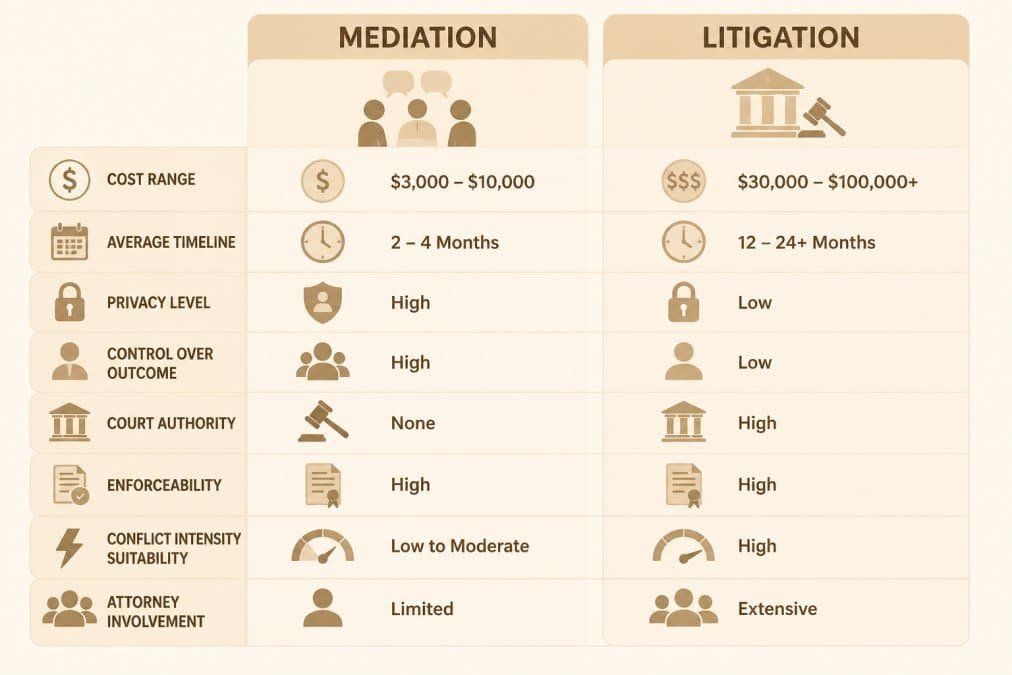
| Factor | Mediation | Litigation |
|---|---|---|
| Cost Range | $7,000-$9,000 total | Significantly higher; hourly attorney fees accumulate |
| Timeline | Weeks to months | Months to years |
| Privacy | Confidential; no public record | Public court proceedings |
| Control | Both parties decide the outcome | Judge decides for you |
| Enforceability | Requires court approval to become binding | Court orders are automatically enforceable |
| Best for | Cooperative couples; lower-conflict disputes | High-conflict, safety concerns, or impasse situations |
| Attorney Role | Optional; advisory only | Essential; represents your interests in court |
| Conflict Intensity | Works best with moderate conflict | Designed for situations where agreement is unlikely |
What Mediation Is and How the Process Works
Mediation is a structured process where a neutral mediator facilitates conversation between you and your ex-partner toward a mutually acceptable settlement.
Mediation unfolds in stages. You each meet the mediator to explain priorities, then joint sessions cover asset division, custody, support, and other contested issues.
The mediator stays neutral and doesn’t advocate for either side. They’re trained to manage emotions, reframe positions, and identify common ground, which works well when both parties can negotiate without excessive hostility.
In mediation, you retain decision-making power. If a proposal doesn’t serve your interests or your children’s welfare, you can reject it without a judge’s permission. This is the core advantage for people who want agency over their divorce settlement.
What Litigation Is and How Court Proceedings Work
Litigation is the adversarial court process where you and your ex-partner present evidence to a judge, who makes binding decisions on all contested issues.
Litigation begins when one spouse files for divorce and each side hires an attorney.
Court proceedings are public: your financial information, communications, and family dynamics become part of the public record.
The judge applies state law to your case, deciding custody based on the “best interests of the child” and dividing marital property fairly. You have no control over these decisions.
In litigation, you lose decision-making control. A judge you’ve never met before makes choices about your children’s custody, your finances, and your future. Even if you disagree with the ruling, appeals are expensive and difficult. This is why litigation is typically reserved for situations where agreement is impossible or safety is at risk.
Divorce Mediation Pros and Cons
Pros of mediation:
- Lower cost. Mediation typically costs less than litigation because attorney fees accumulate hourly and can easily exceed $15,000-$30,000 or more.
- Faster resolution. Mediation can be completed in weeks or a few months. Litigation routinely takes 12-24 months or longer.
- Privacy. Mediation is confidential; litigation filings and testimony become part of the public record.
- Control over outcomes. You and your spouse decide the settlement, not a judge’s interpretation of what’s “fair.”
- Flexibility. Mediation allows creative solutions courts cannot order, like non-standard custody schedules or tailored payment arrangements.
- Reduced conflict and preserved relationships. The collaborative, non-adversarial nature can reduce ongoing hostility and make it easier to maintain a workable relationship with your ex, critical when children are involved.
Cons of mediation:
- Requires good-faith participation. Mediation fails if one party refuses to negotiate honestly or uses the process to stall or manipulate.
- Power imbalances can undermine fairness. A more assertive, financially savvy, or controlling spouse may dominate and push through unfavorable terms.
- Not suitable for abuse situations. Mediation is dangerous when domestic violence, intimidation, or coercion exists; face-to-face meetings can re-traumatize the victim.
- No court authority to compel compliance. If your ex later refuses to follow through, enforcement is slower and more expensive than with a court order.
- Limited discovery. You may not uncover hidden assets or financial misconduct as thoroughly as in litigation’s formal discovery.
Mediation works best when both parties want to end the marriage cooperatively and are willing to negotiate in good faith. It fails when one party is unwilling to be honest, when power imbalances exist, or when safety is a concern.
When to Choose Litigation in Divorce
Choose litigation when mediation is unsafe, impossible, or inappropriate. Litigation exists because not all divorces can be resolved through negotiation.
Choose litigation when:
- Domestic violence or abuse is present. With a history of physical violence, sexual abuse, emotional abuse, or threats, mediation puts you at risk. A judge can issue protective orders without requiring you to sit across from your abuser.
- One party refuses to negotiate. If your ex won’t mediate, files for litigation, or uses mediation as a delay tactic, you must litigate.
- Serious power imbalances exist. A significantly more educated, financially savvy, or controlling spouse may dominate mediation and extract unfair concessions; a judge can apply the law to protect the vulnerable party.
- Hidden assets or financial misconduct is suspected. Litigation’s formal discovery lets you subpoena documents, depose witnesses, and uncover what your ex is hiding; mediation has no such tools.
- Complex high-asset or high-net-worth cases. Significant assets, business ownership, or complex financial structures often require litigation’s structured process and expert testimony.
- Child safety or custody disputes are severe. If your ex poses a danger to your children or custody is genuinely contested, a judge’s custody evaluation and court authority are essential.
- Your ex is mentally ill, substance-addicted, or otherwise incapable of reasonable negotiation. If good-faith mediation is impossible, litigation is the only path.
The court’s authority is both a limitation and a protection. You cannot control the outcome, but neither can your ex manipulate the process or bully you into unfair terms.

How Long Does Divorce Mediation Take vs Court
Mediation timeline:
Mediation typically takes 2-4 months, though motivated parties with straightforward issues can resolve in 6-8 weeks. Sessions usually last 1-2 hours, and most cases need 4-8 sessions.
Litigation timeline:
Litigation is far slower. A typical contested divorce takes 12-24 months from filing to final judgment, and complex cases can take 2-3 years or longer, depending on court backlog, number of disputes, discovery scope, and appeals. Here’s why:
- Discovery phase: 3-6 months of exchanging documents and depositions
- Settlement negotiations: Months of back-and-forth between attorneys
- Trial preparation: 2-4 months of preparing evidence and witnesses
- Trial itself: Anywhere from a few days to several weeks
- Post-trial motions and appeals: Additional months or years
Even if you settle during litigation (which many cases do), the process up to that point has already consumed significant time.
For high-conflict divorces, mediation’s speed advantage is substantial: you can move forward with your life months faster than litigation allows.
High-Conflict Co-Parenting Communication Scripts and Safety Screening
In a high-conflict divorce, especially one involving infidelity or ongoing hostility, communication with your ex remains essential for co-parenting, but standard communication often escalates conflict. Structured communication tools become critical.
Safety screening first:
Before choosing mediation in a high-conflict situation, screen for safety red flags:
- Has your ex ever physically threatened or harmed you or your children?
- Do you feel afraid of your ex’s reactions or behavior?
- Has your ex isolated you from friends, family, or resources?
- Does your ex use money, custody threats, or other control tactics to manipulate you?
- Is there a pattern of lying, deception, or breaking agreements?
If you answered yes to any of these, mediation is not safe. Litigation with a protective order is the appropriate path.
If you’re co-parenting after high-conflict separation:
Example Gray Rock script for a custody dispute:
“I understand you want to change the pickup time on Thursday. I can move it to 4:30 p.m. instead of 4:00 p.m. Please confirm by email by Wednesday.”
This script acknowledges their request, offers a specific solution, and sets a clear deadline, removing emotional language and avoiding argument.
Compare this to a reactive response:
“You always do this. You change plans at the last minute because you don’t respect my time. This is exactly why we can’t co-parent well.”
The reactive response invites retaliation; the Gray Rock script closes the conversation.
For high-conflict situations, After the Affair Series provides 50+ age-appropriate scripts for conversations with your children, your ex, and co-parenting logistics, removing the guesswork when emotions are high.
In high-conflict co-parenting, every communication is a potential trigger. Structured scripts remove the need to improvise under stress. They protect you and your children by keeping interactions predictable and emotionally neutral.
Deciding Between Mediation and Litigation: A Framework for High-Conflict Cases
Use this framework to determine which path fits your situation when deciding between mediation vs litigation for high conflict divorce:
Step 1: Safety screening (non-negotiable)
If abuse, violence, threats, or serious control tactics are present, stop here. Choose litigation. Mediation is unsafe.
Step 2: Assess willingness to negotiate
Can your ex mediate in good faith, disclose finances honestly, and compromise?
- If yes → proceed to Step 3
- If no → litigation is necessary
Step 3: Evaluate power balance
Is there a significant imbalance in finances, education, assertiveness, or decision-making?
- If balanced → mediation is viable
- If imbalanced → consider litigation or mediation with strong attorney support
Step 4: Assess case complexity
How many issues are contested? Are there hidden assets, business ownership, or high-net-worth concerns?
- If straightforward → mediation works
- If complex → litigation may be necessary to uncover facts
Step 5: Consider your need for control
Do you need decision-making power, or are you comfortable with a judge’s decision?
- If you need control → mediation
- If you accept a judge’s ruling → litigation is acceptable
Step 6: Evaluate timeline and cost
Can you afford months of litigation? Do you need resolution quickly?
- If cost and speed matter → mediation
- If court authority matters more than speed → litigation
The hybrid approach:
Frequently Asked Questions
Can mediation work in a high-conflict divorce with a controlling or abusive spouse?
Mediation can work in some high-conflict cases, but not all. A neutral mediator can help structure communication and create boundaries. However, if there is a history of abuse, intimidation, or serious power imbalance, mediation may not be safe or effective. Domestic violence screening is essential before choosing mediation. In these situations, litigation with court authority to enforce orders may be necessary to protect you and your children. Always consult a family law attorney about your specific circumstances before deciding.
What are the main advantages of mediation compared to litigation in a high-conflict divorce?
Mediation typically costs less than litigation because there are fewer attorney hours and no court fees. The process is faster, often resolving in weeks or months rather than a year or more. You maintain privacy, court records are public, mediation is confidential. Most importantly, you keep control over the outcome instead of letting a judge decide. Mediation also reduces ongoing conflict, which protects children from continued exposure to adversarial proceedings. For couples willing to cooperate, these benefits make mediation attractive even in moderately high-conflict situations.
How long does divorce mediation take compared to litigation?
Mediation typically takes 2 to 6 months if both parties cooperate and reach agreement. Litigation can take 1 to 3 years or longer, depending on court schedules, discovery disputes, and trial backlogs. Mediation moves faster because you control the pace and don’t wait for court dates. However, if mediation stalls due to high conflict or unresolved issues, you may shift to litigation, which then adds months or years. The timeline depends on complexity, cooperation level, and whether children or significant assets are involved.
What is the downside to divorce mediation in a high-conflict situation?
Mediation requires both parties to participate in good faith. If one spouse is hostile, refuses to disclose finances, or uses intimidation, mediation fails. A mediator cannot force compliance or make decisions, they can only guide negotiation. If abuse or severe power imbalance exists, the weaker party may agree to unfavorable terms under pressure. Mediation also produces a private agreement that is only enforceable if both parties follow it; violations require returning to court. For genuinely high-conflict cases with safety concerns or refusal to cooperate, litigation may be necessary.
Can a divorce use both mediation and litigation?
Yes. Many couples start with mediation to resolve easier issues like parenting time or asset division, then move to litigation for contested matters a judge must decide. This hybrid approach saves time and money on issues you can agree on while preserving court intervention for deadlocked disputes. Some couples also mediate successfully on some issues, fail on others, and return to litigation for the remainder. An attorney can help you structure this staged approach to avoid wasting effort or money.