TL;DR:
- Grief after infidelity can mirror PTSD, involving complex emotional and neurological trauma.
- Recovery typically spans 1 to 3 years, with six emotional stages to navigate.
- Genuine support, self-compassion, and processing are vital for healing and rebuilding trust.
Discovering a partner’s affair doesn’t just break your heart. It can shatter your entire sense of reality. Many people expect to feel sad, maybe angry, and then move on. But grief after infidelity can mirror the symptoms of post-traumatic stress disorder, making the emotional aftermath far more complex than a typical breakup. This guide breaks down the grief stages specific to infidelity, explains what makes this kind of loss uniquely devastating, and offers evidence-backed steps so you can move through the pain with clarity and self-compassion rather than confusion and shame.
Table of Contents
- Why grief after infidelity feels overwhelming
- The six stages of grief in infidelity
- Timelines and what affects your healing process
- Nuance and diversity: not everyone grieves the same
- Why honoring your grief is the real foundation for healing
- Tools and support for your infidelity grief journey
- Frequently asked questions
Key Takeaways
| Point | Details |
|---|---|
| Infidelity triggers trauma | Grief after betrayal can mirror PTSD, with overwhelming emotional and physical symptoms. |
| Grief has clear stages | Most people experience shock, denial, anger, bargaining, depression, and acceptance when processing infidelity. |
| Healing takes time | Recovery is typically 1-3 years and depends on many personal and situational factors. |
| No single way to heal | People process infidelity grief differently based on gender, coping style, and relationship context. |
| Support accelerates recovery | Guided resources and support systems can make healing smoother and more sustainable. |
Why grief after infidelity feels overwhelming
When someone you love and trust betrays you, the damage goes far deeper than hurt feelings. Betrayal fractures three things at once: your trust in your partner, your sense of safety in the relationship, and your understanding of who you are within it. That triple loss is what makes infidelity grief so disorienting. You’re not just grieving a person. You’re grieving a version of your life you believed was real.
Clinical psychologist Dennis Ortman coined the term Post-Infidelity Stress Disorder, or PISD, to describe this experience. PISD mirrors PTSD symptoms including anxiety, rage, emotional numbness, and intrusive flashbacks. This isn’t dramatic language. It’s a clinical recognition that betrayal trauma is a genuine psychological injury, not a sign that you’re being oversensitive or weak.
Common reactions in the early weeks include:
- Emotional numbing: Feeling detached or unable to process what happened
- Intrusive thoughts: Replaying scenes, conversations, or imagined moments on a loop
- Rage and emotional outbursts: Anger that feels disproportionate but is actually a survival response
- Self-doubt and shame: Questioning your worth, your judgment, and what you missed
- Physical symptoms: Sleep disruption, appetite changes, and difficulty concentrating
These aren’t personality flaws. They are trauma responses.
“The pain of infidelity isn’t just emotional. It’s neurological. Your brain is processing a threat to your survival, not just your relationship.”
The scale of this impact is significant. Research shows that 30 to 60% of betrayed partners exhibit symptoms consistent with PTSD or clinical depression, even months after the discovery. Understanding post-infidelity stress as a real condition is the first step toward treating it with the seriousness it deserves.
Knowing your healing timeline after infidelity can also help you stop measuring yourself against an impossible standard. Recovery is not linear, and the intensity of your grief is not a measure of weakness. It is a measure of how deeply you invested in something real.
Now that we’ve set the stage for just how deep the pain of infidelity can cut, let’s clarify what the grief journey looks like.
The six stages of grief in infidelity
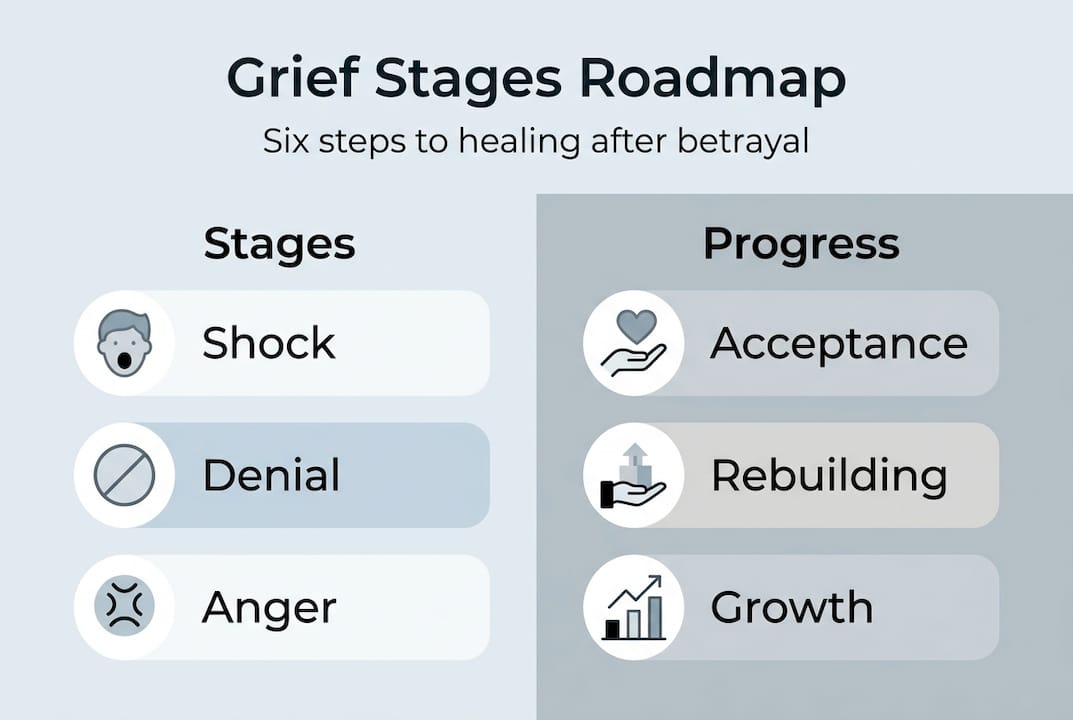
Understanding why grief after infidelity is so intense, it’s essential to get familiar with the journey’s shape. Research on grief stages in infidelity recovery identifies six distinct phases that most betrayed partners move through, though rarely in a perfect sequence.
Recovery after infidelity involves six stages of healing, each with its own emotional texture and challenges:
- Shock: The initial discovery leaves you stunned. Your mind struggles to accept what it has learned. Decision-making feels impossible.
- Denial: You may minimize what happened, rationalize your partner’s behavior, or convince yourself it wasn’t that serious.
- Anger: Rage surfaces, sometimes explosively. This is healthy and necessary, but it needs safe outlets.
- Bargaining: You search for explanations, make promises, or try to negotiate your way back to how things were.
- Depression: A deep sadness settles in as the reality of the loss becomes undeniable. This stage often feels the heaviest.
- Acceptance and reconnection: You begin integrating the experience into your identity without letting it define you. This doesn’t mean forgetting. It means finding a new footing.
Here’s a quick overview of each stage:
| Stage | Typical feelings | Common challenges |
|---|---|---|
| Shock | Disbelief, numbness | Inability to function or decide |
| Denial | Minimizing, confusion | Avoiding the full truth |
| Anger | Rage, resentment | Destructive behavior, isolation |
| Bargaining | Desperation, hope | Unrealistic expectations |
| Depression | Sadness, hopelessness | Withdrawal, self-neglect |
| Acceptance | Clarity, resolve | Fear of moving forward |
One of the most important things to understand about this healing stages guide is that you will not move through these stages in a straight line. You might feel acceptance on a Tuesday and wake up in rage on a Wednesday. That’s not regression. That’s grief doing its work.
Pro Tip: Allow yourself to cycle through stages more than once. Progress in grief is measured in overall direction, not in daily consistency. If you find yourself back in anger after a week of calm, it means you’re processing, not failing.
Now that the roadmap is clear, the next step is managing expectations about how long your grief process might take.
Timelines and what affects your healing process
One of the most common questions after betrayal is: how long will this take? The honest answer is that healing can take 1 to 3 years, with three broad phases: crisis (roughly weeks 0 to 8), processing (months 2 to 12), and rebuilding (months 12 to 36). These are averages, not deadlines.
The crisis phase is the most acute. Emotions are raw, functioning is hard, and the shock is still fresh. The processing phase is where the real grief work happens. You begin to examine what the relationship meant, what you want, and who you are outside of the betrayal. The rebuilding phase is about constructing a new identity and, if you choose, a new relationship with either your partner or yourself.
Several factors influence how quickly or slowly you move through these phases:
- Support systems: People with close friends, family, or a therapist heal faster
- Partner behavior: Whether the betraying partner takes genuine accountability matters enormously
- Personal coping style: Avoidance slows healing; active processing speeds it
- Prior trauma: Existing wounds can amplify the impact of betrayal
- Type of affair: Emotional affairs often cause more identity confusion than purely physical ones
The recovery timeline for betrayal is also shaped by obstacles that many people don’t recognize until they’re stuck in them. Continued contact with the affair partner, social isolation, and a lack of honest communication are among the most common roadblocks.
| What helps healing | What slows healing |
|---|---|
| Consistent emotional support | Isolation and secrecy |
| Partner accountability | Minimizing or gaslighting |
| Professional therapy | Avoidance of grief work |
| Clear boundaries | Continued affair contact |
| Self-compassion | Self-blame and shame |
It’s also worth noting that 30 to 60% of betrayed partners still report PTSD or depression symptoms well into the recovery process. This doesn’t mean you’re failing. It means the wound is real and the relationship healing process takes genuine time and care. Understanding why it takes time to heal can protect you from the damaging belief that you should be over this by now.
Not every grief story follows the same arc. What makes yours unique?
Nuance and diversity: not everyone grieves the same
Grief after infidelity is not one-size-fits-all. The way you process betrayal is shaped by your personality, your history, your gender, and the specific nature of what happened. Recognizing this diversity isn’t about making excuses. It’s about giving yourself permission to heal in your own way.
Research shows that men often use avoidance while women tend to favor emotional expression and support-seeking after betrayal. Neither approach is superior. Both carry risks. Avoidance can delay processing and allow unresolved pain to resurface later. Over-expression without support can become re-traumatizing. The goal is finding a middle path that keeps you moving.
Some less-discussed factors that shape your grief experience include:
- Relationship length: Longer relationships often produce more layered grief because more of your identity is intertwined
- Prior trauma: If you’ve experienced abandonment or abuse before, betrayal can activate older wounds
- Sexual vs. emotional infidelity: Emotional affairs often feel more threatening to the relationship’s foundation
- Whether children are involved: Co-parenting obligations can complicate the grieving process significantly
- The betrayer’s response: Genuine remorse versus defensiveness changes the entire emotional landscape
“Your grief doesn’t need to look like anyone else’s to be legitimate. The only measure that matters is whether you’re moving through it, not around it.”
The type of infidelity also changes the dynamic for the person who had the affair. Emotional betrayal often carries more guilt and shame for the betrayer, which can affect how they show up during the relationship growth after betrayal phase.
Pro Tip: If your way of coping looks different from your partner’s or from what you see in others, that’s not a problem to fix. It’s information to work with. Comparing your grief style to someone else’s is one of the fastest ways to feel like you’re doing it wrong when you’re actually doing it your way.
Why honoring your grief is the real foundation for healing
Here’s something that often gets lost in the rush to feel better: skipping the grief doesn’t make it go away. It stores it. People who push through betrayal without fully processing it often find themselves cycling back to the same pain months or years later, sometimes in new relationships, sometimes in old patterns, sometimes in their own bodies as anxiety or numbness.
There’s enormous pressure, from well-meaning friends, from culture, sometimes from therapists, to forgive quickly and move forward. But real-world recovery stories consistently show that lasting healing only comes when people allow themselves to fully feel and process what happened. Forgiveness, if it comes, is a byproduct of that work. It is not the starting point.
Recovery is not weakness. It is the hardest kind of strength there is. Sitting with grief, naming it, and moving through it stage by stage is what builds a foundation that actually holds. The people who try to skip ahead often find themselves rebuilding on sand.
Tools and support for your infidelity grief journey
Equipped with science, compassion, and realistic expectations, you deserve tools tailored to guide these next steps. Understanding the stages of grief is one thing. Having structured support to navigate them is another.
At After the Affair, we’ve built resources specifically for where you are right now. The infidelity recovery checklist gives you a clear, actionable starting point so you’re not just surviving each day but actually moving forward. If you want to understand the full arc of recovery, our stages of healing resource maps the journey in detail. And if you’re supporting someone else through this, the guide for healing offers professional-grade insight in accessible language. You don’t have to figure this out alone.
Frequently asked questions
How long does it take to get over infidelity?
Healing typically takes 1 to 3 years, with the crisis phase in the first few months feeling the most intense and disorienting. Individual factors like support and partner accountability can significantly shift that timeline.
Is it normal to feel like you have PTSD after betrayal?
Absolutely. Up to 60% of betrayed partners report symptoms including anxiety, intrusive thoughts, and depression, which are consistent with a clinical trauma response rather than ordinary heartbreak.
Are grief stages in infidelity the same as grief after death?
They share structural similarities, but infidelity grief involves PTSD-like symptoms layered with broken trust and identity disruption that make it distinctly more complex than grief tied to loss through death.
What helps speed up the healing process?
Support systems and partner accountability are two of the strongest predictors of faster recovery, alongside professional therapy and a willingness to actively process rather than avoid the grief.
Recommended
- Navigate stages of infidelity recovery: structured guide – After the Affair Series
- How to Guide Clients After Infidelity for Healing – After the Affair Series
- Stages of Healing – After the Affair Series
- How to process emotional trauma after infidelity – After the Affair Series