TL;DR:
- Honest, ongoing transparency after betrayal significantly increases the likelihood of couples staying together.
- True transparency involves consistent honesty coupled with vulnerability, not complete disclosure or secrecy.
- Practicing transparency through structured agreements and regular communication fosters trust and aids long-term healing.
Couples who practice honest, transparent Q&A after betrayal are almost 30% more likely to stay together than those who avoid difficult conversations. That single fact challenges one of the most common instincts after an affair: the urge to protect yourself or your partner by staying quiet. Transparency after betrayal is not about confessing every detail or performing perfect honesty. It is about creating a consistent, emotionally safe space where truth can exist without punishment. This guide explains what real transparency looks like, why it matters so deeply for healing, and how you can begin practicing it in ways that actually rebuild trust.
Table of Contents
- Defining transparency after betrayal
- Why transparency is essential for healing and trust
- Navigating power, vulnerability, and honesty
- Practical steps to build and sustain transparency
- The uncomfortable truth about transparency and forgiveness
- Your next step to lasting healing and trust
- Frequently asked questions
Key Takeaways
| Point | Details |
|---|---|
| Transparency defined | True transparency means open, ongoing honesty and the willingness to be vulnerable after betrayal. |
| Proven healing power | Couples who commit to transparency have much higher success rates in rebuilding trust and satisfaction. |
| Complex but manageable | Power dynamics, culture, and emotional hurdles make transparency challenging but achievable with guidance. |
| Actionable steps | Frameworks and specific routines can help set, maintain, and grow transparency even after setbacks. |
Defining transparency after betrayal
Transparency after betrayal means committing to open, ongoing honesty about what happened and what is happening now. It is not a one-time conversation. It is a practice, repeated daily, that signals to your partner that you are no longer hiding. Most people confuse transparency with total disclosure, but they are not the same thing.
True transparency is not about dumping every detail onto your partner in a way that overwhelms them. It is also not the same as selective truth, where you share just enough to seem honest while leaving out the parts that matter most. Secrecy and partial honesty both erode trust in the same direction, just at different speeds.
What makes transparency work is vulnerability. As research confirms, transparency replaces the need for perfection with vulnerability, and that shift is what allows real connection to return. You do not have to get it right every time. You have to keep showing up honestly.
Here is how genuine transparency compares to its common substitutes:
| Approach | What it looks like | Effect on trust |
|---|---|---|
| Real transparency | Consistent honesty, even when uncomfortable | Builds safety over time |
| Selective truth | Sharing partial facts to manage reactions | Creates ongoing suspicion |
| Over-disclosure | Sharing every detail without regard for impact | Overwhelms and destabilizes |
| Secrecy | Avoiding topics to prevent conflict | Deepens the wound |
Common misconceptions about transparency include:
- It means your partner can ask anything, anytime. Boundaries still matter. Agreements about how and when to talk protect both people.
- It only applies to the person who cheated. The betrayed partner also benefits from being honest about their pain, needs, and boundaries.
- It ends once the affair is over. Transparency is an ongoing commitment, not a phase.
“Vulnerability, not perfection, is the foundation of honest recovery. Showing up imperfectly but consistently is what actually heals.”
The emotional landscape of this process is real and complex. Fear, guilt, deep curiosity, and fragile hope all exist at the same time. Setting up transparency agreements early in recovery gives both partners a structured way to navigate those emotions without chaos.
Why transparency is essential for healing and trust
Once you understand what transparency is, the evidence for why it works becomes hard to ignore. Couples therapy has a 35 to 60 percent success rate for infidelity recovery, and healing typically takes 18 to 24 months or longer. That timeline feels long, but transparency is one of the most powerful tools for moving through it with less damage.
The numbers around honest Q&A sessions are striking. Couples who engage in transparent, structured conversations after betrayal show significantly better long-term outcomes than those who avoid them. Transparency accelerates forgiveness not because it erases pain, but because it removes the uncertainty that keeps wounds open. When you do not know what happened, your mind fills in the gaps, usually with something worse than reality.
Here is a general timeline of healing milestones when transparency is practiced consistently:
| Healing milestone | Typical timeframe | What transparency contributes |
|---|---|---|
| Restoring baseline safety | 1 to 3 months | Reduces immediate suspicion |
| Decrease in conflict frequency | 3 to 6 months | Creates shared understanding |
| Emotional openness returns | 6 to 12 months | Builds genuine intimacy |
| Trust becomes stable | 12 to 24 months | Replaces anxiety with security |
Here is why transparency works so well for healing:
- It removes the need for surveillance. When your partner is consistently honest, you stop needing to check their phone or track their location.
- It validates your experience. Being told the truth, even when it hurts, confirms that your instincts were right and that you are not imagining things.
- It creates shared accountability. Both partners become responsible for the health of the relationship going forward.
- It builds a new foundation. The relationship that exists after betrayal is not the same as the one before. Transparency is part of what makes the new version stronger.
The role of counseling in this process is significant. A skilled therapist can guide transparent conversations that might otherwise spiral into conflict. If you are wondering whether professional support is right for you, exploring the benefits of therapy after infidelity can help clarify what kind of help fits your situation.
Navigating power, vulnerability, and honesty
Transparency sounds straightforward until you factor in the real dynamics of your specific relationship. Power imbalances, cultural backgrounds, and personal histories all shape how willing or able each person is to be honest.
In some relationships, one partner holds more financial, social, or emotional power. That imbalance affects transparency in ways that are easy to miss. The less powerful partner may fear that full honesty will lead to abandonment or punishment. The more powerful partner may use selective truth to maintain control. Neither pattern supports genuine healing.
Both expressed honesty, what you actually say, and perceived honesty, what your partner believes about your sincerity, matter equally. You can say all the right things and still be perceived as dishonest if your behavior does not match your words. Consistency between words and actions is what closes that gap.
Common pitfalls that undermine transparency include:
- Answering questions technically but not emotionally, giving facts without acknowledging impact
- Becoming defensive when asked the same question more than once
- Using cultural norms around privacy as a reason to avoid difficult conversations
- Treating transparency as a performance rather than a genuine commitment
“Cultural and relational power dynamics significantly affect how forgiveness is pursued and whether genuine healing becomes possible.”
Understanding the role of boundaries helps both partners feel safer during honest conversations. Boundaries are not walls. They are agreements about how truth gets shared in a way that does not cause additional harm. For those managing co-parenting after betrayal, transparency takes on additional complexity, since honesty must be balanced with protecting children from adult conflict.
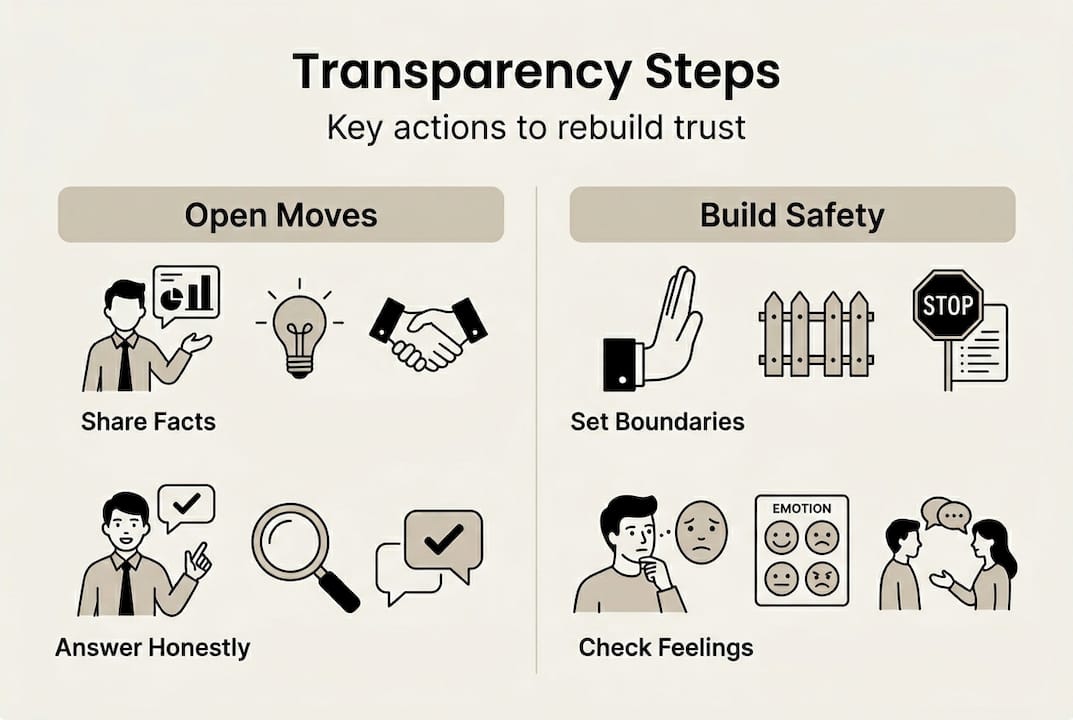
Pro Tip: Before a difficult conversation, tell your partner what you need from them. Say something like, “I need you to listen without interrupting before we talk about what this means.” That one sentence can change the entire tone of what follows.
Practical steps to build and sustain transparency
Understanding transparency is one thing. Practicing it consistently, especially when emotions are raw, is another. Here are concrete steps that make a real difference:
- Set a transparency agreement early. Decide together what honesty looks like in your relationship right now. What questions are fair? What topics need boundaries? Writing it down removes ambiguity. You can use structured transparency agreements as a starting point.
- Schedule regular Q&A time. Spontaneous conversations about the affair often happen at the worst moments, when someone is tired, stressed, or already defensive. Setting aside dedicated time, even 20 minutes a week, creates a safer container for honesty.
- Answer with intent, not just facts. When your partner asks a question, answer the emotional reality behind it, not just the surface detail. “Where were you?” is often really asking, “Can I trust you?”
- Track consistency over time. Trust rebuilds through repeated small moments of honesty, not grand gestures. Notice and acknowledge when your partner follows through.
- Address setbacks without abandoning the process. Slipping back into avoidance or defensiveness is normal. What matters is returning to the commitment quickly. Transparent Q&A sessions significantly improve long-term outcomes, but only when they are maintained through setbacks, not just during calm periods.
Using trust-building exercises alongside honest conversations creates a more complete recovery process. If you are supporting someone else through this, resources on guiding clients after infidelity offer a professional framework. And if you are unsure whether to pursue individual or couples therapy, both have distinct benefits depending on where you are in the process.
Pro Tip: If conversations keep escalating into arguments, bring in a neutral third party before the pattern becomes entrenched. A therapist or trained counselor can facilitate the kind of honest exchange that is too charged to manage alone.

The uncomfortable truth about transparency and forgiveness
Here is what most guides on this topic will not tell you: transparency is not a magic fix, and it is not always comfortable. It is ongoing, sometimes painful work that asks both partners to keep choosing honesty even when it would be easier to go quiet.
We have seen couples grow profoundly stronger through this process. We have also seen couples who did everything right and still chose to part ways. Both outcomes are valid. What they share is that courageous honesty made the outcome real, rather than a performance of recovery.
The couples who struggle most are not the ones who fight. They are the ones who choose half-truths to avoid short-term discomfort. That choice feels protective in the moment, but it delays genuine intimacy indefinitely. Quick fixes and partial honesty do not heal the wound. They just cover it.
Real relationship growth after infidelity requires accepting that the path forward is not linear and that some conversations will need to happen more than once. That is not failure. That is how deep healing actually works.
Your next step to lasting healing and trust
If this article has clarified what transparency really means and why it matters, the next step is putting it into practice in a structured way.
Start with the infidelity recovery checklist, a step-by-step resource designed to help you set up transparency agreements, track healing milestones, and avoid the most common pitfalls. For deeper guidance on healing and trust-building, the site offers evidence-informed frameworks built specifically for where you are right now. You do not have to figure this out alone. The full resource library at AfterTheAffair.uk covers every stage of recovery with the kind of depth and compassion that makes a real difference.
Frequently asked questions
How long does it take to rebuild trust after betrayal with transparency?
Most couples need 18 to 24 months or longer to fully heal, even with consistent transparency, though individual timelines vary based on the nature of the betrayal and the commitment of both partners.
Can transparency guarantee forgiveness or staying together?
No guarantee exists, but 86% of couples who practice transparent Q&A stay together compared to 59% who do not, making it one of the strongest predictors of reconciliation.
What should transparency look like day-to-day?
Daily transparency means giving honest updates, having open conversations about feelings, and answering questions with genuine intent, since expressed honesty consistently strengthens relationship satisfaction over time.
Does transparency only matter immediately after betrayal?
Transparency remains essential throughout the entire healing process, not just in the early weeks, because trust is rebuilt through sustained honesty over months and years, not a single conversation.
Recommended
- Relationship Healing Process – After the Affair Series
- Relationship Growth After Infidelity – After the Affair Series
- Step-by-step betrayal recovery: healing trust in 2026 – After the Affair Series
- Rebuilding Trust Timeline – After the Affair Series
- Rebuilding trust after cheating: a 2026 Canadian guide
- How to Communicate in Recovery for Stronger Relationships | Glendora Recovery Center