TL;DR:
- Guilt after infidelity is an overwhelming but temporary signal that can be transformed into meaningful recovery. Processing guilt requires external support, honest self-reflection, and differentiated focus between guilt and remorse for genuine healing. Sustained behavioral change and structured transparency foster long-term trust and relationship repair.
Knowing how to process guilt after infidelity may be one of the hardest emotional challenges you will ever face. The guilt doesn’t arrive neatly. It floods in at unexpected moments, tightens your chest at 2 a.m., and makes you question everything you thought you knew about yourself. What you’re feeling is real, and it’s complex. But guilt, as overwhelming as it feels right now, is not a permanent state. It’s a signal. And with the right tools, the right support, and the kind of honest self-examination that most people avoid, you can move through it toward something more livable.
- Key takeaways
- How to process guilt after infidelity: guilt vs. remorse
- Preparing emotionally: acknowledging what happened
- Executing healthy guilt processing: steps and techniques
- Recognizing healing signs and avoiding common pitfalls
- Maintaining long-term growth after infidelity
- My perspective on guilt after infidelity
- FAQ
Key takeaways
| Point | Details |
|---|---|
| Guilt differs from remorse | Guilt centers on your own discomfort, while remorse shifts focus to your partner’s pain and drives real repair. |
| External support is non-negotiable | Processing guilt through your betrayed partner adds to their burden; seek a therapist, counselor, or trusted friend instead. |
| EMDR therapy targets stuck guilt | Trauma-informed approaches like EMDR reduce fear-based beliefs and break the cycle of rumination after infidelity. |
| Transparency needs boundaries | Structured, time-bound agreements rebuild safety without turning into surveillance that keeps both of you in fear. |
| Healing is incremental | Progress looks like softening intensity, growing self-forgiveness, and sustained behavioral change over weeks and months. |
How to process guilt after infidelity: guilt vs. remorse
Most people use guilt and remorse interchangeably after an affair. They are not the same, and that distinction will shape everything about how you heal.
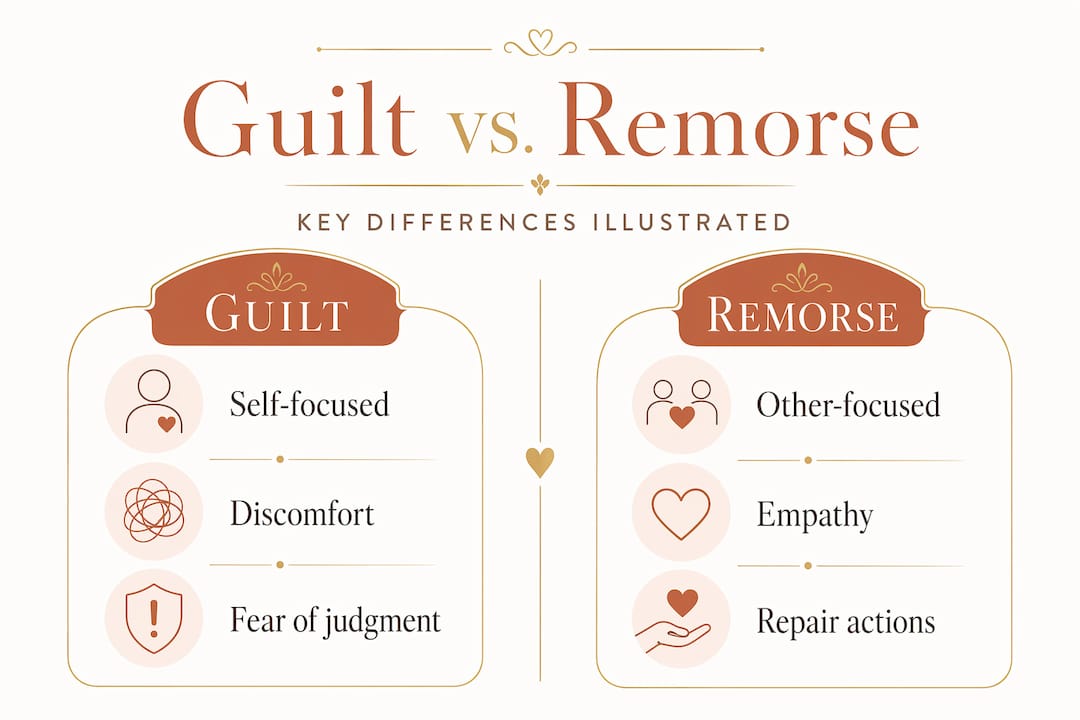
Guilt is self-focused. It centers on your discomfort, your fear of judgment, your dread of consequences. When you’re stuck in guilt, the internal loop sounds like: “I’m a terrible person,” “I can’t live with what I did,” or “I don’t deserve to be happy.” That loop keeps the spotlight on you, not on the person you hurt.
Remorse operates differently. Remorse involves sustained empathy, specific apologies that acknowledge the harm caused, and a genuine commitment to behavioral change. Where guilt says “I feel awful,” remorse says “I understand how much pain I caused you, and I’m going to show you through my actions that I take this seriously.”
Here’s why this matters practically:
- Guilt alone often produces superficial apologies, defensive reactions, and an unconscious desire for your partner to comfort you.
- Remorse produces accountability, patience, and the willingness to sit with your partner’s pain without rushing them to forgive you.
| Guilt | Remorse |
|---|---|
| Self-focused (“I feel terrible”) | Other-focused (“I hurt you deeply”) |
| Driven by fear and shame | Driven by empathy and accountability |
| Often leads to avoidance or pleading | Leads to sustained behavioral change |
| Can stall healing for both partners | Supports genuine relationship repair |
The goal of processing guilt is not to eliminate it, but to transform it into something productive. That transformation starts with remorse. Guilt alone doesn’t repair a relationship. Remorse does.
Preparing emotionally: acknowledging what happened
Before you can do the work of processing guilt, you have to be honest about the defenses you’re running. Denial, minimization, and blame-shifting are the most common ones. Minimizing sounds like “It wasn’t that serious” or “It only happened a few times.” Blame-shifting sounds like “Things between us weren’t good anyway.” Both are forms of self-protection that block genuine accountability, and both will stall your healing.
Here’s a step-by-step approach to prepare yourself emotionally:
- Write out what happened without excuses. Not to share with your partner, but to face it yourself. Raw, unfiltered honesty on paper is harder than it sounds.
- Identify your defenses. Notice when you catch yourself minimizing or rationalizing. Label it. “That’s a defense.” Then set it aside.
- Step away when activated. Christine Olsen recommends stepping away from conversations when emotionally flooded. You cannot do accountability work when your nervous system is in panic mode.
- Find external support. Lean on a therapist, a counselor, or a trusted friend who can hold space for your guilt without being harmed by it.
- Schedule guilt breaks. Set aside 20 minutes a day to sit with your guilt intentionally, then close it. This prevents guilt from bleeding into every conversation and every moment.
Pro Tip: Do not use your betrayed partner as your primary support for processing guilt. Pushing guilt onto your partner adds emotional burden to someone already in pain. Keep guilt processing and relationship repair as separate tracks.
The distinction between processing guilt independently and doing relational repair work together is one of the most underrated insights in infidelity recovery. Mixing those two tracks creates role confusion, which hurts both of you.
Executing healthy guilt processing: steps and techniques
Once you’ve acknowledged what happened and identified your defenses, you can begin the active work. This is where coping with infidelity guilt moves from survival mode into real healing.
Journaling and self-reflection are foundational. Writing gives structure to emotions that feel chaotic. Ask yourself: What need was I trying to meet? What values did I violate? What do I want to be true about me going forward? These aren’t easy questions, and the answers often take weeks to clarify. That’s fine. The process matters more than quick resolution.
EMDR therapy deserves specific attention. EMDR helps reduce shame and fear-based beliefs that interfere with recovery. When guilt becomes stuck, it often isn’t just an emotion but a belief, something like “I am fundamentally a bad person.” EMDR works directly on that belief at the neurological level, shifting intrusive guilt without erasing accountability. You can learn more about how this works through Aftertheaffair’s overview of therapy benefits post-infidelity.
Pro Tip: If traditional talk therapy feels like you’re going in circles, EMDR may be the missing piece. EMDR addresses trauma-related urgency and defensive behaviors that keep couples stuck before they can even begin repair conversations.
On the practical side, rebuilding trust requires structure. A transparency agreement with clear rules about sharing passwords, check-in schedules, and contact with the affair partner supports healing far better than open-ended monitoring. The key elements of an effective transparency plan look like this:
| Element | What it means in practice |
|---|---|
| Clear rules | Both partners agree in writing on what will be shared and how |
| Time-bound | The agreement has an expiration date for review, not endless surveillance |
| Boundaries | Includes what crosses into compulsive checking vs. reasonable accountability |
| Consistency | Regular scheduled check-ins replace reactive, fear-driven requests |
Transparency works best as a bridge, not a permanent state of monitoring. When it becomes surveillance, it keeps both partners in fear rather than rebuilding safety. You can find practical guidance on structuring these agreements through Aftertheaffair’s resource on post-affair boundaries.
Recognizing healing signs and avoiding common pitfalls
Overcoming guilt after cheating is not linear, and knowing what progress actually looks like will help you stay oriented.
Signs that your guilt processing is working:
- The intensity of guilt is softening. You’re no longer consumed by it every waking hour.
- You’re thinking more about your partner’s experience and less about your own discomfort.
- You can receive your partner’s pain without becoming defensive or shutting down.
- Sustained behavioral efforts are becoming natural rather than forced. Over weeks and months, honesty and empathy feel less like a performance.
- You’re developing genuine self-forgiveness without bypassing accountability.
The traps that derail progress are just as important to understand. Watch for these patterns:
- Overwhelming your partner with your guilt. If every conversation becomes about how bad you feel, you have reversed the emotional burden.
- Emotional role reversal. This happens when the person who cheated becomes so visibly distressed that their partner ends up comforting them. It’s a subtle but damaging dynamic.
- Impatience with recovery time. Repair is incremental and requires balancing responsibility, self-compassion, and emotional availability. Expecting your partner to be “over it” in weeks is unrealistic and signals that your guilt is still self-focused.
- Using apologies as pressure. Repeated apologies that seem designed to produce forgiveness are a form of emotional manipulation, even if unintentional.
Managing feelings of guilt well means sitting with discomfort without seeking rapid relief through your partner’s absolution.

Maintaining long-term growth after infidelity
Moving forward after infidelity requires a shift from internal emotional work to consistent external actions. The feelings matter, but your behavior over months and years is what rebuilds a relationship.
Long-term healing involves several sustained commitments:
- Maintain honesty without being prompted. Volunteering information before your partner asks demonstrates that transparency is a value, not a strategy.
- Continue individual therapy even when things feel better. Growth plateaus when support stops.
- Engage in couples therapy to create a shared narrative about what happened and what kind of relationship you’re building now.
- Revisit your transparency agreement at the agreed intervals and adjust it collaboratively as trust rebuilds.
- Read, learn, and stay self-aware. Self-forgiveness after infidelity grows when you understand the psychology of why the affair happened, not just that it happened.
Restoring trust after cheating is a long-term process, not a single conversation or grand gesture. The unfaithful partner’s job is to be reliably, quietly present, month after month, even when it feels thankless. That sustained presence is what eventually makes trust credible again.
My perspective on guilt after infidelity
I’ve worked with a lot of people who come in expecting guilt to be a problem they can solve quickly. They want a framework, a plan, a way to feel like themselves again within a few weeks. What I’ve learned, over and over, is that the urgency to escape guilt is itself part of the problem.
The people I’ve seen make the most meaningful progress are the ones who got honest about something uncomfortable: their guilt was largely about themselves. Not about their partner’s pain. When that clicked, something shifted. The work became less about managing a feeling and more about actually becoming accountable.
Superficial apologies and quick transparency gestures rarely hold. What works is slow, unglamorous consistency: showing up, telling the truth, staying present in your partner’s pain without making it about you. In my experience, professional support isn’t optional when the guilt is deep or the nervous system is dysregulated. EMDR in particular changes what talk therapy often can’t reach.
The most honest thing I can tell you is this: healing from guilt after infidelity is not about feeling better. It’s about being better. The feelings follow, eventually. But they follow the behavior, not the other way around.
— Silviya
Ready to take the next step in your healing?
If this article resonated, you’re already doing something right. Seeking understanding is the first step toward doing something about it. Aftertheaffair has created structured, evidence-informed resources specifically for people at exactly this stage of recovery.
The 7 Steps Infidelity Recovery Checklist is one of the most practical tools available for anyone working through guilt and trying to understand what genuine repair looks like. For those focused on rebuilding the relationship itself, Aftertheaffair’s relationship growth resources offer structured guidance on rebuilding trust at every stage. You don’t have to figure this out alone, and you don’t have to start from zero.
FAQ
What is the difference between guilt and remorse after cheating?
Guilt focuses on your own discomfort and fear, while remorse focuses on your partner’s pain and motivates sustained accountability and behavioral change. Only remorse supports genuine relationship repair.
How do I process guilt without burdening my partner?
Seek external support through a therapist, counselor, or support group, and keep your guilt processing separate from your shared repair work with your partner. Pushing guilt onto the betrayed partner adds to their emotional burden.
How long does it take to overcome guilt after infidelity?
There is no fixed timeline. Meaningful progress typically involves softening intensity and growing remorse over weeks to months, with sustained behavioral change as the clearest marker of healing.
Can EMDR therapy help with infidelity guilt?
Yes. EMDR reduces shame, fear-based beliefs, and intrusive guilt that can become stuck in the nervous system after infidelity. It creates space for reflection without erasing accountability.
What does healthy transparency look like after an affair?
A structured, time-bound transparency agreement with clear rules about sharing information and scheduled check-ins rebuilds safety far more effectively than open-ended monitoring or compulsive checking behaviors.
Recommended
- How to Guide Clients After Infidelity for Healing – After the Affair Series
- Forgiving after cheating steps: A guide to healing and trust
- Understanding forgiveness after an affair: healing guide – After the Affair Series
- How to Cope After Infidelity – After the Affair Series