TL;DR:
- Recovery from infidelity takes 12 to 24 months or longer, not just time alone.
- A true stall is marked by no progress after 18 to 24 months, needing outside help.
- Honest self-assessment and professional intervention can restart healing even after prolonged stalls.
Recovery from infidelity is rarely a straight line, and the idea that time alone will heal betrayal trauma is one of the most damaging myths out there. Research shows that acute crisis lasts 0 to 3 months, emotional processing runs from 3 to 12 months, and true integration takes 12 to 24 months or longer. When no meaningful progress appears after 18 to 24 months, that silence is a signal, not just a rough patch. Understanding the difference between a temporary setback and a permanent stall could be the most important distinction you make in your recovery. This article will help you recognize the signs, understand the stages, and know exactly what to do next in your journey of healing from infidelity.
Table of Contents
- Understanding the stages of recovery after infidelity
- Red flags that indicate your recovery may be stalled
- How permanent stalls are different from normal setbacks
- What to do if you suspect permanent stalling in your recovery
- Why honest self-assessment is key and what most people get wrong
- How After the Affair Series can help restart your recovery
- Frequently asked questions
Key Takeaways
| Point | Details |
|---|---|
| Benchmarks matter | Most people progress through acute crisis, processing, and integration stages, but stalling after 18-24 months is a critical warning sign. |
| Know the red flags | Persistent emotional pain, no relational change, and the absence of new coping skills signal a permanent stall. |
| Differentiate setbacks | Not all slowdowns are permanent—compare your recovery markers against researched benchmarks. |
| Take proactive steps | If you detect a stall, honest self-assessment and seeking targeted help are essential for reigniting recovery. |
Understanding the stages of recovery after infidelity
Recovery does not happen randomly. It follows recognizable phases, and knowing what each one looks like gives you a way to measure where you are. Think of it less like a calendar and more like emotional terrain you have to actually cross, not just survive.
| Stage | Typical timeline | Signs of progress |
|---|---|---|
| Acute crisis | 0 to 3 months | Emotional stabilization, reduced panic |
| Processing | 3 to 12 months | Grief decreasing, anger becoming manageable |
| Integration | 12 to 24+ months | Acceptance growing, identity rebuilding |
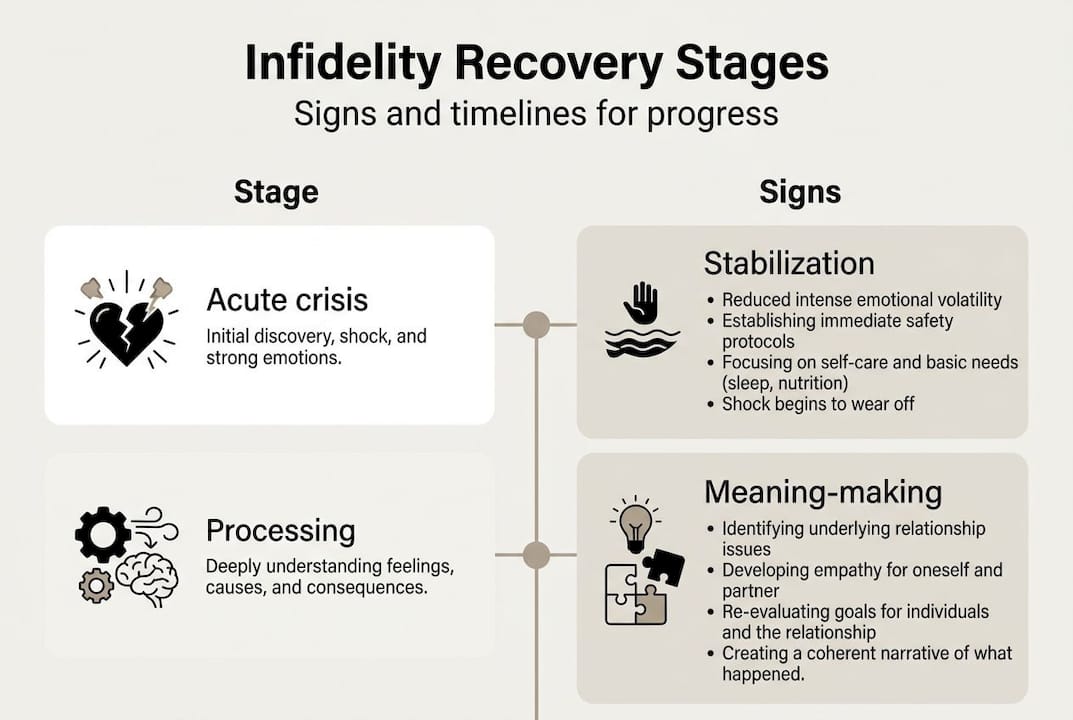
During the acute crisis stage, your nervous system is in overdrive. Progress here looks like sleeping more than two hours at a stretch, eating regularly, and finding even five minutes of calm in a day. These feel small, but they are real movement.
The processing stage is where most of the emotional heavy lifting happens. You start to make meaning out of what occurred. Flashbacks and intrusive thoughts become less frequent. You may still have terrible days, but they are no longer every day. The healing stages after an affair are rarely clean, but you can still track direction even when the pace is uneven.
The integration stage is when you begin to absorb the experience into your broader life story without it consuming you. You may not forgive, and you may not reconcile, but you develop a sense of who you are now, separate from what was done to you. That is genuine healing.
Here are key milestones to watch for across all three stages:
- Reduced frequency of intrusive thoughts about the betrayal
- Ability to make decisions without constant emotional flooding
- Sense of personal identity returning or strengthening
- Capacity to feel joy or connection, even briefly
- Clearer sense of your values and what you want going forward
Pro Tip: Patience in recovery is active, not passive. Patience means continuing to do the work even when results are slow. Passivity means waiting for healing to arrive on its own. Only one of these actually moves you forward.
Red flags that indicate your recovery may be stalled
Knowing the stages is helpful, but spotting when your healing may be stuck is just as important. A slow recovery and a stalled one are not the same thing, and confusing them can cost you years of unnecessary pain.
Slow progress still shows movement. You might have a terrible month followed by three decent weeks. That is not a stall. That is recovery being hard. A true stall means no meaningful emotional, relational, or personal shift in a sustained period. When no progress appears after 18 to 24 months, the likelihood of a permanent stall without intervention rises significantly.
Here are the most telling warning signs to watch for:
- You feel exactly the same emotionally as you did 12 or 18 months ago
- Triggers are just as intense and frequent as they were in the early months
- You have stopped trying to understand what happened and why
- You feel numb rather than sad, or permanently angry rather than intermittently so
- Relationships, including friendships, feel impossible or pointless
- You have given up on imagining a future that feels good
- You engage in avoidance behaviors and call it “moving on”
Statistic to know: Research indicates that when recovery shows no positive change beyond the 18 to 24 month mark, it is likely that healing has stalled permanently without some form of outside intervention.
One of the most important distinctions in recognizing a stall is understanding the difference between coping and healing. Coping keeps you functional. Healing changes how you feel and think about what happened. Many people stay in coping mode for years and mistake it for recovery because they are not falling apart. But if nothing is actually changing internally, staying functional is not the same as getting better.
If the warning signs above sound familiar, exploring tips for emotional healing can help you assess what is missing from your current approach.
Pro Tip: Ask yourself honestly: “Has anything genuinely shifted in how I feel about this over the last six months?” If the answer is no, that is worth paying serious attention to, especially if you are processing emotional trauma without structured support.
How permanent stalls are different from normal setbacks
Spotting a stall is only half the battle. You also need to know how to tell the difference between a lasting stall and a temporary bump, because they require very different responses.
| Feature | Temporary setback | Permanent stall |
|---|---|---|
| Duration | Days to weeks | Months to years |
| Emotional response | Fluctuating, still reactive | Flat, numb, or rigidly stuck |
| Adaptability | Returns after the hard moment passes | Absent, nothing shifts |
| Trigger intensity | Gradually decreasing over time | Unchanged or worsening |
| Sense of future | Flickering but present | Absent or bleak |
A temporary setback might hit you hard on an anniversary, after seeing a mutual friend, or during a stressful life event. It feels awful in the moment, but it passes. You recover back to your baseline, and that baseline itself continues to improve over time. That is the signal that you are still healing.
A permanent stall does not recover back to a baseline because the baseline itself has not changed. You are not going through waves. You are sitting in still water.
“When no meaningful improvement occurs beyond 18 to 24 months despite ongoing effort, the evidence strongly suggests that external intervention is needed to restart the healing process.” Based on empirical recovery benchmarks.
If you fear you may be stalled, here are concrete steps to take right now:
- Write an honest assessment of where you were emotionally 12 months ago versus today
- List three specific ways your thinking about the betrayal has or has not changed
- Identify whether you are coping or actively healing
- Reach out to one trusted person and share your honest assessment
- Consider whether your current support structure is actually helping you grow
Looking at steps for emotional affair recovery can also help you evaluate whether your approach needs to shift.
What to do if you suspect permanent stalling in your recovery
So what can you actually do if you are seeing the signs that your recovery is stuck? The good news is that a stall is not a dead end. It is a signal that what you have been doing is not enough, and that means something different is needed, not that healing is impossible.
Here are the steps to take if you believe your recovery has stalled:
- Acknowledge the stall without judgment. Recognizing that you are stuck is not failure. It is the first act of genuine self-awareness in a long time.
- Conduct a structured self-review. Look back at the past 12 months and identify what has and has not changed in your emotional life.
- Identify gaps in your support. Are you working with a therapist? Have you only relied on self-help or friends? Gaps in structured support are a common reason stalls persist.
- Seek professional help. A therapist trained in betrayal trauma or infidelity recovery can introduce interventions you have not tried.
- Build or revise your recovery plan. Healing needs structure. If you do not have a plan, build one. If your plan is not working, change it.
Here are signs that professional support is specifically needed:
- Suicidal thoughts or self-harm behaviors at any point
- Inability to function at work or care for children
- Substance use as a primary coping tool
- Complete emotional shutdown with no sign of returning
If you are not sure where to start, the guide for healing after infidelity offers structured frameworks. The healing together guide is especially useful if your stall is relational as much as personal.
Pro Tip: Hope is not passive. Acting on hope, even when it feels hollow, is what separates people who restart their healing from people who stay stuck. When no progress appears after 18 to 24 months, waiting longer without intervention is not resilience. It is avoidance dressed up as patience.
Why honest self-assessment is key and what most people get wrong
Here is the uncomfortable truth most resources will not say directly: the biggest barrier to restarting stalled recovery is not lack of information or access to therapy. It is the stories we tell ourselves to avoid admitting we are not getting better.
“I’m just taking it one day at a time.” “I’ve accepted it and moved on.” “I don’t need to talk about it anymore.” These statements can be genuine signs of growth or they can be protective narratives that stop real progress in its tracks. The difference is whether your inner life has actually changed or whether you have just gotten better at not showing it.
Facing the reality of a stall takes courage. It means admitting that time has not healed this wound on its own, and that vulnerability is deeply uncomfortable for most people. But it is also an act of self-respect. You are saying: I deserve more than this, and I am going to do something about it.
Outside support, whether from a skilled therapist, a structured program, or trusted resources like emotional healing tips, changes the equation. You stop being the only one evaluating your own progress, and that outside perspective is often what breaks the cycle of self-deception that keeps stalls in place.
How After the Affair Series can help restart your recovery
If the signs in this article feel familiar, you do not have to figure out your next step alone.
The After the Affair Series was built specifically for people who are past the early crisis but still feel stuck. It offers structured, evidence-informed tools including an infidelity recovery checklist that helps you identify exactly where you are and what is missing. Resources covering relationship growth after infidelity give you a clear path forward whether you are healing alone or with a partner. And if you need a refresher on where you should be in the process, revisiting the stages of healing can ground your self-assessment in real benchmarks.
Frequently asked questions
What is a permanent stall in infidelity recovery?
A permanent stall is when emotional healing stops for more than 18 to 24 months with no meaningful progress, even when effort has been made. It is different from slow healing because no improvement occurs at all.
How can I tell if my recovery is just slow or actually stalled?
Slow recovery still shows occasional improvement over time, even if the pace is frustrating. If you see no emotional improvement after 18 to 24 months, that pattern points to a stall rather than slow progress.
What should I do if I suspect my recovery is stuck?
Start with honest self-reflection, then identify gaps in your support structure, and use structured resources to regain momentum. Waiting longer without changing your approach after 18 to 24 months rarely produces different results on its own.
Can recovery from infidelity restart after a permanent stall?
Yes. Even when healing has been stuck for years, targeted intervention and new frameworks can break the cycle. Evidence shows that intervention, not time alone, is what restarts progress after a stall.