TL;DR:
- Up to 70% of couples recover with professional support after infidelity, and growth is possible.
- Posttraumatic growth involves meaningful change, such as increased resilience and deeper relationships.
- Genuine healing requires active effort, self-awareness, setting boundaries, and personalized meaning-making.
Up to 70% of couples recover with the right professional support after infidelity, yet many people assume healing or personal transformation is simply out of reach. That assumption is worth questioning. Betrayal is devastating, but it does not have to be the end of your story. Posttraumatic growth (PTG), a psychological term for the positive change that can emerge from severe adversity, is a real and documented outcome for people navigating life after an affair. This article walks you through what PTG actually looks like, how to move from raw pain toward real transformation, and the practical steps you can start taking today.
Key Takeaways
| Point | Details |
|---|---|
| PTG is possible | Most people can experience positive growth after infidelity with intentional effort. |
| Forgiveness matters | True forgiveness is a strong predictor of long-term healing and transformation. |
| Emotional work is essential | Acknowledging pain and addressing trauma are necessary for moving from hurt to growth. |
| Recovery isn’t one-size-fits-all | Healing pathways differ, and both solo and partnered journeys can foster personal development. |
What is personal growth after an affair?
Personal growth after an affair is not the same as pretending it never happened or simply “moving on.” Posttraumatic growth, first described by psychologists Richard Tedeschi and Lawrence Calhoun, refers to meaningful psychological change that arises directly because of the struggle, not despite it. It shows up as new personal strengths, reshaped priorities, deeper relationships, or a clearer sense of who you are and what you value.
Research confirms that PTG arises from relational violations rather than self-blame, meaning the path forward is built on processing what was done to you, not punishing yourself for it. Understanding the infidelity effects and anxiety that follow betrayal is a critical starting point because you cannot grow past what you have not acknowledged.
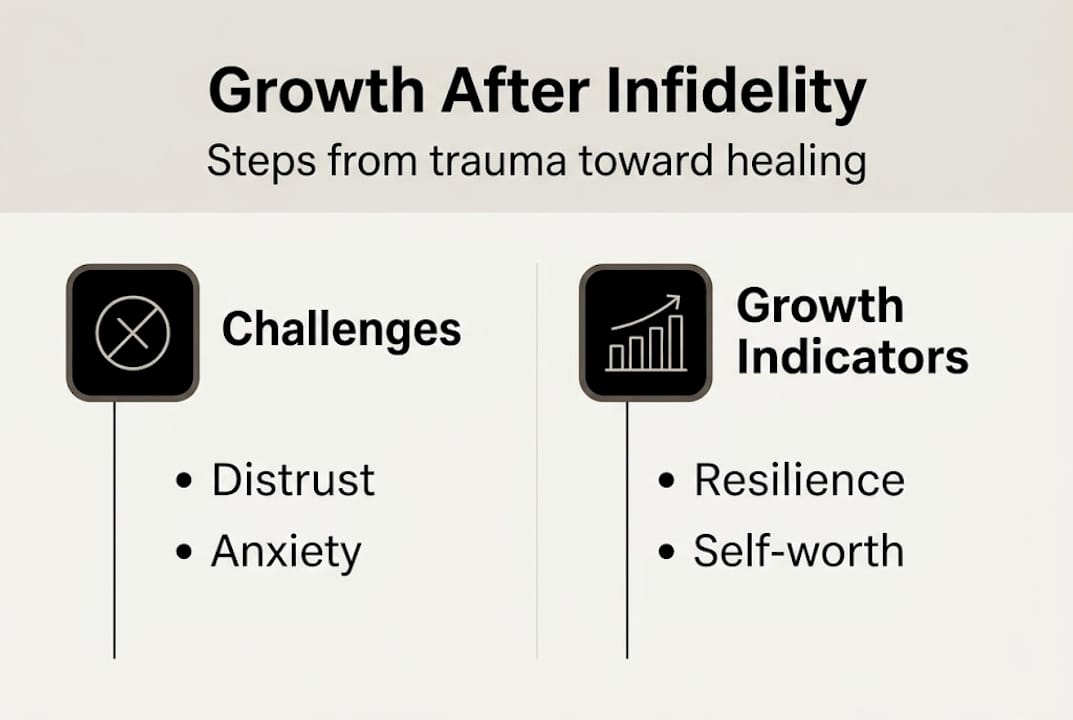
It also helps to look honestly at the long-term effects of infidelity, since surface-level recovery and genuine transformation look very different over time. True growth requires sitting with discomfort, not bypassing it.
Common PTG indicators, challenges, and outcomes
| PTG indicator | Common challenge | Reported outcome |
|---|---|---|
| Increased personal strength | Fear of vulnerability | Greater resilience |
| Deeper relationships | Difficulty trusting again | More authentic bonds |
| New possibilities | Uncertainty about identity | Clearer life direction |
| Spiritual or existential shift | Meaning-making takes time | Stronger sense of purpose |
| Appreciation for life | Grief and loss linger | Renewed perspective |
Some myths about post-affair growth are worth addressing directly:
- Only couples can grow. False. Individuals healing alone often experience some of the most profound personal transformation.
- Growth means forgetting the pain. False. PTG exists alongside grief, not instead of it.
- Time heals everything automatically. False. Growth requires active, intentional work.
- Forgiveness must come first. Not necessarily. Meaning-making can precede or exist without full forgiveness.
“Growth after betrayal is not about becoming who you were before. It is about discovering who you are capable of becoming.”
Navigating the emotional fallout: From trauma to growth
The emotional aftermath of infidelity is genuinely traumatic. 30 to 60% of betrayed partners develop anxiety or PTSD-like symptoms, including intrusive thoughts, hypervigilance, emotional numbness, and sleep disruption. These are not signs of weakness. They are normal responses to a profound breach of trust.
The good news is that these same symptoms, when properly addressed, can become the starting points for growth rather than permanent fixtures.
Trauma symptoms vs. personal growth indicators
| Trauma response | Growth pathway |
|---|---|
| Hypervigilance and distrust | Developing healthy personal boundaries |
| Intrusive thoughts | Building emotional self-awareness |
| Identity confusion | Rediscovering authentic self-values |
| Emotional numbness | Learning to sit with and process feelings |
| Social withdrawal | Choosing relationships with greater intention |
Here is a practical roadmap for moving through early trauma toward genuine healing:
- Acknowledge the full impact. Do not minimize what happened. Name the emotions, including anger, shame, grief, and betrayal, without judgment.
- Stabilize your daily life. Sleep, movement, nutrition, and routine form the physical foundation recovery depends on.
- Seek appropriate support. Whether individual or couples therapy is right for you, professional guidance significantly accelerates progress.
- Process, not suppress. Journaling, art, or guided exercises help externalize internal chaos so it can be examined and released.
- Set a recovery intention. Decide what growth means for you, not what anyone else says it should look like.
Pro Tip: Avoid the urge to rush past the pain. Authentic growth arises from fully experiencing your emotional reality, not from skipping stages. Many people who try to fast-forward healing find themselves cycling back to the same wounds months later. Learning how to cope after infidelity at your own pace matters more than meeting someone else’s timeline.
Recovery is not linear. Expect setbacks. A difficult anniversary, an unexpected reminder, or a new stressor can temporarily pull you back. That is not failure. It is part of the process.
The role of forgiveness and meaning-making
Forgiveness is one of the most misunderstood concepts in infidelity recovery. Research identifies it as the primary predictor of PTG, yet it is not about excusing what happened or pretending the betrayal was acceptable. Forgiveness is a decision you make for your own freedom, not a gift you hand to the person who hurt you.
For women especially, genuine empowerment is required before forgiveness can be authentic. Without it, what looks like forgiveness may actually be compliance or suppression, sometimes called pseudo-forgiveness, which stalls real growth rather than enabling it.
Steps toward authentic meaning-making:
- Reflect on what you have learned about yourself. Your needs, your limits, your values.
- Identify what you want your life to stand for going forward. Betrayal clarifies priorities in ways comfort never does.
- Establish boundaries that protect your wellbeing, whether you stay in the relationship or leave it.
- Reclaim your narrative. You are not defined by what was done to you. Read more through our forgiveness healing guide for structured steps.
- Empower yourself through action. Healing that includes active decision-making builds self-trust faster than passive waiting.
Pro Tip: Do not let anyone, including a therapist, pressure you toward forgiveness before you are ready. Premature forgiveness can actually delay relationship growth and reinforce unhealthy patterns. Agency is not optional in this process. It is the engine.
Research also confirms an expert nuance on PTG: the quality of forgiveness matters far more than its speed. Meaningful, empowered forgiveness predicts long-term positive outcomes. Rushed forgiveness often does not.

Practical strategies for personal transformation
With forgiveness and meaning-making as foundations, it is time to put real strategies in place. PTG does not happen passively. It requires deliberate, consistent effort.
Step-by-step actions for personal transformation:
- Commit to self-care as a non-negotiable. 70% of couples see growth with professional therapy, and individual self-care is equally vital for those healing alone.
- Process emotions daily. Set aside time, even 10 minutes, for journaling, breathwork, or structured reflection.
- Create clear personal boundaries. In conversation, in the relationship, and in your own internal self-talk.
- Seek support that fits your situation. Solo healers benefit enormously from peer communities and one-on-one counseling.
- Track your growth. Notice shifts in how you think, respond, and relate. Small changes are still changes.
Resources that support transformation:
- Structured recovery workbook exercises designed specifically for infidelity recovery
- Reading real-life healing examples from people who have rebuilt after betrayal
- Peer support groups (online or in-person) for validation and community
- Trauma-informed therapy or counseling
- Mindfulness and somatic (body-based) practices to release stored stress
- Guided relationship growth strategies if rebuilding together
For those healing alone, the focus shifts toward rediscovering identity after betrayal, reclaiming your values, and building a life defined by your choices rather than someone else’s failures.
“Transformation is not something that happens to you. It is something you build, one intentional act at a time.”
Why most people misunderstand growth after infidelity
Here is what we have observed, both through research and the stories of real people navigating this: most recovery advice oversimplifies the process. It says “forgive and move on” as if those two things are the same, and as if either one is simple.
Growth after infidelity is not a byproduct of reconciling with your partner. It is a byproduct of confronting yourself. Your beliefs about your worth, your assumptions about relationships, and your vision of what your life can be. That work happens whether you stay or leave.
We also see too many one-size-fits-all healing timelines that set people up to feel like failures when six months pass and they still feel broken. Recovery does not follow a calendar. It follows effort, support, and self-honesty.
Reading emotional recovery stories from others can help you realize that your non-linear, messy, complicated journey is not a detour. It is the road.
Growth is available to you. But it requires you to be an active participant, not a passenger.
Resources to guide your healing journey
You now have a clear picture of what posttraumatic growth looks like and how to pursue it deliberately. But understanding is only the beginning.
At After the Affair, we have built a suite of structured, evidence-informed resources specifically designed for every stage of your recovery. Start with our recovery checklist, a practical seven-step guide that turns overwhelming emotions into manageable actions. Explore the relationship growth series if you are working to rebuild trust, or access our trauma healing resources for deeper psychological support. These tools are built to meet you exactly where you are, and move you forward.
Frequently asked questions
What are the first steps for personal growth after infidelity?
Begin by acknowledging your emotions fully, committing to self-care, and reaching out for reliable support or professional guidance. Self-care and support initiate the conditions healthy recovery depends on.
Is forgiveness required for healing and growth?
Forgiveness is not a strict requirement, but it is the strongest predictor of PTG after infidelity. Pursuing it at your own pace and from a place of genuine agency yields the best long-term outcomes.
Can I experience personal growth if I decide to heal alone?
Absolutely. Healing alone often centers on empowerment, boundary-setting, and identity rediscovery. Research on post-infidelity growth confirms solo healing can be just as meaningful as partnered recovery.
How long does it take to experience posttraumatic growth?
There is no fixed timeline. PTG requires consistent effort and may take months or longer, especially if trauma symptoms are pronounced. The depth of your engagement matters more than the speed.
Recommended
- Relationship Growth After Infidelity – After the Affair Series
- How to Guide Clients After Infidelity for Healing – After the Affair Series
- Top marriage healing strategies to rebuild trust after infidelity
- How to Cope After Infidelity – After the Affair Series