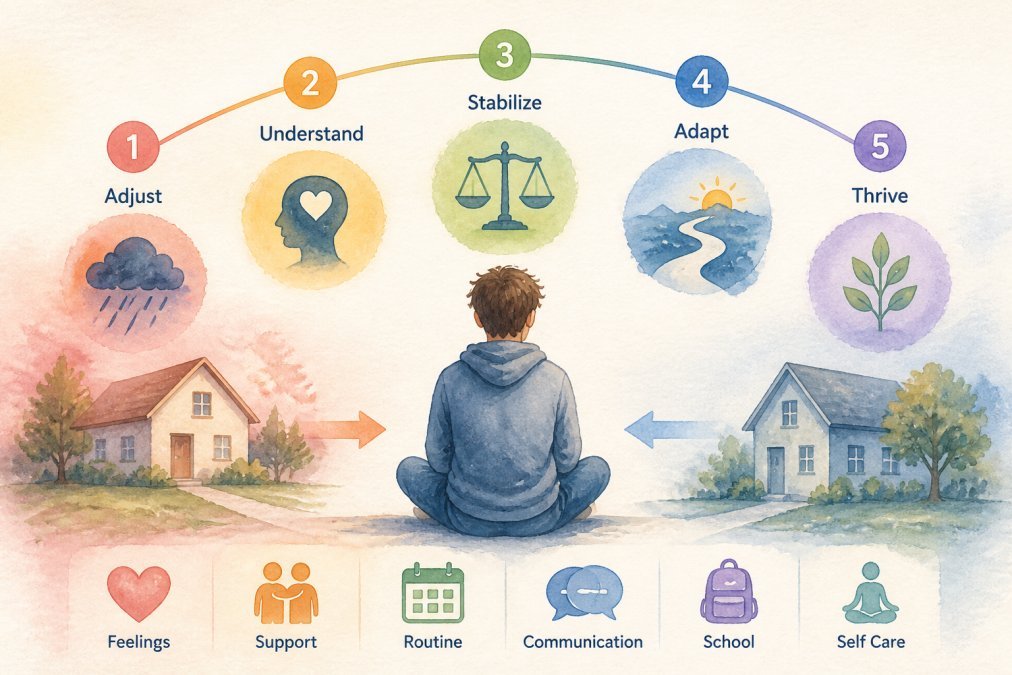
TL;DR:
- Disclosure after an affair is a deliberate, structured process aimed at rebuilding trust through honesty and transparency. It involves sharing essential facts safely and appropriately, guided by professional support, to foster emotional safety and long-term healing. When done well, it shortens anxiety, improves communication, and lays a foundation for genuine relationship growth.
- Key Takeaways
- What is disclosure in affair recovery?
- Types and depth of disclosure: what gets shared?
- The role of timing, process, and emotional support in disclosure
- Common challenges and pitfalls in the disclosure process
- How disclosure helps rebuild trust after infidelity
- Why successful disclosure demands more than honesty
- Frequently asked questions
Many people assume that disclosure after an affair simply means admitting what happened. In reality, it is far more structured and purposeful than that. Full disclosure after infidelity is a deliberate process that lays the groundwork for genuine trust recovery. Without it, couples often spend years circling the same wounds without ever truly healing. This guide explains what disclosure actually involves, how to navigate it safely, what to expect emotionally, and why doing it well is one of the most powerful moves you can make toward rebuilding your relationship and your sense of self.
Key Takeaways
| Point | Details |
|---|---|
| Disclosure is foundational | Honest, structured disclosure builds a basis for trust recovery after infidelity. |
| Types of disclosure matter | Couples should choose what information is disclosed to balance healing and emotional safety. |
| Support and timing are key | Both partners need emotional readiness and professional support for the process to be effective. |
| Challenges are normal | Expecting setbacks and emotional responses helps couples navigate disclosure more successfully. |
| Disclosure accelerates healing | Done well, disclosure paves the way for faster rebuilding of trust and long-term growth. |
What is disclosure in affair recovery?
Disclosure in affair recovery is an intentional, structured process of revealing honest information about an affair to the betrayed partner. It is not a spontaneous confession made in a moment of guilt, and it is not about punishment. Its purpose is to provide enough truth that both partners can begin processing what happened and decide, with clear eyes, what comes next.
A common misconception is that disclosure means sharing every graphic detail. It does not. Another misconception is that it is entirely the unfaithful partner’s decision to make alone. Good disclosure is a guided process, ideally supported by a counselor or therapist, where both partners have some say in what is shared and how.
Disclosure is central to affair recovery and rebuilding trust, because it transforms a relationship defined by secrecy into one built on honesty. Without that shift, trust cannot genuinely form again.
The key elements of healthy disclosure include:
- Transparency: Sharing the essential truth without deception or omission
- Safety: Creating emotional and physical conditions where the conversation can happen without escalation
- Emotional readiness: Ensuring both partners are in a stable enough place to engage meaningfully
- Structure: Having a plan, ideally with professional guidance, so the conversation does not spiral
“Disclosure is not about reopening wounds for the sake of it. It is about replacing the fog of suspicion and half-truths with something solid enough to stand on.”
That distinction, between disclosure as punishment and disclosure as foundation, is what shapes whether this process heals or harms.
Types and depth of disclosure: what gets shared?
Not all disclosures are the same. Couples and their counselors often discuss two broad approaches: partial disclosure and full disclosure. Understanding the difference helps you make an informed choice about what fits your situation.
Partial disclosure means sharing some information about the affair while withholding certain details. This might be chosen to protect the betrayed partner from overwhelming pain, or because certain facts feel irrelevant to healing. The risk, however, is significant. Partial disclosure often leads to what therapists call “trickle truth,” where fragments of the story emerge over weeks or months, each one re-traumatizing the betrayed partner and eroding the trust that partial disclosure was meant to protect.
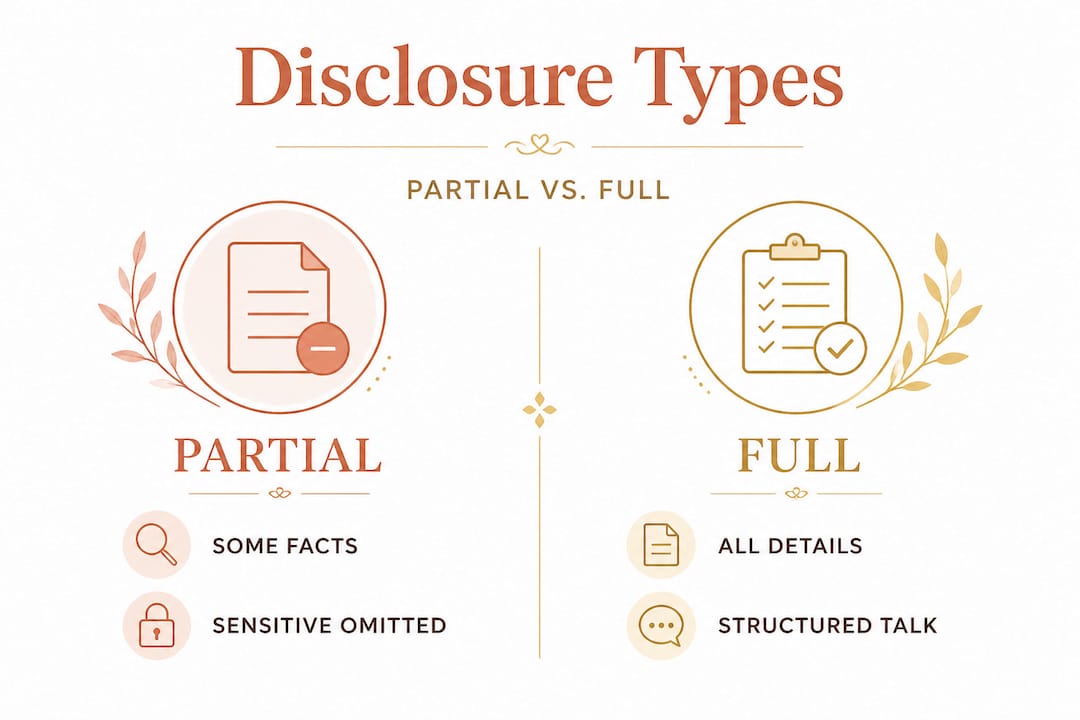
Full disclosure means sharing a complete, honest account of the affair, typically within a structured setting and with therapeutic support. Disclosure must balance honesty and emotional safety, which is why full disclosure does not necessarily mean sharing every intimate detail. It means sharing enough that the betrayed partner is not left with unanswered questions that fuel anxiety.
| Type | What is typically shared | Risks | Benefits |
|---|---|---|---|
| Partial disclosure | Basic facts, general timeline | Trickle truth, ongoing mistrust | Feels safer short-term |
| Full disclosure | Who, what, when, general why | Emotional intensity upfront | Faster trust recovery |
| Therapeutic disclosure | Structured, guided by counselor | Requires professional support | Safest, most thorough option |
What is typically disclosed in a healthy process:
- A general timeline of the affair
- Who the other person was (relationship to the partner)
- Where contact occurred
- Why it happened, in broad emotional terms
What is often withheld for emotional safety:
- Graphic sexual details
- Specific intimate moments or conversations
- Comparisons to the primary relationship
Pro Tip: Before any disclosure conversation, write down what you want to share and what your intention is in sharing it. Ask yourself: “Does this information help my partner heal, or does it satisfy my need to confess?” That question alone can sharpen your choices considerably. This kind of clarity also supports long-term relationship growth after infidelity.
The role of timing, process, and emotional support in disclosure
Knowing what to share leads naturally to the question of how and when. Timing matters enormously. A disclosure attempted in the middle of an argument, or within days of discovery when emotions are at their rawest, can cause more harm than good.
A structured process for disclosure improves trust recovery outcomes, and the research backing this is consistent. Couples who use a planned, stepwise approach to disclosure report lower levels of anxiety and higher levels of relational satisfaction in the months following.
Here is a recommended process for structured disclosure:
- Prepare individually. Both partners should spend time with a counselor or trusted support person before the disclosure conversation. This includes identifying questions, setting emotional limits, and clarifying goals.
- Choose a safe setting. Select a private, neutral space. Not a public place, not a location tied to the affair, and not late at night when emotional reserves are low.
- Hold the disclosure conversation. The unfaithful partner shares what has been prepared, clearly and without defensiveness. The betrayed partner listens and may ask questions, though it helps to agree in advance on the scope of questions.
- Create space for response. After disclosure, the betrayed partner needs time to react, cry, ask follow-up questions, or simply be quiet. Rushing toward resolution is counterproductive.
- Access guided support. Schedule a follow-up session with a counselor within days. Do not let the conversation sit without professional processing.
Learning how to communicate after an affair is a skill that most couples need help building, because the communication patterns that existed before the affair are often part of what allowed disconnection to grow.
It is also worth understanding the trust rebuilding timeline, because many couples expect healing to happen in weeks. In reality, rebuilding deep trust after betrayal typically takes one to two years of consistent effort, and disclosure is just the beginning of that process.
Pro Tip: If the betrayed partner is struggling to form their questions ahead of disclosure, suggest writing them down over several days. Questions that feel urgent in hour one often shift significantly by day three, and that shift reveals what the person truly needs to know.
Common challenges and pitfalls in the disclosure process
Even with the best intentions, disclosure is rarely smooth. Couples face predictable obstacles, and knowing what they are in advance reduces their power to derail the process.
Typical emotional responses during and after disclosure include:
- Intense anger from the betrayed partner, sometimes lasting weeks
- Deep shame in the unfaithful partner, which can cause withdrawal
- Emotional numbness or dissociation, especially in the first few days
- Hypervigilance, where the betrayed partner scans for additional deception
These are all normal. Emotional reactions and setbacks are normal but can be managed with preparation, and normalizing these responses reduces the secondary shame that often builds around them.
Common pitfalls include:
- Trickle truth: Revealing information piecemeal over time rather than all at once. Each new revelation re-traumatizes the betrayed partner and signals ongoing dishonesty.
- Oversharing graphic details: Sharing intimate specifics that serve the unfaithful partner’s guilt rather than the betrayed partner’s healing.
- Defensive behavior: Explaining, justifying, or minimizing during disclosure instead of simply owning what happened.
- Premature resolution: Rushing to “fix” the relationship before the betrayed partner has had adequate time to process.
“The biggest mistake couples make in disclosure is treating it as a single event rather than the beginning of an ongoing process of honesty.”
To navigate setbacks effectively, focus on three things: patience, empathy, and structured support. Patience means resisting the urge to hurry through pain. Empathy means staying present with your partner’s experience even when it is hard to hear. Structured support means using the trust rebuilding steps that have been shown to work, rather than improvising in crisis.
The healing process after an affair is rarely linear. Expect regression. Expect days when the betrayed partner feels as raw as they did at discovery. Those moments are part of healing, not evidence that it is failing.
How disclosure helps rebuild trust after infidelity
Now that you understand the challenges, it is worth focusing on what disclosure genuinely delivers when it is done well.
Successful disclosure accelerates trust rebuilding and relationship healing by replacing uncertainty with facts. One of the most painful aspects of betrayal is not knowing. The imagination fills gaps with worst-case scenarios, and those imagined scenarios are often more damaging than the truth. Good disclosure closes those gaps.
The positive outcomes of structured, supported disclosure are well-documented:
- Improved communication patterns: Couples who go through therapeutic disclosure often report better overall communication than they had before the affair
- Reduced anxiety in the betrayed partner: Knowing the truth, even when painful, is less destabilizing than ongoing uncertainty
- Empathy development: When disclosure includes an honest account of the emotional drivers behind the affair, it sometimes opens understanding, though this takes time
- Reduced risk of relapse: Couples who address root causes through disclosure are better positioned to prevent future affairs and strengthen relational boundaries
| Outcome measured | Before structured disclosure | After structured disclosure |
|---|---|---|
| Anxiety in betrayed partner | High, often chronic | Significantly reduced |
| Communication quality | Often broken or avoidant | More direct and honest |
| Reported trust level | Very low | Gradual, meaningful recovery |
| Relationship satisfaction | Severely impaired | Improved over 12 to 18 months |
The role of transparency after betrayal cannot be overstated. Transparency is not a one-time act. It is a sustained commitment that begins with disclosure and continues through daily choices: being where you say you will be, following through on what you promise, and communicating proactively rather than reactively.

Why successful disclosure demands more than honesty
Here is something most guides on this subject will not tell you: honesty alone is not enough to make disclosure work.
We have seen this pattern repeatedly. A partner sits down, tells the truth, answers the questions, and believes they have done their part. But the betrayed partner leaves the conversation feeling worse, not better. The information was accurate, but the delivery lacked something essential.
What disclosure actually requires is honesty paired with humility. That means not just saying what happened, but sitting with the weight of it. Allowing the betrayed partner’s pain to land without immediately trying to reduce it. Not defending the decisions you made, even if part of you still believes they were understandable in context. The need to justify is one of the most destructive impulses in a disclosure conversation, and it is one of the hardest to resist.
Disclosure also demands non-defensiveness, which is genuinely difficult when you are already carrying shame. Shame makes people want to explain, minimize, or deflect. But what the betrayed partner needs is not explanation. They need to feel that you understand the scale of what you did.
Perhaps most importantly, disclosure is a two-way process. The unfaithful partner is not the only one who needs support through it. The betrayed partner needs guidance on how to receive information without it becoming interrogation, how to identify what they actually need to know versus what they are asking out of trauma, and how to process what they hear without it becoming a weapon in future conflict.
Working with therapist tips for affair recovery brings both partners into the room as participants in healing, rather than positioning one as the accused and the other as the judge. That shift, subtle as it sounds, changes everything about how disclosure lands and what it makes possible afterward.
Find your next step: resources for healing after disclosure
Disclosure is a turning point, but it is not the finish line. What happens in the weeks and months following disclosure determines whether the conversation becomes the foundation of something new or just another source of pain.
If you are working through this process right now, you do not have to figure it out alone. The After the Affair series is designed specifically for this stage of recovery, offering structured, compassionate guidance that goes well beyond what a single conversation can accomplish. Start with the infidelity recovery checklist to orient yourself and identify where you are in the healing process. When you are ready to think beyond survival and toward something more, the relationship growth guide offers a clear path forward, grounded in real experience and clinical insight. Recovery is hard, but with the right support, it is genuinely possible.
Frequently asked questions
Is it necessary to disclose every detail of the affair?
Not every detail must be shared. Focus on key information that aids healing and maintains emotional safety, as disclosure must balance honesty and emotional safety rather than satisfying every question.
When is the best time to disclose an affair?
The best time is when both partners are emotionally ready and a safe, private setting can be established, because a structured process improves trust recovery outcomes compared to disclosure made in crisis or conflict.
Can disclosure harm the relationship further?
If handled poorly, disclosure can cause additional pain. But when structured and supported, it becomes a healing act, because disclosure is central to affair recovery and provides the honest foundation both partners need.
What should the betrayed partner do after receiving disclosure?
Seek support, set emotional limits, and consider counseling to process the information, because emotional reactions and setbacks are normal and professional guidance helps manage them constructively.
How long does it take to rebuild trust after disclosure?
Trust recovery varies, but structured disclosure and ongoing transparency often accelerate healing because successful disclosure accelerates trust rebuilding and sets the conditions for long-term relational repair.
Recommended
- How to Guide Clients After Infidelity for Healing – After the Affair Series
- Therapist tips for affair recovery: heal and rebuild trust
- How to communicate after affair: rebuild trust in 2026 – After the Affair Series
- Why full disclosure matters for healing after infidelity – After the Affair Series