
Many people believe that staying quiet about the full details of an affair protects their partner from more pain. It feels kind, even logical. But that instinct, however well-meaning, often backfires. Research consistently shows that partial truths and ongoing secrecy create a different kind of wound, one that quietly festers beneath the surface. Healing after betrayal does not begin with silence. It begins with truth. This article walks you through why full disclosure is foundational to genuine recovery, what it actually looks like in practice, and how to approach these difficult conversations in ways that protect both partners.
Table of Contents
- Understanding the impact of secrecy after infidelity
- What does full disclosure really mean?
- Why full disclosure is essential for emotional healing
- Steps for practicing full disclosure safely and compassionately
- A deeper truth about full disclosure and healing
- Using expert resources for infidelity and betrayal recovery
- Frequently asked questions
Key Takeaways
| Point | Details |
|---|---|
| Secrecy hinders healing | Keeping secrets after infidelity increases anxiety and prevents genuine recovery. |
| Full disclosure fosters trust | Honest communication is vital for rebuilding trust and achieving lasting healing. |
| Guided steps reduce harm | A structured, compassionate approach to disclosure supports both partners’ well-being. |
| Ongoing support matters | Using professional resources can make the disclosure and recovery process more manageable. |
Understanding the impact of secrecy after infidelity
Secrecy after an affair is not just the absence of information. It is an active force that shapes how both partners experience the aftermath of betrayal. When the person who was unfaithful withholds key truths, even with protective intentions, they are making a unilateral decision about what their partner deserves to know. That dynamic alone erodes trust in ways that are hard to repair.
In the post-affair context, secrecy and partial truth can take many forms. It might be omitting the emotional depth of the affair, downplaying how long it lasted, or hiding whether contact has truly ended. Each of these omissions keeps the betrayed partner stuck in a fog of uncertainty. They sense something is still wrong but cannot name it. That gap between instinct and information is one of the most psychologically damaging places a person can live.
The emotional toll of secrecy is real and well-documented. Common effects include:
- Persistent anxiety rooted in the feeling that the full picture has not been shared
- Hypervigilance, where the betrayed partner is constantly scanning for new signs of deception
- Inability to move forward, because healing requires a stable foundation of known facts
- Erosion of relational safety, making vulnerability and reconnection feel impossible
- Distrust of one’s own perceptions, sometimes called self-doubt or gaslighting effects
Many couples stall their healing entirely because they avoid full disclosure. They may believe they are protecting each other, or they fear that more truth will cause more damage. But the opposite is usually true. The stages of healing after an affair cannot progress when either partner is operating on incomplete information.
“Withholding critical information prolongs trauma for both partners and can worsen emotional distress.”
This is not a minor footnote in recovery. It is a central truth. The betrayed partner’s nervous system remains in a state of threat when it senses that the story is incomplete. Understanding how to process emotional trauma after infidelity starts with acknowledging that secrecy is itself a form of ongoing harm.
What does full disclosure really mean?
Full disclosure is one of the most misunderstood concepts in affair recovery. Many people hear it and immediately picture a brutal, graphic confession that leaves their partner with images they can never unsee. That fear is valid, but it reflects a misunderstanding of what healthy disclosure actually involves.
Full disclosure is not about sharing every physical detail or reliving every moment of the affair. It is about honesty regarding the facts and emotional realities that matter to the healing process. The betrayed partner needs to understand the scope of what happened, whether it is truly over, and whether they can trust what they are being told going forward. That is the core of disclosure.
Here is a useful way to think about the difference:
| Helpful disclosure | Harmful disclosure |
|---|---|
| Confirming the timeline and duration of the affair | Describing intimate physical details unprompted |
| Acknowledging the emotional connection involved | Comparing the affair partner to your spouse |
| Being honest about whether all contact has ended | Sharing information designed to wound rather than inform |
| Answering direct questions truthfully | Volunteering graphic details that serve no healing purpose |
| Owning responsibility without deflecting blame | Minimizing the betrayed partner’s pain during the conversation |
Clear, honest communication about the affair allows both partners to process reality and begin rebuilding trust. The goal is transparency about what matters, not an exhaustive confession that prioritizes the unfaithful partner’s relief over the other’s wellbeing.
Knowing what questions to ask after an affair disclosure can help the betrayed partner identify what information they actually need, rather than spiraling into questions that increase pain without adding clarity.
Pro Tip: Before having a disclosure conversation, write down the specific questions or concerns you want addressed. This prevents the conversation from becoming overwhelming and ensures both partners stay focused on what genuinely supports healing. If emotions escalate, pause and return to the list. Having clear boundaries after betrayal in place before these conversations makes them far more productive.
Why full disclosure is essential for emotional healing
Once you understand what disclosure actually looks like, the benefits become much clearer. Full honesty is not just morally right. It is practically necessary for recovery to take root.
Here are the core benefits that full disclosure brings to both partners:
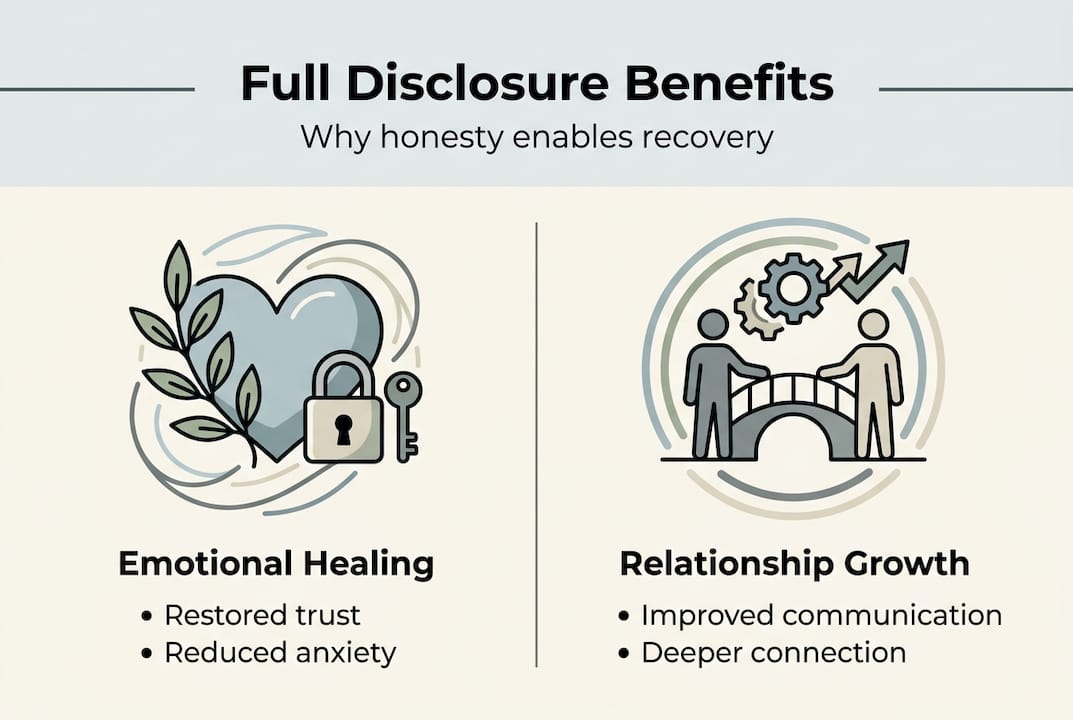
- Restores a foundation of trust: When the betrayed partner receives honest answers, they can begin to assess whether rebuilding is possible. Without that, every interaction is shadowed by doubt.
- Minimizes painful guesswork: The imagination is often crueler than reality. Partial information leaves the betrayed partner filling in gaps with worst-case scenarios.
- Enables authentic connection: Genuine intimacy cannot exist alongside hidden truths. Disclosure clears the space for real reconnection.
- Supports emotional closure: Knowing what actually happened allows the betrayed partner to grieve what was lost and begin moving forward.
- Reduces long-term resentment: Secrets discovered later, especially after trust has been partially rebuilt, cause devastation that is often worse than the original betrayal.
Couples who practice honest disclosure experience faster and more complete emotional recovery. This is not a small advantage. It represents the difference between a healing process that actually moves forward and one that circles the same painful ground indefinitely.
Disclosure also opens the door to relationship growth after infidelity, which may seem impossible in the early stages but becomes increasingly real when both partners are working from the same set of facts. Growth requires honesty as its raw material. You cannot build something new on a cracked foundation.
For the unfaithful partner, disclosure is also an act of accountability. It signals that they are choosing transparency over self-protection, which is one of the most powerful early steps in rebuilding credibility.
Steps for practicing full disclosure safely and compassionately
Knowing that disclosure is necessary is one thing. Actually doing it is another. These conversations are among the hardest any couple will ever have. But approached with care and intention, they can also be turning points.
Here is a step-by-step process for engaging in full disclosure safely:
- Prepare individually first. Both partners should spend time before the conversation identifying what they need to say or ask. Writing things down reduces the risk of the conversation spiraling.
- Set a clear intention. Agree that the goal of the conversation is healing, not punishment or self-defense. This shared intention shapes the tone of everything that follows.
- Choose the right time and place. Pick a private, calm environment where neither partner feels rushed or unsafe. Avoid initiating these conversations during conflict or when either person is exhausted.
- Use guided dialogue. Rather than free-flowing argument, try structured turns: one partner speaks while the other listens without interrupting, then they switch. This prevents the conversation from becoming a battle.
- Seek professional support. A therapist or structured guide can help manage emotional intensity and keep both partners focused on healing rather than harm.
- Practice self-care throughout. After each disclosure conversation, both partners need time to process. Schedule recovery time, whether that is a walk, journaling, or simply quiet space.
A staged, honest approach to discussion allows both partners to process information without overwhelm. Trying to cover everything in one conversation is rarely productive and often retraumatizing.
Pro Tip: Use a healing together guide to structure your disclosure conversations. Having a framework removes some of the pressure from both partners and provides a safe container for difficult truths. Pairing this with ongoing work on forgiveness after an affair creates a more complete path forward.
A deeper truth about full disclosure and healing
Here is something we do not say enough: time alone does not heal betrayal. It just ages it. We often hear the phrase “give it time” as if the calendar itself is doing therapeutic work. But when secrecy is still present, time does not soften the wound. It hardens resentment and widens distance.
The couples who genuinely recover are not the ones who waited long enough. They are the ones who were willing to be uncomfortable. Full disclosure requires the unfaithful partner to say, in effect, “here is my whole story, and I am not going to protect myself from your reaction to it.” That kind of courage is rare. And it is exactly what makes healing possible.
We have seen, both in clinical work and in the resources we share with those who guide clients after infidelity, that the most durable recoveries come from couples who chose truth over comfort. The short-term discomfort of full disclosure is real. But it is far smaller than the long-term cost of a relationship built on incomplete honesty.
Using expert resources for infidelity and betrayal recovery
Full disclosure is one of the most important steps you can take, and it is also one of the hardest to navigate alone. That is exactly why structured support exists.

At After the Affair, we have developed resources specifically designed to make these conversations less daunting and more healing. Whether you are working through an infidelity recovery checklist to understand where you are in the process, exploring what relationship growth after infidelity can look like for you, or browsing our full collection of infidelity healing resources, you will find evidence-informed tools built for exactly this moment in your journey. You do not have to figure this out alone.
Frequently asked questions
Does full disclosure always mean sharing all the details?
Full disclosure is about crucial truths, not unnecessary specifics. It means sharing what is significant and honest without volunteering graphic details that serve no healing purpose.
What if one partner isn’t ready for full disclosure?
If either partner is hesitant, seeking professional guidance is the most constructive next step. Professionals can facilitate productive and safe disclosure conversations that respect both partners’ readiness.
How soon after discovery should full disclosure happen?
Timing and safety are critical for effective disclosure. Rushing can cause additional harm, but ongoing avoidance keeps both partners stuck and prevents meaningful progress.
Can a relationship heal if there are still secrets?
True healing is very difficult when key truths remain hidden. Undisclosed secrets erode trust and consistently delay emotional recovery, even when both partners are genuinely trying to move forward.
Recommended
- How to Guide Clients After Infidelity for Healing – After the Affair Series
- Relationship Growth After Infidelity – After the Affair Series
- Effective tips for emotional healing after infidelity – After the Affair Series
- Questions to Ask After an Affair – After the Affair Series