TL;DR:
- Trust can be rebuilt through remorse, open communication, and consistent actions.
- Emotional reactions to infidelity include shock, grief, anger, and self-blame, which are human responses.
- A structured, gradual process using five key factors supports long-term trust recovery and relationship growth.
Many people believe that once an affair shatters trust, it’s gone for good. That belief keeps thousands of couples and individuals trapped in pain, convinced that healing is simply out of reach. But the research tells a different story. Trust repair is possible when guided by concrete factors including remorse, open communication, and intentional action. This guide walks you through exactly what happens when trust breaks, why it breaks the way it does, and how you can begin rebuilding it using evidence-backed strategies. Whether you’re the betrayed partner or the one who caused harm, real recovery is within reach.
Table of Contents
- Understanding trust breakdown after infidelity
- The five essential factors for rebuilding trust
- Step-by-step process for trust rebuilding
- Practical tools to support trust rebuilding
- A fresh perspective on trust rebuilding: What most guides don’t tell you
- Continue your healing journey with specialized support
- Frequently asked questions
Key Takeaways
| Point | Details |
|---|---|
| Trust can be rebuilt | Evidence shows that trust after infidelity is repairable with the right approach. |
| Follow proven steps | Integrating transparency, remorse, communication, and shared activities forms the foundation for healing. |
| Expect gradual progress | Rebuilding trust is a stepwise process with setbacks and requires patience from both partners. |
| Practical tools matter | Using daily exercises, boundaries, and open communication creates real change over time. |
Understanding trust breakdown after infidelity
With the core promise in mind, it’s vital to first understand what trust breakdown really means and why it affects us so deeply.
Trust is not simply a feeling. It is the invisible foundation on which every healthy relationship is built. When you trust your partner, you feel safe enough to be vulnerable, to share fears, to assume good intentions. You aren’t scanning for threats. You aren’t bracing for pain. You just exist in the relationship with a sense of security that most people don’t even notice until it’s completely gone.
Infidelity doesn’t just remove that foundation. It detonates it. Understanding why trust breaks the way it does is the first step toward eventually healing it, because knowing what you’re dealing with reduces the terror of feeling like you’ve lost your mind.
When betrayal is discovered, the emotional response is almost always overwhelming. Research confirms that trust breakdown triggers a wave of emotional turmoil, where normal reactions include shock, anger, grief, and a loss of the sense of personal safety. These are not signs of weakness. They are signs that something important was violated.
Common emotional responses to discovering infidelity include:
- Shock and disbelief: Your mind struggles to process information that contradicts everything you believed was true.
- Hypervigilance: You suddenly feel the urge to check phones, question stories, and monitor your partner’s every move.
- Grief: You mourn not just the relationship you had, but the future you imagined together.
- Shame and self-blame: Many betrayed partners ask themselves what they did wrong, even when they did nothing at all.
- Rage: Anger that arrives in waves, sometimes unpredictably, often at the worst moments.
- Physical symptoms: Sleep disruption, appetite changes, heart racing, and exhaustion are extremely common.
“Healing is not a straight line. It is a winding road where some days feel like progress and others feel like you’ve gone back to the beginning. Both experiences are part of the same journey.”
It’s also important to understand that these reactions don’t mean you are broken or that healing is impossible. They mean you are human. Working on rebuilding self-esteem alongside trust is critical, because betrayal attacks your sense of self just as much as it attacks your sense of safety in the relationship.
The key insight here is that healing trust is a process, not a single decision. You won’t wake up one morning and find that you trust again. Trust is rebuilt slowly, through repeated consistent actions over an extended period of time. Knowing that in advance removes some of the pressure and sets realistic expectations for the work ahead.
The five essential factors for rebuilding trust
Once you understand how trust breaks down, the next step is knowing exactly what actually drives successful healing. Research identifies five specific factors that predict whether trust can be repaired after betrayal.
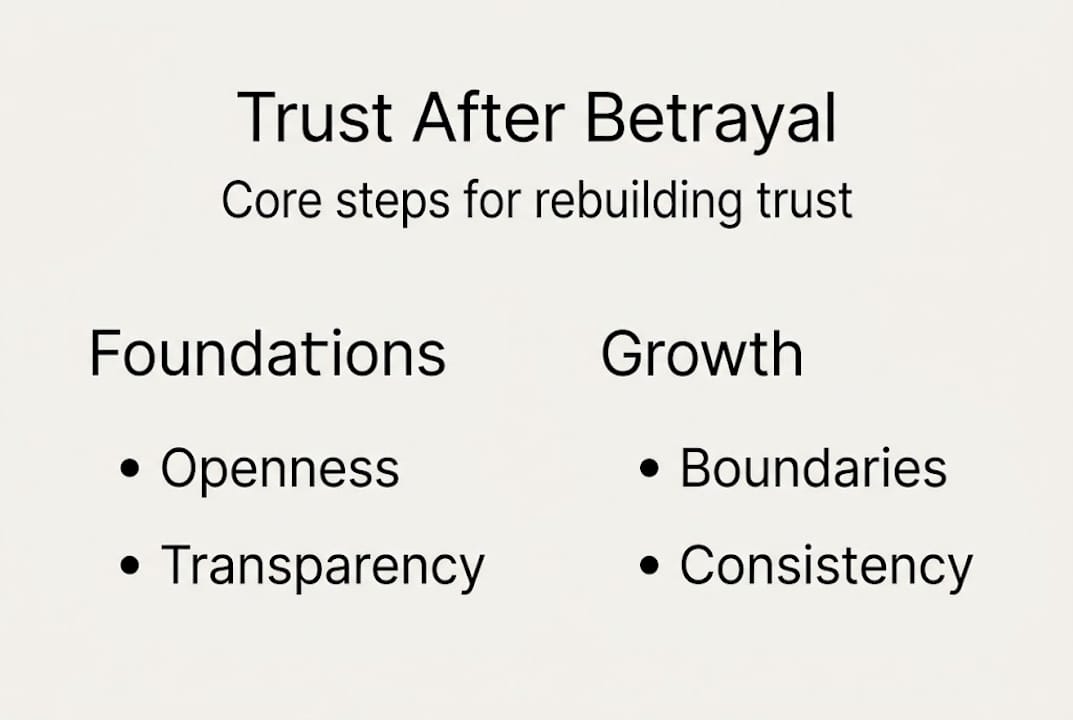
A systematic review of trust repair identified five research-backed factors: proactive transparency, active monitoring, remorse and accountability, shared activities, and clear communication about the reasons behind the betrayal. These aren’t abstract ideas. Each one translates into concrete daily behaviors that both partners can practice.
Here’s how each factor works in real life:
- Proactive transparency: The unfaithful partner volunteers information rather than waiting to be asked. They share where they are, who they’re with, and what they’re doing without prompting. This reduces the betrayed partner’s need to investigate.
- Active monitoring: The betrayed partner engages in reasonable oversight while both partners acknowledge this as a normal part of recovery. This might mean access to phones, location sharing, or regular honest check-ins.
- Remorse and accountability: The unfaithful partner takes full ownership of their choices, expresses genuine sorrow, and stops minimizing or deflecting. Accountability means accepting consequences without resentment.
- Shared activities: Couples invest in meaningful time together that rebuilds positive associations and emotional connection. Date nights, shared hobbies, and small rituals all count.
- Clear communication of betrayal reasons: Both partners work to understand why the affair happened. This is not about excusing behavior. It is about understanding context so that meaningful change is possible.
| Factor | Definition | Practical example |
|---|---|---|
| Proactive transparency | Sharing information without being asked | Texting your whereabouts unprompted |
| Active monitoring | Reasonable oversight by the betrayed partner | Shared phone access during early recovery |
| Remorse and accountability | Genuine ownership of harm caused | No deflection when the affair is discussed |
| Shared activities | Intentional quality time together | Weekly date night or shared hobby |
| Clear communication | Honest discussion of why the affair happened | Structured conversations with a counselor |
Understanding transparency after betrayal and learning how to set healthy limits through the importance of boundaries are two of the most powerful starting points for applying these factors.
Pro Tip: Transparency doesn’t mean your partner gets unlimited access to your every thought forever. In early recovery, more openness helps. Over time, as trust grows, those levels naturally recalibrate. Build in regular conversations about what feels right for both of you.
Step-by-step process for trust rebuilding
With the five core principles in mind, you’ll need a practical roadmap to organize your next steps. Abstract concepts only go so far. What you actually need is a sequence of actions that moves you from crisis toward connection.
The repair process follows a recognizable journey: initial response, remorse and accountability, ongoing actions, movement toward forgiveness, and the establishment of new boundaries. We break this down into five stages:
- Recognize (Weeks 1 to 4): Name what happened without minimizing it. Both partners acknowledge the reality of the affair and the damage it caused. This stage is about stopping denial. Expect raw emotion. Expect difficult conversations. This is not the time for big decisions about the future of the relationship. Focus on surviving each day.
- Respond (Months 1 to 3): The unfaithful partner demonstrates remorse through consistent behavior, not just words. The betrayed partner begins to assess their own needs and what they require to feel safe. This might include individual therapy, time apart to process, or asking for specific behavioral changes.
- Repair (Months 3 to 9): Active trust-building begins. Both partners engage the five factors regularly. Communication becomes more structured. Conversations about the affair shift from crisis to understanding. This stage often benefits from professional support. Check the healing timeline after cheating to normalize what you’re experiencing during this period.
- Rebuild (Months 6 to 18): Positive experiences accumulate. Both partners begin creating a new shared identity. This isn’t about returning to the relationship you had before the affair. It’s about building something stronger and more honest. Many couples find that relationship growth after infidelity leads to a connection they didn’t previously experience.
- Renew (Ongoing): Trust becomes self-sustaining through habits and mutual investment. Setbacks still happen but are handled with skill rather than crisis. Both partners recognize how far they’ve come and actively protect what they’ve built.
Pro Tip: Setbacks are not failures. If you hit a difficult week at month seven and feel like you’re back at week one emotionally, that does not erase the progress you’ve made. Resilience in recovery means continuing to show up even when the process feels broken.
Timeframes are estimates, not guarantees. Some couples move faster. Others need more time. What matters is direction, not speed.

Practical tools to support trust rebuilding
To bridge the gap between plan and action, equip yourself with effective practices that build trust day by day. Having the right tools makes the difference between trying to heal in theory and actually feeling it shift in practice.
Research confirms that active monitoring and shared activities directly support the trust repair process. But that doesn’t mean surveillance or control. It means intentional engagement.
Here are tools you can start using right away:
- Trust check-ins: Set aside 15 minutes weekly to ask each other “What do you need this week to feel safe?” and “What am I doing that helps or hinders your healing?” Keep it structured so it doesn’t spiral into argument.
- Shared goals: Identify one thing you’re working toward together, a trip, a project, a shared commitment. Shared goals create a sense of “us” that can get lost after betrayal.
- Open phone policy: During early recovery, both partners agree to access each other’s devices. This isn’t permanent. It’s a bridge that reduces anxiety while new patterns form.
- Scheduled conversations about the affair: Rather than letting painful topics erupt unpredictably, set a specific time to discuss them. This gives the betrayed partner guaranteed space and protects both partners from being blindsided at dinner.
- Individual journaling: Each partner processes privately between difficult conversations, reducing emotional flooding during direct dialogue.
Explore trust-building exercises and a step-by-step betrayal recovery framework for structured practices that match where you are in the process.
| Strategy | Trust outcome | When to use |
|---|---|---|
| Open communication | High trust growth over time | Throughout recovery |
| Silence or avoidance | Trust stagnation or erosion | Avoid when possible |
| Scheduled check-ins | Reduces anxiety and ambiguity | Weekly, especially early on |
| Shared activities | Builds positive emotional memories | Ongoing, from early stages |
| Reactive monitoring only | Increases stress without resolution | Avoid as primary strategy |
Choosing the right tools for your specific stage matters. What helps in week two may feel suffocating in month twelve. Keep checking in about what’s still serving both of you.
A fresh perspective on trust rebuilding: What most guides don’t tell you
Most resources on infidelity recovery focus heavily on checklists, apologies, and a return to normal. The uncomfortable truth is that returning to your old normal is rarely the goal worth pursuing. The relationship that existed before the affair was, in some cases, already carrying problems that neither partner had fully addressed. That doesn’t excuse the affair. But it does mean that “getting back to how things were” sets an incomplete target.
What separates couples who genuinely heal from those who simply endure is that they build something new. They use the crisis as painful, brutal, and unfair as it is as the forcing function that makes them finally address the things they’d been quietly tolerating for years.
Performative apologies won’t get you there. Rehearsed conversations won’t either. What moves the needle is authentic emotional presence, the willingness to sit in discomfort without deflecting, and a genuine curiosity about who your partner is and what they actually need. Growth after betrayal is real, but it requires both partners to stop performing recovery and start actually living it.
The couples who struggle most are often the ones trying to rush through grief to get to the “fixed” version of themselves. Healing has its own pace, and forcing it produces brittle results.
Continue your healing journey with specialized support
If this guide has helped you find your footing, the next step is applying these insights with structured, ongoing support. Real healing doesn’t happen in a single afternoon of reading.
At After the Affair, we’ve built a resource library specifically designed for where you are right now. Whether you’re in the raw early days or navigating the longer road of rebuilding, start with our infidelity recovery checklist for a clear, sequential action plan. If you’re ready to focus on what comes next, our guides on ongoing relationship growth will take you deeper. Browse the full comprehensive resource library to find resources matched to your specific stage of healing.
Frequently asked questions
How long does it usually take to rebuild trust after infidelity?
Rebuilding trust often takes months to years, depending on commitment and consistency from both partners. Research confirms that trust repair is a long-term process, not a quick resolution.
What are the first steps to take after betrayal?
Acknowledging the pain and opening honest dialogue are vital first steps in the trust rebuilding process. Remorse and communication are recognized as key elements in early trust repair.
Can trust really be fully restored after an affair?
Trust can be rebuilt to a meaningful degree, though the relationship may look different or even stronger after healing. Repair is possible when guided by the five research-backed trust factors.
What if my partner won’t take accountability?
Trust repair is extremely difficult without active remorse and accountability from the unfaithful partner. Research identifies remorse and accountability as essential components for successful rebuilding.
Recommended
- Relationship Growth After Infidelity – After the Affair Series
- How to Guide Clients After Infidelity for Healing – After the Affair Series
- How to Cope After Infidelity – After the Affair Series
- Rebuilding Trust Timeline – After the Affair Series