TL;DR:
- Effective disclosure after infidelity requires balancing honesty with emotional safety to foster trust and healing. Sharing essential truths in a structured, ongoing manner helps both partners understand the reality and regain autonomy. Pacing and emotional awareness are critical, as truthful, compassionate communication accelerates recovery and supports genuine personal and relational growth.
- Key Takeaways
- Why disclosure matters in post-infidelity healing
- Types and levels of disclosure in affair recovery
- The risks and rewards of disclosure: ethical pacing and timing
- How disclosure accelerates and supports personal healing
- A fresh perspective: Why ‘just the facts’ isn’t enough for real healing
- Frequently asked questions
The belief that knowing everything will speed your recovery is one of the most common assumptions people carry into the aftermath of betrayal. In reality, how truth is shared after infidelity matters just as much as the truth itself. Too many details, delivered too soon, can shatter an already fragile mind. Too little honesty can trap you in a cycle of suspicion and second-guessing. What heals is not simply the volume of information exchanged, but the quality, timing, and emotional intelligence behind that exchange. This article walks you through what disclosure really means in affair recovery and how to approach it wisely.
Key Takeaways
| Point | Details |
|---|---|
| Disclosure is essential | Disclosure enables trust rebuilding and emotional clarity after infidelity. |
| Not every detail helps | Sharing just enough for truth and restoration—without excessive vividness—protects both partners. |
| Pacing matters | Gradual or ethically timed disclosure can support safety and long-term healing. |
| Healing is active | Disclosure works best when paired with empathy, support, and ongoing communication. |
Why disclosure matters in post-infidelity healing
When a betrayal surfaces, the hurt partner is left holding a reality that has been completely rewritten. Everything they thought was true is suddenly in question. Relationships cannot rebuild on a foundation of silence or half-truths, and that is precisely why the importance of full disclosure is so frequently emphasized in recovery work.
Disclosure matters because it gives the betrayed partner something real to stand on. Without it, the imagination fills in every blank, often with scenarios far worse than the actual truth. Honest sharing stops that spiral. It allows someone to make informed decisions about whether they want to stay, leave, or take more time to decide. That autonomy, the ability to choose based on reality rather than assumption, is fundamentally connected to dignity and self-respect.
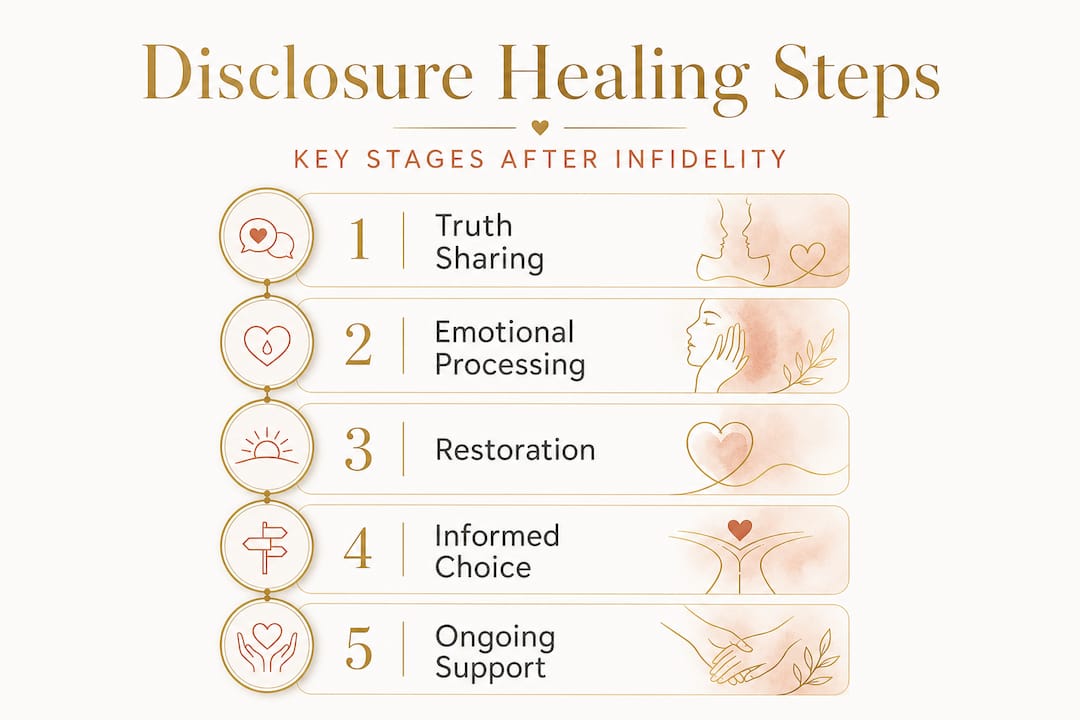
There is also a structural element here. Secrecy is the environment in which affairs survive. The moment transparency enters, the dynamic shifts. The disclosure steps to healing move the relationship out of a hidden world and into one where both partners can finally see the same picture.
One important distinction bears repeating: disclosure is not the same as a graphic confession. As recovery experts consistently note, “the aim is restoration and informed decisions, not reliving or collecting all graphic details.” The goal is clarity, not punishment. This distinction shapes every productive conversation about truth-telling in relationship repair.
Disclosure is not about reliving pain. It is about creating enough shared truth that both partners can finally stand in the same reality.
Key reasons disclosure plays such a foundational role include:
- It interrupts the secrecy that allowed the affair to continue
- It restores the hurt partner’s access to their own life story
- It enables the unfaithful partner to take genuine accountability
- It creates a starting point for transparency and trust to grow again
- It helps both individuals understand what repair or closure might look like
Types and levels of disclosure in affair recovery
Having established why disclosure is vital, the next challenge is understanding what counts as healthy, useful truth-sharing versus what may do harm. Not all disclosure is created equal, and the difference between “full” disclosure and “wise” disclosure is something every couple in recovery needs to understand.
“Advocates of disclosure distinguish ‘full truth’ from the need to share every graphic sexual or emotional detail.” Full truth refers to the essential facts: the who, the duration, whether there was emotional involvement, whether safe sex practices were followed, and whether the affair has ended. Wise disclosure means delivering this truth in a way that prioritizes healing over emotional devastation.
| Type of disclosure | Focus | Potential outcome |
|---|---|---|
| Full disclosure | Every fact and graphic detail shared | May cause retraumatization and intrusive images |
| Wise disclosure | Essential facts, context, and accountability | Supports healing and informed decision-making |
| Partial disclosure | Only some facts shared | Prolongs suspicion and may delay trust repair |
| Outcome-focused disclosure | Emotional truth and impact centered | Helps both partners understand what broke down |
This table makes a practical point: the type of disclosure you choose has real consequences for how healing unfolds. Outcome-focused disclosure, for example, prioritizes understanding what emotional conditions made the affair possible. This approach often produces more relational insight than a fact-by-fact account of events.
A structured approach to wise disclosure typically follows these steps:
- Identify what the hurt partner needs to know to make informed choices about the future
- Agree on a safe, private setting with enough time for emotional processing
- Share the essential facts clearly, without minimizing or embellishing
- Allow space for questions, and answer them honestly but with care for impact
- Avoid unsolicited graphic details unless directly and persistently asked
- Follow up in subsequent conversations, because disclosure is rarely a one-time event
Your healing process steps will also clarify what questions are worth asking and which ones may stall rather than support recovery.
Pro Tip: Write down the questions you most need answered before your first disclosure conversation. This helps you stay grounded when emotions rise and ensures you leave with the clarity you came for, not just more confusion.
The risks and rewards of disclosure: ethical pacing and timing
Understanding the different models of disclosure leads naturally to the question of timing. Should everything come out immediately, or is pacing sometimes necessary for healing and safety?
The answer depends on context. In crisis moments, when someone is in acute emotional shock, flooding them with every piece of information at once can cause what therapists call secondary trauma. The role of boundaries in this stage is critical. Pacing disclosure responsibly means recognizing that timing affects how information is received and integrated.
In medical and clinical settings, a framework called “therapeutic privilege” is sometimes used. Therapeutic privilege is a clinical concept where a caregiver decides to pace or temporarily withhold information when sharing it immediately might cause serious harm. As current clinical guidance notes, this approach requires that if a person directly asks a question, they receive an honest answer, even if the broader disclosure is being paced. This same principle applies in relationship recovery: gradual honesty is not the same as deception, but it must never become a reason to avoid truth entirely.
| Disclosure timing approach | When it may apply | Key risk |
|---|---|---|
| Immediate full disclosure | When both partners are emotionally stable | Overwhelm if delivered without support |
| Gradual paced disclosure | When one partner is in acute crisis or shock | Risk of being perceived as ongoing deception |
| Delayed disclosure | When safety concerns are present | Prolongs trauma and erodes trust further |
| Therapist-facilitated disclosure | When emotional volatility is high | Requires access to professional support |
Signs that disclosure may be happening too fast or carelessly include:
- The hurt partner is dissociating or shutting down during conversations
- Graphic imagery is being shared without any therapeutic purpose
- The unfaithful partner appears to be confessing for their own relief rather than the other person’s healing
- Both partners are exhausted and unable to process what is being shared
The step-by-step recovery framework used in structured infidelity recovery programs accounts for this by building disclosure into a broader sequence of healing, rather than treating it as a single event to get through.
Pro Tip: If you notice that conversations about the affair are leaving you more dysregulated than before, not less, consider whether pacing is needed. Bringing a counselor into the process is not a sign of weakness. It is a practical safeguard against re-wounding.
How disclosure accelerates and supports personal healing
With the principles and risks of disclosure established, it is time to see how putting these insights into practice truly impacts healing and future relationship growth. Because when disclosure is handled with skill and care, it genuinely does accelerate recovery in ways that avoidance and silence never can.
Disclosure enables restoration and informed choice, and those two outcomes are central to what healing actually requires. When you have clarity about what happened, you stop being a prisoner of your own guesses. The mind can settle around facts far more readily than it can settle around uncertainty.
Truth-telling also restores autonomy. One of the most damaging aspects of betrayal is that it is done to someone, without their knowledge or consent. Every day the deception continued, the hurt partner’s ability to make real choices was quietly stolen from them. Disclosure gives that back. It says: here is the reality you were denied, and now you get to decide what to do with it.
For couples attempting relationship growth after infidelity, the act of disclosure also creates a shared reference point. Both partners now have access to the same story, which makes genuine communication possible. Without that, one person is always operating with more information than the other, and that imbalance quietly poisons every attempt at reconnection.
Here is how appropriate disclosure translates into practical healing gains:
- Reduces anxiety and hypervigilance: When you know the truth, you stop scanning for hidden clues. The mental exhaustion of constant suspicion begins to lift.
- Creates accountability: For the unfaithful partner, speaking the truth aloud is itself a form of accountability. It cannot be minimized when it has been said clearly to the person who was hurt.
- Enables grieving: You cannot properly grieve a loss you do not fully understand. Disclosure defines what was lost, which allows mourning and, eventually, movement.
- Opens the door to empathy: When both partners understand what happened and why, even if that understanding is painful, it becomes possible to have a genuine conversation about the future.
- Builds a foundation for rebuilding trust: Every honest answer given freely, rather than pried out reluctantly, is a small deposit into the trust account. Over time, those deposits accumulate.
Healing is not the absence of pain. It is the presence of enough truth that pain finally has somewhere to go.

A fresh perspective: Why ‘just the facts’ isn’t enough for real healing
Here is something that the standard disclosure frameworks often miss. Facts, even true ones, delivered without emotional context can re-wound just as surely as silence can.
Imagine being told: “Yes, it happened for six months. It’s over. I’ve told you everything.” That is technically disclosure. But it is not healing. Because what the hurt partner is often asking, underneath every question about dates and locations, is something far more human: Did I matter to you? Were you thinking about me? Do you understand what this has done?
Facts without emotional accountability leave that deeper question unanswered. And when that question stays unanswered, no amount of logistical detail will bring peace.
Real recovery-oriented disclosure is not a statement. It is a conversation, and often an ongoing one. The unfaithful partner who answers questions clearly in week one but then shuts down in week eight has not completed disclosure. They have only just begun it. The hurt partner’s needs evolve. New questions surface as shock gives way to grief, and grief gives way to the slow work of understanding.
We have seen this pattern repeat consistently: couples who treated disclosure as a single event, a one-time confession, stalled badly in recovery. Couples who treated it as an evolving, responsive process, one where meaningful transparency was rebuilt through ongoing honesty, made genuine progress.
The uncomfortable truth is this: the unfaithful partner’s discomfort with repeated conversations is real, but it is a fraction of the discomfort the betrayed partner carries every single day. Sitting with that, truly sitting with it, is what makes disclosure transformative rather than merely procedural.
Resources to help you heal after disclosure
Navigating disclosure after infidelity is not something you have to do alone, and having structured guidance makes a real difference in how safely and effectively recovery unfolds.
At After the Affair, we have built our resources specifically for this stage of the journey, the raw, disorienting period when truth has entered the room and you are not yet sure what to do with it. Whether you are the hurt partner trying to ask the right questions, or the unfaithful partner trying to answer them with care, our infidelity recovery checklist gives you a clear, step-by-step structure to follow. Our relationship growth resources go deeper, covering the long arc from initial disclosure through to rebuilding a future worth having. If you are a counselor or therapist supporting clients through this process, our dedicated guide for supporting healing offers clinically informed frameworks you can apply directly. Healing is possible. The right resources help you get there faster.
Frequently asked questions
What if my partner wants all the details, but I worry it will hurt them?
This is one of the most common tensions in disclosure, and it does not require choosing between honesty and care. Wise disclosure distinguishes between essential truths and graphic specifics, aiming to restore trust without producing imagery that causes lasting trauma.
Is it ever okay to withhold information after infidelity?
Pacing disclosure, sometimes called “therapeutic privilege” in clinical settings, may be appropriate when immediate full disclosure poses a significant emotional risk, but it requires that direct questions are still answered honestly.
How do I know when enough has been disclosed for healing to start?
Healing typically becomes possible once both partners feel they share the same basic reality. As recovery-centered guidance puts it, the aim is restoration and informed choice, not exhaustive painful detail.
Can disclosure help if we decide to end the relationship?
Absolutely. Honest disclosure provides clarity and closure regardless of the outcome. Disclosure provides the foundation for genuinely informed choices, and sometimes the most healing thing a couple can do is part with clear eyes rather than unresolved questions.
Recommended
- Why full disclosure matters for healing after infidelity – After the Affair Series
- Disclosure in affair recovery: key steps to healing
- How to Guide Clients After Infidelity for Healing – After the Affair Series
- Questions to ask after discovering infidelity