TL;DR:
- Empathy is essential for healing betrayal trauma by validating feelings and reducing hypervigilance. Without consistent, genuine empathic repair, the risk of relationship breakdown and prolonged suffering increases. Inner self-empathy for both partners lays the foundation for authentic, lasting recovery and trust rebuilding.
- Key Takeaways
- Understanding betrayal: Why wounds cut so deep
- Why empathy is the cornerstone of healing after betrayal
- Empathy in action: What healing looks like for both partners
- Self-empathy: The missing link in repairing from the inside out
- What if empathy is missing? Pitfalls and roadblocks in recovery
- A hard truth: Empathy isn’t easy, why it’s worth the discomfort
- Frequently asked questions
People say time heals all wounds. After betrayal, that’s one of the most damaging things you can tell someone. Time doesn’t heal. What happens inside that time does. And the single factor most likely to determine whether you come out the other side with a repaired relationship or a deeper wound is empathy. Not therapy alone, not grand gestures, not endless apologies. Empathy. The kind that is felt, practiced, and consistently demonstrated, even when it’s uncomfortable.
Key Takeaways
| Point | Details |
|---|---|
| Empathy repairs trust | Offering genuine empathy is essential for rebuilding trust and emotional safety after betrayal. |
| Healing is relational | Both the betrayed and betrayer benefit from empathy for true relationship recovery. |
| Self-empathy matters | The betrayer must practice self-empathy before they can authentically empathize with their partner. |
| Absence of empathy stalls progress | Healing often stalls or reverses without persistent, demonstrated empathy. |
| Practical steps accelerate growth | Intentional application of empathetic practices enables deeper connection and post-traumatic growth. |
Understanding betrayal: Why wounds cut so deep
Before we explore how empathy shapes recovery, let’s clarify what makes betrayal such a unique emotional wound.
Betrayal isn’t just a broken promise. It’s a collapse of safety. When someone you trusted completely acts in a way that violates that trust, your brain doesn’t just register disappointment. It registers danger. Betrayal trauma, a term used to describe the psychological harm caused by a trusted person breaking that trust, activates the same threat response systems involved in physical danger. Your nervous system floods with cortisol and adrenaline. Your ability to feel safe around another person becomes temporarily impaired at a biological level.
What makes this even more complex is how the body and mind process healing betrayal trauma. The experience can look a lot like PTSD (Post-Traumatic Stress Disorder), with symptoms including hypervigilance (constantly scanning for danger), intrusive thoughts, emotional numbness, and difficulty trusting your own instincts. Research confirms that betrayal activates trauma responses similar to PTSD, where empathy provides validation that reduces hypervigilance and aids nervous system regulation.
One critical finding that often surprises people is this: subjective perceived betrayal predicts PTSD, depression, and dissociation beyond objective betrayal, highlighting the need for empathic validation of feelings. In plain terms, it doesn’t matter if the betrayal was “technically” not that serious. If you felt betrayed, your nervous system responded accordingly. This is why dismissing someone’s pain with comparisons (“at least it wasn’t worse”) causes additional harm.
Here’s what betrayed partners commonly experience in the aftermath:
- Constant mental replaying of events (intrusive thoughts)
- Difficulty trusting their own perceptions of reality
- Emotional swings from grief to rage to numbness
- Physical symptoms including insomnia, appetite changes, and fatigue
- Fear that they are “overreacting” to what happened
“Emotional validation is not a luxury in recovery. It is a prerequisite. Without empathic acknowledgment of pain, the nervous system remains in a state of high alert, making genuine healing neurologically impossible.” — Adapted from trauma-informed therapeutic frameworks
The relationship healing process cannot begin in any meaningful way until the betrayed partner feels their pain has been truly seen. That requires more than an apology. It requires empathy. You can find additional trauma-informed clarity steps that help ground the healing experience from the very beginning.
Why empathy is the cornerstone of healing after betrayal
Having established why betrayal is such a profound injury, we can now see why empathy is uniquely positioned as a healing force.
Empathy from the betrayer is essential for rebuilding trust and emotional safety after betrayal trauma. This isn’t just about feeling good. Empathy actually works on a neurological level to help the betrayed partner’s nervous system shift out of threat mode. When your pain is genuinely witnessed and validated by the person who caused it, something important happens: your brain starts to update its threat assessment. The person who was a source of danger is slowly, over time, recategorized as a potential source of safety again.
That process requires specific mechanics. True empathic repair includes:
- Active listening without interrupting or redirecting
- Non-defensive validation, meaning accepting the partner’s feelings without explaining them away
- Consistent presence, showing up repeatedly with patience even when emotions are intense
- Acknowledgment of impact, not just intent (“I understand you are devastated, regardless of what I meant”)
Empathy fosters emotional attunement, vulnerability, and deeper connection, which leads to post-traumatic growth and stronger relationships. Post-traumatic growth (PTG) refers to the positive psychological change that emerges from struggling with highly challenging life circumstances. It doesn’t mean the pain was worth it. It means something meaningful can be built from it, but only when empathy is consistently present.
Here’s a comparison of what healing looks like with and without empathic repair:
| Factor | With empathy | Without empathy |
|---|---|---|
| Safety restoration | Gradual but measurable | Minimal or absent |
| Intrusive thoughts | Reduce over time | Often persist or increase |
| Partner communication | Opens progressively | Becomes transactional or hostile |
| Long-term relationship outcome | Higher chance of repair | Higher rates of separation |
| Individual healing | Supported and affirmed | Isolated and prolonged |
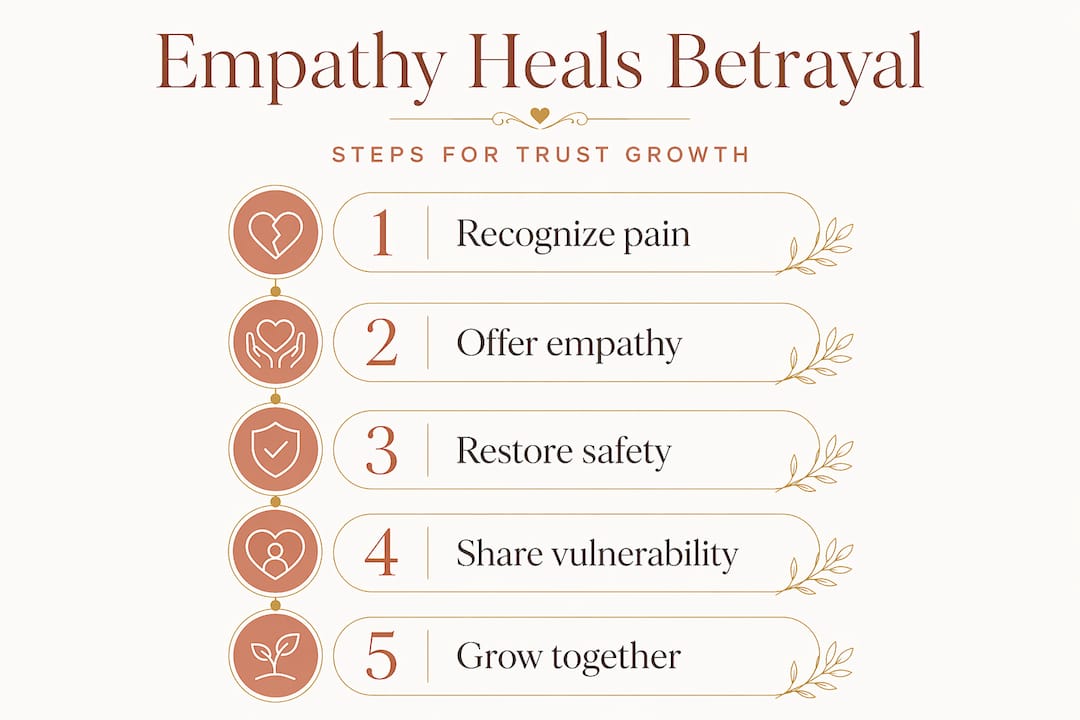
Pro Tip: Empathy is “proof-of-work,” not just words. Saying “I understand you’re hurt” once does nothing. Empathic repair works through repetition, behavioral consistency, and genuine presence over months, not days. Think of it less like a conversation and more like a daily practice. Explore trust rebuilding steps for a structured approach, and understand the trust rebuilding timeline so neither partner has unrealistic expectations. For additional post-traumatic growth strategies, there are broader frameworks that support this kind of relational transformation.
Empathy in action: What healing looks like for both partners
While understanding empathy’s importance is useful, applying it day-to-day transforms relationships. Here’s how that process unfolds practically.
For the betrayer, empathic repair requires what researchers call “one-way repair”, meaning the betrayer must practice relentless empathy and accountability before mutual healing can occur. This is a difficult concept for many betrayers to accept. The instinct may be to want the relationship to “move forward” quickly, to have the slate wiped clean. But that impulse, as understandable as it is, often accelerates the betrayed partner’s suffering.
Here’s a practical step-by-step guide for betrayers practicing genuine empathic repair:
- Stop defending and start listening. When your partner expresses pain, your first task is to absorb it without explaining, minimizing, or redirecting.
- Acknowledge the full impact. Go beyond “I’m sorry I hurt you” to “I understand this has shaken your sense of safety in this relationship.”
- Tolerate discomfort without shutting down. Learning to self-soothe during hard conversations prevents you from becoming emotionally unavailable when your partner needs you most.
- Show up consistently. Empathy must be demonstrated daily through actions: transparency, patience, and willingness to revisit painful conversations when needed.
- Accept that healing is nonlinear. Good days will be followed by hard ones. This is normal, not a sign of failure.
The mechanics of betrayer empathy involve active listening, self-soothing to avoid defensiveness, and consistent presence with a partner’s pain, rebuilding safety through repeated proof of effort.
For the betrayed partner, empathy within healing also includes self-directed compassion. Rebuilding self-trust is a parallel process. You’re not just learning to trust your partner again. You’re learning to trust your own perceptions, your own judgment, and your own emotional responses. Both processes need space and time.
Here’s a data summary of behaviors that either strengthen or undermine rebuilding:
| Behavior | Effect on healing |
|---|---|
| Consistently checking in on partner’s emotional state | Strengthens trust |
| Minimizing or comparing pain (“others have it worse”) | Undermines healing |
| Volunteering information proactively | Builds transparency |
| Becoming defensive when asked questions | Reinforces fear |
| Expressing remorse without prompting | Accelerates safety |
| Rushing forgiveness timelines | Increases resentment |
Pro Tip: Sample dialog matters. Instead of “Can we please stop bringing this up?”, try: “I can see this still hurts. I’m here. Tell me more about what you’re feeling right now.” One sentence shift can change the emotional temperature of an entire conversation. Resources on healing guidance after infidelity and coping after infidelity offer real-world scripts and frameworks for exactly these moments.
Self-empathy: The missing link in repairing from the inside out
Empathy doesn’t just occur between people; it also begins within. Let’s explore why inner work is vital for true relational healing.
One of the most overlooked dynamics in betrayal recovery is the internal state of the betrayer. Many betrayers carry enormous shame. Shame, as distinct from guilt, attacks the self rather than the behavior. Guilt says “I did something terrible.” Shame says “I am terrible.” And shame, left unaddressed, creates a powerful roadblock to empathic repair.
Self-empathy for the betrayer is a prerequisite to effectively empathize with the betrayed partner, overcoming the shame and defensiveness cycle. When a betrayer cannot extend compassion to themselves for what they have done, they often become defensive or emotionally withdrawn precisely when their partner needs them most. The shame becomes too overwhelming to sit with, so they shut down.
“You cannot give what you don’t have. A betrayer drowning in unprocessed shame cannot offer a partner the empathy they desperately need. Self-compassion isn’t selfish — it is the foundation from which genuine repair is built.”
Self-empathy techniques that make a measurable difference include:
- Reflective journaling focused on understanding motivations, not excusing behavior
- Self-compassion exercises, such as treating yourself with the kindness you’d offer a struggling friend
- Mindfulness practices that allow you to observe shame without being controlled by it
- Therapy specifically targeting shame and self-worth independent of the relationship
- Honest self-inventory of the values you want to live by going forward
Signs that self-empathy is actively at work in recovery include:
- Ability to hear your partner’s pain without immediately defending your intentions
- Willingness to stay present in difficult conversations rather than shutting down
- Taking accountability without catastrophizing or collapsing emotionally
- Demonstrating consistent behavior change without needing external recognition
For deeper support in understanding betrayal recovery, this inner work is not optional. And for those wanting additional structure around rebuilding self trust, there are guided frameworks that complement relational repair.
What if empathy is missing? Pitfalls and roadblocks in recovery
Even armed with all of the above, it’s possible to hit major snags if empathy is lacking. Understanding these pitfalls helps protect your progress.
When empathy is absent from the healing process, the relationship doesn’t just stall. It often moves backward. In cases of repeated betrayal or lack of betrayer self-empathy, healing stalls and self-trust rebuilding for the betrayed becomes a separate, isolated process. The betrayed partner is left doing all the emotional labor of recovery on their own, which compounds the original trauma.
Here are the most common pitfalls that occur when empathy is missing:
- Forced forgiveness. Pressure to forgive before healing is complete creates resentment that poisons future attempts at repair.
- Rushing to closure. Moving on too quickly means pain goes underground, not away. It resurfaces later, often more intensely.
- Emotional withdrawal by the betrayer. When the betrayer becomes unavailable during conflict, the betrayed partner’s nervous system re-enters threat mode.
- Minimizing the severity. “It wasn’t that bad” or “You’re still talking about this?” are phrases that reignite trauma rather than calm it.
- Circular arguments without resolution. Without empathy anchoring the conversation, conflict loops without producing connection or clarity.
Research suggests that couples who report high levels of empathic engagement during the repair process show significantly better outcomes at the one, two, and three-year marks post-betrayal. Those without it often report that unresolved pain continues to contaminate the relationship for years.
Knowing when to seek professional support is also critical. If conversations consistently escalate without resolution, if the betrayed partner shows signs of clinical anxiety or depression, or if the betrayer is unable to provide empathy without shutting down, the benefits of therapy for betrayal become essential, not optional. A skilled therapist can help create the conditions where empathy becomes possible even when partners are stuck.

A hard truth: Empathy isn’t easy, why it’s worth the discomfort
So what does this all mean for your own journey? Here’s the honest view that many experts avoid.
Empathy after betrayal is genuinely hard work. Not “difficult but manageable” hard. Sometimes it is painful, exhausting, and deeply counterintuitive. The betrayed partner must allow themselves to be vulnerable again with the very person who hurt them. The betrayer must sit with someone else’s devastation while carrying their own shame. Neither of those tasks is comfortable, and neither happens overnight.
We’ve worked with and alongside many couples navigating this. The ones who make it through are not the ones who found it easy. They are the ones who stayed in what we call the “messy middle,” the period where things feel worse before they feel better, and kept showing up anyway.
Here’s the uncomfortable truth that we think matters: most relationship casualties from betrayal don’t happen because the damage was irreparable. They happen because one or both partners quit empathizing before trust had time to rebuild. Empathy is slow. It asks you to feel things you’d rather not feel, again and again, for longer than seems fair.
But the relationships that are forged through genuine empathic repair are often stronger than they were before the betrayal. Not because the affair was good. Because the work it demanded was real. That’s where real intimacy is built. Explore relationship growth truths for a grounded look at what that transformation can actually look like.
Don’t mistake the struggle for a lack of progress. In recovery, discomfort is often a sign that you’re doing it right.
Resources for deep healing after betrayal
If you’re ready to take the next step from reflection to action, the following resources can help steer your journey.
At After the Affair, we understand that reading about empathy is one thing. Living it, day after day in the middle of grief and confusion, is entirely another. That’s why we’ve built structured, evidence-informed resources specifically designed for exactly where you are right now.
Whether you’re looking for a practical infidelity recovery checklist to organize your next steps, guidance on relationship growth after betrayal, or a comprehensive guide for post-betrayal healing that supports both partners through the process, our library of books and resources covers every stage. You don’t have to navigate this alone, and you don’t have to figure it out from scratch. Real, compassionate support is available to walk you through every phase.
Frequently asked questions
How does empathy aid nervous system recovery after betrayal?
Empathy from a partner validates emotional pain, reduces hypervigilance, and helps regulate trauma-impacted nervous systems. As research confirms, empathy provides validation that specifically reduces the hypervigilance response and supports nervous system healing after betrayal trauma.
Can you recover from betrayal if the betrayer refuses to show empathy?
Recovery is far more difficult and often stalls without empathetic repair; the betrayed partner frequently ends up isolated in their healing. The expectation is that the betrayer must engage in one-way repair with consistent accountability before joint recovery can progress.
What is “one-way repair” and why is it important?
One-way repair means the betrayer provides empathy and accountability first, without expecting mutual healing to happen simultaneously. This concept from relational repair research recognizes that the betrayed partner cannot do the same emotional labor at the same time as the person who caused the harm.
How does self-empathy help someone who betrayed their partner?
Self-empathy allows the betrayer to process shame without collapsing into defensiveness, which is the very defensiveness that blocks their ability to care for their partner. Self-empathy is a prerequisite to genuinely empathizing with the betrayed partner rather than performing empathy under pressure.
Is empathy effective even when betrayal isn’t “major”?
Yes, because subjective perceived betrayal predicts PTSD, depression, and dissociation regardless of the objective severity of events. If the wound feels real, empathic validation is just as critical as in more obvious cases of betrayal.
Recommended
- Relationship Healing Process – After the Affair Series
- Relationship Growth After Infidelity – After the Affair Series
- Understanding and Rebuilding Trust After Betrayal
- Step-by-step betrayal recovery: healing trust in 2026 – After the Affair Series