
TL;DR:
- Many couples who actively work on rebuilding trust after infidelity stay together long-term.
- Recovery involves sustained transparency, accountability, and patience, often taking several years.
Around 60–75% of couples who actively work on rebuilding their relationship after infidelity stay together long-term. That number comes as a surprise to most people sitting in the wreckage of betrayal, convinced their marriage is finished. The clinical term for what you are facing is betrayal trauma recovery, and the research on it is more hopeful than the pain you feel right now suggests. Studies published in the Journal of Sex & Marital Therapy and Contemporary Family Therapy consistently show that committed recovery, not the affair itself, determines the outcome. This article covers the statistics on infidelity recovery, the real mechanics of rebuilding trust, and one couple’s story of what healing actually looks like.
What do the statistics reveal about marriage survival after infidelity?
Infidelity is far more common than most people admit. 20–25% of marriages experience at least one episode of infidelity, and some research places that figure even higher for committed relationships overall. That means millions of couples face this exact crisis every year.
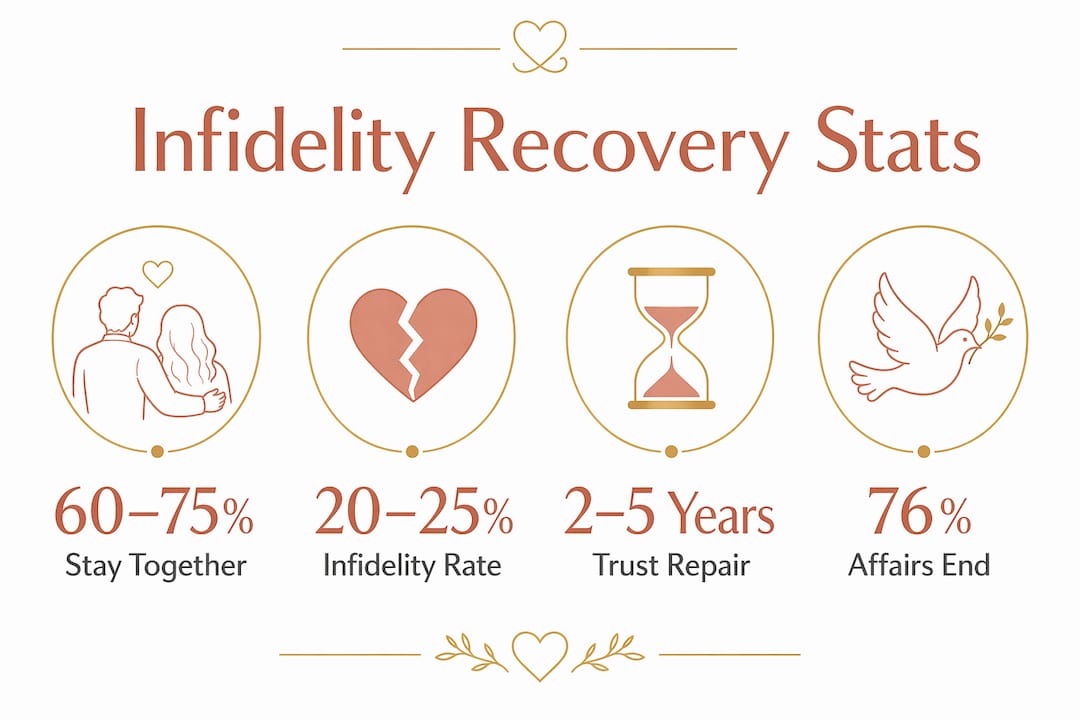
The survival data is genuinely encouraging. One study found that 76% of unfaithful partners ended the affair and stayed with their partner, while 79% of betrayed partners reported remaining in the relationship after the initial crisis. Those numbers reflect real decisions made by real people under enormous pressure.
Long-term stability is a different question from short-term survival. Research shows that about 50% of couples who work through infidelity remain together, and many of them report stronger, more honest marriages after recovery. The gap between initial survival and long-term stability closes significantly when both partners engage in structured, supported recovery.
| Statistic | Finding |
|---|---|
| Marriages affected by infidelity | 20–25% experience at least one episode |
| Couples staying together initially | 79% of betrayed partners remained post-crisis |
| Unfaithful partners who ended the affair | 76% ended the affair and stayed |
| Long-term survival with active recovery | 60–75% stay together when both commit |
| Couples reporting stronger marriages | Significant portion report improved honesty and depth |
The pattern across studies is consistent. Survival is not a coin flip. It correlates directly with whether both partners choose active, sustained recovery work.
How do couples successfully rebuild trust after cheating?
Trust does not return because someone says sorry. Trust rebuilds through “proof of work”, a term used in couples therapy to describe sustained transparency, repeated openness, and calm patience demonstrated over months and years. One apology, however sincere, cannot undo the neurological damage that betrayal causes.

The unfaithful partner carries the heaviest responsibility in early recovery. Radical ownership means accepting full accountability without minimizing, deflecting, or attaching conditions to the apology. Couples therapists identify this as the single most foundational step toward forgiveness. Without it, the betrayed partner cannot begin to feel safe.
Rebuilding also requires addressing the body, not just the mind. The betrayed partner’s nervous system is in a state of threat activation, and no amount of rational conversation repairs trust while that alarm is still ringing. Biological regulation, through breathwork, physical exercise, or somatic therapy, must come before productive dialogue can happen. The relationship healing process works in stages, and the body stage comes first.
Practical steps that support recovery include:
- Full transparency on location, devices, and communication for as long as the betrayed partner needs it
- Answering painful questions repeatedly and without defensiveness, even when it feels like punishment
- Consistent emotional availability, showing up calmly during the betrayed partner’s worst moments
- Therapeutic support from a counselor trained in betrayal trauma and emotion-focused coping
- Tracking progress, not just setbacks, to recognize how far the relationship has come
Pro Tip: Keep a shared weekly check-in, 15 minutes where both partners name one thing that felt safer this week. Small, named progress prevents the feeling that nothing is changing.
Infidelity affects 20–50% of committed relationships, and healing requires what researchers call dyadic resilience, meaning both partners building couple-level strength together, not just individual coping. Recovery is not a solo project.
What are the real challenges in recovering from infidelity?
The hardest part of recovery is not the first week. The hardest part is month seven, when the betrayed partner has a sudden wave of rage over something that happened nine months ago, and the unfaithful partner wonders if this will ever end. That moment is normal. It is not regression.
The betrayed partner typically exhibits a trauma response similar to PTSD, with the brain’s threat system on constant alert. This hypervigilance is not irrational. The brain learned that the person it trusted most was dangerous, and it is doing its job by staying watchful. Calming the nervous system is the prerequisite for any cognitive repair work.
One of the most misunderstood dynamics in recovery is the difference between a trigger and an actual threat. A song, a smell, or a particular time of year can activate the full trauma response even when the relationship is genuinely improving. Distinguishing triggers from actual threats prevents couples from derailing their progress over false alarms. A trained therapist helps both partners name and manage these moments without catastrophizing.
“I kept thinking every quiet moment meant he was hiding something again. My therapist helped me realize I was responding to the memory, not to what was actually happening in front of me.”
Trust repair after betrayal takes 2–5 years in most cases. Slow progress is not failure. It is the normal pace of deep healing. Recognizing betrayal trauma symptoms early helps both partners understand what they are dealing with, rather than interpreting normal trauma responses as signs that recovery is impossible.
Not every marriage should survive infidelity. When the unfaithful partner refuses accountability, continues deceptive behavior, or when the relationship was already harmful, leaving is the healthiest choice. Recovery requires two willing participants.
What does a real infidelity recovery story reveal about healing?
Sarah and Marcus (names changed) discovered his two-year affair on an ordinary Tuesday morning. Sarah described the first three months as “living inside a nightmare I couldn’t wake up from.” She checked his phone constantly, drove past his office at lunch, and woke at 3 a.m. replaying conversations for hidden lies. This is textbook hypervigilance, and it is one of the most common early infidelity recovery experiences.
Marcus entered therapy within two weeks of discovery. He answered every question Sarah asked, even the ones that hurt him to answer. He shared location access voluntarily. He did not complain that her grief was taking too long. That consistent behavior, sustained over 14 months, is what the “proof of work” framework looks like in practice.
What their story reveals about real healing:
- Month 3: Sarah still felt physically sick when Marcus traveled for work. Progress felt invisible.
- Month 8: The intrusive thoughts reduced from hourly to a few times a day. She noticed the shift herself.
- Month 14: They had their first genuinely good week, where neither of them was managing the affair every day.
- Year 3: Sarah described their communication as “better than it ever was before.” They had conversations they had avoided for a decade.
“I didn’t forgive him because the pain went away. I forgave him because I watched him become someone who deserved it.”
The lingering trauma did not disappear. Sarah still had hard days at year two. But new positive memories began to accumulate alongside the painful ones, and over time the ratio shifted. Finding hope after infidelity does not mean forgetting. It means building enough new evidence that the old evidence no longer defines the relationship.
Key Takeaways
Most marriages can survive infidelity when both partners commit to sustained, structured recovery work rather than waiting for time alone to heal the wound.
| Point | Details |
|---|---|
| Survival rates are real | 60–75% of couples who actively recover stay together long-term. |
| Proof of work matters | Trust rebuilds through repeated transparency and patience, not apologies alone. |
| Trauma response is normal | Hypervigilance and triggers are PTSD-like reactions, not signs of failure. |
| Recovery takes years | Deep trust repair typically takes 2–5 years; slow progress is not regression. |
| Accountability is foundational | The unfaithful partner’s radical ownership is the single most critical first step. |
What I’ve learned from watching couples do the hardest work of their lives
The statistic that stays with me is not the survival rate. It is the finding that many couples who survive infidelity describe their marriage as stronger afterward. That is not a comfortable thing to say to someone in acute pain, and I do not say it to minimize what you are going through. I say it because it is true, and you deserve to know it.
What I have seen consistently is that couples who enter structured support early, within the first 60 days if possible, have significantly better outcomes than those who wait until the relationship is nearly gone. Early therapeutic support is not a sign of weakness. It is the most practical decision you can make.
The other thing I want you to hear is this: realistic expectations protect your recovery. You will not feel better in a month. You will not trust again in six months. But you can feel measurably safer in six months, and that is worth fighting for. Honor your own pace. Do not compare your timeline to anyone else’s story.
If you are the betrayed partner, your anger is not a problem to be managed. It is information. If you are the unfaithful partner, your discomfort with the process is not a reason to slow it down. The work is supposed to be hard. That is how you know it is real.
— Silviya
Aftertheaffair resources for structured infidelity recovery
Knowing the statistics is one thing. Having a clear path forward is another.
Aftertheaffair offers structured, evidence-informed resources built specifically for this stage of recovery. The 7-step infidelity recovery checklist gives you a concrete sequence to follow when everything feels chaotic. The Relationship Growth After Infidelity program takes couples through the deeper work of rebuilding trust and transforming the relationship. For those who want to understand the full picture of what they are healing from, the ways to rebuild trust resource covers practical, therapist-aligned steps that go beyond generic advice. You do not have to figure this out alone.
FAQ
Can a marriage really survive infidelity long-term?
Yes. Research shows 60–75% of couples who actively work on recovery stay together, and many report stronger marriages afterward.
How long does it take to rebuild trust after cheating?
Trust repair typically takes 2–5 years. Slow progress is normal and does not indicate that recovery has stalled.
What is the most important thing the unfaithful partner must do?
Radical ownership is the most critical step. Full accountability without excuses or conditions is the foundation on which forgiveness can be built.
Why does the betrayed partner keep having intrusive thoughts?
Infidelity triggers a trauma response similar to PTSD, with the brain’s threat system on high alert. Distinguishing triggers from actual threats with therapeutic support reduces the intensity and frequency of these episodes over time.
Should every couple try to stay together after infidelity?
No. Recovery requires two willing, accountable participants. When the unfaithful partner refuses responsibility or continues harmful behavior, leaving is the healthiest and most self-respecting choice.
Recommended
- Top marriage healing strategies to rebuild trust after infidelity
- Will a Married Partner Leave Their Spouse? A Realistic Guide – After the Affair Series
- Can Couples Recover From Multiple Affairs? – After the Affair Series
- Relationship Growth After Infidelity – After the Affair Series