Table of Contents
Last Updated: September 20, 2026
Why Narcissists Escalate During the Holidays
Narcissistic ex during holidays amplify the narcissist’s need for control, attention, and drama. Family gatherings, gift-giving obligations, and shared child custody schedules create multiple pressure points where a narcissist can insert themselves into your life.
A narcissist thrives on narcissistic supply, attention, whether positive or negative. The holidays concentrate this supply: your stress is visible, your children are vulnerable, and your family is watching, especially during situations involving a Narcissistic Ex During Holidays.
Narcissists weaponize seasonal traditions: promising special time then canceling, sending expensive gifts with strings attached, or contacting extended family to build sympathy. Each tactic pulls you back into their orbit.
The narcissist isn’t acting out of love or nostalgia, they’re acting from a calculated need to regain control during a time when you’re most vulnerable.
Setting Clear Boundaries Before the Season Starts
Boundaries are your foundation. Set them now, weeks before the holidays arrive, not on Thanksgiving morning.
Identify your non-negotiables and write them down. Be specific: “My children will not spend more than two consecutive days with their other parent without a break” is actionable; “I want to protect my kids” is not.
Next, communicate these boundaries clearly and in writing. Email is your tool here, not a phone call. Written communication creates a record and removes the opportunity for the narcissist to misremember or gaslight you about what was agreed.
Digital Boundary Setting
Your phone, email, and social media are entry points. Set rules now.
Use dedicated apps or email for co-parenting only. Texts about “how are you doing?” or “I miss the kids” get no response.
Mute notifications from your ex. Check communication once daily at a scheduled time to remove constant emotional activation.
Block your ex on social media or set privacy so they cannot see your posts. Do not provide fuel for their ammunition.
Financial Boundaries
Money is control. Set clear financial boundaries now.
Determine your budget and communicate it in writing: “I will cover 50% of costs for the children’s gifts, up to $X per child. Anything beyond that is your responsibility.”
Do not loan money, co-sign anything, or agree to “we’ll figure it out later.”
Do not waive child support or alimony payments because of the holidays. Stick to the court order.
Co-Parenting With a Narcissist During Holidays
Co-parenting with a narcissist requires parallel parenting: you manage your time with the kids, they manage theirs, and you minimize overlap and conflict.
Managing Custody Schedules and Court Orders
Your custody schedule is a legal document, not a suggestion.
Do not swap days or extend time. A narcissist will test your boundaries constantly, and each time you bend, they’ll push further.
Document everything: violations, late pickups, and schedule changes. This record protects you if custody issues escalate.
If the custody order is vague about holiday timing, file a modification with the court now. Spending money on legal clarification saves you from conflict later.

Extended Family Dynamics
Your ex may use extended family as flying monkeys, people who report back, pressure you, or take sides. Set boundaries with them too.
You do not owe your ex’s family an explanation for your decisions. You do not need to defend your parenting. If a family member contacts you about custody or your relationship with your ex, respond briefly and redirect: “I appreciate your concern. These decisions are between me and [ex’s name]. I’m not able to discuss them.”
If your children have relationships with extended family members, those relationships are separate from your relationship with your ex. You can support those connections without engaging with your ex. For example: “Your cousin can visit you at my house on Saturday. Your mom will pick you up at 4 p.m.” This keeps the boundary clear. Maintaining these firm boundaries often requires a deeper understanding of how to break cycles of enmeshment, which is why seeking psychological support for codependency can be a vital step in reclaiming your emotional autonomy.
Do not bad-mouth your ex to extended family. Not because you’re protecting them, but because anything you say will get back to your ex and be used as evidence that you’re the unreasonable one.
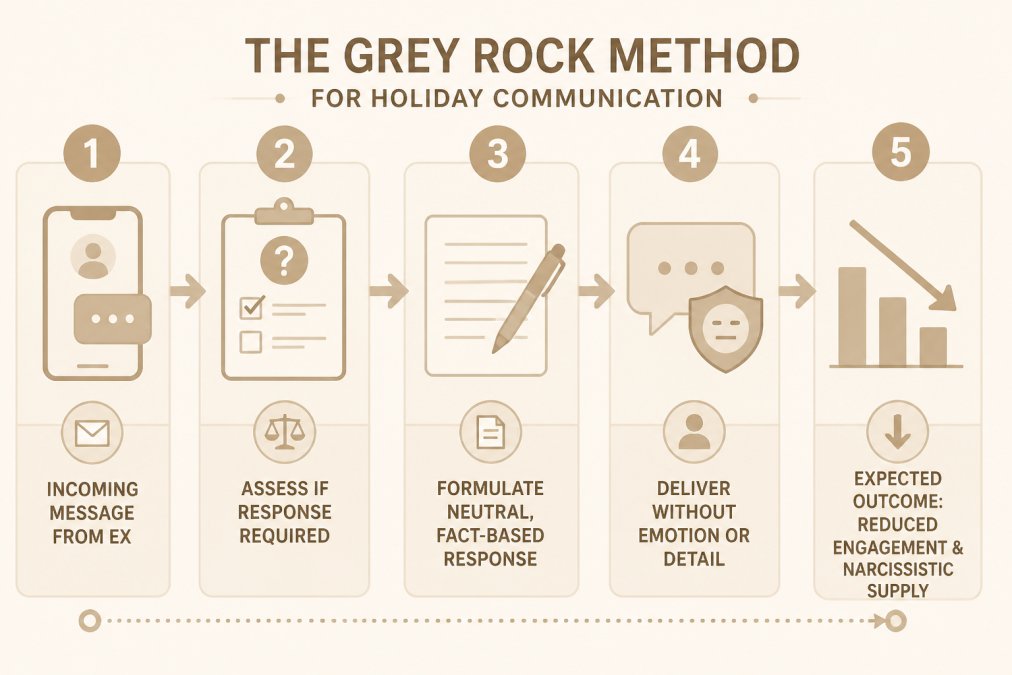
The Grey Rock Method for Holiday Communication
The grey rock method is your communication strategy when you must interact with your narcissistic ex. It’s simple: be as boring and unresponsive as a grey rock. Provide no emotional reaction, no detail, no engagement.
A narcissist feeds on your response. Anger, sadness, defensiveness, these are all supply. If you remove the supply, they lose interest. The grey rock method does exactly that.
How to Stay Neutral and Limit Emotional Engagement
When your ex contacts you, respond with facts only. No emotion. No explanation. No detail beyond what’s necessary.
They say: “I can’t believe you’re keeping the kids from me on Christmas Eve.”
You respond: “The custody schedule shows you have them December 25-26. That hasn’t changed.”
They say: “You always do this to me.”
You respond: “The schedule is in the court order. Let me know your pickup time.”
Notice what’s missing: your feelings, your reasoning, your defense. You’re not trying to convince them you’re right. You’re not explaining why the schedule is fair. You’re stating facts and moving on.
Keep your responses short. One or two sentences. If they push back, repeat the same response. “I understand you’re frustrated. The schedule remains the same.”
Do not engage with accusations or insults. They’re trying to get a reaction. A grey rock gets no reaction.
Practical Scripts for Common Holiday Scenarios
Here are scripts you can adapt for situations you’ll likely face:
When they ask to change the custody schedule:
“I’m not able to adjust the schedule. If you need a modification, we can discuss it with our mediator/attorney.”
When they send an expensive gift with expectations attached:
“Thank you for the gift. The children appreciate it. We’ll see you at the scheduled pickup time.”
When they contact you about what the kids said about you:
“I’m glad the children are comfortable with both of us. I’m not able to discuss parenting decisions or personal matters.”
When they claim they can’t afford their portion of costs:
“I understand finances are tight. The agreement is [X]. Let me know if you need to discuss a modification through proper channels.”
When they try to negotiate last-minute:
“I need to stick to the schedule we have. If you’d like to discuss changes, send me an email and we can review it together.”
Recognizing and Resisting Narcissistic Holiday Hoovering
Hoovering is when a narcissist tries to suck you back in. The name comes from the Hoover vacuum, they’re trying to pull you back into their orbit. During the holidays, hoovering intensifies because they know you’re emotionally activated.
Identifying Hoovering Tactics
A narcissist might send a message saying they miss you. They might claim they’ve changed and want to rebuild the family. They might say the kids need both parents together for the holidays. They might send nostalgic photos from past holidays when things seemed better.
These aren’t genuine attempts at connection. They’re tactics designed to make you question your decision to separate or set boundaries. They’re designed to pull you back into emotional engagement.
Watch for the pattern: they reach out when you’ve been quiet, when you’ve set a boundary, or when you’re stressed.
Avoiding the Trap of Conflict
A narcissist will also try to provoke you into conflict. They might send a message designed to upset you. They might claim you’re being unfair to the kids. They might say you’re keeping them from their family.
Protecting Your Children’s Emotional Well-Being
Your children are watching. They see the conflict. They feel the tension. Your job is to protect them from the narcissist’s behavior while maintaining their relationship with their other parent.
Managing Holiday Nostalgia and Disappointment
Children often idealize the pre-separation family. They remember the good moments and forget the dysfunction. During the holidays, this nostalgia intensifies. They may ask why the family can’t be together. They may express disappointment about split holidays.
Communication Protocols With Your Children
Establish clear rules about what you will and won’t discuss with your children.
Self-Care and Recovery After the Holidays
The holidays will drain you. Plan for recovery before they arrive.
Frequently Asked Questions
What is the gray rock method and how does it work during holiday interactions?
The gray rock method involves responding to a narcissistic ex with minimal emotional content, treating interactions like a boring rock. During holidays, this means keeping messages brief, factual, and unemotional. For example, instead of explaining why you’re changing a custody exchange time, simply state: ‘Exchange will be at 2 p.m. on December 23rd.’ This removes the narcissistic supply they seek from your emotional reactions and typically reduces conflict escalation.
How can I protect my children from narcissistic manipulation during holiday exchanges?
Establish clear communication protocols that keep children insulated from adult conflict. Use a neutral co-parenting app or email for logistics, never discuss the other parent negatively, and prepare children for transitions by normalizing the schedule. Validate their feelings about split holidays without criticizing their other parent. Maintain consistent routines and traditions on your time to give children stability and predictability, which counters the chaos narcissistic behavior often creates.
What should I do if my narcissistic ex tries to hoover me back during the holidays?
Hoovering, sudden displays of charm, nostalgia, or offers to ‘make things work’, is designed to pull you back into the narcissistic cycle. Recognize it as a pattern, not genuine change. Document all contact, stick to your boundaries, and avoid engaging with the emotional appeal. Use gray rock responses. If you share custody, keep interactions strictly about logistics. Reach out to your support network immediately when hoovering attempts trigger doubt or nostalgia, and remind yourself why the relationship ended.
How do I set financial boundaries with a narcissistic ex during the holiday season?
Establish clear financial limits before the season: decide what you will and won’t pay for regarding gifts, holiday activities, or travel. Document any court-ordered support amounts and ensure compliance. Don’t be pressured into ‘special holiday expenses’ beyond what’s legally required. If your ex demands extra money for holiday activities, respond with gray rock: ‘That’s not in our agreement. Please refer to the custody order.’ Keep all financial communication in writing to protect yourself legally.