TL;DR:
- Double betrayal involves both a partner’s affair and betrayal by a trusted person, intensifying trauma.
- It deeply impacts brain stress responses, causing physical symptoms and emotional flooding.
- Healing requires acknowledgment of losses, boundary setting, professional support, and self-focus.
- What is double betrayal?
- How double betrayal affects your mind and body
- Coping with double betrayal: Gendered differences and strategies
- Healing from double betrayal: Practical frameworks for recovery
- A fresh perspective: Double betrayal and the myth of “just move on”
- Continue your healing journey with expert guidance
- Frequently asked questions
When a partner’s affair also involves your closest friend or a trusted family member, something shifts in you that goes far beyond ordinary heartbreak. Double betrayal doesn’t just break a relationship. It rewires how your brain processes safety, trust, and connection. The pain is not dramatic exaggeration. It is neurobiological reality. Research shows that betrayal trauma can be understood both as a violation of relational norms and as a genuine neurological wound, especially when dependency and deep trust are involved. This guide walks you through what double betrayal actually is, how it affects your mind and body, and what practical steps genuinely support healing.
Key Takeaways
| Point | Details |
|---|---|
| Double betrayal defined | It’s a unique trauma where both partner and a trusted other break your trust. |
| Trauma is intensified | The emotional and neurobiological effects go well beyond common infidelity. |
| Healing is self-focused | Prioritizing your well-being is the proven path to meaningful recovery. |
| Coping strategies differ | Men and women often respond with different, research-backed coping styles. |
| Practical help matters most | Step-by-step guidance and expert support accelerate lasting healing. |
What is double betrayal?
Most people understand infidelity as one partner breaking a commitment. Double betrayal goes further. It happens when the person your partner had an affair with was also someone you trusted, such as a close friend, a family member, or a colleague you depended on. You lose two people at once, and the emotional architecture of your life collapses from two directions simultaneously.
This is not just a worse version of ordinary betrayal. It is a qualitatively different experience. Standard infidelity violates the trust bond with one person. Double betrayal fractures your broader sense of who is safe in your world. Some researchers frame betrayal as a relational norm violation, while others describe it as a neurobiological trauma rooted in broken dependency, and double betrayal fits both definitions at once.
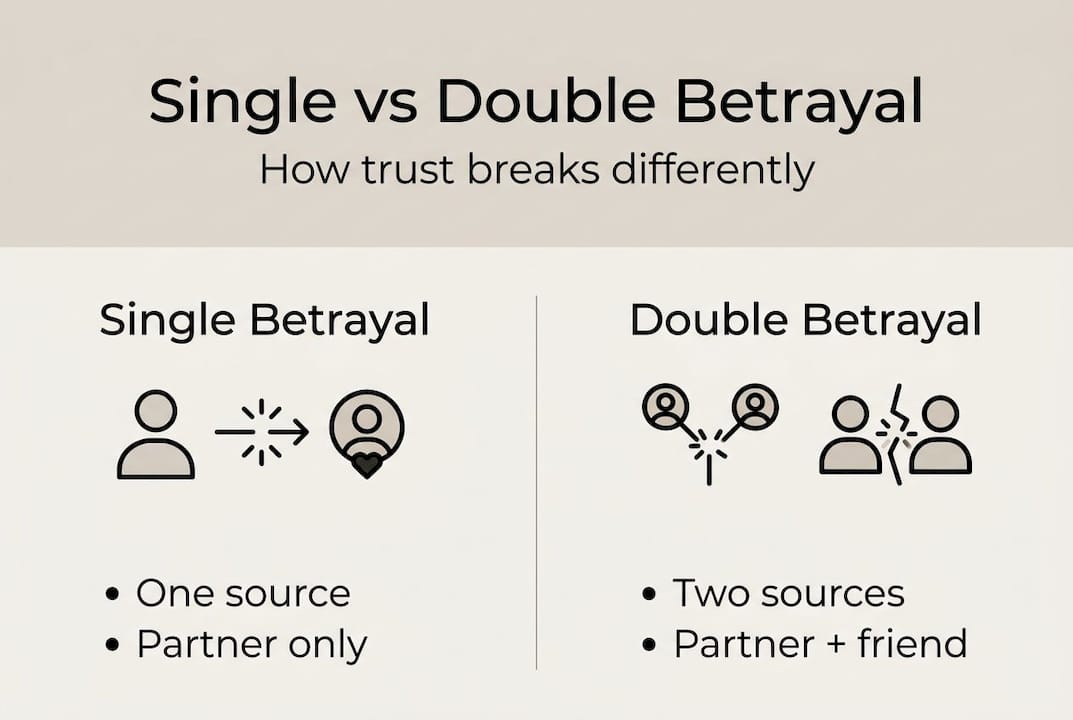
What does double betrayal in infidelity really mean? Understanding this concept is crucial for grasping the deep emotional wounds that arise when trust is shattered not just by one person, but by two. Let’s explore this together.
The layering effect is what makes double betrayal so destabilizing. You cannot process grief for one relationship without it triggering grief for the other. Every memory of your friend or family member becomes contaminated. Every shared experience is rewritten. Understanding infidelity’s effects on the brain helps explain why this contamination feels so total.
Common symptoms people experience include:
- Persistent confusion about what was real in both relationships
- Deep self-doubt and questioning your own judgment
- Social withdrawal and reluctance to trust new people
- Intrusive memories involving both the partner and the third person
- A sense of being fundamentally unsafe in close relationships
“The depth of betrayal trauma is directly proportional to the depth of trust that existed before it. When two trust bonds break at once, the wound is not doubled. It is multiplied.”
Recognizing this distinction is not about ranking your pain. It is about understanding why healing requires a different approach.
How double betrayal affects your mind and body
Your brain does not distinguish between emotional danger and physical danger. When you discover double betrayal, your threat-detection system, specifically the amygdala, fires as if you are in genuine physical peril. Stress hormones flood your body. Your nervous system shifts into survival mode. This is not weakness. This is biology doing exactly what it was designed to do.
What makes double betrayal particularly complex is that the people who would normally help you regulate that stress response, your partner and your close friend, are now the source of the threat. Your support system and your trauma source are the same people. That leaves your nervous system with nowhere safe to land.
Here is how the trauma response typically unfolds:
- Shock and disbelief — The mind protects itself by initially refusing to process the full reality.
- Hypervigilance — You scan constantly for new threats, replaying events for missed signals.
- Emotional flooding — Waves of grief, rage, shame, and confusion arrive without warning.
- Withdrawal — Social contact feels dangerous; isolation increases.
- Physical symptoms — Sleep disruption, appetite changes, and immune suppression become common.
The physical toll is real and measurable. Chronic stress from betrayal trauma suppresses immune function, disrupts cortisol rhythms, and can contribute to long-term cardiovascular strain. Many people report physical illness in the weeks following discovery, and this is not coincidence.
Statistically, infidelity is far more common than most people realize. Lifetime prevalence data shows that approximately 20 to 35 percent of men and 15 to 25 percent of women experience infidelity, and those who do face a 4 to 5 times higher risk of divorce. When double betrayal is involved, those emotional stakes are compounded.
Pro Tip: Keep a simple daily log of your physical symptoms alongside your emotional state. Patterns in sleep, appetite, and energy often reveal where your nervous system is stuck, and that information is genuinely useful for a therapist or counselor.
A structured betrayal recovery guide can help you map these stages and understand that what you are experiencing has a shape, a progression, and an endpoint. You are not broken. You are responding to a genuine wound. Resources focused on processing trauma after infidelity can provide the framework your nervous system needs to begin settling.
Coping with double betrayal: Gendered differences and strategies
Not everyone responds to double betrayal the same way, and understanding your own coping style is one of the most practical things you can do. Research consistently shows that gendered coping patterns differ significantly: women tend to show higher attachment anxiety and actively seek social support, while men more commonly rely on emotional avoidance and suppression.
Neither approach is inherently wrong, but both carry risks when taken to an extreme. Women who seek support may find that their social network was shared with the person who betrayed them, making that support unavailable or complicated. Men who suppress may appear to recover quickly while actually deferring the trauma, which tends to surface later in unexpected ways.
Here is what the research suggests actually helps, regardless of gender:
- Named emotional processing — Putting words to specific feelings, not just “I feel terrible” but identifying shame, rage, grief, or fear separately, reduces their intensity over time.
- Selective disclosure — Sharing your experience with one or two genuinely safe people rather than broadcasting widely protects you from secondary wounds.
- Structured distraction — Short, intentional breaks from rumination, like exercise or creative activity, give the nervous system recovery windows without denying the pain.
- Avoiding premature forgiveness pressure — Forgiving too quickly, especially under social pressure, often delays genuine processing and can deepen shame.
Pro Tip: If you tend toward avoidance, try a five-minute daily check-in where you name three specific emotions you felt that day. You do not have to do anything with them. Just naming them is a neurologically meaningful act.
One of the most common pitfalls is measuring recovery by how functional you appear to others. You can look fine and still be in crisis internally. Genuine resources for coping with infidelity focus on internal progress, not external performance. Practical steps to address betrayal trauma can give you a clearer map of what internal progress actually looks like.
Healing from double betrayal: Practical frameworks for recovery
Once you understand your coping patterns, the next step is building a recovery structure that actually fits your situation. The most important shift is this: healing from double betrayal must prioritize you, not the relationship. Research on betrayal recovery is clear that healing prioritizes self over relationship repair, especially in the early stages.
Here is a practical stepwise framework:
- Accept the reality of both losses — Trying to minimize one betrayal to process the other keeps you stuck. Both losses are real and both deserve acknowledgment.
- Establish clear boundaries immediately — Decide what contact, if any, you are willing to have with both the partner and the third person. Ambiguity here prolongs pain.
- Build a new support network — Deliberately identify people who were not connected to either person who betrayed you. This may feel like starting from scratch, and that is okay.
- Engage professional support — A therapist who understands betrayal trauma specifically, not just general relationship counseling, will make a measurable difference.
- Create daily resilience anchors — Small, consistent practices like morning walks, journaling, or scheduled social contact create neurological stability over time.
- Monitor for complicated grief — If symptoms intensify after three months rather than gradually easing, that is a signal to seek more specialized support.
Pro Tip: Write a brief “recovery intention” each week. Not a goal, but a direction. Something like “This week I will focus on sleep” or “This week I will call one safe person.” Small, directional intentions outperform big vague goals in trauma recovery.
Rebuilding after double betrayal also means rebuilding your relationship with yourself. Rebuilding self-esteem after betrayal is not a luxury step. It is the foundation everything else rests on. Your sense of your own judgment, your worth, and your capacity to trust again all need deliberate attention.

A fresh perspective: Double betrayal and the myth of “just move on”
Here is something we hear often that genuinely frustrates us: well-meaning people telling survivors of double betrayal to “just move on” or “focus on the positive.” This advice is not just unhelpful. In many cases, it actively delays recovery.
The reason is simple. Betrayal’s impact on the brain is not metaphorical. The neural pathways associated with trust, safety, and social bonding are genuinely disrupted. You cannot think your way out of a neurobiological wound any more than you can think your way out of a broken bone.
What actually gives people measurable progress is not positive thinking. It is honest acknowledgment of the complexity of what happened, combined with structured, patient support. Your healing timeline belongs to you. It is not calibrated to your partner’s remorse, your family’s comfort level, or your friend group’s patience. Setting your own pace is not self-indulgence. It is clinical wisdom. The people who recover most fully are often those who refused to rush themselves and instead built a recovery process that respected the real weight of what they experienced.
Continue your healing journey with expert guidance
If this article has helped you name what you are going through, the next step is finding structured support that meets you where you are.
At After the Affair, we have built resources specifically for the complexity of double betrayal and infidelity trauma. Start with our infidelity recovery checklist for a clear, step-by-step framework you can use today. If trauma symptoms are prominent, our trauma recovery checklist offers targeted guidance for navigating the harder stages. For therapists and counselors supporting clients through this, our resource on how to guide clients after infidelity provides evidence-informed tools. You do not have to figure this out alone.
Frequently asked questions
What exactly qualifies as double betrayal?
Double betrayal occurs when infidelity involves not just a romantic partner but also a close friend or trusted figure, meaning two trust bonds are broken simultaneously, which significantly deepens the trauma.
Is recovery from double betrayal harder than single infidelity?
Yes. Because two sources of trust are violated at once, the trauma is more layered and the social support network is often more disrupted, making healing genuinely more complex.
Why do people react so differently to infidelity?
Reactions vary based on attachment style, personal history, and gendered coping patterns, with women typically showing more attachment anxiety and men more commonly using avoidance and suppression.
How common is infidelity and divorce after betrayal?
Infidelity affects 20 to 35 percent of men and 15 to 25 percent of women over a lifetime, and those who experience it face a 4 to 5 times greater risk of divorce.
What is the first step for healing double betrayal?
Prioritize your own mental health and safety before attempting any relationship repair. Self-focused healing is not selfish. It is the foundation of any genuine recovery.
Recommended
- Relationship Healing Process – After the Affair Series
- How to address betrayal trauma: steps for healing
- Relationship Growth After Infidelity – After the Affair Series
- Rebuilding trust: what transparency after betrayal means