TL;DR:
- Research shows that criticism, contempt, defensiveness, and stonewalling—known as the Four Horsemen—are the strongest predictors of marital breakdown, often emerging from everyday communication patterns. Contempt, characterized by disrespect and belittling, is the most dangerous, signaling a loss of respect and increasing divorce risk. Recognizing these behaviors early and actively replacing them with respectful communication can help couples repair and strengthen their relationships.
Most people assume divorce happens because of a single dramatic event. An affair. A blowout fight. A financial catastrophe. But research tells a different story. When you ask what are the four behaviors that cause the most fall of marriages, the answer points not to crises but to everyday communication patterns that quietly erode the relationship from the inside. These four behaviors, known as the “Four Horsemen,” are measurable, recognizable, and far more predictive of divorce than most couples realize until it’s too late.
Table of Contents
- Key takeaways
- What are the four behaviors that cause the most fall of marriages
- How these behaviors interact and compound
- Other common triggers that make things worse
- How to recognize and address these behaviors
- My honest take after years of working with couples in crisis
- Ready to take the next step toward healing
- FAQ
Key takeaways
| Point | Details |
|---|---|
| Four behaviors predict divorce | Criticism, contempt, defensiveness, and stonewalling are the strongest behavioral predictors of marital breakdown. |
| Contempt is the most dangerous | Contempt signals superiority and disrespect, making it the single most reliable indicator of a marriage in serious trouble. |
| Combined behaviors multiply risk | Couples who display all four behaviors face significantly higher divorce risk than those with fewer patterns present. |
| Other triggers reinforce the pattern | Financial stress, infidelity, and poor communication amplify the damage caused by the Four Horsemen. |
| Change is possible with awareness | Recognizing these behaviors early and using specific communication tools can shift the trajectory of a struggling marriage. |
What are the four behaviors that cause the most fall of marriages
Psychologist John Gottman identified four specific divorce-predicting behaviors through decades of research with couples. He called them the Four Horsemen: criticism, contempt, defensiveness, and stonewalling. Understanding each one individually is the first step toward recognizing them in your own relationship.
Criticism
Criticism goes beyond complaining about a specific action. It attacks your partner’s character or personality. The difference matters enormously. Saying “you forgot to pay that bill again” is a complaint. Saying “you’re so irresponsible and you never think about anyone but yourself” is criticism. One addresses a behavior. The other attacks who your partner is as a person.
Criticism often feels justified in the moment, especially when you’ve been hurt repeatedly. But each critical statement chips away at your partner’s sense of self-worth and safety in the relationship. Over time, the person on the receiving end either shuts down or fires back. Neither response helps.
Contempt
Contempt is the strongest predictor of divorce, and it’s the most corrosive of the four. Contempt communicates that you see your partner as beneath you. It shows up as eye-rolling, sarcasm, name-calling, mockery, and sneering. It’s not just what you say. It’s the tone, the facial expression, the dismissive wave of a hand.
What makes contempt so damaging is what it signals underneath. When you express contempt, you’re not frustrated with a behavior. You’ve lost respect for the person entirely. Partners who regularly experience contempt report feeling worthless and hopeless about the relationship, and research backs that up as the clearest emotional signal that a marriage is in trouble.
Defensiveness
Defensiveness shows up when one partner responds to a concern or complaint by immediately deflecting blame or playing the victim. Instead of listening and taking responsibility, the defensive partner counter-attacks or makes excuses. “I wouldn’t do that if you didn’t always do this.” Sound familiar?
The problem with defensiveness is that it sends a message to your partner that their feelings don’t matter and their concerns won’t be heard. It stops the conversation from going anywhere productive. Both people end up feeling unheard, and the original issue never gets resolved. It’s one of the more common divorce behavior patterns because it feels protective, even though it accelerates conflict.

Stonewalling
Stonewalling involves shutting down communication entirely. One partner withdraws, goes silent, gives monosyllabic answers, or physically leaves the room. It’s often called the silent treatment, though it can be subtler than that. Stonewallers are usually flooded with emotion and feel overwhelmed by the conflict, so they disengage as a way to cope.
The partner on the receiving end interprets stonewalling as indifference or contempt. They feel abandoned in the middle of an emotional crisis. And because the conversation never gets resolved, the same issues keep resurfacing, each time with more frustration attached.
Pro Tip: Watch for patterns, not just incidents. If you notice any of these behaviors showing up regularly in how you and your partner communicate, that consistency is the real warning sign.
How these behaviors interact and compound
One of these behaviors in a relationship is damaging. All four together create a self-reinforcing cycle that research shows is extremely hard to break without deliberate effort. A critical remark triggers defensiveness. Defensiveness escalates into contempt. Contempt leads to stonewalling. And stonewalling fuels more criticism at the next opportunity.
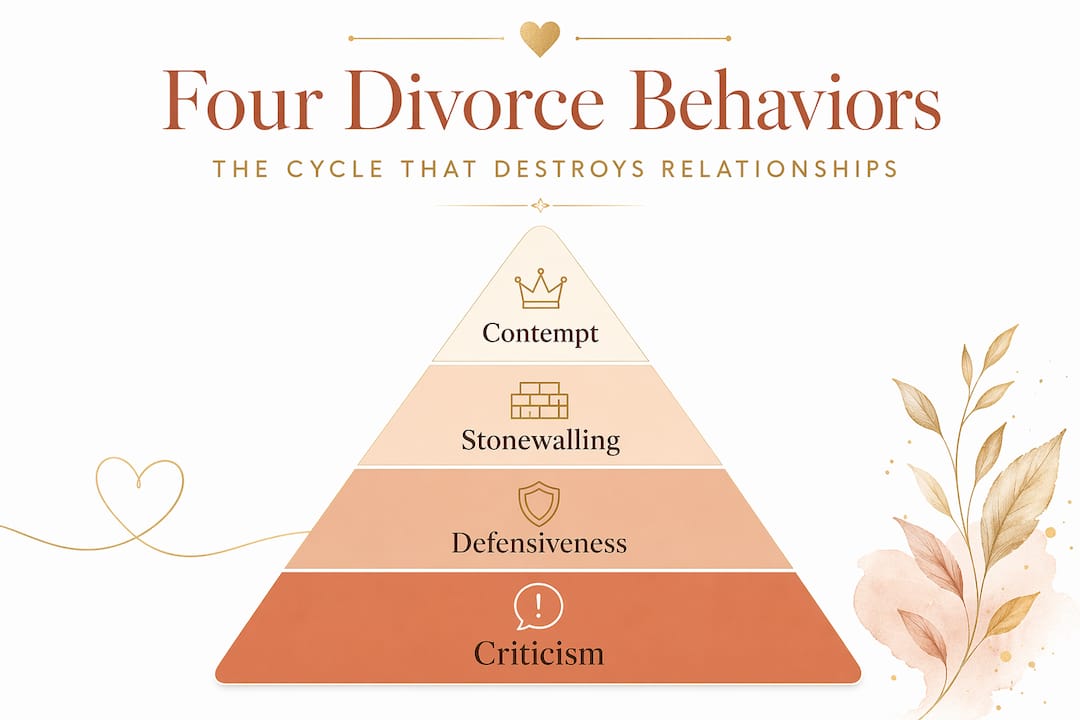
The frequency and combination of these behaviors signal relationship dysfunction far more clearly than any single incident. Couples who argue occasionally, even intensely, don’t automatically divorce. What predicts the outcome is whether these four patterns dominate how the couple communicates over time.
| Behavior combination | Risk level | What it looks like |
|---|---|---|
| Criticism only | Moderate | Frequent complaints framed as character attacks |
| Criticism plus defensiveness | High | Arguments go in circles, nothing gets resolved |
| Contempt plus stonewalling | Very high | One partner feels superior, the other shuts down |
| All four behaviors present | Severe | Divorce risk spikes significantly; cycle is deeply entrenched |
The cumulative effect is what makes this model so useful. You’re not looking for a single bad fight. You’re looking for a pattern that has become the default way two people interact when things get hard.
Pro Tip: If you recognize your relationship in that “all four” row, that’s not a verdict. It’s a starting point. Couples who name these patterns and commit to changing them can and do turn things around. Early intervention matters enormously.
Other common triggers that make things worse
The Four Horsemen don’t operate in a vacuum. They typically show up alongside other stressors that act as accelerants. Understanding the broader picture of what causes most divorces helps you see how these behavioral patterns connect to the real-world pressures couples face.
Over 60% of divorcing couples cite money issues and infidelity as primary triggers for the marriage ending. Communication problems appear in over 40% of cases. These aren’t separate from the Four Horsemen. They’re deeply intertwined with them.
Financial secrecy and hidden debt erode trust in ways that almost always trigger contempt and defensiveness. When one partner discovers the other has been hiding financial information, the betrayal triggers a cycle of accusations, denials, and emotional withdrawal. That’s the Four Horsemen, activated by a money crisis.
Poor communication increases divorce risk by 3.5 times within ten years. That statistic points directly back to the Four Horsemen, because all four behaviors are fundamentally communication failures.
Here are the most common relationship issues that interact with the Four Horsemen to push couples toward divorce:
- Financial stress and conflict over money management: Arguments about spending, debt, and financial priorities create fertile ground for contempt and criticism.
- Infidelity and betrayal: Affairs create deep wounds that the Four Horsemen carve wider. If you’re dealing with this, resources on rebuilding trust after betrayal can help map a path forward.
- Emotional withdrawal and lack of commitment: When one or both partners have mentally checked out, stonewalling becomes a permanent state rather than a response to conflict.
- Incompatibility in core values: Differences in parenting, religion, or lifestyle that never get honestly discussed eventually breed contempt.
- Chronic conflict without resolution: When the same arguments repeat without any change, couples stop trying, and defensiveness becomes automatic.
What’s worth noting is that none of these triggers alone causes a marriage to end. It’s the combination of external stressors and the Four Horsemen behaviors in response to them that creates the conditions for divorce.
How to recognize and address these behaviors
Awareness is the beginning, but it’s not enough on its own. Once you can name these patterns, the next step is changing them. Here’s a practical framework for addressing each one:
- Replace criticism with specific complaints. Instead of “you never listen to me,” try “I felt dismissed when I was talking about my day and you were on your phone.” Target the behavior, not the person.
- Counter contempt with genuine appreciation. This sounds simple and takes real effort to sustain. Start by actively noticing what your partner does well. Say it out loud, often. The antidote to contempt is a culture of respect, built through daily practice.
- Interrupt defensiveness by taking responsibility. When you feel the urge to deflect, pause. Ask yourself if there’s even 10% of truth in what your partner is saying. Acknowledge that piece before defending yourself. Learning to manage defensiveness productively is one of the most powerful communication shifts a couple can make.
- Prevent stonewalling with self-awareness. When you feel overwhelmed and the urge to shut down kicks in, say so. “I’m feeling flooded right now. I need twenty minutes and then I want to come back to this.” That’s honest, it honors both people, and it keeps the conversation from dying entirely.
- Have honest financial conversations before stress becomes crisis. Schedule monthly money check-ins. Bring mindfulness into difficult conversations to reduce emotional flooding before it triggers stonewalling.
- Seek counseling when you can’t shift the patterns alone. A skilled therapist can help you slow down the cycle and practice new responses in real time.
Pro Tip: The “I feel” statement formula works because it removes blame from the equation. “I feel hurt when…” is harder to argue with than “You always make me feel…” Use it consistently, especially in conversations that have historically gone sideways.

My honest take after years of working with couples in crisis
I’ve seen couples walk in completely convinced that their marriage ended because of one event. The affair. The bankruptcy. The blowout fight at Christmas. What almost always surfaces instead is that the Four Horsemen had been present for years before that event ever happened. The event was the match, but the Four Horsemen were the fuel.
The most painful thing I witness is when people have been living inside these patterns for so long that they can’t imagine communicating any other way. Contempt feels like honesty to them. Stonewalling feels like self-preservation. Defensiveness feels like standing up for themselves. They’re not wrong to want those things. They’ve just developed damaging ways of trying to get them.
What I’ve also learned is that recognition is genuinely transformative. When a person sits across from me and says “that’s exactly what we do,” something shifts. There’s a kind of relief in naming the pattern. It stops being personal and starts being solvable. That shift in mindset is where real change begins.
The research on the Four Horsemen offers something rare. A specific, learnable framework for understanding what’s actually happening in a struggling relationship. That is worth more than any amount of vague advice about “communicating better.” You can’t fix what you can’t name.
— S.J.Howe
Ready to take the next step toward healing
If this article has surfaced something painful and real for you, you’re not alone. Whether you’re questioning your relationship, processing betrayal, or trying to understand how things fell apart, Aftertheaffair offers structured, evidence-informed resources designed for exactly this moment.
The 7-step infidelity recovery checklist gives you a clear, practical path through the hardest phases of healing, whether you’re deciding whether to stay, trying to rebuild, or moving forward on your own. For those working to repair what was broken, the relationship growth guide walks through rebuilding trust with honesty and skill. These aren’t generic self-help resources. They’re built around the real emotional and behavioral complexity that people in your situation are actually navigating.
FAQ
What are the four behaviors that predict most divorces?
The four behaviors are criticism, contempt, defensiveness, and stonewalling. Research identifies these as the strongest behavioral predictors of marital breakdown, collectively called the Four Horsemen.
Which of the four behaviors is the most damaging?
Contempt is widely considered the most serious predictor of divorce. It signals a loss of basic respect and includes sarcasm, eye-rolling, and name-calling, all of which communicate that one partner views the other as inferior.
Can a marriage recover if all four behaviors are present?
Yes, though it requires deliberate effort and usually professional support. Couples who display all four behaviors face higher divorce risk, but recognizing the patterns and committing to new communication strategies can meaningfully change the outcome.
How does communication breakdown relate to divorce?
Poor communication increases divorce risk by 3.5 times within ten years, with 42% of marital disputes tied to unresolved communication problems. The Four Horsemen are fundamentally communication failures that worsen over time when left unaddressed.
How do I start changing these patterns in my relationship?
Start by replacing criticism with specific complaint statements and using “I feel” language. Take responsibility for your part in conflicts rather than deflecting. If contempt or stonewalling has become habitual, a couples counselor can help you practice new responses with guidance.
Recommended
- Behavioral Red Flags in Kids – After the Affair Series
- 15 Boundary Scripts for Divorce Moments – After the Affair Series
- 15 Boundary Scripts for Divorce Moments – After the Affair Series
- 4 parenting styles for infidelity recovery success – After the Affair Series