TL;DR:
- Complex trauma results from repeated harmful experiences, often within relationships, that physically rewires the brain and fractures self-identity. Unlike single-event PTSD, complex trauma involves chronic symptoms such as emotional dysregulation, negative self-concept, and relational disturbances, requiring phased treatment focused on stabilization first. Recognizing trauma as an injury rather than a character flaw can improve diagnosis, reduce self-blame, and support effective healing for high-functioning survivors.
Most people picture trauma as a single catastrophic event. A car accident. A natural disaster. One terrible moment that splits life into before and after. Complex trauma explained properly looks nothing like that. It’s the accumulation of repeated, often inescapable harm, typically within relationships that were supposed to be safe. Understanding complex trauma means confronting how prolonged exposure to abuse, neglect, or relational violence doesn’t just scare you. It physically rewires your brain, fractures your sense of self, and leaves symptoms that look like personality flaws to everyone who doesn’t know better.
Key takeaways
| Point | Details |
|---|---|
| Complex trauma is chronic, not acute | It stems from repeated exposure to harm, often in childhood or inescapable relational contexts. |
| C-PTSD goes beyond standard PTSD | It includes three additional symptom clusters: affect dysregulation, negative self-concept, and relational disturbances. |
| Symptoms are physiological injuries | Brain architecture changes are measurable, making complex trauma a nervous system injury, not a character flaw. |
| Treatment requires phased care | Effective complex trauma therapy starts with stabilization before any trauma processing begins. |
| High-functioning survivors often go undiagnosed | Compensation through intellectual or professional success can mask severe internal distress. |
Complex trauma vs. PTSD: the clinical difference
When most clinicians and survivors hear “PTSD,” they think of combat veterans or assault survivors. Standard PTSD follows a recognizable pattern: a discrete traumatic event, followed by flashbacks, hypervigilance, and avoidance. Complex trauma, and the diagnosis it produces, Complex PTSD (C-PTSD), is a different clinical picture entirely.
Complex PTSD was formally recognized by the WHO in the ICD-11 in 2018, though it still lacks a standalone entry in the DSM-5. That classification gap creates real problems for American survivors seeking diagnosis and insurance coverage. Prevalence estimates range from 1 to 8% in the general population, and up to 30 to 50% among survivors of childhood abuse and prolonged relational trauma.
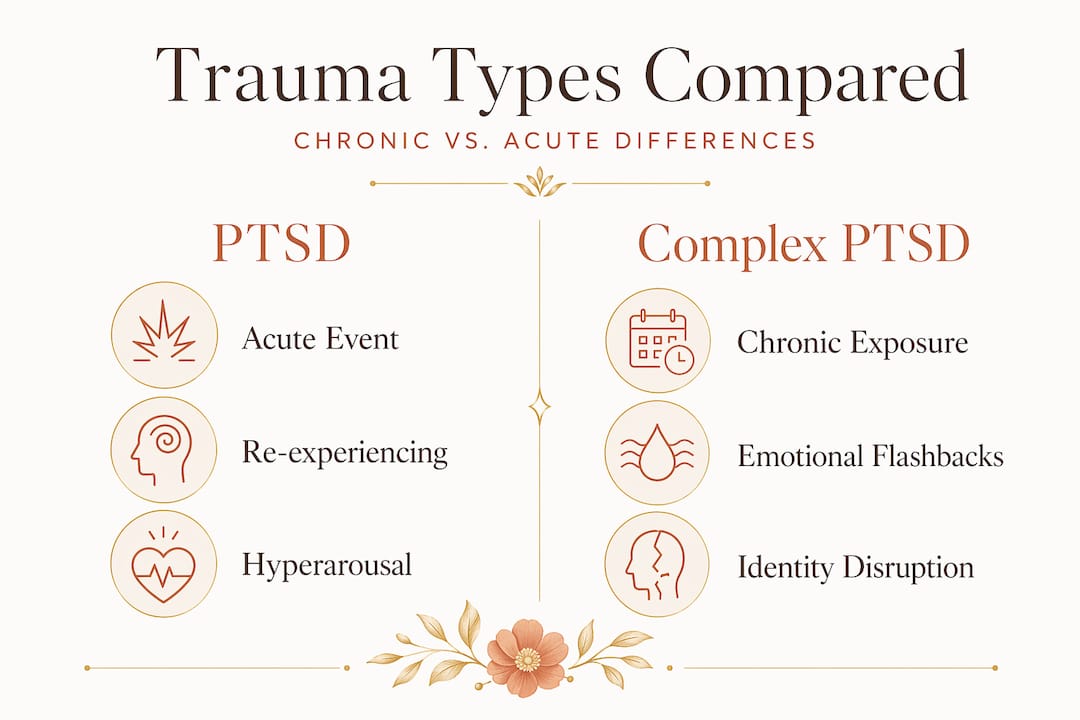
The core distinction is this: what is complex trauma, at its foundation, is defined by chronicity and inescapability rather than a single dramatic event. It typically develops when someone is trapped in repeated harmful situations, such as childhood abuse, domestic violence, captivity, refugee experiences, or sustained emotional neglect.
Beyond the standard PTSD symptom set, C-PTSD presents 17 recognized symptom markers organized across three additional domains not present in standard PTSD:
| Symptom Domain | Standard PTSD | Complex PTSD (C-PTSD) |
|---|---|---|
| Re-experiencing | Yes (flashbacks, nightmares) | Yes, plus emotional flashbacks |
| Avoidance | Yes | Yes |
| Hypervigilance | Yes | Yes, often chronic |
| Affect dysregulation | No | Yes (emotional overwhelm, mood instability) |
| Negative self-concept | No | Yes (chronic shame, self-blame) |
| Relational disturbances | No | Yes (distrust, isolation, attachment difficulties) |
This table isn’t just academic. It’s the difference between a survivor being told they have anxiety versus being given a framework that actually explains their experience.
How complex trauma reshapes the brain
The impact of complex trauma isn’t metaphorical. It’s measurable inside the skull.
Prolonged trauma alters brain architecture in three documented ways: reduced hippocampal volume (the region responsible for memory consolidation and context), a hyperreactive amygdala (the brain’s threat detection system, stuck in overdrive), and dysregulation of the HPA axis (the hormonal stress response system that governs cortisol release). These aren’t abstract findings. They mean that a survivor’s brain is physically less equipped to distinguish past threats from present safety.
The cognitive effects follow logically from those structural changes. Memory becomes fragmented rather than narrative. You may remember sensations, emotions, or physical states from traumatic periods without being able to construct a coherent story around them. Executive functioning, meaning the capacity to plan, regulate impulse, and make decisions under stress, becomes compromised.
One of the most misunderstood features of complex PTSD explained in clinical literature is the emotional flashback. Unlike standard PTSD flashbacks that involve vivid visual or sensory re-experiencing, emotional flashbacks lack narrative or visual memory. They are sudden, intense regressions to the overwhelming emotional states of childhood: terror, shame, despair, rage. You feel six years old without knowing why. That’s not weakness. That’s a nervous system that learned to protect itself.
Pro Tip: Reframing complex trauma symptoms as physiological injuries rather than personal failings isn’t just semantically kinder. It has measurable clinical value. When survivors stop blaming their character and start treating their nervous system as an injury site, self-regulation becomes possible in a way that sheer willpower never produced.
Common symptoms in daily life
Recognizing complex trauma symptoms in yourself or a client requires looking past the obvious crisis moments into the steady undertow of daily experience.
Core PTSD symptoms are present, including re-experiencing, avoidance, and persistent hypervigilance. But the effects of childhood trauma and prolonged relational harm add a layer of complexity that changes the texture of every relationship and every quiet moment.
Here’s what complex trauma symptoms frequently look like when they show up in real life:
- Chronic shame and self-blame that operates as a background hum, not just triggered by specific events
- Emotional flashbacks that feel like sudden, inexplicable crashes into despair, terror, or rage without obvious cause
- Dissociation ranging from mild spacing out to more significant disruptions in memory or identity
- Deep distrust of others, especially people in positions of authority or intimacy
- Difficulty identifying or naming emotions (alexithymia) because emotional awareness was never safe
- Self-sabotage in relationships driven by the expectation that closeness leads to harm
- Physical symptoms including chronic pain, fatigue, gastrointestinal issues, and autoimmune disorders linked to sustained stress hormone exposure
- Perfectionism and hyperachievement used as survival strategies to stay safe through control or approval
That last point deserves special attention. High-functioning survivors often appear outwardly successful while enduring severe internal emotional exhaustion and shame. A woman with a thriving career and a full social calendar can be experiencing C-PTSD symptoms every single day. The professional polish is the coping strategy, not evidence of wellness. Survival does not equal wellness, and confusing the two is one of the most dangerous misconceptions in this field.
Effective therapy and healing pathways
Healing from complex trauma is not a linear process, and any approach that treats it like one will eventually fail the person sitting across from the therapist.
Effective treatment requires phased approaches that conventional single-event PTSD protocols were never designed to deliver. The recognized phases move through stabilization, emotion regulation skill-building, careful trauma processing, and finally relational repair. Skipping phase one because a client seems stable is one of the most common clinical errors in complex trauma therapy, and it frequently leads to retraumatization.
Pro Tip: Safety must come before processing. Introducing trauma memories before a client has reliable self-regulation tools doesn’t accelerate healing. It deepens dysregulation. Build the container first.
Several therapeutic modalities have accumulated evidence for complex trauma work. EMDR (Eye Movement Desensitization and Reprocessing) adapted for complex presentations, somatic therapies that work directly with the body’s held stress responses, Internal Family Systems (IFS), and structured trauma processing approaches that build physical, mental, and emotional safety before touching core memories, all show meaningful outcomes.
Avoidance as a coping mechanism is understandable and often kept survivors safe during the trauma itself. In recovery, however, chronic avoidance prevents the memory consolidation process that transforms distressing fragmented memories into integrated long-term memory. Gentle, paced exposure within a regulated therapeutic relationship is the mechanism of change, not confrontation for its own sake.
The stages of healing are rarely clean or predictable. Survivors cycle back through earlier phases, especially during stress or relational triggers. Understanding this as the normal topology of complex trauma recovery, rather than failure, is what keeps people in treatment long enough for it to work.
My perspective on trauma as injury, not identity
What I’ve seen consistently, across years of working with survivors and professionals in this space, is that the single most damaging belief a person with complex trauma can hold is the belief that they are broken.
The framing matters enormously. When complex trauma is reframed as a nervous system injury rather than evidence of personal deficiency, something shifts clinically. Not just emotionally. The self-blame that was perpetuating the hypervigilance cycle starts to loosen. Regulation becomes possible. Hope stops feeling like a lie.
What I find most concerning in current practice is how often high-functioning survivors fall through diagnostic cracks. They present as capable, articulate, even insightful about their own trauma. And they walk out of assessment appointments without a diagnosis that reflects their actual experience, because their coping strategies look like health.
Professionals in this field need to hold two truths simultaneously: that symptoms are real physiological injuries requiring adapted clinical care, and that survivors are not defined by those injuries. That language shift, from “you are damaged” to “you were harmed and your nervous system adapted to survive,” changes the therapeutic relationship at its foundation.
Advocates for systemic change, including survivors who share their stories and clinicians who push for DSM recognition of C-PTSD, are doing work that will eventually reduce the years it takes most survivors to reach an accurate understanding of what happened to them. That work matters.
— S.J.Howe

Start your healing with the right support
If this article resonated with you, the chances are good that you are already living what complex trauma explained in clinical terms only partially captures.
At Aftertheaffair, we recognize that many survivors of infidelity and relational betrayal are not just dealing with hurt feelings. They are carrying the weight of complex trauma, often without a name for it. The resources available through the After the Affair Series were built with that reality in mind. The 7-step recovery checklist gives survivors a structured, phase-sensitive path through the earliest and most disorienting stages of healing. For those further along, rebuilding relationship trust addresses the relational repair work that comes after stabilization. Clinicians supporting clients through betrayal trauma will also find practical guidance in our therapist-specific resources. You do not have to figure this out alone.
FAQ
What is complex trauma?
Complex trauma refers to repeated, prolonged exposure to harmful experiences, often within relationships, that overwhelms a person’s ability to cope and reshapes their emotional regulation, self-concept, and capacity for trust.
How is complex PTSD different from regular PTSD?
Standard PTSD typically follows a single traumatic event, while C-PTSD involves additional symptom clusters including chronic shame, affect dysregulation, and lasting relational difficulties caused by sustained or repeated trauma.
What are the most common complex trauma symptoms?
Core symptoms include emotional flashbacks, chronic shame, dissociation, difficulty trusting others, fragmented memory, and physical symptoms like fatigue and chronic pain, often alongside standard PTSD features.
Can complex trauma be treated effectively?
Yes. Phased trauma therapy that prioritizes stabilization before memory processing, using approaches like EMDR, somatic therapy, or IFS, produces meaningful recovery outcomes when applied consistently over time.
Why do some complex trauma survivors appear high-functioning?
High-functioning survivors often use professional achievement, perfectionism, and intellectual insight as coping strategies that mask internal distress, making accurate diagnosis and appropriate support significantly harder to access.
Recommended
- Betrayal Trauma Hub – After the Affair Series
- Therapy types that work best for infidelity trauma
- Betrayal Trauma Symptoms – After the Affair Series
- Trauma complejo en pareja: cómo reconocerlo y sanar