- Introduction to parenting styles and family trauma
- Detailed descriptions of the four parenting styles
- How parenting styles affect children during infidelity recovery
- Common misconceptions about parenting styles in crisis
- Comparing parenting styles: pros, cons, and family recovery outcomes
- Practical guidance for adjusting parenting styles after infidelity
- Summary and next steps for healing parents
- Explore expert resources for infidelity recovery
- What are the four types of parenting styles?
- Recommended
Parenting under the weight of infidelity recovery presents unique challenges that can profoundly shape your children’s emotional health. Studies reveal that children in families using authoritative parenting during crises experience 50% less emotional distress compared to other approaches. Understanding how your parenting style impacts recovery can transform your family’s healing journey and build lasting resilience.
Key takeaways
| Point | Details |
|---|---|
| Four distinct parenting styles | Authoritative, authoritarian, permissive, and uninvolved each combine different levels of warmth and control. |
| Authoritative style excels in recovery | Balances warmth with firm boundaries, supporting emotional regulation and trust rebuilding after infidelity. |
| Permissive and uninvolved hinder healing | Lack of structure or emotional connection delays children’s ability to process trauma effectively. |
| Style changes are achievable | Parents can intentionally shift toward more effective approaches with practice and support. |
| Warmth matters more than control | Emotional connection forms the foundation for children’s resilience during family crises. |
Introduction to parenting styles and family trauma
Your parenting approach determines how your children process and recover from the trauma of infidelity in your family. Four primary styles exist, each defined by unique combinations of warmth and control.
Authoritative parenting blends high warmth with consistent boundaries. You provide emotional support while maintaining clear expectations. Authoritarian parenting emphasizes strict rules with minimal emotional warmth. You demand obedience without much explanation or flexibility.
Permissive parenting offers abundant warmth but few boundaries. You avoid confrontation and let children make most decisions. Uninvolved parenting reflects low warmth and minimal control, leaving children to navigate challenges alone.
During infidelity recovery, your parenting style shapes how children understand trust, manage emotions, and rebuild security. The infidelity impact on children extends beyond the immediate crisis, influencing their emotional development for years.
Warmth provides the emotional safety children need to express confusion and fear. Control offers structure when their world feels chaotic. Together, these dimensions create a framework that either accelerates healing or compounds trauma. Your approach directly affects whether children develop resilience or struggle with lasting emotional wounds from family betrayal.
Detailed descriptions of the four parenting styles
Each parenting style creates a distinct emotional climate in your home, particularly visible during crisis periods like infidelity recovery.
Authoritative parenting characteristics:
- You combine warmth with age appropriate expectations and consistent consequences
- You explain rules clearly and listen to your children’s perspectives
- You validate emotions while guiding behavior toward healthy outcomes
- You adapt boundaries as children grow but maintain core values
Authoritarian parenting characteristics:
- You enforce rigid rules without room for discussion or emotional expression
- You prioritize obedience over understanding
- You use punishment rather than teaching moments
- You maintain emotional distance to preserve authority
Permissive parenting characteristics:
- You avoid setting limits to prevent conflict or disappointment
- You act more like a friend than a parent figure
- You struggle to follow through on consequences
- You provide excessive freedom without guidance
Uninvolved parenting characteristics:
- You disengage from children’s emotional and practical needs
- You offer minimal supervision or emotional connection
- You focus primarily on your own concerns
- You remain unaware of children’s activities or struggles
These patterns intensify during recovery. Preparing kids for parenting changes becomes essential when you recognize your current approach isn’t serving your family’s healing needs. Understanding your default style helps you identify areas for growth.
How parenting styles affect children during infidelity recovery
Your parenting approach directly influences your children’s ability to process betrayal trauma and rebuild emotional security.
Authoritative parenting creates the strongest foundation for recovery. Children feel safe expressing confusion and hurt because you respond with empathy while maintaining stability. They learn healthy emotional regulation through your modeling. Research shows families adopting authoritative parenting during infidelity recovery experience a 50% reduction in child emotional distress compared to other approaches.
Authoritarian parenting typically backfires during crisis. Demanding obedience without addressing emotions forces children to suppress legitimate pain and confusion. They may:
- Develop anxiety from unexpressed feelings
- Show increased behavioral problems as emotional outlets
- Withdraw from parents emotionally
- Struggle trusting adults who demand rather than connect
Permissive parenting leaves children adrift when they need anchors most. Without boundaries, they can’t distinguish between normal family conflict and serious problems. They may feel responsible for fixing adult issues or develop confusion about relationship expectations.
Uninvolved parenting compounds trauma significantly. Children in uninvolved households show a 30% increase in academic and emotional difficulties. During infidelity recovery, neglect signals that their pain doesn’t matter, creating deep wounds around self worth.
Children experiencing family trauma need both emotional warmth and structural stability. When parents provide only one dimension or neither, recovery stalls and secondary issues emerge.
Building kids resilience after infidelity requires intentional parenting that addresses both emotional and practical needs. Your response to their questions, your consistency in daily routines, and your willingness to validate feelings while maintaining boundaries all contribute to their healing trajectory.
Common misconceptions about parenting styles in crisis
Several myths about effective parenting during infidelity recovery can lead you toward harmful approaches.
Myth: Strict control prevents chaos
Many parents believe authoritarian strictness provides stability during crisis. You might think tighter rules and harsher consequences will keep children from acting out. Actually, rigid control increases anxiety and rebellion. Children need structure, but they also need space to process emotions safely.
Myth: Extra warmth compensates for everything
Some parents swing permissive, believing unlimited affection heals trauma. While warmth matters tremendously, children also need boundaries to feel secure. Permissiveness without structure creates confusion about what’s normal and safe in relationships.
Myth: Your parenting style is fixed
You might think you’re stuck with your default approach because it’s how you were raised. Change requires effort but remains entirely possible. Most parents successfully shift toward more effective styles when motivated by their children’s needs.
Myth: Children just need time
Uninvolved parents often assume children naturally recover if given space. Passive hope doesn’t heal trauma. Active, engaged parenting accelerates recovery while neglect extends suffering.
Pro Tip: Track one specific parenting behavior weekly, like how you respond to emotional outbursts. Small, consistent changes compound into significant style shifts over months.
Understanding how to guide clients after infidelity reveals that professional support often focuses on correcting these exact misconceptions. Your willingness to challenge assumptions opens pathways to more effective parenting during recovery.
Comparing parenting styles: pros, cons, and family recovery outcomes
A direct comparison helps you evaluate which approach best supports your family’s healing journey.
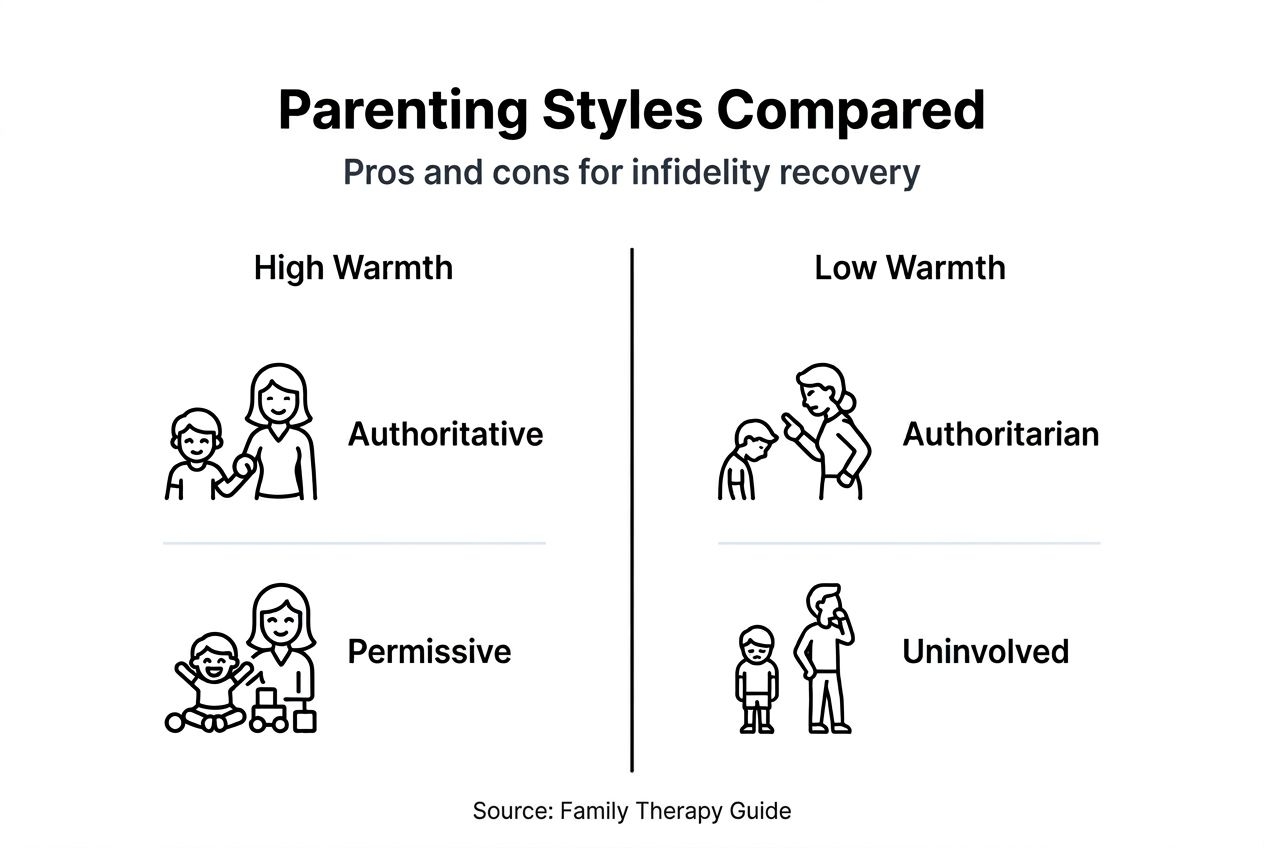
| Parenting Style | Warmth Level | Control Level | Recovery Outcome | Key Advantage | Main Drawback |
|---|---|---|---|---|---|
| Authoritative | High | High | Excellent | Builds resilience and emotional regulation | Requires consistent effort and self awareness |
| Authoritarian | Low | High | Poor | Maintains order temporarily | Suppresses emotions and damages trust |
| Permissive | High | Low | Fair | Children feel loved | Lacks structure for processing trauma |
| Uninvolved | Low | Low | Very Poor | Minimal parental stress | Severely harms children’s emotional development |
Authoritative parenting advantages:
- Children develop strong coping skills for future challenges
- Family communication improves significantly
- Trust rebuilds faster through consistent reliability
- Emotional wounds heal with proper support
Authoritative parenting challenges:
- Demands emotional energy when you’re already drained
- Requires learning new skills if it’s not your default
- Takes patience as changes unfold gradually
Other styles’ recovery impacts:
Authoritarian approaches may quiet immediate behavioral issues but create emotional distance that hinders genuine healing. Children comply externally while struggling internally. Permissive warmth feels good short term but fails to teach children how to process complex emotions within healthy boundaries.
Families adopting authoritative parenting during infidelity recovery experience a 50% reduction in child emotional distress within six months. This data driven outcome demonstrates clear advantages over other approaches.
The connection between parenting style and relationship growth after infidelity extends beyond parent child dynamics. Children who see healthy boundaries modeled learn critical relationship skills that serve them lifelong.
Practical guidance for adjusting parenting styles after infidelity
Transitioning toward authoritative parenting requires specific, actionable steps you can implement starting today.
- Assess your current default honestly. Notice whether you tend toward control without warmth, warmth without boundaries, or disengagement. Track your responses to challenging moments for one week without judgment.
- Increase warmth through active listening. When children express feelings, pause everything else. Reflect what you hear before problem solving. Say things like “That sounds really confusing” or “I hear how much that hurt.”
- Establish age appropriate boundaries collaboratively. Involve children in creating rules where appropriate. Explain why boundaries exist rather than demanding blind obedience. Be consistent in enforcing agreed upon limits.
- Practice emotion coaching daily. Help children name feelings rather than acting them out. Teach coping strategies through your own example. Validate emotions even when you can’t validate behaviors.
- Create predictable routines. Consistency in daily schedules provides security when emotional landscapes feel chaotic. Maintain bedtimes, mealtimes, and family rituals even during difficult periods.
- Repair ruptures promptly. When you react poorly, apologize genuinely and explain what you’ll do differently. Modeling accountability teaches children how relationships heal after mistakes.
- Seek professional support. Individual therapy, family counseling, or parenting coaching provides personalized guidance. Professionals help you navigate your specific family dynamics.
Pro Tip: Focus on changing one interaction pattern at a time rather than overhauling everything simultaneously. Master responding to bedtime resistance with warmth and boundaries before tackling homework conflicts.
Resources for preparing kids for parenting changes offer frameworks for explaining shifts in your approach. Transparency about your growth journey helps children understand that change signals improvement, not instability.
Implementing healthy co parenting after infidelity becomes easier when both parents align on authoritative principles. United approaches prevent children from playing parents against each other or receiving mixed messages during vulnerable times.
Professionals trained in guiding clients after infidelity often recommend starting with warmth increases before boundary adjustments. Children need emotional safety before they’ll accept new limits without resistance.
Summary and next steps for healing parents
Your parenting style profoundly influences how your entire family recovers from infidelity trauma.
Authoritative parenting emerges as the most effective approach, combining emotional warmth with consistent boundaries. This balance provides children the security and support they need to process betrayal, rebuild trust, and develop resilience. Research consistently shows faster recovery and better long term outcomes for families using this approach.
Key principles to remember:
- Warmth creates safety for emotional expression
- Boundaries provide structure during chaos
- Consistency rebuilds trust damaged by betrayal
- Active engagement accelerates healing
Changing your parenting style requires intention and practice, but the investment pays dividends in your children’s emotional health and your family’s cohesion. Start with small adjustments, seek support when needed, and trust that improvement compounds over time.
Your children’s recovery depends partly on how you show up as a parent during this challenging period. Authoritative parenting gives them the best chance to emerge from this crisis stronger, more emotionally intelligent, and better equipped for future relationships.
Explore expert resources for infidelity recovery
Navigating parenting challenges during infidelity recovery becomes easier with structured, evidence based guidance tailored to your family’s unique situation.

Our 7 steps infidelity recovery checklist provides a comprehensive framework for healing that includes parenting strategies alongside personal and relational recovery work. These sequential steps help you prioritize actions when everything feels overwhelming.
Explore resources on relationship growth after infidelity to understand how improved parenting connects with broader family healing. When you model healthy relationship skills through authoritative parenting, children learn patterns that serve them lifelong.
Discover practical approaches for preparing kids for parenting changes that reduce resistance and increase cooperation as you shift toward more effective styles during recovery.
What are the four types of parenting styles?
What are the four types of parenting styles?
The four parenting styles are authoritative, authoritarian, permissive, and uninvolved. They differ based on warmth and control levels, creating distinct emotional climates for children.
How does authoritative parenting help during infidelity recovery?
Authoritative parenting combines emotional warmth with consistent boundaries, helping children feel safe enough to express difficult emotions. This balance reduces emotional distress by 50% during recovery compared to other styles. The approach teaches healthy coping skills while maintaining stability, accelerating trust rebuilding and kids resilience after infidelity.
Can parenting styles be changed after infidelity?
Yes, parenting styles can absolutely be modified through intentional practice and support. Most parents successfully shift toward authoritative approaches when motivated by their children’s needs during recovery. Resources for preparing kids for parenting changes provide frameworks for successful transitions that children understand and accept.
What common mistakes should parents avoid when recovering from infidelity?
Avoid swinging to authoritarian control expecting immediate compliance, as this suppresses necessary emotional processing. Don’t confuse permissive warmth without boundaries as effective support. Prioritize validating children’s emotions even when you’re overwhelmed by adult relationship challenges, as uninvolved parenting significantly compounds trauma.
Recommended
- 15 Workbook Exercises for Recovery – After the Affair Series
- 7 Steps-Infidelity Recovery Checklist – After the Affair Series
- How to Guide Clients After Infidelity for Healing – After the Affair Series
- Recovery Book Series – After the Affair Series