Last Updated: August 3, 2026
- How to Decide Whether to Stay or Leave Your Marriage: A Structured Approach
- Recognize the Signs It Is Time to Get a Divorce
- Questions to Ask Before Divorce: Your Self-Assessment Checklist
- How to Talk to Your Spouse About Divorce
- How to Know If Marriage Counseling Is Working
- Evaluate Financial Independence and Long-Term Stability
- The Gray Divorce Phenomenon: Special Considerations for Older Adults
- Cultural and Religious Barriers to Leaving a Marriage
- Key Takeaways: Moving Forward with Clarity
- Frequently Asked Questions
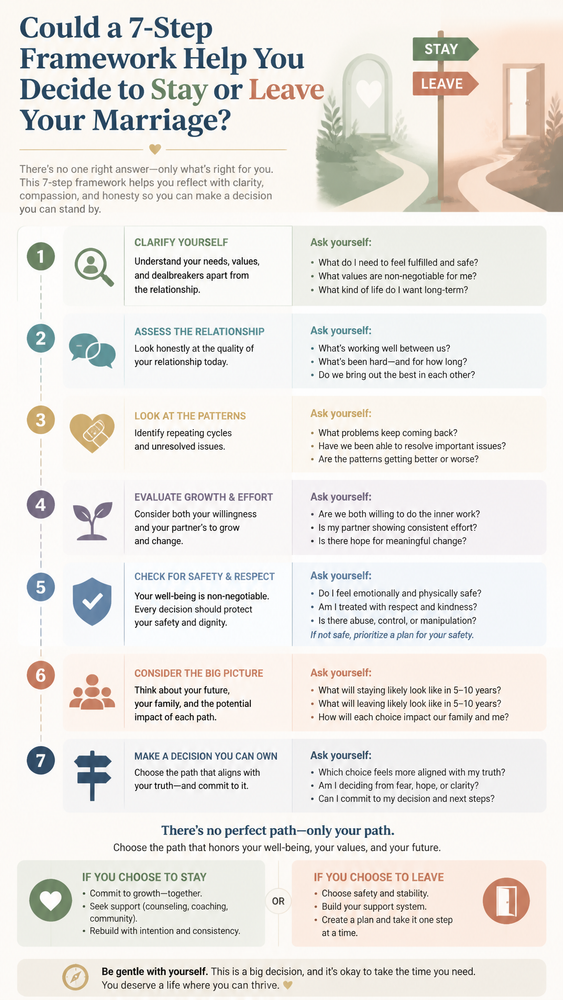
How to Decide Whether to Stay or Leave Your Marriage: A Structured Approach
When contemplating whether to stay or leave your marriage, you’re facing one of life’s most consequential decisions. This decision demands honest self-reflection, structured assessment, and often professional support. It emerges from patterns you’ve noticed, questions you’ve avoided, and a growing awareness that something fundamental has shifted.
The stakes are high: your decision affects your own future, your children’s emotional wellbeing, your financial security, and your long-term life trajectory. This guide provides a framework to help you move through this decision with clarity rather than paralysis.
Below is a structured seven-step assessment process addressing core questions: Are the problems temporary or terminal? Have you genuinely explored reconciliation? What would staying and leaving each cost you? And what does your gut tell you when you strip away fear, obligation, and guilt?
Recognize the Signs It Is Time to Get a Divorce
Deciding whether to leave marriage becomes urgent when certain patterns emerge consistently over time. Months or years of the same dynamic despite your efforts tells a different story than one bad week.
The most reliable signs include: you feel fundamentally unsafe emotionally or physically; you’ve stopped trying because effort feels futile; you fantasize regularly about life without your spouse; there’s no emotional intimacy left and no desire to rebuild it; infidelity or betrayal has destroyed trust you cannot imagine rebuilding; you’re staying primarily out of fear, obligation, or judgment; your spouse is unwilling to work on the relationship or acknowledge problems; and your children are picking up on tension affecting their behavior or security.
After the Affair Series provides tools for individuals who discovered infidelity and found themselves at this crossroads. In many cases, the affair wasn’t the terminal issue but the catalyst forcing the question: “Do I actually want to stay?”
Ultimately, the question of whether to Stay or Leave Your Marriage can only be answered by you, and it requires a deep dive into your feelings, desires, and life circumstances.
Distinguishing a Temporary Crisis from a Terminal Issue
Not every crisis means the marriage is ending. The difference comes down to whether the core problem can be resolved and whether both partners are willing to work toward resolution.
A temporary crisis involves: a specific, identifiable problem; both partners acknowledging it exists; at least one partner motivated to fix it; no long pattern of the same issue recurring despite previous attempts; and the emotional foundation (respect, basic care, willingness to try) still intact.
A terminal issue involves: deep patterns persisting for years despite repeated attempts; fundamental incompatibility on core values; one or both partners emotionally checked out with no genuine interest in reconnecting; or the relationship becoming a source of harm rather than support.
Ask yourself: If this specific problem were solved tomorrow, would I actually want to stay? If the answer is still “no,” you’re likely facing a terminal issue.
The Role of Non-Negotiables in Your Relationship
Non-negotiables are values, behaviors, and boundaries defining the absolute minimum for staying in a relationship. They’re different from preferences. You might prefer emotional expressiveness but not require it. However, you might absolutely require fidelity, honesty, or commitment to sobriety.
Common non-negotiables include: honesty and transparency; physical or emotional safety; commitment to fidelity or agreed-upon exclusivity; willingness to work on problems; respect for your boundaries; and shared vision for major life decisions.
Many people have non-negotiables they haven’t communicated clearly to their spouse. Before concluding your spouse has violated one, ask: Have I been explicit about this boundary? Have I explained why it matters? Have I given my spouse genuine opportunity to understand and change?
Questions to Ask Before Divorce: Your Self-Assessment Checklist
Work through these questions in writing. Writing forces clarity in a way rumination doesn’t.
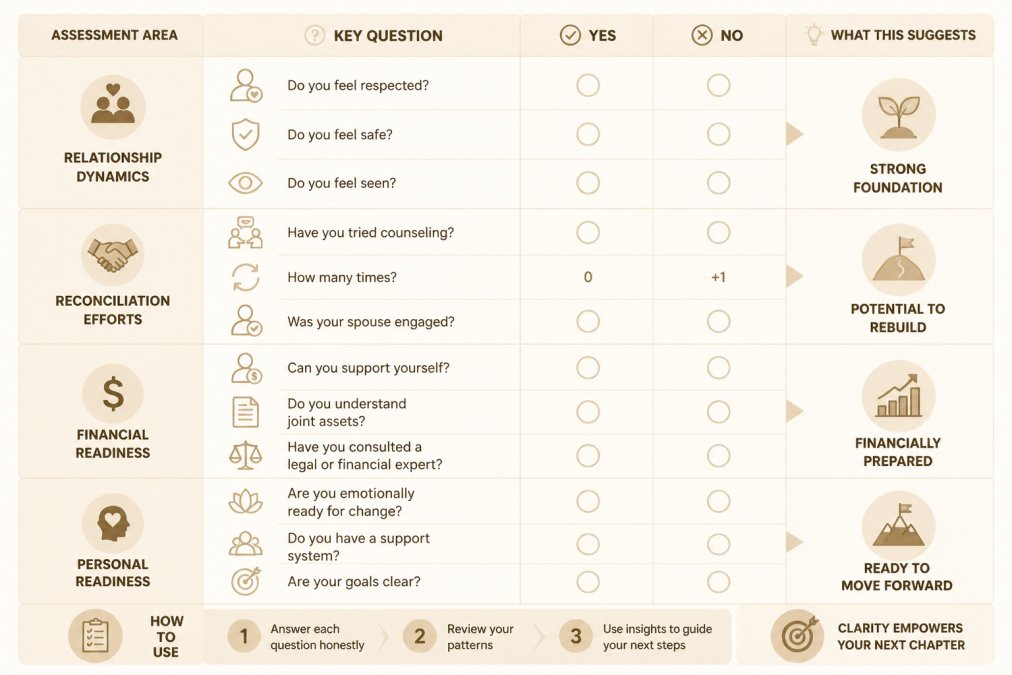
On your relationship dynamics:
- Do you feel fundamentally respected by your spouse, with your perspective, feelings, and needs actually valued?
- Do you feel safe emotionally, physically, and psychologically?
- Has your spouse violated your core trust, and if so, have they genuinely taken responsibility and worked to rebuild it?
- Can you imagine being vulnerable with your spouse again, or has that door closed?
On reconciliation efforts:
- Have you tried marriage counseling with a qualified therapist for at least 8-12 weeks?
- If you’ve tried counseling, was your spouse genuinely engaged or going through the motions?
- Have you had explicit conversations about specific issues making you consider leaving?
- Has your spouse acknowledged these issues exist, or do they deny, minimize, or blame you?
On financial and practical readiness:
- Do you have realistic understanding of your financial situation post-separation?
- Can you support yourself and your children on your own income?
- Do you have access to important financial documents?
On your children (if applicable):
- How are your children being affected by your marriage’s current state?
- What would co-parenting look like with your spouse?
On your emotional state:
- Are you experiencing depression, anxiety, or mental health symptoms related to the marriage?
- Are you staying primarily out of fear, or are there genuine reasons to stay?
Evaluating the Effort Put Into Reconciliation
Before concluding your marriage is beyond repair, honestly assess whether genuine reconciliation efforts have been made. You should be able to say, “I did everything I could reasonably do to save this marriage.”
Genuine reconciliation effort looks like: both partners acknowledging problems; both willing to attend counseling and actively participate; willingness to be vulnerable and honest about your own role; and genuine attempts to change specific behaviors over months.
The absence of reconciliation effort looks like: one partner refusing to acknowledge problems; refusal to attend counseling; attending but being defensive and unwilling to reflect; or repeated promises to change followed by no action.
If you haven’t tried professional counseling, that’s a reasonable next step before a final decision. If you’ve tried it and your spouse wasn’t genuinely engaged, or tried multiple times with no progress, you have your answer about whether reconciliation is possible.
Assessing the Impact on Children
Research is clear: children are harmed more by ongoing conflict in a marriage than by divorce itself. A high-conflict marriage with contempt and hostility causes measurable psychological harm. A divorce handled with co-parenting respect is difficult for children but manageable.
Ask honestly: Are my children better served by me staying in this marriage, or by me leaving and establishing a healthier co-parenting dynamic?
How to Talk to Your Spouse About Divorce
If you’ve concluded that leaving is right, you still need to have a conversation with your spouse. This deserves to be done with intention.
Before the conversation:
- Be clear that this is a decision, not a threat or negotiation.
- Choose a time when you’re both calm and have privacy, not in front of children.
- Consider whether you need a mediator or therapist present if there’s a history of escalation.
- Have practical information ready: divorce attorney information, understanding of your financial situation, clarity on what you’re proposing regarding children and assets.
During the conversation:
- Use “I” statements: “I’ve come to the conclusion that I need to separate” rather than blaming.
- Be honest but not cruel.
- Expect a range of reactions: shock, anger, sadness, denial. None mean you’ve made the wrong decision.
- Don’t let the conversation become a negotiation about whether you should leave.
- Be clear about next steps: “I’m going to consult with a divorce attorney. I’d like us to work through this civilly, but I’m prepared to do what I need to do to move forward.”
After the Affair Series provides structured communication tools that can help individuals approach difficult conversations with clarity and compassion, while maintaining firm boundaries, which can lead to better outcomes in the separation process.
How to Know If Marriage Counseling Is Working
If you’re still exploring and haven’t decided to leave, marriage counseling can be valuable. You need to know what progress actually looks like.
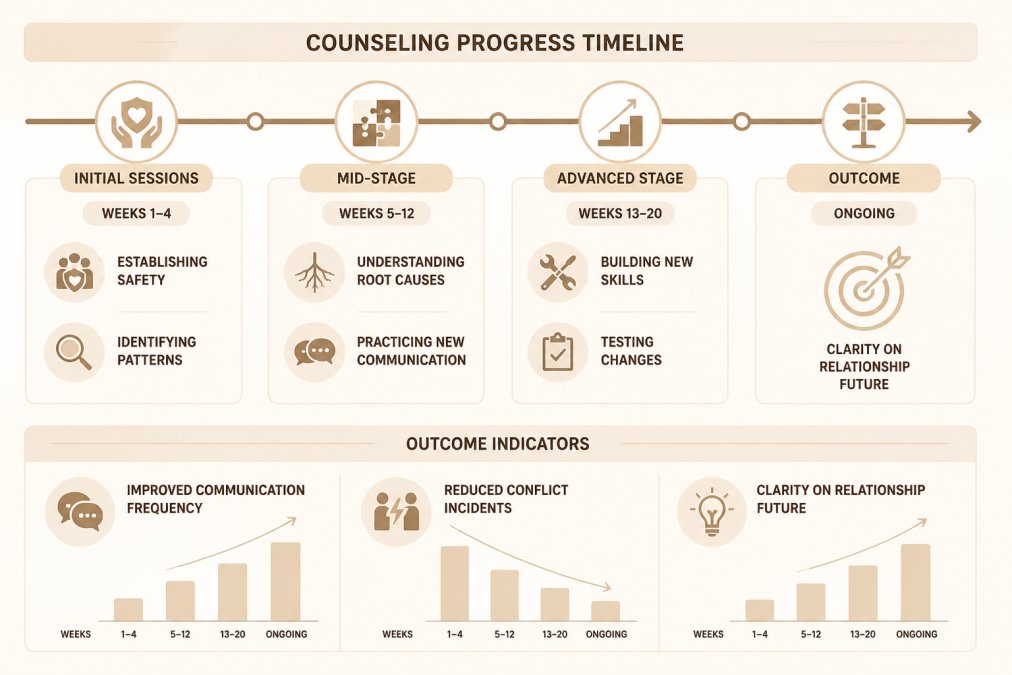
Signs that counseling is working:
- You’re having conversations at home you wouldn’t have without the counselor’s framework.
- You’re understanding your spouse’s perspective better, even if you disagree.
- You’re noticing specific behavioral changes (more present, less defensive, more willing to listen).
- You have clarity about whether the marriage is salvageable.
Signs that counseling is not working:
- After 8-12 weeks, you see no meaningful change in how you interact.
- Your spouse attends but is defensive, dismissive, or unwilling to reflect.
- You’re having the same arguments at home as before counseling.
- Your spouse is unwilling to attend or attends sporadically.
If you’ve been in counseling for 12-16 weeks with no progress, discuss with your counselor whether continuing makes sense. Sometimes the clarity that the marriage isn’t salvageable is itself progress.

Evaluate Financial Independence and Long-Term Stability
Financial fear is one of the most practical barriers to leaving. Before making a final decision, understand your financial situation post-separation realistically.
What you need to understand:
- Your household’s total income and assets (retirement accounts, home equity, investments).
- Your own earning capacity and whether you can support yourself on current income.
- Your spouse’s earning capacity and what spousal or child support might look like in your jurisdiction.
- Your monthly expenses and what they might be post-separation.
- Your state’s laws regarding property division, spousal support, and child support.
Consult with a divorce attorney who can explain your state’s specific laws and help you understand what a realistic settlement might look like. Many offer free initial consultations. Also consider consulting with a financial advisor or divorce financial specialist who can help you model different scenarios.
Financial fear is real and legitimate, but it’s often worse in imagination than reality. Once you have concrete information about your actual financial situation, you can make a more grounded decision.
The Gray Divorce Phenomenon: Special Considerations for Older Adults
If you’re over 50, you’re part of a growing demographic ending marriages later in life. The “gray divorce” rate has increased significantly, driven by longer lifespans, changing attitudes toward divorce, and a generation prioritizing personal fulfillment over staying in unhappy marriages out of obligation.
Gray divorce presents unique considerations: your financial situation may be more complex (pensions, Social Security, long-term care planning); your social circles may be intertwined with your spouse’s; and health considerations affect both independence and ability to support yourself.
However, gray divorce also has advantages: you likely have more financial resources; you have more clarity about what you want; your children are adults unaffected by custody arrangements; and you have time, potentially decades, to build a fulfilling life post-divorce.
If you’re considering leaving a marriage in your 50s, 60s, or beyond, pay particular attention to: your health and long-term care needs; retirement planning and how divorce affects it; your Social Security strategy; and your social support system.
Cultural and Religious Barriers to Leaving a Marriage
For many people, the decision to leave is complicated by cultural or religious beliefs about divorce, family loyalty, or marriage’s sanctity. These beliefs are deeply held and deserve respect, but they shouldn’t trap you in a harmful or deeply unhappy situation.
If navigating cultural or religious objections, consider: Are these genuinely your beliefs, or inherited beliefs you’ve accepted without examining? What would your community actually do if you divorced? Are there religious leaders or cultural figures within your tradition who support divorce in certain circumstances?
Many religious traditions have nuanced teachings allowing divorce in cases of infidelity, abuse, abandonment, or irreconcilable differences. If your faith is important, consult with a trusted religious leader who can help you understand what your tradition actually teaches.
After the Affair Series provides structured toolkits that can help individuals navigate complex personal decisions, including those influenced by cultural and religious considerations. The decision to leave is ultimately yours. Your cultural and religious community can inform it, but shouldn’t be the sole determinant.
Key Takeaways: Moving Forward with Clarity
The process of deciding whether to leave marriage is rarely linear. You’ll have moments of clarity followed by doubt. This is normal. What matters is moving through the decision systematically, using the framework above to assess your situation honestly.
The core questions are: Have I genuinely tried to fix this? Is my spouse willing to work on the relationship? Am I staying out of love and commitment, or out of fear and obligation? What would my life look like if I gave myself permission to leave?
Once you have answers, the decision often becomes clearer. It may not become easier, leaving a marriage is one of the hardest things you’ll ever do. But clarity is better than limbo, and a decision made from self-knowledge is one you can live with, even when painful.
If you’re struggling with infidelity, betrayal, or discovery aftermath, the decision-making process may be even more complicated. Trauma, shock, and grief can cloud judgment. Give yourself time. Seek professional support. Remember that deciding to leave isn’t a failure; sometimes it’s the most courageous and honest choice you can make.
Many individuals find that working through these questions with structured support helps them move from paralysis to clarity. After the Affair Series provides a free 23-point assessment that helps you evaluate your specific situation and understand where you stand. The assessment gives you scored results across key dimensions, relationship dynamics, reconciliation readiness, financial stability, impact on children, and emotional wellbeing, so you can see clearly where your relationship stands and what your next steps should be.
Whether you decide to stay and work on your marriage, or to leave and build a new life, the goal is to move forward with intention rather than drift in indecision. Take the assessment, and give yourself the clarity you deserve.
Frequently Asked Questions
How do I know if I should stay in my marriage or leave?
Start by assessing whether core non-negotiables have been violated (infidelity, abuse, fundamental value misalignment) and whether both partners are willing to work on the relationship. Evaluate your emotional safety, the impact on your children, and whether marriage therapy has produced measurable progress over 6-12 months. Use the self-assessment framework in this article to score each area objectively. If you’re experiencing decision paralysis after infidelity, the After the Affair Series free 23-point assessment helps clarify whether you’ve truly explored reconciliation or if separation is the healthier path.
What are the signs that a marriage is beyond repair?
Terminal issues include persistent infidelity without accountability, physical or emotional abuse, complete emotional detachment lasting months, refusal to engage in counseling, or fundamental incompatibility on life goals and values. A key distinction: temporary crises (job loss, grief, conflict) are often survivable with effort; terminal patterns involve repeated boundary violations, contempt, or one partner’s unwillingness to change. If you’ve invested 6+ months in marriage therapy with no improvement in communication or intimacy, and one or both partners have checked out emotionally, the relationship may be beyond repair.
How does divorce affect children, and what should I consider?
Research shows children adapt better to a healthy separation than to a high-conflict marriage. Key considerations: your ability to co-parent with civility, your ex’s willingness to prioritize the child’s relationship with both parents, and your financial stability to maintain the child’s standard of living. High-conflict co-parenting requires structured communication tools (like the Gray Rock Method) to shield children from adult conflict. Before deciding, assess whether staying in the marriage models healthy relationships or teaches children to tolerate toxicity. Children need emotional safety more than an intact family structure.
What should I consider before filing for divorce in the US?
Consult a family law attorney in your state to understand property division, spousal support, and custody frameworks specific to your jurisdiction. Gather financial documentation (tax returns, bank statements, retirement accounts). Understand your state’s residency requirements (typically 6 months) and whether you need grounds for divorce or can file no-fault. If infidelity is involved, determine whether it affects spousal support in your state. Separate your finances where possible, secure housing, and establish a support network. Document any abuse or safety concerns. The emotional and financial implications of divorce are substantial; clarity on these factors prevents costly mistakes.