- Understanding the Guilt Amplification Loop
- Guilt Cycle Psychology: How the Loop Intensifies
- Healthy Guilt vs. Toxic Guilt: Know the Difference
- Recognizing Self-Destructive Thought Patterns
- Self-Compassion for Guilt: Rewriting Your Inner Dialogue
- Somatic Release Techniques: Healing Beyond Thought
- Therapy for Guilt and Shame: When Professional Support Helps
- Breaking the Cycle of Self-Blame: Practical Action Steps
- Frequently Asked Questions
Last Updated: August 2, 2026
The guilt amplification loop is a self- perpetuating spiral of self-blame and emotional exhaustion that follows betrayal or relationship breakdown. This guide explains how the loop forms, why it’s difficult to escape, and the specific techniques that interrupt the cycle before it deepens into shame.
The guilt amplification loop is not a character flaw. It’s a neurochemical and psychological process that your brain defaults to under stress.
Understanding the Guilt Amplification Loop
When guilt takes hold after infidelity, separation, or high-conflict co-parenting, it doesn’t sit quietly. Instead, guilt triggers a cascade of thoughts, feelings, and behaviors that reinforce the original guilt, creating a self-feeding cycle.
What Happens During a Guilt Cycle
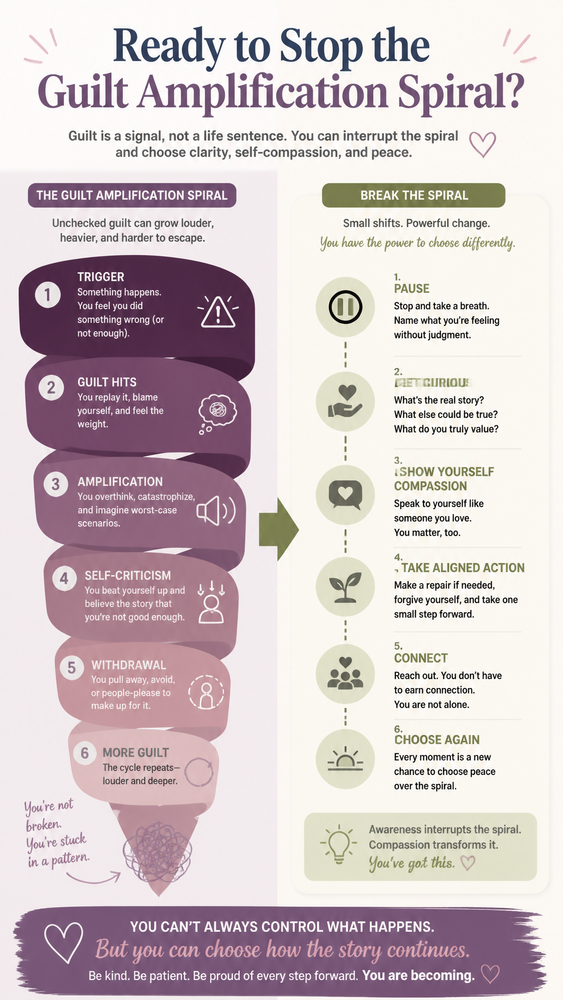
A guilt cycle begins with a triggering event: a harsh exchange with your ex-partner, a parenting mistake, or a moment when your mind replays the betrayal. Your brain generates a self-critical thought: “I should have known,” “I’m a bad parent,” or “This is my fault.” That thought activates your emotional nervous system, creating physical sensations, tension, chest tightness, or a sinking feeling. Your mind interprets that physical sensation as proof the guilt is justified, reinforcing the original thought and deepening the emotional response. Within minutes, you’ve moved from a single regretful thought to a full emotional state. Within hours, if unchecked, you may ruminate, withdraw from your children, or engage in self-destructive behaviors.
Why Guilt Becomes Self-Reinforcing
The guilt amplification loop persists because guilt operates on multiple levels simultaneously: cognitive (what you think), emotional (what you feel), physical (what your body experiences), and behavioral (what you do in response). Each level reinforces the others. When you believe you’re a failure, you feel shame. That shame creates physical tension, which your mind reads as confirmation. In response, you might avoid your children or isolate yourself, generating new guilt about not being present. The loop becomes self-sustaining because your brain tries to solve an unsolvable equation: “How do I feel better about something I believe is unforgivable?” The harder you try through self-criticism and avoidance, the more entrenched the guilt becomes.
Guilt Cycle Psychology: How the Loop Intensifies
The guilt amplification loop follows predictable neurochemical and psychological patterns. Understanding these patterns helps you recognize when you’re caught in the cycle and intervene before it deepens.
The Neurochemical Component
When you experience guilt, your brain releases cortisol (a stress hormone) and activates your amygdala (the emotional processing center). This is useful if guilt signals you’ve done something harmful and need to make amends. But in the guilt amplification loop, this neurochemical state becomes chronic. Prolonged cortisol exposure keeps your nervous system in a heightened threat state, making you hypersensitive to anything that could be interpreted as criticism or failure. A neutral comment feels like an attack. A parenting mistake feels catastrophic.
This neurochemical state also impairs your prefrontal cortex, the part responsible for rational thinking and decision-making. That’s why guilt amplification feels irrational even while you’re experiencing it. You know logically you’re not a terrible person, but your neurochemistry prevents you from accessing that knowledge. The longer the loop continues, the more entrenched these neural pathways become.
Rumination and Thought Pattern Traps
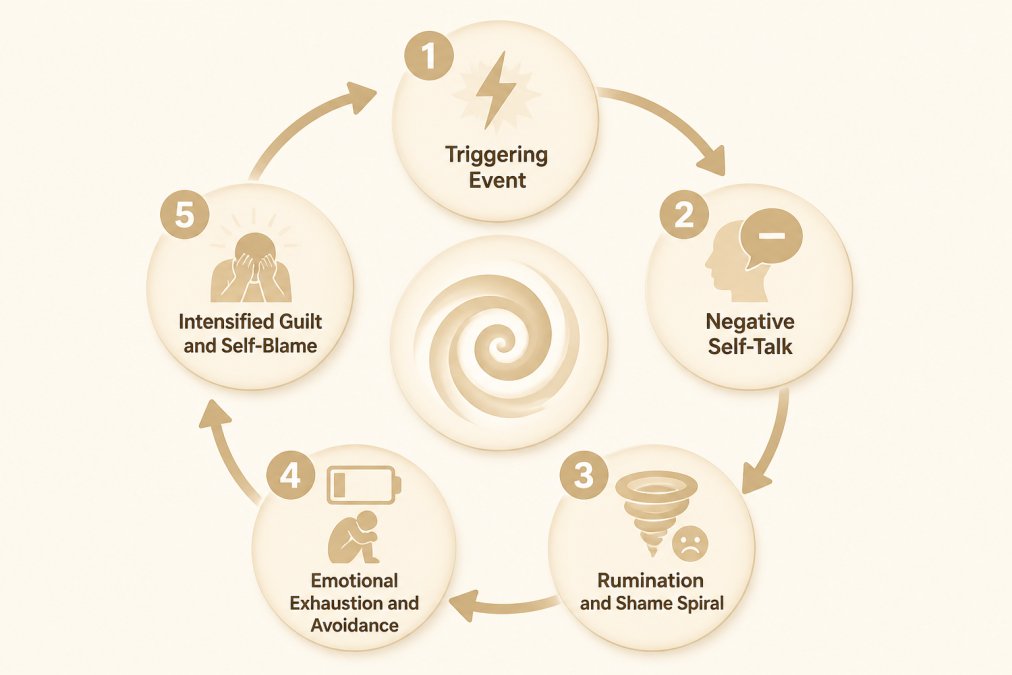
Rumination, the repetitive replaying of guilt-inducing thoughts, is the psychological engine that keeps the guilt amplification loop running. When you ruminate, you’re not problem-solving; you’re rehearsing the guilt, which strengthens the neural pathways associated with it.
Common rumination patterns include catastrophizing (“I made a mistake with my child. Now they’ll be damaged for life”), mind-reading (“My ex thinks I’m a terrible parent”), overgeneralization (“I failed in my marriage. I fail at everything”), and personalization (“This conflict exists because I’m not good enough”). These thought patterns feel like truth, but they’re actually distortions that your guilt-activated brain generates to make sense of emotional pain. Rumination creates a false sense of control, replaying scenarios repeatedly feels productive, but it deepens the emotional groove and makes alternative perspectives harder to access.
Healthy Guilt vs. Toxic Guilt: Know the Difference
Not all guilt is destructive. Understanding the difference between healthy guilt and toxic guilt is essential for knowing when to listen to your guilt and when to actively work against it.
When Guilt Serves a Purpose
Healthy guilt is adaptive. It emerges when you’ve genuinely done something that conflicts with your values or harmed someone you care about. This guilt signals that you need to take corrective action, apologize, make amends, or change your behavior. Healthy guilt is tied to a specific action, motivates you toward change rather than away from engagement, and resolves relatively quickly once you’ve taken meaningful action. You can feel guilty about a particular parenting decision while maintaining a fundamentally positive view of yourself as a parent.
When Guilt Becomes Destructive
Toxic guilt is global and unmoored from specific corrective action. It says “I am bad” rather than “I did something I regret.” Toxic guilt doesn’t motivate change, it motivates avoidance, self-punishment, and withdrawal. It often emerges in response to situations you couldn’t have controlled or betrayals inflicted upon you rather than harm you’ve caused. A partner’s infidelity is not your fault, yet many betrayed partners experience intense guilt about “missing the signs.” This guilt is toxic because no amount of self-criticism will change what happened. Toxic guilt is persistent and resistant to resolution. Even after you’ve taken corrective action or made amends, the guilt remains.
The guilt amplification loop is almost always toxic guilt.
Recognizing Self-Destructive Thought Patterns
The guilt amplification loop thrives in the space between your thoughts and your actions. By recognizing the specific thought patterns that fuel the loop, you create opportunities to interrupt it.
Negative Self-Talk and Self-Attack
Self-attack is the internal voice that criticizes, blames, and condemns you. In the guilt amplification loop, this voice becomes relentless and distorted. Common patterns include absolute language (“I always fail. I never get it right”), comparison to impossible standards (“A good parent would never have missed this”), blame-shifting to yourself (“This is all my fault”), and identity fusion (“I am a failure” rather than “I made a failure”). These thoughts feel like objective facts, but they’re habitual patterns of interpretation. Your brain has learned to default to self-attack as a response to stress. The key to interrupting self-attack is recognizing it as a thought rather than a truth.

Procrastination as a Guilt Amplifier
Procrastination is often framed as a time-management problem. In the guilt amplification loop, it’s an emotional regulation strategy, a way to escape the discomfort of guilt by avoiding the situation that triggered it. When you feel guilty, the impulse is to avoid. You delay scheduling the co-parenting conversation. You avoid spending time with your children, which generates more guilt. Procrastination creates a vicious cycle: avoidance → guilt about avoidance → more avoidance → intensified guilt. Breaking this cycle requires understanding procrastination not as laziness but as emotional avoidance.
Procrastination in the guilt amplification loop often masks deeper paralysis. You’re not just avoiding a task, you’re avoiding the emotional discomfort it triggers. Pushing through procrastination without addressing the underlying guilt typically intensifies both.
Self-Compassion for Guilt: Rewriting Your Inner Dialogue
The antidote to self-attack is self-compassion, not self-indulgence or self-excuse, but a fundamentally different way of relating to your own suffering. Self-compassion means recognizing that you’re struggling, that struggle is normal, and that you deserve kindness rather than condemnation, especially from yourself.
Cognitive Reframing Techniques
Cognitive reframing is the process of taking a guilt-inducing thought, examining it for accuracy, and generating a more balanced alternative.
The reframing process:
- Identify the thought: “I’m a terrible parent because I lost patience with my child.”
- Question its accuracy: “Is this absolutely true? Have I never been a good parent? Did this one moment define my entire parenting?”
- Identify the distortion: This thought overgeneralizes (one mistake → I’m terrible) and uses absolute language.
- Generate a balanced alternative: “I made a mistake in how I responded. That’s human. I can apologize and try differently next time. One moment doesn’t erase all the times I’ve shown up well for my child.”
The balanced alternative isn’t false positivity. It’s accuracy.
When reframing a guilt-inducing thought, ask yourself: “Would I say this to a friend in the same situation?” If the answer is no, the thought is likely distorted. Use the same compassion you’d extend to someone you care about.
Acceptance as a Tool for Breaking the Cycle
Acceptance means acknowledging what is true without fighting it, judging it, or trying to escape it through guilt. It involves acknowledging reality (“I made a mistake. My marriage ended”), releasing the demand that it shouldn’t have happened, separating the event from your identity (“This happened, but it doesn’t define who I am”), and committing to action despite the guilt. Acceptance breaks the guilt amplification loop because it stops secondary guilt, the guilt about feeling guilty. When you accept that you’re struggling and that you feel guilty, you remove the fuel that keeps the loop spinning.
Somatic Release Techniques: Healing Beyond Thought
The guilt amplification loop lives in your body as much as in your mind. Chronic guilt creates chronic tension: a tight chest, shallow breathing, clenched jaw, or a knot in your stomach. This physical tension reinforces emotional guilt, which reinforces physical tension. Breaking the guilt amplification loop requires releasing this somatic holding.
Body-Based Methods to Discharge Guilt
Somatic release techniques work directly with your nervous system to discharge accumulated tension and stress.
Breath work: Your breathing pattern reflects your nervous system state. When caught in guilt, your breathing typically becomes shallow and rapid. Intentional breathing, particularly extending your exhale longer than your inhale, signals safety to your nervous system. A simple practice: Breathe in for a count of 4, hold for a count of 4, exhale for a count of 6. The extended exhale activates your parasympathetic nervous system, responsible for rest and recovery. Practice this for 5 minutes when you notice guilt beginning to spiral.
Movement: Guilt creates a freeze response. Movement counteracts this. Walking, dancing, swimming, or any form of physical activity helps discharge accumulated stress. Consistency matters more than intensity. A 15-minute daily walk is more effective for breaking the guilt amplification loop than occasional intense exercise.
Shaking and tremoring: Your body naturally shakes to discharge stress. Intentional shaking, allowing your body to tremble for several minutes, can release trapped nervous system energy.
Mindfulness and Emotional Regulation Practices
Mindfulness is observing your thoughts, feelings, and sensations without judgment or the impulse to change them. In the guilt amplification loop, you typically fight your guilt or use it as evidence against yourself. Mindfulness interrupts this pattern.
A mindfulness practice for guilt: (1) Notice the guilt: “I’m experiencing guilt right now.” (2) Locate it in your body: Where do you feel it? What does it feel like? (3) Breathe into it: Rather than escaping the sensation, breathe into the area where you feel it. (4) Observe without judgment: Watch the guilt without labeling it or trying to fix it. (5) Notice its impermanence: Sensations change. The guilt will shift or ease naturally when you stop fighting it. This practice typically takes 5-10 minutes. The goal is not to eliminate guilt but to change your relationship to it.
Therapy for Guilt and Shame: When Professional Support Helps
Some guilt amplification loops are too entrenched to interrupt alone. Professional support, particularly therapy, can be essential for breaking the cycle and rebuilding a sense of safety and agency.
Evidence-Based Therapeutic Approaches
Cognitive-behavioral therapy (CBT) is designed to interrupt the thought-feeling-behavior cycle that fuels guilt. A therapist helps you identify distorted thought patterns, challenge their accuracy, and develop more balanced thinking. CBT is particularly effective for guilt because it directly addresses the cognitive distortions driving the loop.
Somatic experiencing therapy works directly with your nervous system and physical sensations associated with guilt and trauma. This approach recognizes that betrayal and relationship breakdown create a trauma response, your nervous system is stuck in a threat state.
Internal Family Systems (IFS) therapy treats different parts of your psyche as separate entities. In the guilt amplification loop, there’s typically a critical “inner critic” part that attacks you relentlessly. IFS helps you develop a compassionate relationship with this critical part.
Acceptance and Commitment Therapy (ACT) focuses on accepting difficult emotions while committing to actions aligned with your values. Rather than eliminating guilt, ACT helps you move forward despite it.
The choice of therapy depends on your specific situation, your therapist’s expertise, and what resonates with you.
Building Psychological Safety for Recovery
Psychological safety, the sense that you can be yourself, make mistakes, and be accepted, is essential for breaking the guilt amplification loop. Many people caught in guilt have internalized a harsh inner critic that never allows for error. Building psychological safety involves creating a supportive environment through therapy or trusted relationships, practicing self-acceptance, redefining failure as part of being human rather than evidence of unworthiness, and setting boundaries with your inner critic.
After the Affair Series provides structured frameworks specifically designed to help you rebuild psychological safety after betrayal and separation. The platform offers concrete scripts and protocols for managing the specific high-conflict situations that trigger guilt amplification.
Breaking the Cycle of Self-Blame: Practical Action Steps
Understanding how the guilt amplification loop works is essential, but understanding alone doesn’t break the cycle. You need concrete, actionable steps to interrupt the pattern when it’s happening.
Step 1: Interrupt the Rumination Cycle
Rumination is the psychological engine of the guilt amplification loop. Without rumination, the guilt loses its power to spiral.
The interruption protocol: (1) Set a rumination timer: When you notice yourself replaying guilt-inducing thoughts, set a timer for 5 minutes. Allow yourself to ruminate fully during this time. (2) When the timer goes off, stop: You’re not suppressing the thoughts, you’re containing them. (3) Redirect your attention: Shift your focus to something present and concrete. Engage one of your five senses deliberately. (4) Take action: Do something requiring your full attention.
This protocol works because it acknowledges you can’t simply stop guilty thoughts through willpower. Instead, you’re creating boundaries around rumination and redirecting your mental energy.
The guilt amplification loop thrives in rumination. By containing rumination to a specific time and then deliberately shifting your attention, you starve the loop of the psychological fuel it needs to intensify.
Step 2: Challenge Distorted Thinking
Once you’ve interrupted the rumination cycle, examine the thoughts themselves. Are they accurate, or are they distorted?
The thought-challenging protocol: (1) Identify the specific thought: “I’m a bad parent,” “This is all my fault,” or “I’ll never recover from this.” (2) Ask: Is this thought 100% true? Not “Do I feel like it’s true?” but “Is it objectively, factually true?” (3) Look for evidence against the thought: Can you find any evidence that contradicts this thought? (4) Generate a more accurate statement: A balanced, realistic statement that acknowledges both the difficulty and your capacity to handle it.
Example: Distorted thought: “I’m a terrible parent because I lost my temper.” Evidence against: “I’ve been patient and present many times. I apologized to my child.” Balanced statement: “I made a mistake in how I responded. That’s human. I’m taking steps to repair it and do better next time.”
Step 3: Take Aligned Action
The final step in breaking the guilt amplification loop is to move from thinking and feeling into action. Aligned action means doing something that matches your values, even while experiencing guilt. Many people wait until they feel better to take action. In the guilt amplification loop, this is a trap. You won’t feel better until you interrupt the cycle, and you won’t interrupt the cycle until you take action despite the guilt.
Aligned action examples: If you feel guilty about not being present with your children, schedule specific time with them. If you feel guilty about a conflict with your ex-partner, take one specific communication action using neutral, fact-based language. If you feel guilty about not taking care of yourself, commit to one self-care action like a 15-minute walk or one therapy session. The key is that aligned action doesn’t require you to feel good first. You take the action while still experiencing guilt, and the action itself interrupts the loop.
| Step | Action | Duration | Frequency |
|---|---|---|---|
| Interrupt Rumination | Set 5-minute rumination timer, then redirect attention | 5 minutes per cycle | As needed when ruminating |
| Challenge Distorted Thinking | Identify thought, examine accuracy, generate balanced alternative | 10-15 minutes | Once per distorted thought pattern |
| Take Aligned Action | Commit to one specific action matching your values | Varies by action | Daily or as situation requires |
Breaking the guilt amplification loop requires understanding that guilt is not a character flaw, it’s a neurochemical and psychological process that can be interrupted. The most effective approach combines thought work (challenging distortions), body work (releasing somatic tension), emotional work (building self-compassion), and action work (moving forward despite guilt).
If you’re navigating guilt after infidelity, separation, or high-conflict co-parenting, professional support can accelerate your recovery. After the Affair Series provides structured frameworks and actionable scripts designed specifically for these situations. The platform offers concrete protocols for managing the exact moments when guilt amplification is most intense: difficult conversations with your ex-partner, parenting decisions that trigger self-doubt, and the emotional overwhelm of early recovery. Take the free 23-point assessment to identify where you are in your recovery journey and get specific resources for your situation.
Frequently Asked Questions
What exactly is a guilt amplification loop?
A guilt amplification loop occurs when an initial feeling of guilt triggers negative self-talk and rumination, which intensifies the guilt further, creating a self-reinforcing cycle. Each cycle of self-criticism and shame spiral deepens emotional distress and extends the duration of guilt. The loop becomes self-perpetuating because the guilt itself becomes the trigger for more guilt, trapping you in emotional paralysis.
How does self-compassion for guilt actually break the cycle?
Self-compassion interrupts the guilt amplification loop by replacing self-attack with acceptance and understanding. Instead of intensifying guilt through criticism, self-compassion acknowledges your mistake as human and temporary. This reduces the neurochemical stress response that fuels rumination, allowing your nervous system to reset. Research shows self-compassion increases emotional resilience and reduces shame spiral intensity more effectively than self-criticism.
What’s the difference between guilt and shame, and why does it matter?
Guilt is about your behavior: ‘I did something wrong.’ Shame is about your identity: ‘I am bad.’ Guilt can motivate positive change and reconciliation. Shame drives self-destructive behaviors and deeper emotional loops. Understanding this distinction matters because shame-based guilt amplification loops are harder to break and require different recovery approaches. Therapy for guilt and shame addresses both but uses different techniques depending on which emotion dominates.
How long does it typically take to recover from a guilt hangover?
The guilt hangover recovery timeline varies based on intensity and duration of the loop. Most people experience noticeable relief within 3-7 days of using somatic release techniques and cognitive reframing. Full recovery of emotional resilience typically takes 2-4 weeks of consistent practice. However, if guilt is tied to unresolved trauma or relationship betrayal, professional therapeutic intervention may extend the timeline to 8-12 weeks for stable, lasting change.