Last Updated: August 11, 2026
Understanding how to heal from relationship betrayal trauma is essential for recovery.
- Understanding Betrayal Trauma and Your Nervous System
- Stages of Betrayal Trauma Recovery
- How Long Does It Take to Heal From Betrayal
- Betrayal Trauma Therapy Techniques That Work
- Somatic Exercises for Trauma Release and Nervous System Regulation
- Rebuilding Trust in Yourself and Setting Boundaries
- Navigating Social Circles and Shared Relationships
- Reconciliation vs. Healing: What's the Difference
- Frequently Asked Questions
Understanding Betrayal Trauma and Your Nervous System
Learning how to heal from relationship betrayal trauma involves acknowledging the pain and seeking support.
Betrayal trauma occurs when someone you trust deeply violates that trust, shaking your sense of safety. When you discover infidelity or deception, your nervous system enters hypervigilance and dysregulation that can last weeks, months, or longer without intervention.
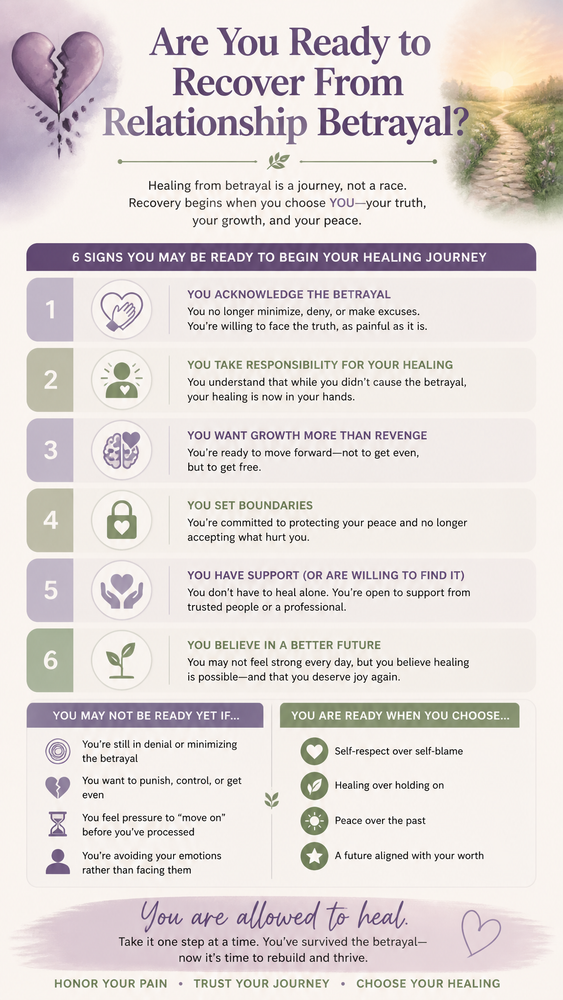
Your body floods with cortisol and adrenaline, preparing you for threat even though the danger has passed. This is why you might experience insomnia, obsessive replaying of conversations, or sudden panic attacks. What makes betrayal trauma distinct is the relational component: the person who was supposed to protect you became the source of harm. This creates “betrayal blindness,” where your mind struggles to reconcile who you thought they were with who they actually are. Understanding this physiological response is the first step toward healing.
Ultimately, understanding how to heal from relationship betrayal trauma will empower you to reclaim your life.
What Happens in Your Body After Betrayal
When betrayal occurs, your amygdala activates immediately. Your body doesn’t distinguish between physical and emotional threat, it responds to infidelity with the same intensity it would respond to physical danger.
This triggers a cascade of neurochemical changes. Cortisol spikes, keeping you in elevated stress. Your prefrontal cortex, responsible for rational thinking and emotional regulation, becomes less active. Your nervous system becomes sensitized to threat cues: a text notification, a song, or a time of day associated with the betrayal can trigger a full-body stress response. Sleep becomes difficult because your nervous system won’t fully relax, compounding emotional dysregulation.
Signs and Symptoms You May Experience
Common symptoms include intrusive thoughts, unwanted mental images, and obsessive replaying of conversations. Emotional dysregulation is nearly universal: rapid swings between rage, despair, numbness, and seeming normalcy. Physical symptoms are common, tension headaches, chest pain, digestive issues, and persistent exhaustion.
Many experience attachment trauma symptoms: difficulty trusting others, fear of abandonment, or an urge to cling to the person who betrayed you. Dissociation and emotional numbness can also occur as protective mechanisms.
Stages of Betrayal Trauma Recovery
Recovery typically unfolds in stages, though not always linearly. You may move forward and cycle back when triggered. Understanding these stages normalizes your experience and provides a roadmap.
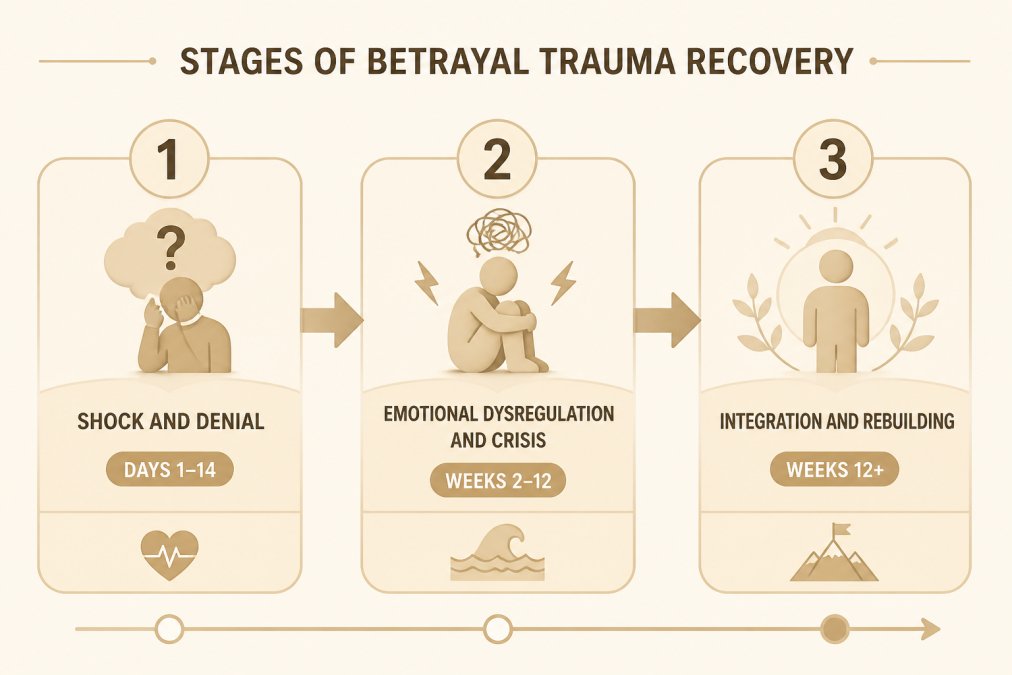
Stage 1: Shock and Denial
The first stage typically lasts from discovery through the first two weeks. Your mind is in shock. Even if you suspected something, confirmation creates a surreal quality. Your nervous system oscillates between frantic activity, searching for information, confronting the person, making urgent decisions, and complete shutdown. Denial often accompanies shock as your mind protects you from overwhelming pain all at once.
Stage 2: Emotional Dysregulation and Crisis
This stage typically begins around week two and lasts four to twelve weeks. The shock wears off, and the full emotional weight hits. Rage, grief, despair, and confusion cycle rapidly. Your nervous system remains highly dysregulated. Sleep disturbances, appetite changes, and difficulty concentrating are common. Professional support becomes most valuable during this stage.
Stage 3: Integration and Rebuilding
This stage begins when your nervous system stabilizes and you can hold multiple truths simultaneously: the person you loved existed, the betrayal happened, and you will survive this. During this stage, you’re developing post-traumatic growth, rebuilding your sense of self, and making intentional decisions about your relationship and life.
How Long Does It Take to Heal From Betrayal
Recovery depends on the severity of betrayal, your support system, your nervous system’s baseline resilience, and the healing practices you engage with.
Most people experience acute crisis for four to twelve weeks. Emotional dysregulation typically decreases around the three-month mark. With structured support, therapy, somatic practices, and clear frameworks, many report significant improvement within six months to a year.
Distinguish between “feeling better” and “healed.” You might feel emotionally stable after three months but still have triggers that activate your nervous system. Full integration, where betrayal no longer controls your daily functioning, often takes longer. Healing isn’t linear, you might have difficult days six months in where the betrayal feels fresh. This doesn’t mean failure; it means you encountered a trigger and your nervous system responded.
Betrayal Trauma Therapy Techniques That Work
Several evidence-based therapeutic approaches show effectiveness for betrayal trauma recovery. The most effective plans combine multiple approaches tailored to your specific needs.
EMDR and Trauma-Informed Approaches
EMDR (Eye Movement Desensitization and Reprocessing) has substantial research support for trauma processing. During EMDR, you recall the traumatic memory while your eyes follow a moving object or you experience bilateral stimulation. This bilateral stimulation helps your brain process the memory similarly to what happens during REM sleep.
Trauma-informed therapy recognizes that your symptoms make sense given what happened. A trauma-informed therapist understands nervous system dysregulation and helps you regulate before diving into deep processing work, preventing retraumatization during therapy itself. Many find combining EMDR with somatic practices produces faster, more lasting results.
Cognitive Processing and Narrative Reframing
Cognitive processing therapy helps you examine and challenge thoughts that emerged from betrayal. Betrayal often creates distorted beliefs: “I’m unlovable,” “I can’t trust anyone,” or “I should have known.”
Narrative reframing involves consciously reshaping your story about the betrayal. Instead of “My entire relationship was a lie,” the reframed narrative might be “I had a relationship with someone who made choices that violated my trust. That relationship included real moments of connection alongside deception.” This allows integration rather than remaining stuck.
Somatic Exercises for Trauma Release and Nervous System Regulation
Somatic experiencing, working directly with your body’s trauma responses, is one of the most effective approaches for resolving betrayal trauma. Your nervous system stores trauma in your body. Talking about it alone often isn’t enough; you need to help your body complete the stress response interrupted by shock.
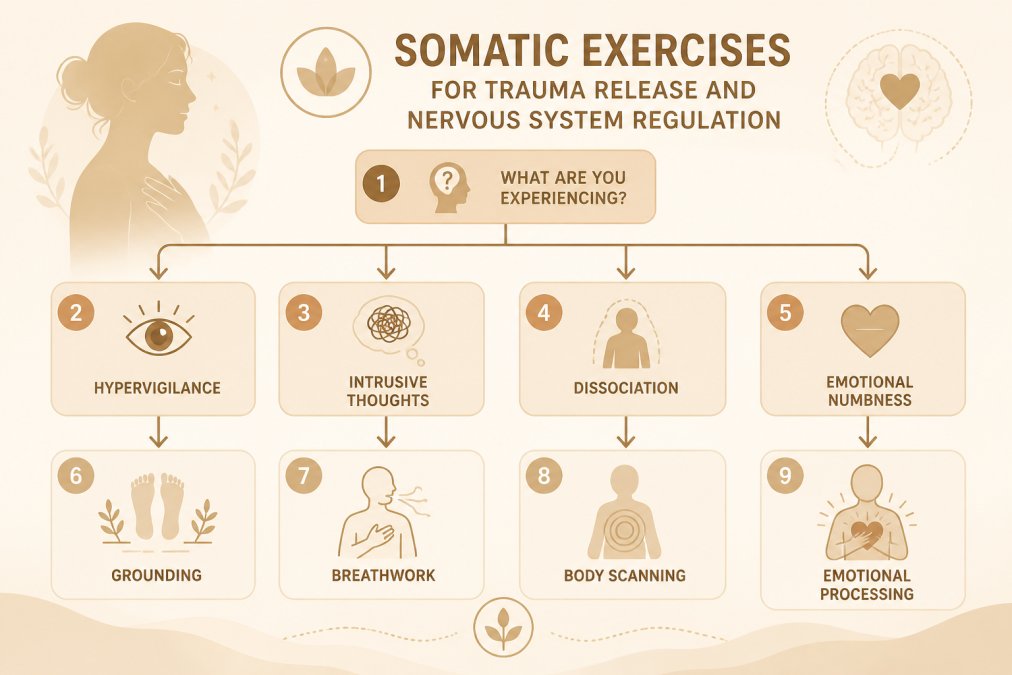
Grounding Techniques for Hypervigilance
Hypervigilance, a constant state of scanning for threat, is exhausting. Grounding techniques anchor your nervous system to the present moment, where you are actually safe.
The 5-4-3-2-1 technique is simple and effective: notice five things you can see, four things you can touch, three things you can hear, two things you can smell, and one thing you can taste. This engages your sensory system and pulls your attention out of threat-scanning mode. These techniques work best when practiced regularly, not just during crisis moments.
Breathwork and Vagal Toning
Your vagus nerve is the primary pathway your nervous system uses to shift from threat mode to safety mode. The 4-7-8 breath is particularly effective: inhale for four counts, hold for seven, exhale for eight. The extended exhale activates your parasympathetic nervous system, signaling safety to your body. Box breathing (inhale for four, hold for four, exhale for four, hold for four) is another accessible technique.
Body Scanning and Emotional Processing
Body scanning goes deeper than grounding. Instead of simply noticing sensations, you’re tracking where emotions live in your body and allowing them to move and release.
Lie down and slowly bring your attention through your body. When you notice tension or sensation, pause there. Don’t try to change it; simply observe it with curiosity. Often, emotions that feel stuck in your mind will begin to move and shift when you bring conscious attention to them in your body. You might feel the urge to cry, shake, or make sounds. Allow these responses; they’re your nervous system completing the stress cycle.

Practice body scanning for 10-15 minutes in a safe, private space where you won’t be interrupted. The first few times, emotions may feel more intense as you’re finally allowing them to surface. This is part of the healing process.
Rebuilding Trust in Yourself and Setting Boundaries
One of the deepest wounds of betrayal is loss of trust in yourself. You might think, “How did I not see this?” This self-blame is common but misplaced. The betrayer’s deception was about their choices, not your failure to detect it.
Rebuilding trust in yourself happens through small, consistent actions. When you say you’ll do something, follow through. When you notice a boundary violation, address it immediately. When your gut gives you information, listen to it.
Validating Your Emotions and Self-Compassion
One of the most powerful healing practices is learning to validate your own emotions without judgment. Betrayal trauma creates shame: shame that you didn’t see it, shame that you stayed, shame that you’re struggling to move forward.
Self-compassion involves treating yourself with the same kindness you’d offer a close friend. When you notice self-critical thoughts, pause and respond with compassion: “This is hard. Many people struggle with this. I’m doing my best.” Validating your emotions means acknowledging them without trying to fix or minimize them.
Healing from betrayal trauma requires both nervous system regulation and emotional processing. You need techniques that calm your body AND practices that help you integrate the emotional reality of what happened.
Post-Betrayal Transformation and Growth
Post-traumatic growth, positive change that emerges from working through trauma, is a real phenomenon. Many who’ve navigated betrayal trauma report increased clarity about values, stronger boundaries, deeper authenticity, and greater resilience. This growth doesn’t erase the pain or mean the betrayal was “worth it.” It means that through difficult healing work, you’ve developed capacities and insights you wouldn’t have otherwise.
Navigating Social Circles and Shared Relationships
One often-overlooked aspect of betrayal trauma is the social dimension. If you have shared friends, family, or community with the person who betrayed you, you face additional complexity. You might encounter them at social events, hear about their life through mutual friends, or face pressure to reconcile for the sake of the group.
Setting boundaries with your social circle is essential. You might tell trusted friends: “I need you to not share updates about them with me” or “I’m not ready to be in the same room with them yet.” Clear communication protects your healing process. Some friendships don’t survive the relationship ending, but many report that remaining friendships deepen because they’re based on authentic connection.
Reconciliation vs. Healing: What’s the Difference
A critical distinction often missed is the difference between reconciliation and healing. These are not the same thing.
Healing is about your nervous system returning to regulation, emotional dysregulation decreasing, trust in yourself rebuilding, and your capacity to experience safety and joy returning. Healing is something you do for yourself, regardless of what happens with the relationship.
Reconciliation is a relational process where both partners acknowledge the betrayal, take responsibility, and work to rebuild trust. Reconciliation requires specific conditions: genuine remorse, transparency, commitment to change, and willingness to do the work. You can heal without reconciling. You can also reconcile without having fully healed, though this is more challenging because unhealed trauma often gets triggered during reconciliation.
Healing from relationship betrayal trauma requires both nervous system regulation and emotional integration. The techniques outlined here, from somatic practices to cognitive processing to boundary-setting, work together to help you move from crisis through dysregulation toward genuine recovery.
Your healing doesn’t depend on your partner’s actions or choices. It depends on your commitment to regulating your nervous system, validating your experience, and rebuilding trust in yourself. After the Affair Series provides structured frameworks and specific tools, including communication scripts, boundary-setting protocols, and crisis management resources, that help you move through this process with clarity and support. Start with the free assessment to identify where you are in the recovery process and access the specific resources that match your current needs.
Frequently Asked Questions
How can I tell if I’m experiencing betrayal trauma versus normal relationship grief?
Betrayal trauma involves specific nervous system responses: hypervigilance, intrusive thoughts about the betrayal, emotional dysregulation, and physical symptoms like insomnia or muscle tension. It goes beyond sadness about a relationship ending. If you’re experiencing fight-flight-freeze responses, difficulty trusting others, or dissociation, these are markers of betrayal trauma. A trauma-informed therapist can help differentiate between grief and trauma responses, which matters because healing approaches differ significantly.
What are the stages of betrayal trauma recovery, and how long does each typically last?
Recovery generally unfolds in three stages. Stage 1 (Shock and Denial) lasts days to weeks as your mind protects itself. Stage 2 (Emotional Dysregulation and Crisis) typically spans weeks to months, where emotions peak and nervous system dysregulation is most intense. Stage 3 (Integration and Rebuilding) can take months to years, focusing on meaning-making and self-trust. Individual timelines vary based on the betrayal’s severity, your support system, and whether you engage in active healing work.
Which betrayal trauma therapy techniques are most effective for nervous system healing?
EMDR (Eye Movement Desensitization and Reprocessing) is evidence-based for trauma processing. Somatic Experiencing helps resolve trauma stored in the body. Cognitive-behavioral approaches address intrusive thoughts and catastrophic thinking. The most effective path often combines techniques: trauma-informed therapy for processing, somatic work for nervous system regulation, and structured communication tools for rebuilding relationships. What works best depends on your specific symptoms and whether you’re healing individually or attempting relational repair.
Can somatic exercises really help with betrayal trauma, or do I need professional therapy?
Somatic exercises are powerful for nervous system regulation and can be used alongside or between therapy sessions. Grounding techniques, breathwork, and body scanning help interrupt hypervigilance and process trapped trauma responses. However, betrayal trauma often requires professional support to safely process the psychological impact, especially if you’re experiencing severe dissociation or suicidal thoughts. The most effective approach combines self-guided somatic practices with trauma-informed therapy to address both body and mind.
Is it possible to heal from betrayal trauma while staying in the relationship?
Yes, but it requires specific conditions. Healing while staying requires the betraying partner to take accountability, engage in their own therapy, and demonstrate consistent behavioral change. This is reconciliation combined with healing. Many people find they need to focus on individual healing first before deciding whether reconciliation is possible. It’s important to distinguish between reconciliation (rebuilding the relationship) and healing (recovering from trauma), as they’re separate processes with different timelines and requirements.
How do I rebuild trust in myself after betrayal, especially if my judgment feels broken?
Self-trust rebuilds through small, consistent actions where you honor your own needs and boundaries. Start by validating that betrayal wasn’t a failure of your judgment, betrayers actively deceive. Practice self-compassion instead of self-blame. Use grounding techniques when intrusive thoughts about ‘how you missed the signs’ arise. Set one boundary daily and follow through. Over time, these actions signal to your nervous system that you can be trusted to protect yourself, which gradually restores self-trust and psychological safety.
What should I do if my social circle is divided or I’m facing judgment after the betrayal?
Navigating shared relationships after betrayal is painful but manageable. Identify which relationships feel safe and prioritize those. You don’t owe anyone a detailed explanation of your decision to leave or stay. Use neutral language in group settings (‘We’re going through a difficult time’ rather than detailed accusations). Consider whether some friendships need temporary distance to protect your healing. Post-betrayal transformation often involves releasing relationships that don’t support your recovery, which is healthy boundary-setting, not punishment.