- Why does your brain keep replaying the betrayal?
- How to interrupt obsessive thoughts every day
- How to talk with your partner without feeding the obsession
- Which therapies help most, and how do you find them in the U.S.?
- What does recovery actually look like over time?
- How the Aftertheaffair recovery series fits into your healing
- Key Takeaways
- The part most recovery advice gets wrong
- Structured recovery resources from Aftertheaffair
- FAQ
The fastest way to interrupt the obsessive loop right now: ground your body, close every investigation window, and reach out to one trusted person. That’s the whole prescription in one sentence. Everything else in this article builds on those three moves.
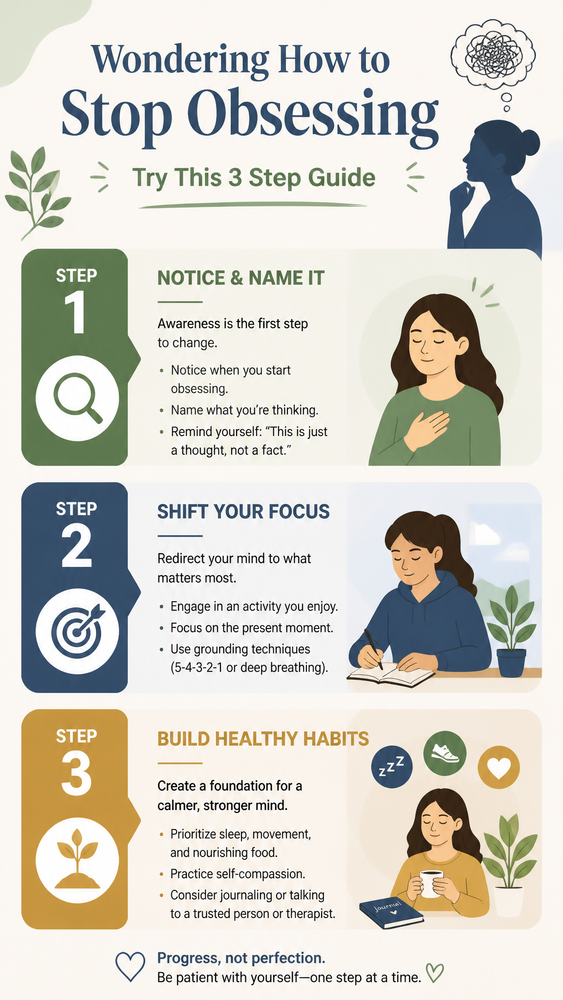
Here’s what to do in the next 15 minutes:
- Ground your body first. Breathe in for 4 counts, hold for 4, out for 6. Do it three times. Your nervous system is running a threat response, and this slows it down.
- Close all investigation windows. Phone, laptop, social media. One search leads to another, and each new detail renews the trauma cycle rather than closing it.
- Name one trusted person you can text or call today. Not to analyze the situation, just to say “I’m struggling and I need someone to know.”
- Set a single daily check-in window. Give yourself 20 minutes at a fixed time to think about what happened. Outside that window, redirect.
- Write down one thing you need right now (sleep, food, a walk) and do it before anything else.
- If you’re having thoughts of harming yourself, call or text 988 (the Suicide and Crisis Lifeline) immediately. Mayo Clinic advises against making any irreversible decisions during acute shock, and getting safe is the only priority.
Pro Tip: Keep a small object in your pocket, a smooth stone or a rubber band, and touch it every time you feel the urge to search or replay. Pair it with one phrase: “I’m safe right now.” The object becomes a physical anchor that interrupts the loop before it starts.
Why does your brain keep replaying the betrayal?
Obsessive thoughts after infidelity aren’t a sign you’re weak or irrational. They’re a predictable trauma response, and understanding the mechanics makes them less terrifying.
When a partner betrays you, it doesn’t just hurt emotionally. It dysregulates your nervous system at a physiological level. Your brain registers the betrayal as a survival threat, the same circuitry that fires when you narrowly avoid a car accident. The result is what clinicians call betrayal trauma: an attachment injury that keeps the nervous system in a state of high alert long after the initial discovery.
The loop works like this:
- Trigger (a song, a location, a text notification)
- Nervous-system alarm (racing heart, tightness in chest, flood of cortisol)
- Compulsive investigation or replay (searching, questioning, mentally reconstructing events)
- Temporary relief (the illusion of certainty or control)
- Reset (the relief fades, uncertainty returns, the loop restarts)
Each pass through the loop feels like it might finally deliver the answer that makes everything make sense. It rarely does. Dr. Richard Nicastro notes that later-stage rumination is often less about needing more facts and more about needing a consistent, caring witness. The “need to know” gradually shifts from information-seeking to a longing to feel less alone.
There’s an important distinction worth making here: healthy reflection means processing what happened so you can make decisions and grieve. Harmful obsession is compulsive replay, forensic investigation, and checking behaviors that temporarily reduce anxiety but ultimately deepen the wound. Therapy modalities like EMDR (Eye Movement Desensitization and Reprocessing), CBT (Cognitive Behavioral Therapy), and betrayal-trauma–informed therapy are specifically designed to interrupt the harmful loop, not suppress the healthy one.
How to interrupt obsessive thoughts every day
Knowing why the loop happens is useful. Having a daily toolkit to break it is what actually changes things.
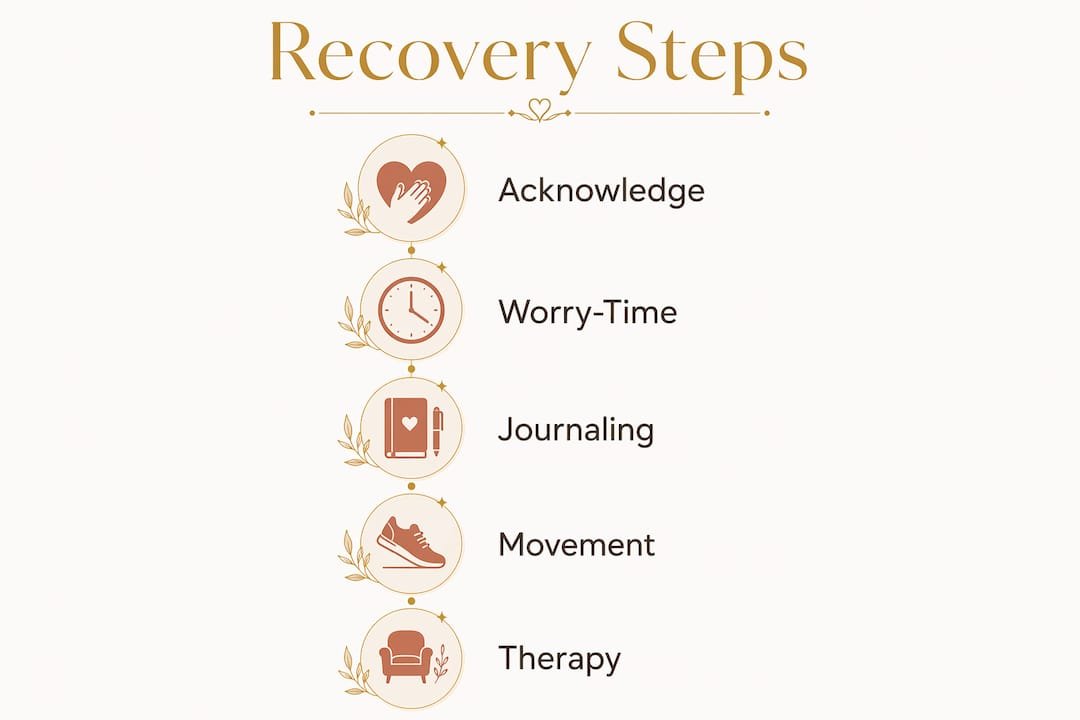
Five-minute grounding sequences
Use these the moment a trigger hits, before you reach for your phone:
- Box breathing: Inhale 4 counts, hold 4, exhale 4, hold 4. Repeat four times.
- 5-4-3-2-1 sensory scan: Name 5 things you can see, 4 you can touch, 3 you can hear, 2 you can smell, 1 you can taste. Forces your attention into the present moment.
- Cold water reset: Run cold water over your wrists for 30 seconds. It activates the dive reflex and slows the heart rate quickly.
Worry-time method
Schedule one 20-minute window per day, same time, same place, to think about the affair. When intrusive thoughts arrive outside that window, write them down and tell yourself: “I’ll think about this at 7 PM.” Over time, the brain learns that the thoughts have a container. The window itself gets shorter as you progress.
Journaling: what helps vs. what doesn’t
Write about your feelings, your needs, and what you want your life to look like. Avoid forensic replay, writing out every detail of what happened in sequence. That’s not processing; it’s re-traumatizing. A useful prompt: “What do I need to feel safe today, and what’s one small thing I can do to get it?”
Pro Tip: Track the frequency of intrusive thoughts in your journal, not just their content. Writing “7 intrusions today, down from 12 last week” gives you objective evidence of progress when it doesn’t feel like anything is changing. The Clarity Accelerator journal is built specifically for this kind of evidence-tracking.
Digital rules
- Set a screen-time limit on social media apps (15 minutes maximum per day during acute recovery).
- Block the other person’s profiles. Not forever, just for now.
- Delete saved screenshots or conversation logs you keep returning to.
- Tell a trusted friend your “one-click rule”: before you search anything related to the affair, you text them first.
Movement as medicine
Stress hormones need somewhere to go. A 20-minute brisk walk, a short run, or even dancing in your kitchen metabolizes cortisol more effectively than sitting with the thoughts. You can find practical emotional healing steps that pair movement with other regulation tools.
For triggered nights, keep a short protocol ready: cold water on wrists, three rounds of box breathing, text your trusted person, then a 10-minute walk if possible. Having the plan written down before the crisis means you don’t have to think when you’re flooded.
How to talk with your partner without feeding the obsession
Conversations about the affair can either help you feel safer or send you straight back into the loop. The difference usually comes down to structure.
Scripts that work
When you need information, keep requests specific and time-limited:
- “I need to understand one thing right now. Can we talk for 20 minutes and then take a break?”
- “I’m not asking to punish you. I need this piece of information to feel safe. Can you answer it without getting defensive?”
- “I need you to check in with me at [specific time] today. Not a long conversation, just a text that says where you are.”
Timeboxed disclosure agreements
Agree with your partner on a structured disclosure process: one conversation per week, with a clear start and end time, focused on specific questions you’ve written down in advance. This prevents “trickle truth,” where details come out slowly over weeks and re-traumatize you each time. Trust rebuild protocols consistently highlight that full, structured disclosure outperforms piecemeal revelation.
Accountability behaviors that restore safety
- No contact with the other person, verified and agreed upon.
- Temporary transparency window: shared location, open phone access for a defined period.
- Proactive check-ins initiated by your partner, not just responses to your questions.
- Consistent follow-through on small commitments (being home when they said, answering calls).
Questions that tend to backfire
Avoid asking for graphic physical details. The research is consistent: specific sensory details tend to become intrusive images that are harder to process than abstract facts. Ask about timelines and emotional meaning if you need context. Skip the visual specifics.
Pro Tip: Before any disclosure conversation, write your three most important questions on paper. Stick to those. When the conversation goes off-script and you feel flooded, say: “I need five minutes” and use the box breathing sequence before continuing.
Genuine repair vs. performative gestures
A genuine repair attempt looks like consistent small actions over time: answering questions without defensiveness, initiating check-ins, following through on agreements. A performative gesture is a grand apology followed by irritation when you’re still struggling two weeks later. The Cleveland Clinic’s guidance on rebuilding trust frames it plainly: trust is rebuilt through repeated small experiences of reliability, not through one-off declarations.
Which therapies help most, and how do you find them in the U.S.?
Therapy is the single highest-leverage thing you can do during recovery. The question is which kind, and when.
Individual therapy first vs. couples therapy
Choose individual therapy first if you’re experiencing severe emotional dysregulation, thoughts of self-harm, or substance use as a coping mechanism. You need a stable nervous system before couples work is productive. Couples therapy becomes appropriate once you can stay in a conversation without completely flooding, and once both partners are genuinely committed to the process.
The three modalities that matter most
- EMDR targets traumatic memories directly. It uses bilateral stimulation (eye movements or tapping) to help the brain reprocess the memory so it loses its grip. It’s particularly effective for the intrusive images and flashbacks that come with betrayal trauma.
- CBT addresses the thought patterns that sustain the obsessive loop. It helps you identify distorted beliefs (“I’ll never trust anyone again,” “This means I’m worthless”) and replace them with more accurate ones.
- Betrayal-trauma–informed therapy combines attachment theory with trauma treatment. A therapist trained in this area understands that the nervous-system response to infidelity is different from other relationship conflicts, and structures both disclosure and boundaries accordingly. You can read more about why therapy helps and what to expect from each modality.
Finding a therapist in the U.S.
- Go to PsychologyToday.com and use the filters: specialty in “infidelity” or “betrayal trauma,” telehealth availability, and sliding scale fees.
- Search for therapists who list EMDR or EFT (Emotionally Focused Therapy) as specific training, not just “relationship issues.”
- Call two or three before booking. Ask directly: “Do you have specific training in betrayal trauma? How many clients have you worked with after infidelity?”
- Ask about fees upfront. Many therapists offer sliding scale rates; some community mental health centers offer sessions for $20–$50. Telehealth options expand access significantly if in-person isn’t feasible.
Pro Tip: In the first 15 minutes of a consultation, ask: “How do you typically structure the first few sessions after infidelity?” A trauma-informed therapist will mention stabilization and nervous-system regulation before diving into the relationship narrative. If they jump straight to “tell me what happened,” that’s a sign they may not have specialized training.
What does recovery actually look like over time?
Recovery from betrayal trauma doesn’t follow a straight line. Knowing the rough shape of it prevents you from concluding you’re broken when you hit a hard week at month four.
The typical phases
- Acute shock (weeks 1–6): Intrusive thoughts are frequent, sleep is disrupted, concentration is poor. The goal here is stabilization, not resolution.
- Stabilization (months 2–4): Intrusions become less constant. You start having hours, then half-days, without the loop running. Basic functioning returns.
- Processing (months 4–12): The deeper grief work happens here. You’re no longer just surviving; you’re making sense of what happened and deciding what you want.
- Integration (12 months and beyond): The event becomes part of your story rather than the whole of it. Research suggests acute pain typically begins to ease between 12 and 24 months, with 18 months often a turning point.
Milestone checklist
- Sleeping through the night more often than not
- Fewer than five intrusive thoughts per day (down from dozens)
- Able to be in the same room as your partner without a constant threat response
- Making decisions about the relationship from a grounded place, not a panicked one
- Going a full day without checking your partner’s phone or location
Pro Tip: Track intrusive thoughts by frequency, not just intensity. Write a number in your journal each evening. A week where you had 40 intrusions is objectively different from a week with 12, even if both felt awful. The number tells you what “feeling better” can’t.
Recovery doesn’t mean forgetting. It means the memory stops running your nervous system. As therapist Figs O’Sullivan frames it, healing prioritizes nervous-system regulation first. Forgiveness, if it comes, is a byproduct of that process, not a prerequisite for it.
How the Aftertheaffair recovery series fits into your healing
The Aftertheaffair series was built to fill a specific gap: the space between a therapy session and the next one, where most of the hard hours actually happen.
The series includes structured books for each recovery stage, a 21-day guided evidence journal, conversation scripts, and practical toolkits. Each resource is evidence-informed and designed to work alongside therapy, not replace it.
Who benefits from each stage:
- Survival stage (first weeks to months): The entry-level book Navigating Infidelity covers the acute phase: what to do first, how to stabilize, and how to avoid decisions you’ll regret.
- Decision-making stage: Resources focused on whether to stay or leave, how to structure disclosure conversations, and how to set boundaries that actually hold.
- Transformation and growth stages: Longer-term tools for rebuilding self-worth, relationship growth after infidelity, and identity reconstruction.
How to use a downloadable resource alongside therapy:
- Bring the journal or workbook to your therapist and use it as a between-session tool.
- Complete one section per week, not one per day. Pacing matters.
- Use the conversation scripts as preparation for disclosure conversations, not as scripts to read verbatim.
- Share relevant sections with your partner if you’re doing couples work.
Key Takeaways
Stopping the obsessive loop after infidelity requires nervous-system regulation first, structured communication second, and consistent small steps over an extended recovery period.
| Point | Details |
|---|---|
| Ground your body immediately | Use box breathing or the 5-4-3-2-1 sensory scan the moment a trigger hits. |
| Timebox your obsessing | Schedule a consistent daily window for affair-related thoughts to help contain and manage intrusive thinking; redirect outside this time. |
| Structure disclosure conversations | Agree on a weekly disclosure format to prevent trickle truth and repeated re-traumatization. |
| Match therapy to your stage | Choose individual therapy first for severe dysregulation; EMDR and CBT have the strongest evidence for betrayal trauma. |
| Use Aftertheaffair resources | The series offers stage-specific books, scripts, and the Clarity Accelerator journal to support recovery between therapy sessions. |
The part most recovery advice gets wrong
There’s a version of infidelity recovery advice that treats obsessive thoughts as a problem to be eliminated as quickly as possible. Get over it. Move on. Forgive and forget. That framing does real damage.
The obsessive loop isn’t a malfunction. It’s your attachment system doing its job: scanning for threat, seeking safety, trying to make sense of a world that just proved less predictable than you thought. Telling someone to simply stop thinking about it is like telling someone with a broken leg to stop limping. The injury is real, and it needs actual treatment.
What the research actually supports is slower and less dramatic: nervous-system regulation before narrative processing, structured disclosure rather than open-ended interrogation, and the accumulation of small reliable behaviors over months, not a single redemptive conversation. Simply Psychology’s analysis of trust repair puts it plainly: for major betrayals, consistent behavioral change over 2–5 years is what meaningfully restores trust. That’s not a pessimistic finding. It’s a realistic one that frees you from expecting a breakthrough that isn’t coming on week three.
The other thing worth saying: forgiveness is not required for healing. You can regulate your nervous system, rebuild your life, and decide what you want from this relationship without ever arriving at forgiveness. Framing recovery as “you’ll heal when you forgive” puts the burden in the wrong place and distorts the healing process for a lot of people. The goal is to stop the past from running your present. That’s it.
Structured recovery resources from Aftertheaffair
The hardest part of the early weeks isn’t the pain. It’s not knowing what to do with it. Aftertheaffair’s 7-step recovery checklist gives you a concrete sequence to follow when everything feels chaotic: stabilize first, gather support, set one boundary, and move forward one step at a time.
For readers who want a longer structured program, the Clarity Accelerator 21-day journal is the most practical starting point. Use it for the first 30 days alongside therapy or self-care:
- Days 1–7: Use the daily prompts to track intrusive thought frequency and identify your top three triggers.
- Days 8–21: Work through the evidence-based reflection exercises to shift from forensic replay to forward-focused processing.
- End of month one: Bring your completed journal to a therapist or use the summary prompts to assess whether you need additional support.
All resources come with clear guidance on which stage they’re designed for. If you’re in the acute phase, Navigating Infidelity is the right starting point. If you’re further along and working on the relationship, the growth-stage tools are a better fit.
Useful sources and where to get help in the U.S.
Finding the right support quickly matters. Here’s a short list of vetted starting points:
- 988 Suicide and Crisis Lifeline: Call or text 988 at any time. Available 24/7 for anyone in emotional crisis, including those experiencing acute distress after betrayal.
- Crisis Text Line: Text HOME to 741741 for free, confidential crisis support via text.
- PsychologyToday.com therapist directory: Filter by “infidelity,” “betrayal trauma,” telehealth availability, and sliding scale fees to find licensed clinicians in your state.
- EMDR International Association (EMDRIA): Search emdria.org for EMDR-certified therapists in the U.S. with specific trauma training.
- Open Path Collective: A nonprofit network offering therapy sessions at reduced rates ($30–$80) for individuals who don’t have insurance coverage.
- Aftertheaffair recovery resources: Stage-specific books, the Clarity Accelerator journal, and free guides at aftertheaffair.uk.
A note on teletherapy: Most U.S. states now allow licensed therapists to practice via video across state lines under temporary or permanent telehealth provisions. When booking, confirm the therapist is licensed in your state and ask whether your insurance covers telehealth sessions. Many plans do.
This article is general information, not professional mental health advice. Please confirm current resources and treatment options with a licensed clinician or primary source for your specific situation.
FAQ
How do I stop obsessive thoughts about my partner cheating?
Use a daily worry-time window (20 minutes at a fixed time) and redirect intrusive thoughts outside that window. Pair this with a grounding sequence like box breathing or the 5-4-3-2-1 sensory scan to interrupt the nervous-system alarm before it escalates.
Can you actually get over a partner cheating?
Yes, though recovery takes longer than most people expect. Research indicates acute pain typically begins to ease between 12 and 24 months, and trust, when rebuilt, is often more honest than what existed before the betrayal.
What’s the difference between healthy reflection and harmful obsession after infidelity?
Healthy reflection means processing emotions and making decisions. Harmful obsession is compulsive replay, repeated digital checking, and forensic questioning that temporarily reduces anxiety but deepens the trauma cycle over time.
What questions should I ask my partner after cheating?
Focus on timeline, emotional meaning, and what they’re willing to do differently. Avoid asking for graphic physical details, as sensory specifics tend to become intrusive images that are harder to process than factual context.
How do I rebuild trust after infidelity?
Trust rebuilds through consistent small actions over time, not grand gestures. The offending partner needs to provide full structured disclosure, proactive check-ins, and transparent behavior sustained over months, as outlined in trust rebuild protocols.
Recommended
- Stop Obsessive Thoughts – After the Affair Series
- After Cheated: Now What? – After the Affair Series
- Handling Your Partner’s Family After They Cheated
- Confronting a Cheating Partner: A Step-by-Step Guide