Table of Contents
- What Is Parallel Parenting and Why High-Conflict Situations Require It
- How to Deal With a High-Conflict Ex-Spouse: Foundation Principles
- Setting Parallel Parenting Boundaries That Actually Stick
- Parallel Parenting Communication Apps and Protocols
- Creating a Parallel Parenting Plan Template for Your Situation
- Strategies for Parallel Parenting High-Conflict: Implementation Steps
- Protecting Your Child’s Emotional Wellbeing During Parallel Parenting
- Conclusion: Moving Forward With Parallel Parenting Confidence
Parallel Parenting High-Conflict Strategies: 7 Proven Methods
Last Updated: July 15, 2026
When high-conflict relationships end, traditional co-parenting often fails. Parallel parenting, operating as independent units with minimal direct communication, becomes essential. This approach fundamentally changes how separated families function, reducing conflict and protecting children from ongoing parental warfare.
What Is Parallel Parenting and Why High-Conflict Situations Require It
Parallel parenting is a structured custody arrangement where each parent maintains separate households with minimal direct communication and independent decision-making authority. Rather than attempting joint decisions on every aspect of parenting, parallel parents operate autonomously within their own spheres.
This approach emerged from family law research recognizing that some relationships are too damaged for traditional co-parenting. When communication consistently devolves into arguments, when children become messengers, or when every interaction becomes a battleground, parallel parenting provides a framework prioritizing child stability over parental cooperation. The core principle is disengagement without abandonment: eliminating unnecessary contact points that trigger conflict while maintaining parenting responsibilities.
The real power of parallel parenting lies in what you stop doing. Stop coordinating every detail. Stop attending the same events. Stop communicating about non-essential matters. This is strategic boundary-setting that protects your child from ongoing conflict.
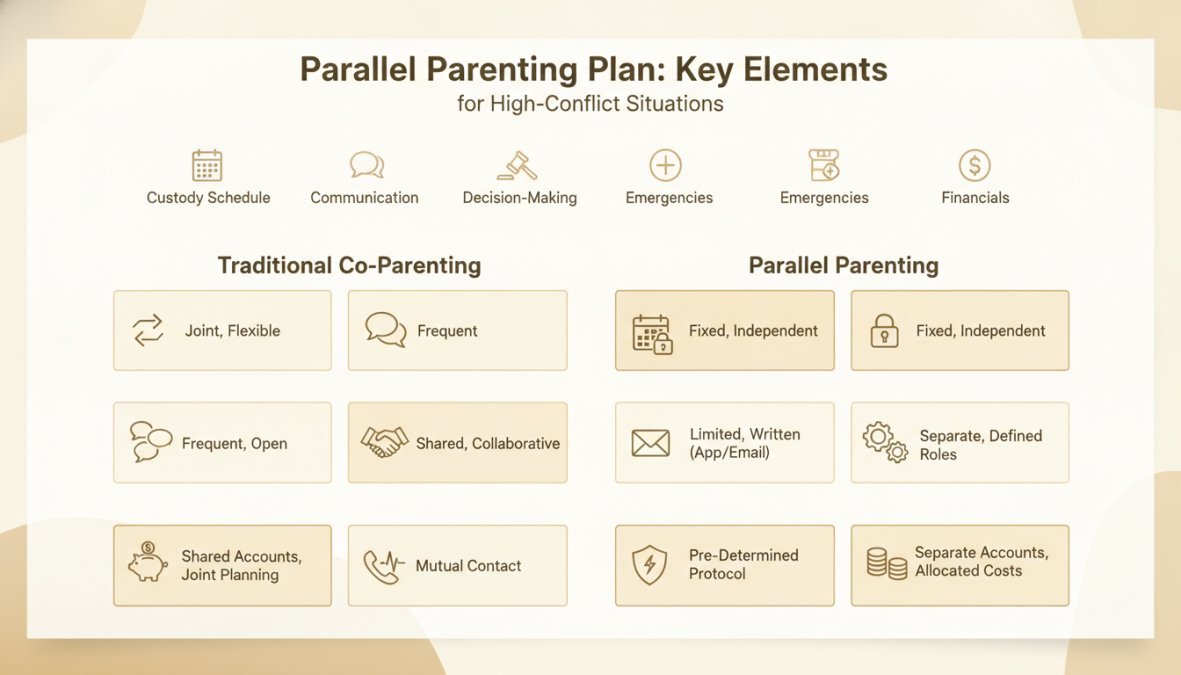
Parallel Parenting vs. Co-Parenting: Key Differences
The distinction between these frameworks determines which suits your situation. Co-parenting assumes both parents can communicate respectfully and make joint decisions. Parallel parenting abandons these assumptions entirely.
| Aspect | Co-Parenting | Parallel Parenting |
|---|---|---|
| Communication Frequency | Regular, frequent | Minimal, scheduled only |
| Decision Authority | Joint on major decisions | Each parent decides independently in their home |
| Shared Events | Both attend same events | Separate attendance or scheduled rotation |
| Conflict Resolution | Direct negotiation | Court order or third-party mediator |
| Contact Method | Phone, email, in-person | Written communication only (apps/email) |
| Parenting Style Alignment | Coordinated approach | Independent approach accepted |
High-conflict situations typically involve ongoing litigation, documented abuse or harassment, inability to have neutral conversations, using children as messengers, or constant boundary violations. If your situation includes these elements, parallel parenting is the realistic option.
Parallel parenting acknowledges that some parents cannot effectively co-parent. Rather than forcing cooperation that generates constant conflict, it creates separate operating systems protecting children from ongoing parental warfare.
How to Deal With a High-Conflict Ex-Spouse: Foundation Principles
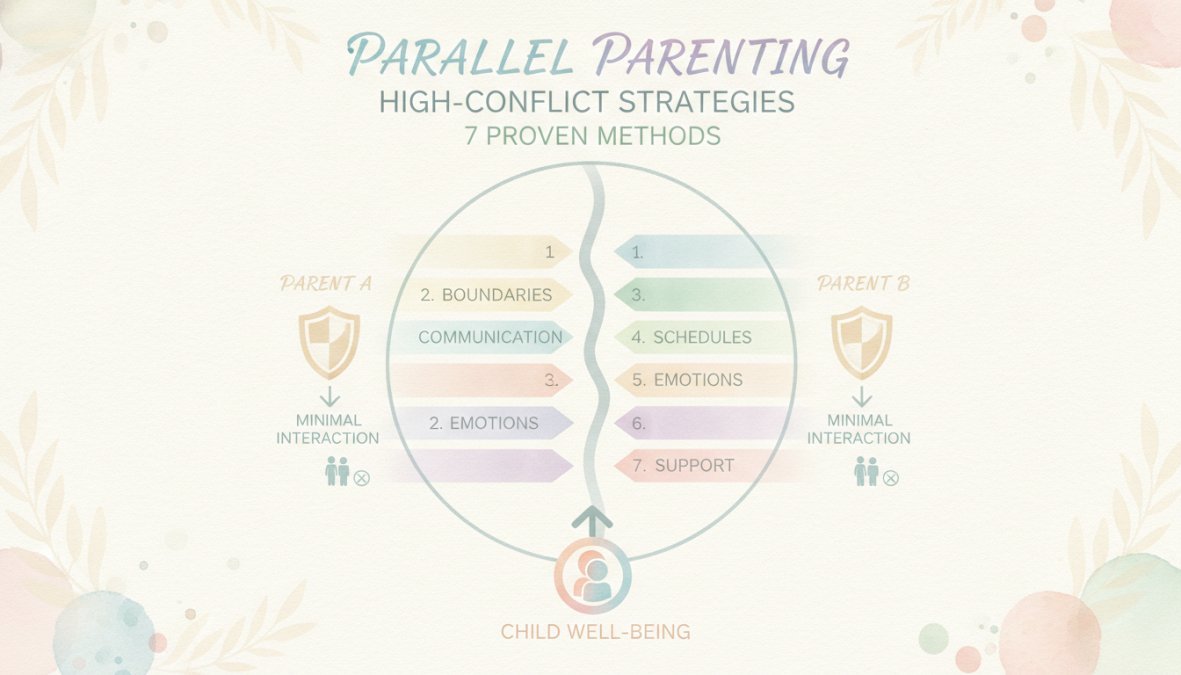
Dealing with a high-conflict ex requires fundamentally different mental frameworks than managing respectful co-parenting. The goal isn’t changing their behavior, it’s making their behavior irrelevant to your peace and your children’s stability.
Accept what you cannot control: how your ex communicates with your children about you, their parenting choices in their own home, their emotional responses. You can control your own responses, household boundaries, and communication protocols. High-conflict individuals are often motivated by control, spite, or unresolved trauma, not rational persuasion. Accepting this frees you to stop trying to convince them and start protecting yourself.
Document every significant interaction, concerning statement your child reports, boundary violation, and hostile communication. Documentation provides legal protection and creates a factual record if court intervention becomes necessary.
Process emotions privately and show up in communications with calm professionalism. Your ex’s behavior is designed to trigger you. When you react emotionally, you give them power. When you respond with neutrality, you remove their leverage.
Do not document as a way to “build a case” in real-time. That mindset keeps you locked in conflict. Document systematically and file it away. Only review it if legal action becomes necessary.
Setting Parallel Parenting Boundaries That Actually Stick
Boundaries that don’t stick aren’t boundaries, they’re suggestions. High-conflict ex-spouses test every boundary repeatedly. Your boundaries must be clear, specific, and enforced without exception.
Establish written boundaries through your custody agreement or court order. Verbal agreements with high-conflict individuals are worthless. Everything goes in writing, preferably with a third-party mediator or family law attorney present.
Communication boundaries: All communication regarding children occurs through a designated parenting app or email only. No phone calls except genuine emergencies. No in-person conversations except at scheduled transitions.
Decision-making boundaries: Each parent makes all decisions during their parenting time without input from the other parent. School choice, medical decisions, extracurricular activities, and religious instruction are determined by the parent with primary custody for that decision area.
Information boundaries: Share only essential information about the child’s health, safety, and schedule. Do not share personal information about your life, relationships, finances, or emotional state.
Transition boundaries: Exchanges happen at a neutral location with no entering each other’s homes or extended conversations.
When your ex violates a boundary, document the violation and proceed with your established consequence without negotiation.
Legal Custody vs. Physical Custody: Boundary Clarification
Understanding these distinctions clarifies where your decision-making authority actually lies and prevents constant disputes.
Physical custody determines where the child lives and which parent provides day-to-day care. The parent with primary physical custody makes routine decisions: bedtime, meals, homework, and minor medical decisions.
Legal custody determines who makes major life decisions: school enrollment, medical treatment, religious upbringing, and significant extracurricular commitments. In high-conflict situations, sole legal custody to one parent is often more practical than joint legal custody, which requires ongoing communication.
For parallel parenting, the ideal arrangement is one parent with primary physical custody and decision-making authority for that household, with the other parent having their own physical custody time and independent decision-making within that time.
If your custody agreement is vague about decision-making authority, petition the court for clarification. Spending $500 on a modification now prevents thousands in conflict and legal fees later.
Parallel Parenting Communication Apps and Protocols
Communication is the primary source of conflict in high-conflict situations. Reducing unnecessary communication and structuring what remains is essential.
The ideal communication method is written only, email or a dedicated parenting app. Written communication creates a record, removes emotional escalation, and gives both parties time to respond thoughtfully rather than reactively.
When you must communicate, follow the BIFF response method: Brief, Informative, Friendly, and Firm.
Brief: Keep messages under 5 sentences.
Informative: Include only necessary facts. “Soccer practice is Tuesday at 5 PM” not “I’m enrolling him in soccer because you never encourage his interests.”
Friendly: Use a neutral, professional tone. Avoid sarcasm, passive aggression, or contempt.
Firm: State decisions clearly without softening language. “Pickup is 6 PM Saturday” not “Would it be okay if pickup was 6 PM Saturday?”
Example:
- BAD: “You never take him to his doctor appointments. I had to reschedule again because you ignored the reminder. Can you please actually be responsible?”
- GOOD: “Dr. Chen’s appointment is Friday at 3 PM. Please confirm you’ll attend.”
The BIFF method removes the emotional hooks your ex uses to pull you into conflict.

Creating a Parallel Parenting Plan Template for Your Situation
A comprehensive parallel parenting plan specifies every major decision point and operational detail. This plan becomes your reference document when disputes arise.
Your plan should include:
Custody schedule: Exact dates, times, and location of exchanges. Include holiday and summer schedules.
Communication protocols: Which communication method for which types of messages. Emergency contact procedures. Response time expectations.
Decision-making authority: Which parent decides about school, medical care, extracurricular activities, religious upbringing, and significant purchases.
Financial responsibilities: Who pays for what, child support, medical expenses, extracurricular activities, and education.
Household rules: Each parent’s rules apply in their own home. The other parent does not enforce the other parent’s rules during transitions.
Conflict resolution process: How disputes are handled. Does one parent’s decision stand until a mediator reviews it?
Information sharing: What information must be shared and what doesn’t need to be communicated.
Emergency Protocol Templates and Crisis Communication
High-conflict situations require predefined protocols for genuine emergencies. When your child is injured, seriously ill, or in danger, you cannot afford to navigate conflict about who decides what.
Your emergency protocol should specify:
Who gets contacted first: The parent present handles immediate medical response. The other parent is notified immediately after emergency services are contacted.
What constitutes an emergency: Define this clearly. A fever is not an emergency. Difficulty breathing is. A scraped knee is not an emergency. A head injury is.
Medical decision-making in emergencies: The parent present makes emergency medical decisions. The other parent cannot override emergency decisions made by the present parent.
Communication during crisis: Both parents receive immediate notification of any serious health event, hospitalization, or safety incident. Communication is factual and focused.
Example emergency protocol language:
“In the event of a medical emergency requiring immediate treatment, the parent present may authorize emergency medical care without waiting for the other parent’s approval. The other parent will be notified within one hour of the emergency.”
Strategies for Parallel Parenting High-Conflict: Implementation Steps
Step 1: Minimize Direct Contact and Use Written Communication
Eliminate unnecessary direct contact. Every in-person interaction, phone call, or real-time conversation with a high-conflict ex is a potential conflict trigger.
Transition exchanges should happen at a neutral location, a school parking lot, community center, or police station lobby, rather than at either parent’s home. Some families use a third-party exchange service where the receiving parent arrives as the other parent departs.
All non-emergency communication goes through written channels only: parenting apps, email, or text message. Use templates and the BIFF method consistently to reduce emotional labor.
Set specific times for checking parenting communication. Check once in the morning and once in the evening. This prevents reactive cycles throughout the day.
Step 2: Establish Independent Household Routines
Each household operates independently with its own rules, routines, and expectations. Your child has one set of rules at your home and potentially different rules at their other parent’s home. This is normal and acceptable in parallel parenting.
Trying to enforce consistency across both households requires constant communication and cooperation. Instead, each parent establishes clear expectations in their own home.
Examples:
Bedtime: Your home has an 8 PM bedtime. The other parent’s home may have a 9 PM bedtime. Both are acceptable.
Screen time: Your home has a one-hour daily limit. The other parent may allow unlimited screen time. You enforce your rules in your home.
Dietary choices: Your home serves home-cooked meals. The other parent may order takeout frequently. You feed your child well in your home.
Do not communicate these differences as criticism. You maintain your expectations in your home without judgment of the other parent’s choices.
Step 3: Document Everything and Maintain Court-Approved Records
Documentation protects you legally, provides evidence if disputes escalate to court, and creates an objective record preventing “he said/she said” conflicts.
What to document:
Communications: Keep copies of all written communication with your ex.
Behavioral incidents: If your child reports concerning statements, write down the date, what was said, and any relevant context.
Health and medical information: Keep records of medical appointments, medications, and health conditions.
Custody schedule compliance: Note any missed pickups, late returns, or schedule changes.
Safety incidents: Document any safety concerns, substance use observations, or incidents affecting the child’s wellbeing.
This documentation is filed and organized but not weaponized. If court intervention becomes necessary, you have evidence.
Protecting Your Child’s Emotional Wellbeing During Parallel Parenting
Your child’s emotional health depends on protecting them from conflict between their parents. Children in high-conflict situations often experience loyalty conflicts, anxiety about disappointing either parent, and confusion about whose “side” they should be on.
Never criticize the other parent to your child, directly, indirectly, or through implication. Your child needs to maintain their relationship with both parents without guilt or conflict. Never use your child as a messenger or ask them to relay information. Never ask your child to choose between parents or keep secrets from the other parent. Create a home environment where your child feels safe, supported, and free from parental conflict.
Recognizing and Mitigating Parental Alienation
Parental alienation occurs when one parent deliberately undermines the child’s relationship with the other parent through criticism, withholding contact, or coaching the child to reject the other parent.
Warning signs include sudden refusal of contact without clear reason, repeating the other parent’s criticisms verbatim, extreme anger toward the other parent that seems disproportionate, or the other parent withholding scheduled parenting time as punishment.
If you recognize these patterns in your child, reassure them that both parents love them and that they’re not responsible for the conflict. If you recognize these patterns in your own behavior, stop immediately. If the other parent is engaging in alienation, document it and consider involving a family therapist or court-appointed evaluator.
Alienation doesn’t always look like obvious rejection. Sometimes it’s subtle: constant criticism, making your child feel guilty for enjoying time with you, or suggesting [your parent](/signs-your-co-parent-is-gaslighting-you-about-the-kids/)ing is inadequate. Watch for these patterns in your child’s anxiety about time with you.
Self-Care for the Parallel Parent: Managing Your Own Stress
Parallel parenting is emotionally exhausting. Without deliberate self-care, you’ll burn out. Self-care isn’t luxury, it’s maintenance.
Practical strategies include therapy or counseling with a specialist in high-conflict relationships, connecting with other parallel parents through support groups or online communities, regular physical activity to process stress and regulate your nervous system, setting specific times when you allow yourself to think about the conflict, celebrating small wins when your ex respects a boundary or transitions go smoothly, and letting go of outcomes you cannot control.
Your ex’s behavior, their parenting choices, their emotional state, these are not your responsibility. Your responsibility is your own household, your own parenting, and your own emotional health.
Parallel parenting high-conflict situations is harder and more emotionally demanding than the parenting journey you envisioned. But it’s often the most realistic path forward when traditional co-parenting is impossible. By implementing these strategies, minimizing contact, using written communication, establishing independent routines, documenting systematically, protecting your child’s emotional wellbeing, recognizing alienation, and prioritizing self-care, you create a functioning system that reduces conflict and provides stability for your children.
Frequently Asked Questions
What is the difference between parallel parenting and co-parenting in high-conflict situations?
Parallel parenting minimizes direct interaction between parents by creating separate, independent household routines and decision-making processes. Co-parenting requires active collaboration and communication. In high-conflict situations, parallel parenting reduces triggers and conflict exposure for both parents and children, making it the more practical approach when a toxic ex makes cooperation difficult or unsafe.
How do you implement parallel parenting communication apps and protocols effectively?
Use court-approved, written-only communication platforms to eliminate direct contact. Adopt the BIFF response method (Brief, Informative, Friendly, Firm) for all written exchanges. Keep messages focused on logistics and child-related matters only. Document all communications for legal custody records. Avoid emotional language, sarcasm, or engagement with provocative statements. This structured approach reduces conflict escalation and creates a paper trail if mediation or legal action becomes necessary.
What should a parallel parenting plan template include to prevent custody disputes?
A comprehensive parallel parenting plan should outline: parenting schedules and physical custody arrangements, decision-making authority for education/health/religion, communication protocols and response times, independent household rules and routines, financial responsibilities, emergency procedures, and dispute resolution methods. Court-ordered plans carry legal weight. Templates should address low-contact protocols, define which parent makes which decisions independently, and establish boundaries around parental involvement in each household to minimize conflict triggers and protect children from exposure to parental tension.
How do you set boundaries with a high-conflict ex-spouse in a parallel parenting arrangement?
Set clear, documented boundaries in your custody agreement and communicate them consistently through written channels only. Establish rules about: when and how information is shared, what topics are off-limits, response time expectations, and consequences for boundary violations. Use disengagement techniques like the Gray Rock Method (being boring and unresponsive to provocations). Never respond emotionally or engage in debates. If your ex violates boundaries repeatedly, document incidents and consult family law professionals about enforcement or custody modifications through mediation.