
Table of Contents
- Step 1: Stay Calm and Avoid Retaliation
- Step 2: Gather Evidence and Document False Allegations for Court
- Step 3: Use Scripts for Responding to Hostile Ex-Partner Messages
- Step 4: Apply the Gray Rock Method for Co-Parenting
- Step 5: When to Involve an Attorney for False Accusations
- Step 6: Prepare for a Restraining Order Hearing or Court Proceeding
- Step 7: Protect Your Parental Rights and Manage Co-Parenting During Active Accusations
- Conclusion
Last Updated: August 19, 2026
Step 1: Stay Calm and Avoid Retaliation
Your response in the first 48 hours shapes how courts, child protective services, and your children perceive the conflict. When accused, adrenaline spikes and you want to respond immediately, but reacting while triggered almost always backfires. Angry messages, defensive calls, and confrontational interactions become evidence your accuser can use against you. Courts don’t see justified rage; they see a warning sign.
Separate your emotional reaction from your strategic response. You can feel furious and still choose not to act on it. Retaliation, counter-accusations, spreading information about your ex, using children as messengers, escalates conflict and undermines your credibility. If accused of harassment and you send hostile messages back, you’ve provided evidence supporting the accusation.
Adopt a "documentation mindset." Everything you do should be something you’d comfortably explain to a judge. That’s your filter: not "Is this what I want to say?" but "Is this what I want the court to see?"
Write down your emotional response privately, journal, voice memo, unsent letter. Get anger out of your system before interacting with anyone involved in the case. This prevents weaponizing your own words against yourself.
Avoid direct communication with your accuser. Every message can be used in legal proceedings and twisted out of context. If you share custody and must communicate about logistics, use a neutral co-parenting platform, not text, email, or social media where tone is ambiguous and screenshots are easily manipulated.
Your goal: create space between the accusation and your response. Let shock and anger settle before moving forward.
Step 2: Gather Evidence and Document False Allegations for Court
Responding to false accusations means building a factual record before memory fades and your accuser refines their story. Evidence is your shield, it transforms "he said, she said" into documented fact.
Start gathering evidence immediately, but legally. There’s a critical difference between documenting what you have access to and illegally obtaining private communications or recordings.
What counts as admissible evidence
Family law judges care about documentation that’s contemporaneous (created when events happened), specific (with dates, times, details), and verifiable (not just your word).
Strong evidence includes:
- Text messages and emails between you and your ex that contradict the false accusation. These are powerful because they’re timestamped.
- Calendar entries and schedules showing you were elsewhere when the alleged incident occurred or your presence at child exchanges.
- Witness statements from people present during the alleged incident or who can testify to your character. Written statements made before the accusation are strongest.
- Medical records or police reports documenting (or failing to document) injuries or incidents consistent with accusations.
- Financial records showing child support payments, healthcare costs, or activity expenses that demonstrate your involvement and responsibility.
- Photos or videos establishing your whereabouts or the condition of shared spaces.
- School records, teacher communications, or pediatrician notes showing your involvement in your children’s lives and any behavioral changes contradicting abuse or neglect claims.
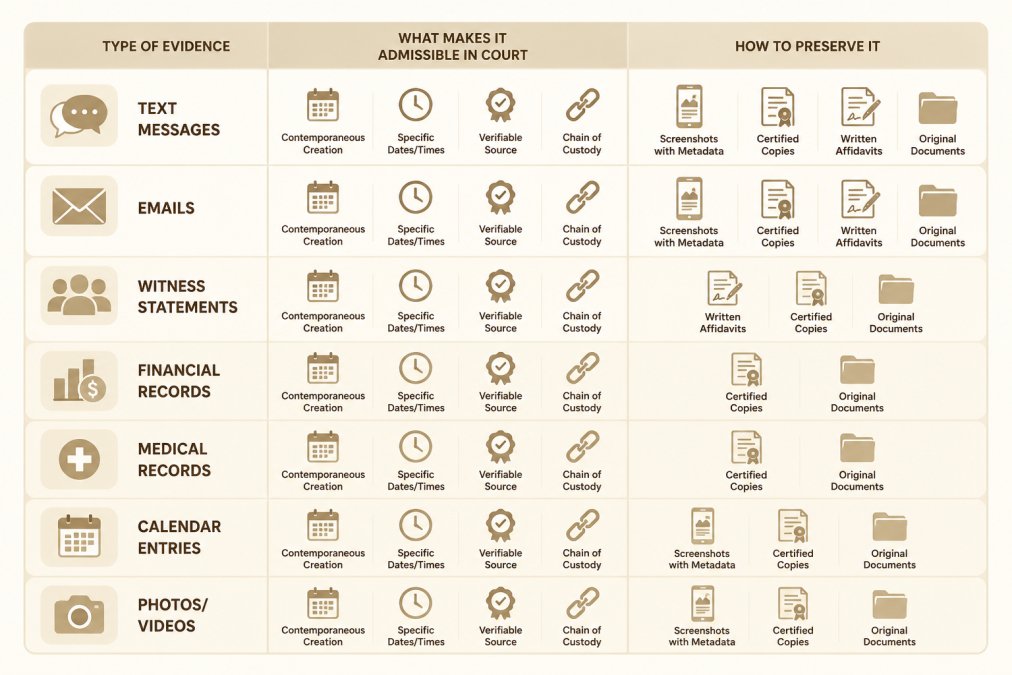
Digital evidence preservation
Digital evidence is fragile. Screenshots can be challenged. Deleted messages disappear. Preserve it properly:
- Screenshot everything with metadata visible. Include full threads, timestamps, and participant names. Don’t crop or edit.
- Create certified copies. Print important communications to PDF with printing date shown, or use your phone’s native export function to create PDFs with full metadata.
- Save to multiple locations. Keep copies on your computer, cloud storage, and printed hard copies. If your ex accesses your phone or hacks your email, you still have evidence.
- Document the chain of custody. Write down when you obtained each piece of evidence, where it came from, and how you’ve stored it.
- Never alter, edit, or selectively crop evidence. Manipulating evidence, even to clarify, contaminates it. Courts treat edited evidence with deep skepticism.
Illegally obtained evidence gets excluded from court and can result in criminal charges against you. Don’t access your ex’s private accounts, phones, or devices. Recording someone without their knowledge is illegal in many jurisdictions. Hacking email or social media is a federal crime.
Document the impact of false allegations: dates you were denied custody, employer communications indicating awareness, mental health treatment related to stress, and financial costs (attorney fees, court costs).
Step 3: Use Scripts for Responding to Hostile Ex-Partner Messages
Your ex sends a hostile message. Your instinct is to respond immediately and emotionally. Every word becomes part of the permanent record. Scripts ensure that when triggered, you don’t write something you’ll regret in a deposition.
When to respond and when to stay silent
Not every message deserves a response. If your ex is venting, accusing, or provoking, silence is often strongest. No response means no new material to twist.
Respond only when:
- The message requires a logistical answer about the children
- You need to correct a factual misstatement affecting custody or safety
- You’re documenting your involvement in parenting decisions
When you do respond, use this structure:
Script 1: Logistical Response
"I received your message about [specific topic]. The plan is [clear, factual statement]. I’m available [specific time/date] if you need to discuss further."
Script 2: Correcting a Factual Claim
"I want to clarify: [your version of events with specific details]. I have [documentation] that supports this. Moving forward, let’s focus on [children’s needs]."
Script 3: Setting a Boundary
"I’m not able to discuss [topic] via message. If this is urgent, contact my attorney. Otherwise, let’s focus on coordinating parenting time."
Script 4: Refusing to Engage with an Accusation
"I’m not going to respond to that claim. If you have concerns about [children’s] safety, contact [child protective services/law enforcement]. Otherwise, I’m available to discuss parenting logistics."
Before sending any message, read it aloud. If it sounds defensive, angry, or like you’re trying to convince someone of your innocence, rewrite it. Innocence doesn’t require explanation, it requires documentation and calm behavior.
Step 4: Apply the Gray Rock Method for Co-Parenting
The Gray Rock Method de-escalates conflict by becoming as uninteresting as a gray rock. Your ex loses the emotional reaction they seek, and conflict naturally diminishes.
In co-parenting, Gray Rock means:
Take the free 23-point assessment →
- Respond to logistics only. Answer questions about pickup times, school events, and medical appointments. Ignore everything else.
- Keep responses short and factual. One sentence is often enough: "Thursday at 6 PM works."
- Use neutral language. No exclamation points, emoticons, or attempts at friendliness. Neutral is boring. Boring is your goal.
- Don’t explain, defend, or justify. These invite argument. "I can’t do Saturday" is complete.
- Don’t ask personal questions. "How are you?" invites connection. You’re not trying to connect, you’re co-parenting efficiently.
- Don’t share information about your life. Your ex doesn’t need to know about your new relationship, job, therapy, or vacation plans.
Gray Rock isn’t about being cold to your children. It’s about professional neutrality with your ex. Your children still get warmth and engagement from you.
Your ex might send longer messages or try harder to provoke initially. This "extinction burst" is temporary and signals the method is working. Stay consistent. Within weeks, most high-conflict exes stop trying because they’re no longer getting emotional payoff. managing workplace conflicts.
Step 5: When to Involve an Attorney for False Accusations
You don’t need an attorney to stay calm or document evidence. But you absolutely need one when the accusation enters the legal system.
Red flags requiring immediate legal counsel
Contact a family law attorney immediately if:
- Criminal charges have been filed against you
- A protective order or restraining order has been filed or served
- Child protective services has opened an investigation
- Your custody or parenting time is being restricted based on the accusation
- Your ex has filed for emergency or temporary custody modification
- You’ve been asked to attend a police interview or investigation
- Your ex’s attorney has contacted you
- The accusation is being used in a divorce or custody proceeding
Even if none apply yet, consult an attorney if the accusation is serious (abuse, neglect, criminal behavior) or your ex has a history of using the legal system as a weapon.
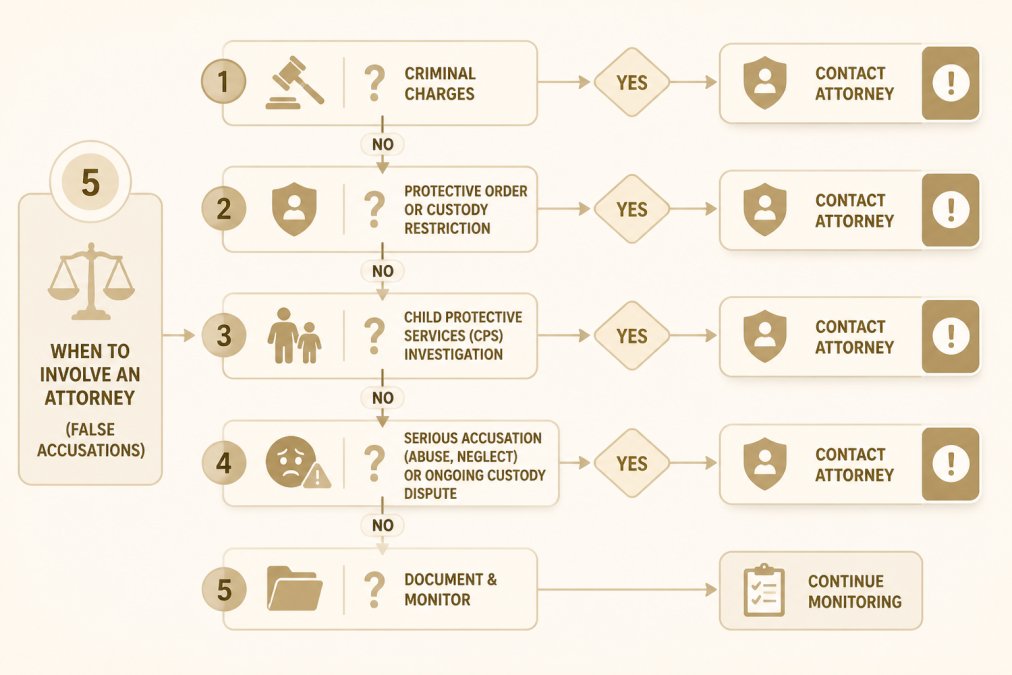
What an attorney does:
- Protects your legal rights by ensuring you don’t inadvertently incriminate yourself
- Navigates procedural requirements (filing deadlines, court rules, discovery requests)
- Builds your defense by identifying weaknesses in your accuser’s case
- Represents you in court so you don’t face your accuser alone
- Negotiates outcomes (charge dismissal, custody agreements, protective order modifications)
- Advises you on what to say and what not to say to authorities and others
When you hire an attorney, stop communicating directly with your ex except about child logistics. Your attorney becomes the intermediary, protecting you through a professional filter.
Step 6: Prepare for a Restraining Order Hearing or Court Proceeding
If your ex has filed for a protective order or the false accusation is being heard in family court, prepare for a hearing. Your documentation becomes critical.
Burden of proof and what the court requires
In a civil protective order hearing, your accuser must prove their case by "preponderance of the evidence", more likely than not. The judge will look for:
- Specific incidents with dates and details. Vague claims ("He’s always threatening me") won’t hold up.
- Evidence supporting the claim. Messages, injuries, medical records, witness statements, police reports. Without evidence, it’s their word against yours.
- A pattern of behavior. One incident might be dismissed as misunderstanding. A pattern suggests intent.
- Credibility. If the accuser has made false accusations before or their story keeps changing, the judge notices.
Your job is to challenge their evidence and present your own:
- Challenge the specifics. Show you were elsewhere when the incident allegedly occurred or provide the actual message if they claim you said something.
- Present your evidence. Bring documentation: messages contradicting their claim, calendar entries, witness statements, photos.
- Establish your credibility. Consistency in your story, organized evidence, and calm demeanor make judges more likely to believe you.
- Show the pattern of false accusations. If this is part of a pattern of your ex making accusations to control you or gain custody advantage, that weakens their credibility.
Prepare for cross-examination. Stay calm, answer directly, and don’t volunteer information beyond what’s asked.
In court, “I don’t remember” and “I don’t know” are acceptable. Making something up or guessing is not. Courts respect honest uncertainty more than confident false claims.
Step 7: Protect Your Parental Rights and Manage Co-Parenting During Active Accusations
While the false accusation is being litigated, you’re still a parent. Your children still need you. The challenge is protecting your relationship with them while protecting yourself legally.
Document your parenting. Take photos and videos of normal, everyday moments with your children: school pickups, homework time, meals, bedtime routines. These establish that you’re involved, present, and capable.
Keep your children out of the conflict. Do not tell them about the accusation or legal proceedings, ask them questions about what they told your ex or child protective services, use them as messengers, bad-mouth their other parent, or make them feel they need to choose sides.
Maintain consistent parenting time. Show up on time, return them on time, and document it. Consistency proves you’re reliable and engaged.
If child protective services investigates, cooperate fully but protect yourself: answer questions honestly, provide documentation, don’t admit to anything you didn’t do, have your attorney present if possible, and follow any safety plans or requirements imposed.
Manage your own mental health. Being falsely accused is traumatic. Seek therapy not because the accusation is true, but because the stress of defending yourself is real. Your therapist’s notes can serve as evidence that you’re taking the accusation seriously.
Set boundaries with your ex about parenting decisions. "I’ve made the decision about [school/activity/medical treatment] based on what’s best for our child. I’m happy to discuss, but the decision stands." Clear boundaries prevent your ex from using parenting decisions as another arena for conflict.
Conclusion
Responding to false accusations from an ex-partner is a marathon, not a sprint. Staying calm, gathering evidence, using scripts, applying Gray Rock, involving an attorney, preparing for court, and protecting your parental rights form a complete strategy for navigating this crisis.
The hardest part isn’t the legal process, it’s resisting the urge to defend yourself emotionally when falsely accused. But that restraint protects you. Every calm message, every documented moment, every professional interaction becomes evidence that you’re stable, reliable, and telling the truth.
Frequently Asked Questions
What should I do if my ex-partner is making false allegations to gain custody advantage?
Document every interaction, preserve all communications, and consult a family law attorney immediately. The court requires evidence to support allegations, and a pattern of false claims can damage your ex's credibility. Avoid retaliation or defensive language in any written communication. Focus on demonstrating your consistent, responsible parenting through documentation of time spent with your children, attendance at school events, and positive interactions. Legal counsel can advise on how to present this evidence effectively in custody proceedings.
How do I document false allegations properly so they hold up in court?
Save all communications (emails, text messages, social media posts) with timestamps intact. Create a detailed written record of false allegations, including dates, what was said, who witnessed it, and how you responded. Take screenshots of digital evidence and store copies in multiple secure locations. For verbal accusations, write a contemporaneous account noting the date, time, location, and any witnesses. Organize evidence chronologically in a folder. Provide this documentation to your attorney, who will advise on admissibility and how to present it effectively during legal proceedings.
When should I involve an attorney for false accusations from my ex?
Contact an attorney immediately if criminal charges are filed, a protective order is requested, your custody rights are threatened, or accusations are escalating in severity. Even if no formal action has been taken, early legal consultation helps you understand your rights and build a defense strategy. An attorney can advise on how to respond to false allegations, what evidence matters, and how to protect yourself. Many attorneys offer initial consultations at reduced cost. Do not delay if allegations could affect your parental rights or legal standing.
How can I use the gray rock method when my ex-partner keeps making accusations?
The gray rock method means responding to hostile messages with minimal emotional content, like a dull rock. Keep responses brief, factual, and unemotional. Example: Instead of defending yourself against an accusation, reply with 'I received your message. Pickup is at 3 PM on Friday.' Avoid explaining, justifying, or engaging with the accusation itself. This reduces the reward your ex gets from making accusations and limits material they can use against you. Use this method consistently in all written communication, especially about co-parenting logistics. This approach protects you legally while managing the emotional drain of constant false allegations.
This article was written using GrandRanker