Everyone told you this was heartbreak. Your nervous system knows otherwise.
TL;DR:
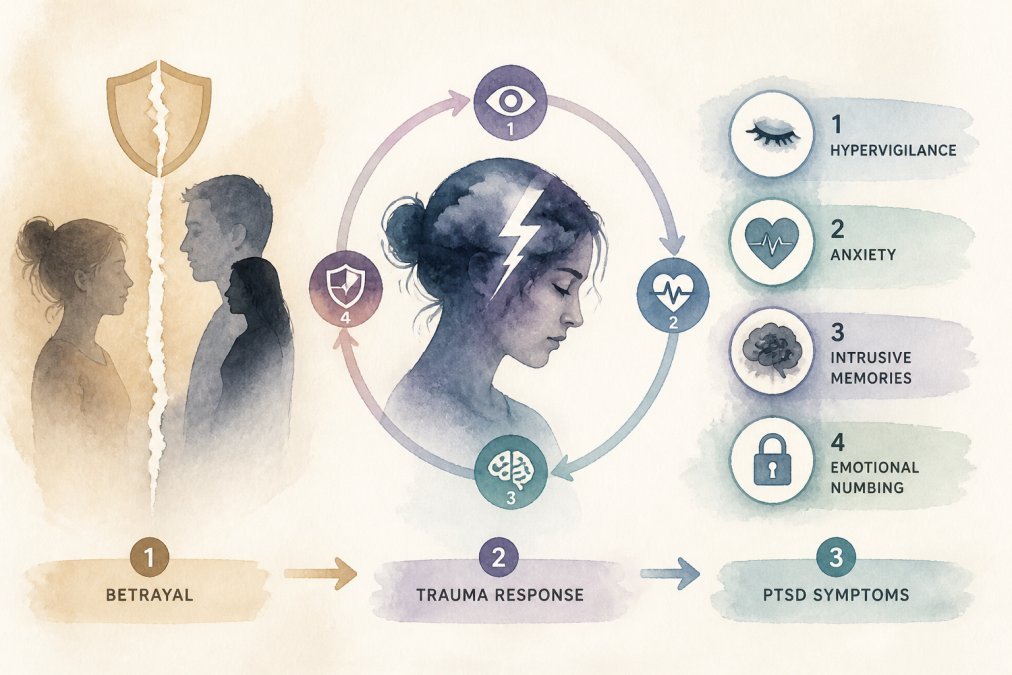
Heartbreak and betrayal trauma are not the same experience, even though they share some surface features. Heartbreak is a grief response — painful, recognisable, and following a process the nervous system broadly understands. Betrayal trauma is a threat response — one that collapses the nervous system’s most fundamental orienting function: the ability to distinguish safe from unsafe. Understanding the difference is not academic. It changes how you approach recovery, what support you seek, and how much patience you extend to yourself when the thing you were told was heartbreak refuses to behave like heartbreak.
Key Takeaways
| Point | What this means for you |
|---|---|
| Heartbreak is a grief response | The nervous system understands what happened. Something is lost. The mourning process begins. |
| Betrayal trauma is a threat response | The nervous system loses its framework for distinguishing safe from unsafe. |
| The source of the wound is what makes them different | In heartbreak, the relationship ends. In betrayal trauma, the attachment figure becomes the threat source. |
| Symptoms respond to different approaches | Grief resolves through mourning. Trauma resolves through nervous system stabilisation and processing. |
| Calling betrayal trauma heartbreak is not just imprecise — it is costly | It produces shame when the “heartbreak” does not resolve on a heartbreak timeline. |
Why the Distinction Matters
You have probably been told, in some form, that what you are going through is heartbreak. By people who love you and are trying to help. By the cultural scripts around relationship endings. Possibly by yourself, in an attempt to put what happened into a category you know how to manage.
Heartbreak is a known thing. It hurts, but it is survivable. People recover from heartbreak. There is a trajectory to it, however painful. The cultural vocabulary for heartbreak is rich and available.
The problem is that what follows infidelity is frequently not heartbreak. Or not only heartbreak. And treating a betrayal trauma response as though it is heartbreak produces a specific and avoidable kind of additional suffering: the suffering of a person who has been given the wrong map for the terrain they are trying to cross.
If the map says the path goes one way and the terrain goes another, the person does not fail for getting lost. The map is wrong. And the most useful thing that can happen is for someone to replace it with an accurate one.
What Heartbreak Actually Is
Heartbreak — the grief of lost love, of a relationship ending — is a genuine and serious emotional experience. It should not be minimised. The pain of it is real.
But heartbreak, at its core, is a grief response. Something valued has been lost. The self is intact and knows what it has lost. The mourning process, however non-linear, follows a recognisable arc. Over time, and with adequate support, the acute pain reduces. New meaning is constructed. Life continues.
Crucially: in heartbreak, the nervous system broadly understands what happened. Someone is gone. The threat is comprehensible, and in a strange way, containable. It is the threat of absence — of someone no longer being there — and absence, however painful, is something the nervous system knows how to orient to.
The body responds to heartbreak with genuine grief physiology: the hollow feeling, the physical ache, the loss of appetite, the tears. These are real. And they belong to a process that the nervous system is equipped, with time and support, to move through.
What Betrayal Trauma Actually Is
Betrayal trauma is something structurally different, and the difference is not one of degree — it is not simply that betrayal trauma is worse heartbreak. It is a different kind of experience, producing different neurological effects through a different mechanism.
In betrayal trauma, the wound is not absence. The wound is the discovery that the person who was supposed to be the safest attachment figure in your life was simultaneously the source of a sustained, concealed danger.
This creates a specific neurological crisis. The nervous system’s most basic orienting function is the ability to distinguish safe from unsafe. Every human nervous system is constantly making this distinction — reading the environment, assessing people, generating a baseline sense of whether the current situation is one that requires protection or one in which it is safe to relax.
The primary source of safety signals for most adults in long-term relationships is their partner. The partner is the person the nervous system has most consistently categorised as safe. They are the person whose presence signals that the immediate environment is not dangerous.
When infidelity is discovered, that categorisation collapses. The person the nervous system had coded as the primary safe presence is simultaneously revealed as the source of a hidden, sustained threat. The nervous system is not designed to process this contradiction quickly, because the contradiction is neurologically unprecedented in the context of that relationship. It has no template for it. It cannot simply update a file. It has to revise an entire framework.
This is why betrayal trauma does not feel like grief. It feels like disorientation. Like the ground has gone. Like nothing can be trusted. Like you have lost access to your own sense of what is real.
The Five Specific Ways They Differ
1. The nature of the loss
Heartbreak involves losing someone who is gone. Betrayal trauma involves losing the version of someone who turned out not to have existed in the way you believed — while they may still be physically present. You are not mourning an absence. You are mourning a reality that has been retroactively rewritten.
2. The direction of the threat
In heartbreak, the pain comes from outside: the person left, the relationship ended, something external is gone. In betrayal trauma, the threat came from inside the relationship — from the place that was supposed to be safest. This reversal of the safety source is what makes the nervous system’s response so severe and so hard to resolve.
3. The timeline of recovery
Heartbreak tends to reduce gradually over a predictable period. Betrayal trauma does not follow a predictable arc. It cycles. It re-activates. It can remain acute for much longer than grief, particularly when there is no adequate name or framework for it, and particularly when recovery support is matched to grief rather than to trauma.
4. The effect on the sense of reality
Heartbreak does not typically make you question your perception of the past. Betrayal trauma rewrites it. The memories that existed as ordinary or happy are re-contextualised by the knowledge of what was also happening. This retroactive rewriting is not a feature of grief. It is specific to the kind of betrayal where sustained concealment is involved.
5. The secondary symptoms
Heartbreak produces grief symptoms: sadness, loss of appetite, fatigue, tearfulness, longing. Betrayal trauma produces trauma symptoms: hypervigilance, intrusive thoughts, emotional flashbacks, physical hyperarousal, sleep disruption, difficulty concentrating, and a persistent state of threat-readiness. These are different symptom clusters. They respond to different approaches.

Why Calling It Heartbreak Costs You Something
The mislabelling is not simply imprecise. It has a real cost.
When betrayal trauma is framed as heartbreak, the implicit expectation is that it will follow a heartbreak trajectory. Painful at first. Gradually improving. Resolved, more or less, within a period that seems proportionate to the relationship.
When the actual experience does not follow that trajectory — when months pass and the hypervigilance has not resolved, when a year passes and the intrusive thoughts are still arriving uninvited, when the nervous system is still behaving as though the threat is present — the person concludes that something is wrong with them. That they are not recovering correctly. That they are too weak, too attached, too unable to let go.
None of that is true. What is true is that they were given the wrong framework, and they have been measuring their recovery against the wrong standard.
The shame that accumulates from failing to recover from heartbreak on heartbreak’s timeline is a secondary wound. It is added to the original trauma. And it makes the recovery harder, not because the original injury was too severe to heal, but because the person is spending resources they need for healing on managing the shame of not healing quickly enough.
What the Correct Framing Changes
When the experience is named accurately — as betrayal trauma, as a nervous system injury with a specific mechanism and a specific recovery process — several things shift.
The timeline expectation adjusts to something realistic. The symptoms are recognised as physiological responses rather than personal failings. The kind of support that is sought matches the kind of support that actually helps. And the self-blame that was amplifying the original symptoms begins to loosen, because it was built on the false premise that a person with a serious nervous system injury should be recovering on grief’s schedule.
The correct framing does not make the experience less painful. But it makes it legible. And legibility is the beginning of the path through it.
If you are reading this and recognising your own experience in it, the pillar article in this series — Why Infidelity Feels Like It Permanently Changed Your Nervous System — covers the neurological mechanisms in full. The posts that follow go deeper into specific symptoms: the intrusive thoughts, the hypervigilance, the emotional flashbacks, the nervous system dysregulation that still has not resolved.
You are not doing heartbreak wrong. You are doing trauma. And those are different things, with different maps.
FAQ
Is it possible to have both heartbreak and betrayal trauma at the same time? Yes, and most survivors do. Infidelity involves genuine loss — of the relationship as it was understood, of the future that was planned, sometimes of the relationship itself. The grief for those losses is real and runs alongside the trauma response. The distinction matters for treatment and timeline, not for dismissing the grief.
My friends keep telling me I should be over this by now. What do I say? The most useful thing is accurate information: what you are going through is not heartbreak, and it does not resolve on heartbreak’s timeline. You might share that betrayal trauma is a recognised neurological injury with its own recovery process. You might also give yourself permission to stop measuring your recovery against other people’s expectations. They are using the wrong framework.
I ended the relationship. Why do I still feel traumatised? Because the trauma was caused by the betrayal, not by the relationship status. Ending the relationship removes the ongoing relational complexity, but it does not resolve the nervous system injury that the betrayal produced. The hypervigilance, the intrusive thoughts, the dysregulation — these belong to the trauma, not to whether you are still with the person.
I feel more like I am in shock than like I am grieving. Is that normal? Yes. The acute phase of betrayal trauma often presents more like shock than grief, precisely because the nervous system is dealing with a threat response rather than a loss response. The disorientation, the unreality, the inability to process what has happened — these are features of a system that has been overloaded, not evidence that something is wrong with your response.