The thoughts are not a choice. Here is what they actually are, and what to do about them.
TL;DR:
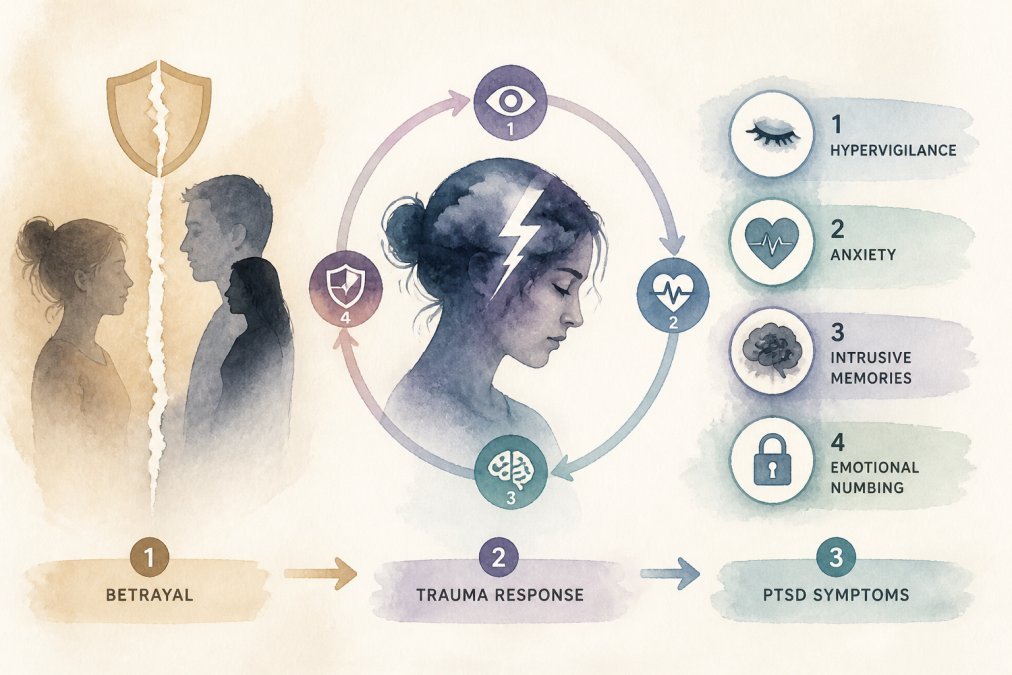
Intrusive thoughts about the affair are one of the most distressing and least understood symptoms of betrayal trauma. Survivors describe them as relentless, involuntary, and deeply shaming — a loop of images, questions, timeline reconstructions, and imagined scenes that arrives without invitation and resists every effort to stop it. This is not rumination as a personality failing. It is a specific neurological process: the brain attempting to consolidate and file threat material that the stress system keeps interrupting. Understanding what the thoughts are and why they are happening changes the experience of having them, and points toward what actually helps. If you find yourself unable to escape these thoughts, it’s essential to learn how to stop thinking about the affair.
Key Takeaways
Seeking support and practicing mindfulness can be effective ways to help you Stop Thinking About the Affair.
| Point | What this means for you |
|---|---|
| Intrusive thoughts are a trauma symptom, not a character flaw | They are not evidence that you are obsessive, weak, or unable to let go. |
| They are produced by a specific neurological failure | The hippocampus cannot consolidate the traumatic material, so it keeps surfacing it. |
| They are not chosen | No amount of willpower stops a process that originates below conscious control. |
| Trying to suppress them makes them worse | Thought suppression is one of the most reliably counterproductive responses to intrusive thoughts. |
| They reduce as the underlying trauma is treated | They are a symptom. When the trauma processes, they diminish. |
| Some of the specific questions driving them have no good answers | Recognising this is part of moving through them, not a failure to resolve them. |
What the Thoughts Actually Are
The affair plays on a loop. You reconstruct the timeline compulsively. You imagine scenes you were not present for. You return, again and again, to specific moments — a particular lie, a specific detail, a piece of information that keeps pulling your attention back however many times you try to redirect it.
You have probably tried to stop this. You have probably told yourself to think about something else, redirected your attention deliberately, decided that you will not go there again today. And then, within minutes or hours, the loop has started again.
This is not a failure of willpower. It is not evidence that you are choosing to stay stuck. It is the output of a specific neurological process that is happening beneath the level of conscious control.
As the post on what betrayal trauma does to the brain explains, the hippocampus is responsible for consolidating memories — processing the raw material of experience and filing it as integrated long-term memory. When a memory has been properly consolidated, its emotional charge reduces and it recedes into the past, accessible when recalled but no longer intruding on present experience.
The traumatic material of the affair has not been consolidated. The stress hormone system, in its chronic state of activation, keeps interrupting the consolidation process. The material cannot be filed. So the brain keeps surfacing it, in awareness, attempting to complete a process that the stress system keeps preventing it from finishing.
The intrusive thoughts are the brain’s attempt to process something it has not yet been able to process. They are not a sign that you are dwelling on the affair. They are a sign that your brain is trying to do the work it needs to do, in the only way currently available to it.
Why They Feel Uncontrollable
They feel uncontrollable because they are, in a specific and important sense, uncontrollable — not in the sense that they will last forever, but in the sense that the mechanism producing them is not accessible to conscious control.
The prefrontal cortex — the part of the brain responsible for executive function, for deciding to think about something else — does not have direct authority over the hippocampal process that is generating the intrusions. Deciding to stop thinking about the affair is like deciding to stop dreaming. The decision is real, and it has no mechanism to execute itself.
This is why the standard advice — “try not to think about it,” “focus on something else,” “give yourself a distraction” — produces, at best, temporary relief and often makes the situation worse. Thought suppression, the deliberate attempt to prevent a specific thought from occurring, is one of the most reliably counterproductive strategies in psychology. The research on this is consistent: suppressing a thought increases its subsequent frequency and emotional intensity. The white bear problem. Try not to think of a white bear. Within seconds, the white bear arrives.
The thoughts are not uncontrollable because you are weak. They are uncontrollable because you are using a tool that does not reach the level where the problem is.
The Specific Forms They Take
Intrusive thoughts in betrayal trauma tend to cluster into recognisable patterns. Naming them can help separate them from the general sense of being overwhelmed.
Timeline reconstruction. The compulsive replaying and rebuilding of the chronology. When did it start? What was happening in the relationship at that point? What does that date mean in terms of something I remember from that time? This is the brain trying to build a coherent narrative from fractured information — an attempt to make sense of something that currently does not have a sensible shape.
Scene construction. The involuntary generating of mental images of events the survivor was not present for. These are particularly distressing because they feel chosen — as though the survivor is imagining something they do not want to imagine — when in fact they are arising from the same process as other intrusive material. They are not fantasies. They are threat memories that have no sensory content of their own, so the brain constructs imagery to attach to the emotional charge.
The questions with no good answers. Did they feel something real? Did they think of me? Were they laughing at me? Do they regret it? What was I doing at that exact moment? These questions are not actually seeking information. They are seeking a resolution that the information cannot provide — a way to make the thing make sense, to find a story in which the pain is explicable and therefore containable.
Comparative thoughts. Measuring oneself against the affair partner. These are among the most shame-inducing of the intrusive thought patterns and among the most universally reported. They are the mind trying to find an explanatory variable — a reason for the thing that happened — and landing on the self as the site of the deficit.
Replaying of pre-discovery moments. Returning to specific memories from the period of the affair and re-experiencing them through the lens of what is now known. The holiday that was also happening while the affair was happening. The conversation that was taking place while the other relationship was also active.
What Makes Them Worse
Suppression. As described above, the attempt to not think about something increases its frequency and intensity. The energy spent on suppression is energy unavailable for processing.
Reassurance-seeking without resolution. Asking the same questions repeatedly and getting answers that do not provide the resolution the questions are really seeking. The questions are not really information-seeking. Answering them repeatedly does not resolve them — it tends to generate new versions of the same question.
Sleep deprivation. The hippocampus does much of its memory consolidation work during sleep. Sleep deprivation disrupts that process further. The intrusive thoughts are reliably worse in the periods of worst sleep disruption, and this is the mechanism.
Isolation. When the intrusive thoughts are the only company available, they expand to fill the space. Social connection, engagement with the world, genuine occupation of attention — these do not make the thoughts go away, but they reduce the available space for the thoughts to occupy.
Shame about the thoughts. The secondary experience of being ashamed of having the thoughts adds an additional emotional charge that makes them harder to process. The shame itself becomes a trigger. One of the most useful early shifts is separating the thoughts from their shame valence: these are a symptom, and having them says nothing about character.

What Actually Helps
Naming them accurately. Not “I am obsessing” but “I am having an intrusive thought.” Not “I cannot stop thinking about this” but “my hippocampus is surfacing unprocessed material.” The naming does not stop the thought. It changes the relationship to it.
Not engaging and not suppressing. The approach that research supports is neither suppression (which increases frequency) nor engagement (which can deepen rumination) but a middle path: acknowledging the thought without following it, letting it pass through awareness without grabbing hold of it. This is a skill that develops with practice. It is also genuinely difficult in the acute phase of betrayal trauma.
Working on the underlying trauma. The intrusive thoughts are a symptom. When the underlying trauma is processed through appropriate therapeutic approaches — particularly those that work directly with the memory consolidation process, such as EMDR — the thoughts reduce. Not because they have been suppressed. Because the material they are arising from has been processed and filed. The alarm stops sounding because the brain has completed the process the alarm was calling for.
Reducing the stress hormone load. Because the hippocampal consolidation failure is partly driven by elevated stress hormones, anything that genuinely reduces the chronic activation of the stress response creates more space for the consolidation process to proceed. Physical movement, somatic regulation practices, adequate sleep where possible, genuine safety and support.
Writing rather than suppressing. Structured expressive writing — not a replay of the affair narrative, but writing about the emotional experience — has research support for reducing the intensity of intrusive thoughts over time. It provides a channel for the material that is not the same as rumination, and it may assist the processing that the hippocampus is trying to complete.
A Note on the Questions That Have No Good Answers
Some of the questions that drive the intrusive thought loop do not have answers that would resolve them, even if the answers were available.
Did they love them? Would knowing change anything you need to change? What were they thinking? Would the answer make the thing more or less painful rather than simply differently painful?
This is not an argument for stopping asking. The questions arise whether you invite them or not. But there is a particular form of additional suffering that comes from treating answerable-feeling questions as though they are answerable — as though finding the right information would finally produce the resolution that has been unavailable.
Some of the questions that betrayal trauma generates are not information questions. They are expressions of a nervous system trying to find a framework for something that has broken its existing framework. They are the brain looking for the story that makes this make sense. And sometimes — often — the thing that helps is not finding the answer but recognising that the question is not looking for information. It is looking for a way through the pain. And the way through the pain is not located in the answer.
The resolution comes from the nervous system processing the threat. Not from the information.
FAQ
How long will the intrusive thoughts last? They tend to be most intense in the acute phase and reduce as the trauma processes. For most survivors, they diminish significantly over time with appropriate support. Without treatment of the underlying trauma, they can persist for much longer. EMDR in particular has strong evidence for reducing the frequency and emotional intensity of intrusive thoughts in trauma.
Is it normal to have intrusive images of things I was not there for? Yes. Scene construction — the involuntary generation of mental imagery attached to events the survivor did not witness — is one of the most commonly reported and most distressing features of infidelity trauma. It is not a sign of morbid fixation. It is the brain attaching imagery to threat memories that do not have their own sensory content.
My partner says I am punishing them by bringing up the affair constantly. But I am not doing it deliberately. The intrusive thought loop often produces questions and conversations that arise from the thoughts rather than from a conscious decision to revisit the affair. This can look, from the outside, like a choice to keep returning to the subject. The distinction between a compelled intrusive process and a chosen revisiting matters, and it is worth naming clearly — ideally with therapeutic support that helps both partners understand what is happening.
Will talking about the thoughts more help them reduce? This depends on what kind of talking. Replaying the affair narrative repeatedly tends to deepen rumination rather than resolve it. Processing the emotional experience of the trauma — the fear, the grief, the rage, the shame — in a therapeutic context tends to help, because it assists the consolidation process that the intrusive thoughts are arising from. The difference is between replaying content and processing experience.