TL;DR:
- Effective post-affair communication involves using specific language, trauma-informed timing, and full transparency to foster healing. Employing “I” statements, clean asks, and scheduling regulated follow-ups reduces defensiveness and builds trust gradually. Consistent empathy, honesty, and patience are essential for rebuilding safety and connection over time.
- How to express needs post-affair without triggering defensiveness
- What are “clean asks” and why do they matter?
- What role does timing play in trauma-informed communication after infidelity?
- Why does full transparency matter when communicating needs post-affair?
- Common mistakes to avoid when expressing needs after an affair
- Key takeaways
- What I’ve learned from watching people find their voice again
- FAQ
Expressing needs post-affair means using direct, empathetic communication that creates emotional safety and gives both partners a clear path toward healing. This process is formally known as betrayal trauma recovery communication, and it requires more than good intentions. It demands specific language, careful timing, and a working understanding of how trauma affects the nervous system. Without these tools, even well-meaning conversations can reopen wounds instead of closing them. The frameworks in this guide, drawn from therapist-backed research and clinical practice, give you a concrete way forward.
How to express needs post-affair without triggering defensiveness
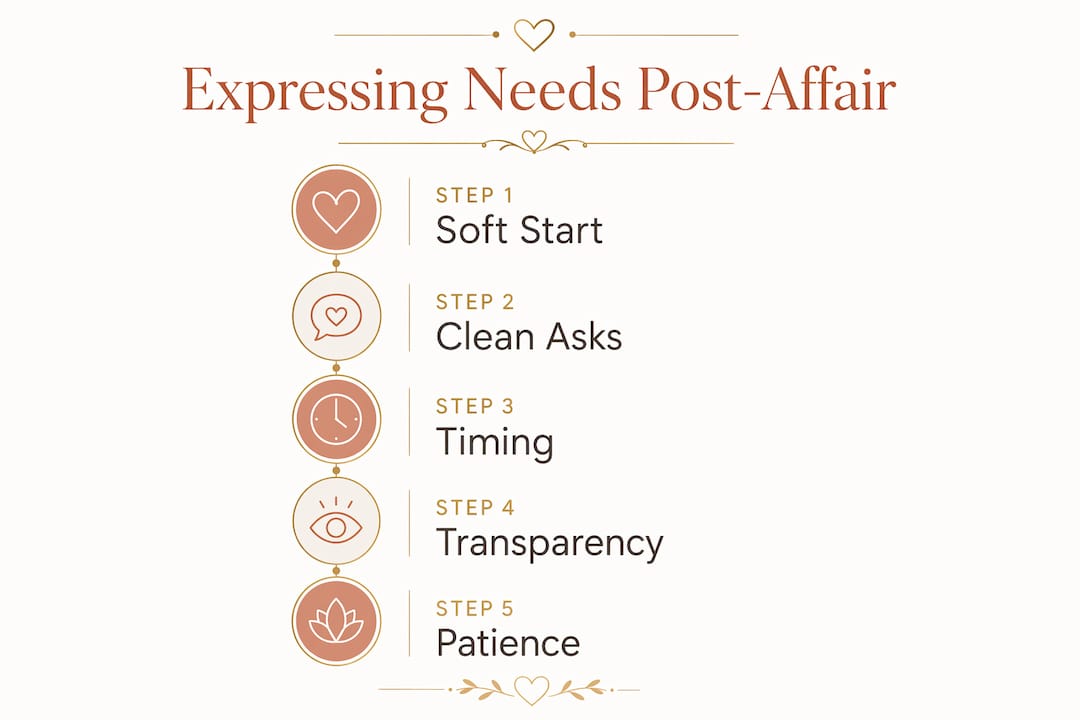
The way a difficult conversation starts determines whether it heals or harms. Research on Gottman’s soft startup shows that opening with “I” statements and specific positive requests reduces defensiveness significantly. This matters because a partner who feels attacked will protect themselves rather than listen, and protection closes the door to genuine repair.
The soft startup approach works by removing blame from the opening sentence. Instead of “You never reassure me,” you say, “I feel scared when I don’t hear from you, and I need a quick check-in text.” The shift from accusation to vulnerability changes the emotional temperature of the conversation immediately.
Here are the core techniques for reducing defensive reactions when expressing feelings post-affair:
- Use “I” statements exclusively. Lead with your feeling, then your need. “I feel anxious. I need reassurance.” Never “You make me feel.”
- Ask permission before starting. “Is now a good time to talk about something important?” This signals respect and gives your partner a moment to prepare.
- Name the feeling before the request. Feelings create connection. Requests without feelings sound like demands.
- Avoid loaded words. Words like “always,” “never,” and “lied” activate defensiveness instantly. Replace them with specific, time-bound observations.
- Keep the opening short. One feeling, one need. Long opening statements overwhelm and invite shutdown.
Pro Tip: Before any difficult conversation, write your opening sentence down. Read it back and ask: does this sentence blame, or does it describe? If it blames, rewrite it until it only describes your experience.
What are “clean asks” and why do they matter?
Clean asks are direct, explicit requests that specify exactly what support you need, rather than leaving your partner to guess. Vague expressions of pain, while understandable, rarely produce the response you need. They create confusion, and confusion creates distance.
The difference between a vague need and a clean ask is specificity. “I need you to be there for me” is vague. “I need you to sit with me for 20 minutes tonight without your phone” is a clean ask. The second version gives your partner something they can actually do, which builds confidence on both sides.
Here is how to build clean asks into your recovery conversations:
- Identify the underlying need first. Ask yourself what would actually make you feel safer or more connected. Write it down before the conversation.
- Translate the need into a behavior. What would your partner do, say, or stop doing if this need were met? Make it observable.
- State the ask in one sentence. “I need reassurance without irritation when I ask where you are.” Short, specific, doable.
- Repeat the ask calmly if needed. Betrayed partners often need to make the same request multiple times. This is not failure. Repetition without escalation shows persistence, not desperation.
- Acknowledge when the ask is met. Positive reinforcement matters. When your partner responds well, say so. “That helped me feel safer. Thank you.”
Expressing needs through concrete requests also shifts the dynamic from performance to partnership. As research confirms, betrayed partners need specific empathy and behavioral commitment, not vague summaries of remorse. A partner who says “I’ll do better” without a defined behavior has not actually answered the need.
Pro Tip: Keep a small notebook of your clean asks. When you feel overwhelmed, refer to it. Having your needs written out prevents you from going blank during emotionally charged moments.
What role does timing play in trauma-informed communication after infidelity?
Timing is not a soft skill in betrayal trauma recovery. It is a clinical necessity. The nervous system of a betrayed partner is frequently in a state of hyperactivation, meaning the brain is scanning for threat rather than processing information. Trying to discuss needs during a trigger is often ineffective because the brain cannot absorb new information while it is in survival mode.
The Empathize, Reassure, Report (ERR) framework, developed within trauma-informed couples therapy, addresses this directly. It sequences the conversation to match the nervous system’s needs. Empathy and reassurance come first, before any facts or requests are introduced.
Here is how ERR works in practice:
- Empathize first. “I can see you’re really hurting right now. That makes complete sense.”
- Reassure second. “I’m not going anywhere. I’m here with you.”
- Report last. Only after the first two steps have landed do you introduce information or make a request.
“Regulation before conversation” is not a delay tactic. It is the only way to ensure that what you say is actually heard.
Scheduling what therapist Jacob Brown, MFT calls after-action conversations is equally important. When a trigger occurs, the moment is rarely the right time to resolve the underlying need. Instead, acknowledge the trigger, regulate together, and schedule a follow-up conversation one to two days later when both nervous systems have calmed. This approach prevents retraumatization and gives the conversation a real chance of producing connection rather than conflict.
Patience is not passive in this context. Consistent, calm re-engagement over weeks and months is what deposits trust into the betrayed partner’s nervous system. Defensiveness withdraws it. Every time you show up with empathy instead of self-protection, you make a measurable deposit.
Why does full transparency matter when communicating needs post-affair?
Full disclosure is the structural foundation of rebuilding trust after an affair. Without it, every conversation about needs sits on unstable ground. The betrayed partner cannot feel safe expressing their needs if they suspect they are still missing information.
The contrast between full disclosure and trickle truth is stark:
| Approach | Impact on healing | Impact on trust |
|---|---|---|
| Full, structured disclosure | Allows nervous system to stabilize around a complete picture | Creates a clear starting point for rebuilding |
| Trickle truth (partial revelations) | Resets the nervous system repeatedly with each new detail | Destroys credibility and prolongs trauma |
| Vague or evasive responses | Keeps the betrayed partner in a state of hypervigilance | Signals ongoing deception, even when unintended |
Jennifer Sigman, LMFT, notes that structured, full disclosure paired with explicit expressions of needs improves healing trajectories. The betrayed partner needs a complete picture, not because they want to punish their partner, but because the brain cannot stop searching for threat until it has enough information to assess safety.
Transparency also means ongoing openness, not just a single disclosure event. Sharing your location, being reachable, and proactively offering information before being asked are all forms of rebuilding trust through transparency. These behaviors communicate that there is nothing left to hide, and that communication is the new norm.
Common mistakes to avoid when expressing needs after an affair
Even people with the best intentions make communication errors in the aftermath of betrayal. Recognizing these patterns early prevents them from becoming entrenched habits that slow recovery.
- Vague apologies and generalized needs. “I’m sorry for everything” and “I just need you to be better” are not communication. They are placeholders. Vague expressions sustain a performance dynamic where both partners feel unsatisfied. Replace them with specific statements and requests.
- Attempting conversations during acute distress. When either partner is flooded, the conversation will escalate. Recognize the signs of flooding (raised voice, shutdown, tears that prevent speech) and call a regulated pause. Return to the topic when both partners are calm.
- Pushing for premature forgiveness. Forgiveness is a destination, not a tool. Asking a betrayed partner to forgive before they feel genuinely heard and safe is a form of pressure that backfires. Focus on safety and understanding first.
- Using needs as leverage. Expressing a need is not the same as issuing a threat. “If you don’t do this, I’m leaving” is not a clean ask. It is coercion, and it shuts down the openness that healing requires.
- Neglecting your own regulation. Both partners carry nervous system activation after an affair. The partner who caused the harm also needs to regulate before speaking. Entering a conversation while flooded with guilt or defensiveness produces the same poor outcomes as entering while flooded with grief.
Rebuilding communication after cheating is a skill that improves with practice and self-awareness. Recognizing a mistake mid-conversation and naming it, “I think I just blamed instead of described, let me try again,” is itself a repair move.
Key takeaways
Expressing needs post-affair requires specific language, trauma-informed timing, and full transparency working together, not any single element alone.
| Point | Details |
|---|---|
| Use clean asks | Replace vague needs with specific, one-sentence behavioral requests your partner can actually fulfill. |
| Start with soft startup | Open every difficult conversation with an “I” statement and a feeling before making any request. |
| Time conversations carefully | Regulate first, then talk. Schedule after-action conversations 1-2 days after a trigger for better outcomes. |
| Prioritize full disclosure | Structured, complete transparency prevents the repeated nervous system resets caused by trickle truth. |
| Consistency builds trust | Repeated empathic responses over time deposit trust more effectively than any single conversation. |

What I’ve learned from watching people find their voice again
After years of working in this space, the pattern I see most often is this: people come in knowing they are in pain, but they have not yet learned to translate that pain into a request. They say “I need you to understand me,” and their partner nods, and nothing changes. The conversation felt real, but it produced nothing concrete.
The shift happens when someone learns to say, “I need you to look at me when I’m talking about this, not at your phone.” That specificity is not coldness. It is clarity, and clarity is what makes healing possible. I have watched that single change, moving from emotional expression to behavioral request, transform the dynamic in a relationship within weeks.
What I also know is that timing undoes more progress than almost any other factor. A person can have the perfect sentence ready, and if they deliver it while their partner is flooded, it lands nowhere. The nervous system is not a metaphor in betrayal trauma. It is the actual mechanism of recovery. Working with it, not against it, is the difference between a conversation that heals and one that reopens the wound.
Healing after infidelity is not linear, and it is not fast. But I have seen it happen, consistently, when people commit to the communication practices that actually match the biology of trauma. The tools exist. The question is whether you are willing to use them even when it feels counterintuitive to slow down, soften your opening, or wait a day before having the conversation you need to have. That patience is not weakness. It is the work.
— S.J.Howe
Resources to support your recovery from Aftertheaffair
If you are ready to move from understanding these principles to applying them, Aftertheaffair has built structured resources specifically for this stage of recovery. The 7-step recovery checklist gives you a clear, sequenced roadmap that covers communication, disclosure, and trust-building in the order that actually supports nervous system healing. For those working on the longer arc of repair, the relationship growth resources at Aftertheaffair address how to move from survival mode into genuine reconnection. These tools are grounded in the same therapeutic frameworks discussed in this article, and they are designed for people doing this work without a therapist in the room.
FAQ
What does “expressing needs post-affair” actually mean?
Expressing needs post-affair means communicating your emotional and practical requirements to your partner using specific, direct language rather than vague expressions of pain. The goal is to make requests your partner can realistically fulfill, which creates safety and builds trust over time.
How do “I” statements help when communicating after infidelity?
“I” statements remove blame from the conversation by focusing on your experience rather than your partner’s behavior. Research on the Gottman soft startup confirms this approach reduces defensiveness and keeps the partner open to listening.
When is the right time to discuss needs after a betrayal trigger?
Discussing needs during an acute trigger is rarely effective because the nervous system is in survival mode and cannot process new information. Scheduling a calm follow-up conversation one to two days later, after both partners have regulated, produces far better outcomes.
What is trickle truth and why does it slow healing?
Trickle truth is the practice of revealing affair details incrementally rather than through a single, structured disclosure. Each new revelation resets the betrayed partner’s nervous system, prolonging trauma and delaying the point at which genuine trust-building can begin.
How long does it take to rebuild trust after an affair?
Trust rebuilds through time, consistency, and transparency rather than through verbal promises alone. Most research and clinical experience points to a recovery arc of two to four years for couples who engage actively with the process, though individual timelines vary significantly based on the depth of the betrayal and the quality of communication throughout recovery.
Recommended
- Relationship Growth After Infidelity – After the Affair Series
- Ways to Rebuild Trust After Betrayal: Real Steps That Work
- How to communicate after affair: rebuild trust in 2026 – After the Affair Series
- Rebuilding Trust Timeline – After the Affair Series