TL;DR:
- Protecting mental health from constant triggers requires intentional self-regulation, trigger curation, and a diverse resilience toolkit. Building strengths across meaning, regulation, relationships, and environment creates distributed resilience, preventing reliance on a single strategy. Daily practices like breathing, movement, and trigger audits, combined with environment design, enhance recovery from relentless emotional triggers.
- How to protect your mental health when triggers are constant
- How can breathing and physical activity regulate emotional responses?
- What is a resilience portfolio and why does it matter?
- How do psychoanalytic and somatic approaches deepen trigger management?
- What daily steps protect your mental health from relentless triggers?
- Key takeaways
- What I have learned about living with triggers that most guides miss
- FAQ
Protecting your mental health when triggers are constant requires more than willpower. It demands intentional self-regulation, selective attention, and a diverse resilience toolkit built across multiple life domains. The clinical term for what many people experience in this state is emotional dysregulation under chronic stress, and it is far more common than most realize, especially among those recovering from betrayal trauma. This article draws on 2026 research into trigger fatigue, resilience portfolio theory, and somatic approaches to give you a practical, evidence-grounded framework for managing constant triggers without burning out.
How to protect your mental health when triggers are constant
Trigger fatigue is the predictable result of too many signals overwhelming the brain’s attention system. It moves through stages: full engagement, selective response, partial dismissal, and finally trigger blindness, where the brain stops registering signals entirely. This is not weakness. It is a neurological cost-saving measure that, left unaddressed, leaves you numb to both threats and genuine needs.
The cognitive cost of ignoring triggers is just as high as the cost of overreacting to them. When your brain learns that signals are unreliable or endless, it stops distinguishing between what matters and what does not. You lose the signal-to-noise ratio that makes emotional awareness useful.
The solution is curation. If you are not acting on a trigger more than 80% of the time, it is noise, not signal. Removing it from your environment reduces cognitive load and restores your capacity to respond meaningfully to the triggers that actually matter. Think of a well-designed trigger system like a monitoring dashboard: fewer, high-confidence alerts produce better decisions than a screen full of warnings you have learned to ignore.
Here is how to audit your personal trigger environment:
- List every recurring trigger you experience in a typical week, whether it is a social media notification, a particular phrase, a location, or a memory cue.
- Mark each one: do you act on it, process it, or simply react and move on?
- Remove or reduce exposure to any trigger you react to but cannot act on or process productively.
- Reassess monthly. Your capacity changes, and your trigger environment should change with it.
Pro Tip: Set a 10-minute weekly “trigger audit” on your calendar. Use a notes app or a simple journal to track which triggers you responded to meaningfully versus which ones just drained you. Patterns become visible within two to three weeks.
“A sparse, well-designed trigger system functions like a monitoring dashboard with high-confidence alerts. The goal is not to eliminate all triggers, but to keep only the ones you can actually use.” — Trigger Fatigue and Attention Management
How can breathing and physical activity regulate emotional responses?
A dysregulated nervous system does not respond to logic. When you are flooded with stress hormones, the prefrontal cortex, the part of the brain responsible for rational decision-making, goes offline. Breathing techniques and physical movement work because they communicate safety to the body directly, bypassing conscious thought.
The 4-4-6-2 breathing technique is one of the most accessible tools for this. Inhale for 4 counts, hold for 4, exhale for 6, and pause for 2 before the next breath. The extended exhale activates the parasympathetic nervous system, which is the body’s rest-and-digest state. Practicing this for just five minutes during or after a trigger response measurably reduces heart rate and cortisol reactivity.
Physical activity compounds this effect over time. 150 minutes per week of moderate movement, divided into 20 to 30 minute sessions, is the CDC’s recommended threshold for emotional stability under chronic stress. That works out to roughly four sessions per week. The consistency matters more than the intensity.
Embodied regulation options that work well for people managing persistent emotional triggers include:
- Yoga and slow flow movement: Activates interoception, the ability to sense internal body states, which is often dulled by chronic stress.
- Walking in natural environments: Reduces cortisol and rumination simultaneously, with effects measurable after just 20 minutes.
- Dance or rhythmic movement: Provides a safe outlet for stored physical tension without requiring verbal processing.
- Cold water exposure: Brief cold showers or face immersion activate the dive reflex, producing rapid parasympathetic response.
Pro Tip: Start with one physical regulation practice and do it at the same time each day for two weeks before adding another. Self-compassion is not optional here. Missing a session is not failure. It is data about what your schedule can realistically hold.
What is a resilience portfolio and why does it matter?
A resilience portfolio is a structured approach to building strengths across four domains: meaning-making, emotion regulation, interpersonal relationships, and environment management. Research involving over 20,000 participants found that people who develop capacity across all four domains consistently outperform those who rely heavily on a single strategy, even a very good one.
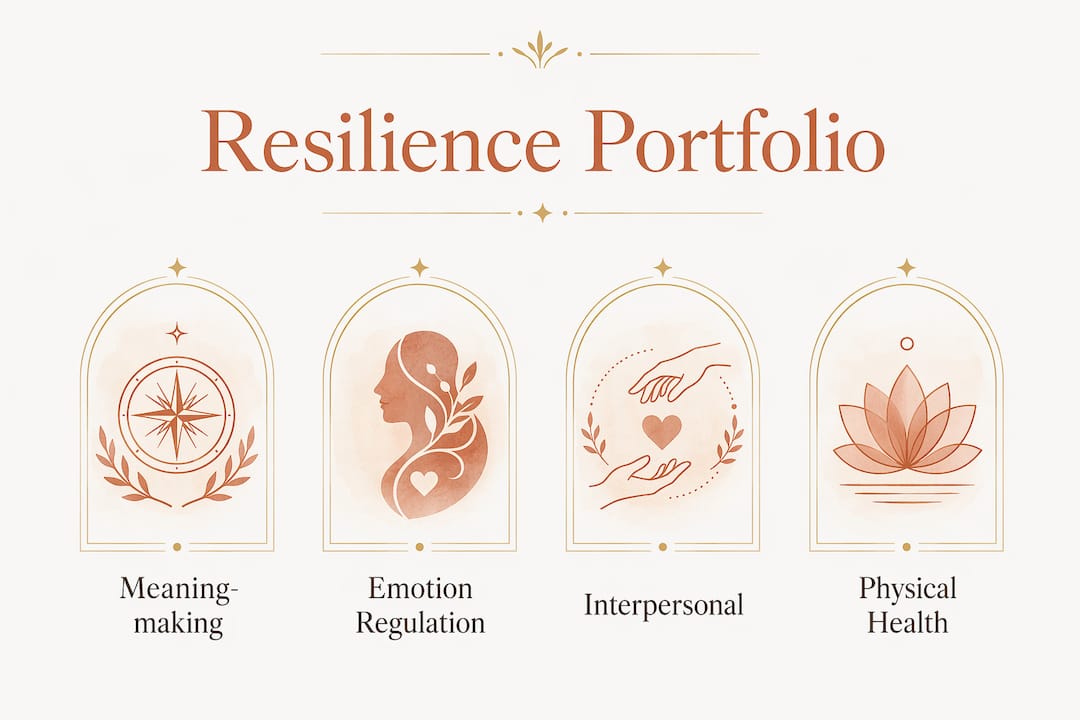
Relying only on emotion regulation, which is what most mental health advice focuses on, is insufficient and often unsustainable. When regulation tools fail under extreme stress, people who have no other domain to draw on collapse. A portfolio approach means you always have somewhere to turn.
| Domain | What it looks like in practice |
|---|---|
| Meaning-making | Cultural or spiritual practices, journaling, therapy, finding purpose in recovery |
| Emotion regulation | Breathing techniques, grounding exercises, apps like Headspace or Calm |
| Interpersonal relationships | Trusted friends, support groups, professional counselors |
| Environment management | Reducing trigger exposure, creating safe physical spaces, digital boundaries |
The most effective coping toolkit is diverse rather than deep. Possessing two to three skills across different categories predicts higher resilience than mastering one technique. This means your goal is not to become an expert meditator. It is to have a breathing tool, a movement practice, one trusted relationship, and one meaningful activity you can return to.
Think of your resilience portfolio like a monitoring dashboard. Each domain is a panel. If one panel goes dark, the others keep running. You want all four lit up, even dimly, rather than one blazing and three offline.
Building emotional resilience after betrayal follows this same logic. The goal is distributed strength, not perfection in any single area.
How do psychoanalytic and somatic approaches deepen trigger management?
When a trigger hits and your reaction feels disproportionate, you have likely activated what psychoanalytic theory calls a complex. Complexes are autonomous emotional clusters formed around past wounds. They operate automatically, lack empathy, and hijack your response before conscious thought can intervene. Recognizing this is not an excuse for reactive behavior. It is the first step toward reclaiming choice.
Making a complex conscious follows a predictable sequence. First, notice the physical sensation before the emotion fully arrives: tightness in the chest, a drop in the stomach, a sudden urge to flee or fight. Second, name it without judgment. “This is a complex activating.” Third, create a pause, even two seconds, before responding. That pause is where your agency lives.
Somatic Experiencing, developed by Dr. Peter Levine, offers structured techniques for working with the body’s stored activation without trying to eliminate it:
- Orienting: Slowly scan the room with your eyes, naming objects you see. This signals to the nervous system that you are physically safe.
- Titration: Work with small amounts of activation at a time rather than processing everything at once.
- Pendulation: Deliberately shift attention between a distressing sensation and a neutral or pleasant one, building tolerance gradually.
- Resourcing: Anchor to a memory, person, or physical sensation that reliably produces calm.
Managing emotional flooding requires accompanying internal experience rather than overriding it. The goal is not to stop feeling. It is to gradually increase your capacity to stay present during overwhelm without being consumed by it. This is especially relevant for those dealing with post-infidelity triggers, where emotional flooding can feel relentless and unpredictable.
“The shift from trying to override internal flooding to accompanying it is where deeper resilience begins to form.” — Rev. Sheri Heller, LCSW
What daily steps protect your mental health from relentless triggers?
Sustainable protection from constant triggers is built through daily habits, not crisis responses. The following sequence synthesizes the frameworks above into a repeatable daily structure.
- Morning trigger audit (5 minutes): Review your schedule and identify likely trigger points. Decide in advance how you will respond to each one.
- Breathing practice before high-exposure periods: Use the 4-4-6-2 method for five minutes before entering known trigger environments, such as checking email or having a difficult conversation.
- One physical regulation session: Schedule 20 to 30 minutes of movement aligned with CDC guidance. Walking counts. Consistency matters more than format.
- Resilience portfolio check-in (evening): Ask yourself which of the four domains you engaged today. If one is consistently missing, that is your growth edge.
- Trigger curation review (weekly): Remove one trigger from your environment that you have not acted on productively in the past week.
Rigid wellness protocols can worsen stress when they feel like punishment. Flexibility is not a compromise. It is a feature of sustainable mental health. If a technique stops working, replace it rather than forcing it.
Pro Tip: Use apps like Headspace for guided breathing or Insight Timer for free somatic meditations. Neither requires a subscription to access basic grounding tools, and both offer short sessions under 10 minutes for high-stress days.
Key takeaways
Protecting mental health under constant triggers requires a diverse resilience portfolio, not a single technique, combined with trigger curation, embodied regulation, and conscious awareness of internal emotional patterns.
| Point | Details |
|---|---|
| Curate your triggers | Remove triggers you cannot act on productively to restore signal-to-noise ratio. |
| Use the 4-4-6-2 method | This breathing ratio directly activates the parasympathetic nervous system during acute stress. |
| Build a resilience portfolio | Develop skills across meaning, regulation, relationships, and environment for distributed strength. |
| Work with complexes consciously | Naming an activated complex creates a pause where intentional response becomes possible. |
| Prioritize consistency over intensity | 20 to 30 minute daily movement sessions outperform occasional intense efforts for emotional stability. |

What I have learned about living with triggers that most guides miss
I have worked with people in the aftermath of betrayal long enough to know that the standard advice, breathe deeply, practice self-care, talk to someone, is not wrong. It is just incomplete. What most guides skip is the environment design piece. You cannot regulate your way out of a trigger-saturated environment indefinitely. At some point, the nervous system simply runs out of capacity.
The most meaningful shift I have seen in people recovering from relentless triggers is not a new technique. It is the decision to stop treating every trigger as something to be endured and to start treating the trigger environment itself as something to be designed. That means cutting social media accounts that consistently destabilize you, having honest conversations about what you need from the people around you, and accepting that protecting your mental wellness sometimes looks like subtraction rather than addition.
The other thing worth saying plainly: the process is not linear. You will have weeks where the portfolio feels solid and weeks where everything falls apart. That is not failure. That is how nervous system healing actually works. The goal is a longer average, not a perfect score.
If you are in the thick of infidelity recovery specifically, the triggers can feel genuinely relentless. Seeking both community and professional support is not a sign that your coping strategies are inadequate. It is a sign that you understand the scale of what you are dealing with. You can also explore natural coping mechanisms that complement the frameworks discussed here.
— S.J.Howe
How Aftertheaffair resources support your recovery
If the frameworks in this article resonate with you, Aftertheaffair has built structured, compassionate resources specifically for people navigating betrayal trauma and its relentless emotional triggers.
The 7-step recovery checklist is a practical starting point that maps the resilience and regulation concepts discussed here onto a concrete healing sequence. For those who want to go deeper into the trauma layer beneath the triggers, the complex trauma resource explains why triggers feel so overwhelming and what the recovery process actually involves. These are not generic wellness guides. They are built for the specific experience of betrayal, with the clinical depth and personal honesty that experience demands.
FAQ
What is trigger fatigue and how does it affect mental health?
Trigger fatigue occurs when the brain is overwhelmed by too many signals and begins dismissing them, leading to emotional numbness and reduced capacity to respond meaningfully. It progresses through stages from full engagement to trigger blindness, making curation of your trigger environment a clinical priority.
How does the 4-4-6-2 breathing technique work?
The 4-4-6-2 method involves inhaling for 4 counts, holding for 4, exhaling for 6, and pausing for 2. The extended exhale activates the parasympathetic nervous system, signaling safety to the body and reducing acute stress reactivity.
What is a resilience portfolio?
A resilience portfolio is a framework for building strengths across four domains: meaning-making, emotion regulation, interpersonal relationships, and environment management. Research with over 20,000 participants shows that breadth across domains predicts better outcomes than depth in any single strategy.
How do somatic approaches help with constant emotional triggers?
Somatic Experiencing techniques like orienting, titration, and pendulation work by gradually increasing the nervous system’s tolerance for activation without trying to eliminate symptoms. They are particularly effective for emotional flooding associated with complex PTSD and betrayal trauma.
How much physical activity helps with chronic stress?
The CDC recommends 150 minutes of moderate physical activity per week, divided into 20 to 30 minute sessions, for emotional stability under chronic stress. Consistency across the week produces better results than longer, infrequent sessions.
Recommended
- Physical Symptoms of Betrayal – After the Affair Series
- Explain Trauma Triggers: a Guide for Betrayal Survivors
- Triggers After Infidelity – After the Affair Series
- Navigating a Physical Affair – After the Affair Series