You are not paranoid. Your nervous system is running a protection programme it cannot switch off.
TL;DR:
Hypervigilance — the state of continuous, exhausting threat-scanning that many infidelity survivors experience — is one of the most misunderstood symptoms of betrayal trauma. It is mistaken for paranoia, for controlling behaviour, for an inability to trust. It is none of those things. It is the amygdala running at a recalibrated sensitivity, having learned from real experience that the context of this relationship was a source of concealed threat. This article explains what hypervigilance is, where it comes from, why it is so exhausting, and what recovery from it actually looks like.
Key Takeaways
| Point | What this means for you |
|---|---|
| Hypervigilance is a physiological response, not a personality trait | It was produced by your experience. It is not who you are. |
| The amygdala recalibrated after a genuine threat | The sensitivity increase is not irrational. It is a well-functioning threat system responding to real learning. |
| It is exhausting because it is continuous | The nervous system cannot distinguish between real threats and reminders of past threats, so it scans constantly. |
| It tends to extend beyond the relationship that caused it | The nervous system does not always accurately limit its heightened sensitivity to the original context. |
| It responds to nervous system approaches, not to logic | Telling yourself there is no current threat does not switch it off. |
| It can recalibrate | The amygdala responds to sufficient consistent evidence of safety over time. |
What Hypervigilance Actually Is
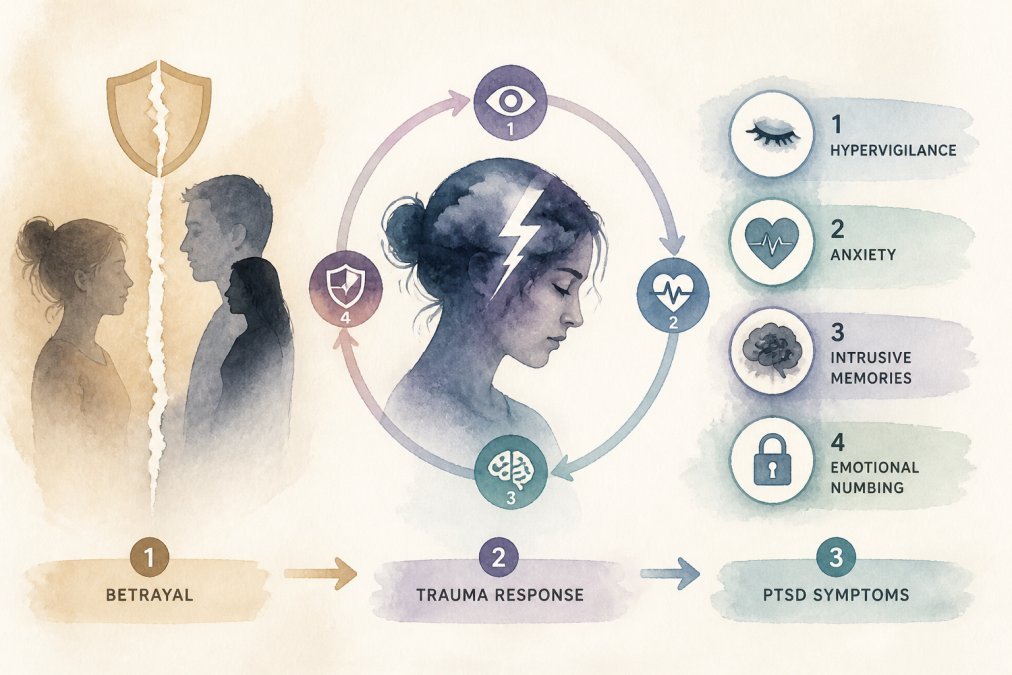
Hypervigilance is a state of heightened, continuous threat-scanning. It is the nervous system running its threat-detection function at an elevated sensitivity — checking, monitoring, reading the environment for signals of danger more constantly and with lower threshold than it did before the traumatic experience.
In the context of infidelity, it tends to look like this: monitoring a partner’s phone, location, energy, tone of voice, and behaviour for discrepancies. Scanning messages and social media. Reading between the lines of ordinary interactions. Noticing and internally flagging things that most people would not consciously register. Being unable to relax the monitoring even when nothing is actively wrong — especially when nothing is actively wrong, because the experience of thinking everything was fine and being catastrophically wrong is exactly what the amygdala learned from.
It is misread, regularly and painfully, as paranoia. As controlling behaviour. As an inability to trust. Partners in reconciliation sometimes interpret it as punishment. Friends and family sometimes interpret it as excessive. The hypervigilant person often interprets it as evidence that something is fundamentally wrong with them.
None of these interpretations are accurate. Hypervigilance is a physiological state produced by a specific threat learning experience. It is not chosen, not irrational in its own terms, and not permanent.
Why the Amygdala Recalibrates After Betrayal
As the post on what betrayal trauma does to the brain explains in more detail, the amygdala is the brain’s threat detection system. It is designed to learn from threat experiences — specifically, to increase its sensitivity to the cues that preceded or accompanied a threat, so that future exposure to those cues produces an earlier and faster protective response.
This is an adaptive mechanism. In most threat contexts, it is exactly the right response.
After infidelity, the threat was concealed within the closest attachment relationship. The cues that preceded or accompanied the threat were ordinary relationship cues: a partner’s presence, their communication patterns, the domestic routines of shared life. The amygdala learned from this that relationship-context cues require heightened monitoring. And it recalibrated accordingly.
The result is a system that is now scanning, with elevated sensitivity, the very context it used to treat as a primary source of safety. Every ordinary interaction carries a slightly higher threat-readiness. Every piece of incoming information about the partner is processed through a filter that is looking for discrepancy, for inconsistency, for the signal that something is being concealed.
This is not irrational behaviour. It is the amygdala doing precisely what it is designed to do: protecting against a known threat pattern. The difficulty is that the threat pattern it learned from no longer accurately represents the current situation — but the amygdala does not have access to that information, and it cannot update on the basis of a decision. It updates on the basis of consistent, repeated experience that contradicts its current calibration.
What Hypervigilance Looks Like in Daily Life
The monitoring of a partner’s phone and location is the most obvious manifestation. But hypervigilance in betrayal trauma extends beyond the obvious.
Reading tone and energy for inconsistency. Not just the explicit content of what a partner says, but the register they say it in. The energy they carry when they come home. The quality of their attention. A slight distraction that used to be unremarkable now carries a flag.
Checking that does not produce relief. This is one of the most characteristic features of hypervigilance: the checking does not resolve the anxiety, because the amygdala is not looking for proof of safety — it is looking for evidence of threat. When it does not find evidence of threat in one place, it scans the next. The relief of a checked phone lasts minutes, not hours, because the scanning function simply moves to the next potential signal source.
Hypervigilance in the body. A physical state of readiness that is sustained even in calm situations. Muscle tension. A difficulty breathing fully. A sense of bracing for something that does not arrive. The body prepared for a threat that the environment is not currently producing.
Hypervigilance extending to other relationships. The recalibration does not always stay precisely limited to the relationship that caused it. Many survivors find elevated monitoring and threat-scanning in other relationships too — with friends, with colleagues, with new people they meet. The amygdala has learned something about the category of close relationships, not only about one specific person.
Hypervigilance to their own internal state. Some survivors develop a secondary hypervigilance to their own reactions — monitoring their own feelings, their own intuitions, their own responses for evidence that they are “being paranoid” or “overreacting.” This is the hypervigilance turned inward, and it is particularly exhausting because it removes the small rests that are available when external monitoring temporarily finds nothing.

Why It Is So Exhausting
The exhaustion of hypervigilance is not simply the exhaustion of anxiety. It is the exhaustion of running a continuous, demanding cognitive and physiological process that does not stop.
The amygdala in hypervigilant mode is consuming resources. The nervous system in sustained threat-readiness is consuming resources. The cognitive load of continuous monitoring — of processing every piece of incoming information through a heightened threat-detection filter — is consuming resources.
These resources are not infinite. The hypervigilance is drawing from the same pool that every other cognitive and emotional function draws from: the capacity to focus, to make decisions, to regulate emotionally, to be present with other people, to rest. As the hypervigilance draws more of that pool, less is available for everything else.
This is why survivors in the acute phase of hypervigilance describe feeling genuinely depleted. Not metaphorically tired. Physiologically exhausted in a way that sleep does not fully resolve, because the system is not fully resting even during sleep. The monitoring does not completely switch off. It continues in some form through the night, which is why the sleep that occurs is so often not restorative.
The Secondary Consequences of Hypervigilance
Beyond the exhaustion, hypervigilance in the recovery context produces several secondary consequences worth naming.
It perpetuates the stress hormone elevation. The hypervigilant state is itself a mild chronic stress state. It keeps cortisol modestly elevated. And elevated cortisol, as the post on the brain explains, disrupts hippocampal consolidation — which means the hypervigilance contributes to the maintenance of the intrusive thoughts that are partly driving it. The two systems reinforce each other.
It can damage relationships beyond the original one. Hypervigilance extending into other relationships — with friends, with a new partner, with adult children — can strain those relationships in ways that are painful and disorienting for everyone involved. The hypervigilant person knows, often, that their scanning is disproportionate in a new context. The knowledge does not disable the scanning.
It consumes the capacity for genuine connection. It is very difficult to be fully present with another person while simultaneously monitoring them for threat signals. The hypervigilance tends to create a slight but persistent distance in interactions — a part of the person that is not participating in the connection but is instead watching it for discrepancy.
It is easy to mistake for continued caring about the betrayal. Partners in reconciliation sometimes interpret the hypervigilance as evidence that the betrayed partner is choosing not to move forward, or is holding the affair as a weapon. This is a misreading that causes significant additional harm. The hypervigilance is not chosen. It is running regardless of the conscious decision to rebuild.
What Does Not Help
Deciding to stop. The amygdala is not accessible to executive decision. Choosing not to monitor does not disable the monitoring function.
Reassurance without change. Reassurance — “I am not doing anything wrong, you can trust me” — provides brief relief that does not last. The amygdala is not looking for verbal reassurance. It is looking for behavioural consistency over time. Reassurance without accompanying consistent behaviour tends to become another variable to monitor rather than a resolution.
Being told it is paranoia. This adds shame to an already exhausting state and does not address the mechanism.
Waiting for it to pass on its own. Without treatment of the underlying amygdala recalibration, hypervigilance can persist for years. It is not resolved by time alone.
What Does Help
Somatic regulation practices. Because hypervigilance is held in the body as well as generated by the brain, approaches that work directly with the body’s arousal state — breathwork, movement, somatic experiencing approaches — can reduce the baseline activation level even when the cognitive content of the threat remains present.
Accumulated behavioural evidence. The amygdala updates on the basis of consistent experience. In the context of reconciliation, proactive transparency — the partner volunteering information rather than waiting to be asked — provides the kind of consistent behavioural data that begins, over time, to give the amygdala the evidence it needs to revise its calibration. This is a slow process. It is also the only process that works at the neurological level.
Therapeutic approaches targeting the amygdala response. EMDR works directly with the threat memories that the amygdala is responding to. Somatic approaches work with the body’s held activation. Both have evidence for reducing hypervigilance in trauma presentations, precisely because they address the mechanism rather than the content.
Reducing the shame about the hypervigilance. The shame about monitoring — the sense that it is irrational, controlling, or evidence of a character failing — adds a secondary activation that compounds the primary hypervigilance. When the hypervigilance is understood as a physiological response to real learning, the shame reduces, and with it, some of the activation it was generating.
FAQ
My partner says my monitoring is controlling behaviour. How do I explain the difference? Controlling behaviour is goal-directed: it aims to restrict another person’s freedom or actions. Hypervigilance is self-protective: it is the nervous system scanning for threat in order to avoid being caught off-guard again. The behaviours may look similar from the outside, but they come from entirely different places. This distinction is worth exploring in a therapeutic context where both partners can hear the explanation together.
Will I always be this hypervigilant? No. The amygdala recalibrates in response to consistent, sufficient evidence of safety. That evidence accumulates slowly and requires consistent input — which is why hypervigilance tends to reduce more in contexts where there is genuine behavioural consistency from a partner, or where distance from the original threat source allows the nervous system to gradually settle. With appropriate therapeutic support, the reduction tends to be more significant and more lasting.
I am hypervigilant even in situations that have nothing to do with my partner. Is that normal? Yes. The amygdala’s learning often generalises beyond the specific relationship context. It has learned something about the category of close relationships, not only about one specific person, and it may apply its heightened sensitivity more broadly. This tends to reduce as the underlying trauma processes.
The checking never makes me feel better. Why do I keep doing it? Because the function of checking is not actually relief — it is threat reduction. The amygdala is not satisfied by finding nothing wrong; it simply moves to the next potential signal source. The temporary relief that checking provides is partial and brief, which is why it tends to escalate rather than resolve. This is one of the clearest signs that the response is amygdala-driven rather than rationally-driven.