TL;DR:
- Proper affair disclosure involves a structured, therapist-supported process that promotes honesty, minimizes harm, and rebuilds trust. Timing, preparation, and sharing only essential facts—avoiding graphic details—are crucial to reducing trauma and ensuring healing. Setting firm boundaries immediately after disclosure sustains progress and facilitates long-term relational recovery.
- What is structured therapeutic disclosure and why is it the best method?
- When and how to prepare for affair disclosure
- How to disclose affair details safely: what to share and what to avoid
- Common disclosure pitfalls and how to avoid retraumatization
- Setting boundaries and rebuilding trust after disclosure
- Key takeaways
- What I’ve learned about disclosure that most guides won’t tell you
- FAQ
Affair disclosure is the process of fully and honestly revealing the facts of an affair to a betrayed partner, ideally within a structured therapeutic framework designed to minimize harm. How you navigate affair disclosure determines whether the conversation becomes a foundation for healing or a source of repeated trauma. The clinical standard, known as structured therapeutic disclosure, gives both partners a controlled, supported environment to exchange truth without the chaos of unplanned confession. Done right, disclosure is not just an act of honesty. It is the first concrete step toward rebuilding trust after infidelity.
What is structured therapeutic disclosure and why is it the best method?
Structured therapeutic disclosure is a clinical protocol where the unfaithful partner prepares a written account of the affair with an individual therapist over several weeks, then reads that account in a joint session with both partners’ therapists present. This is not a spontaneous conversation at the kitchen table. It is a deliberate, professionally supported process designed to protect both people from unnecessary harm.
The structured disclosure protocol works because it removes the interrogation dynamic. The betrayed partner submits questions in advance, which means they receive answers to what matters most without having to extract information under emotional duress. The unfaithful partner arrives prepared, which reduces the likelihood of defensive reactions or incomplete answers.
Here is why this method outperforms unplanned confession:
- It prevents trickle truth. When disclosure is complete and prepared in advance, there are no follow-up revelations that restart the trauma cycle.
- It reduces retraumatization. Clinicians help calibrate what level of detail serves healing versus what detail creates lasting intrusive imagery.
- It creates a shared record. Both partners leave the session with the same understanding of what happened, which is the foundation of a shared reality.
- It keeps both partners emotionally regulated. Therapists can intervene when either partner becomes overwhelmed, preventing the conversation from collapsing into crisis.
- It signals genuine accountability. The preparation required shows the betrayed partner that their pain is being taken seriously.
Pro Tip: If your therapist has not worked with structured therapeutic disclosure before, ask them specifically about the protocol. Not all couples therapists use it by default, and requesting it by name is entirely appropriate.
When and how to prepare for affair disclosure
Timing and emotional readiness are not secondary concerns. Premature or poorly paced disclosure can worsen trauma, even when the intent is honest. Knowing when to disclose what, and how to prepare the environment, makes a measurable difference in outcomes.
The first two to four weeks after discovery are the acute crisis phase. During this window, the betrayed partner needs answers to immediate safety questions: Is the affair over? Is there ongoing contact? Are there health risks? These questions cannot wait. Deeper questions about the timeline, the emotional meaning of the affair, and the full scope of the relationship are best addressed four to eight weeks after discovery, when both partners have had some time to stabilize.
Before the disclosure session, both partners benefit from individual preparation. Consider the following:
- Choose a private, neutral setting. Home can feel unsafe for the betrayed partner after disclosure. A therapist’s office or a private space neither partner associates with the affair is preferable.
- Allow enough uninterrupted time. A few uninterrupted hours in a calm environment prevents the conversation from being cut short at a critical moment.
- Avoid alcohol or substances beforehand. Disclosure requires full emotional presence. Substances impair both the delivery and the reception of difficult truths.
- Schedule follow-up support. Both partners should have individual therapy sessions booked for the days immediately following disclosure.
- Do not try to calm your partner immediately. Emotional reactions are valid and necessary. Rushing to soothe can feel dismissive and shuts down the processing your partner needs.
Pro Tip: Write down the key facts you need to disclose before the session. A written account reviewed with your therapist prevents omissions and helps you stay grounded when emotions run high.
How to disclose affair details safely: what to share and what to avoid
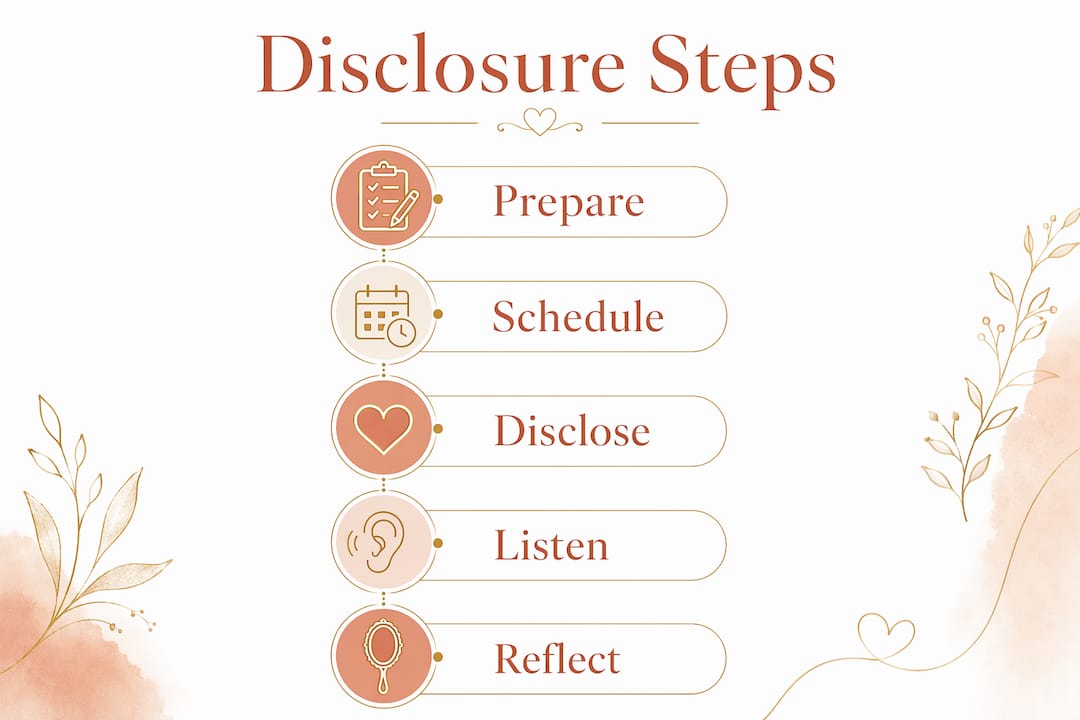
The goal of disclosure is to restore a shared reality, not to provide a complete documentary account. Graphic sexual details often fuel long-term intrusive imagery rather than providing the safety the betrayed partner is seeking. Knowing the difference between what heals and what harms is one of the most important skills in this process.
| Share this | Avoid this |
|---|---|
| Timeline: when the affair started and ended | Graphic sexual descriptions or positions |
| Scope: how many times contact occurred | Comparisons between the affair partner and your spouse |
| Financial impact: money spent on the affair | Unsolicited details about the affair partner’s appearance |
| Physical health risks: STI exposure, testing | Emotional intimacy details that serve no safety purpose |
| Whether contact has fully ended | Specific locations that hold meaning for your partner |
The facts that matter most to the betrayed partner are the ones that help them understand the scope of the deception and assess their own safety. Share the major facts completely and honestly. A complete, calibrated disclosure delivered with clinical support gives the betrayed partner what they need without adding unnecessary injury.
One principle applies without exception: tell the truth once, completely. Partial disclosure followed by additional revelations weeks or months later is more damaging than the original affair in many cases. Each new detail resets the trauma response and restarts the trust recovery clock.
Common disclosure pitfalls and how to avoid retraumatization
The most damaging mistake in affair disclosure is not saying too much. It is saying too little, too slowly. Trickle truth is the pattern of releasing information in small increments, often only when pressed. Each partial revelation feels like a new betrayal because it confirms that the unfaithful partner is still choosing what to hide.
“Each time a new detail surfaces, the betrayed partner does not experience it as a continuation of the original disclosure. They experience it as a fresh act of deception. The trauma clock resets to zero.”
Avoiding retraumatization requires more than just telling the truth. It requires how you tell it. The most common pitfalls are:
- Deflecting responsibility. Phrases like “I only did it because we were having problems” shift blame and prevent the betrayed partner from receiving a genuine acknowledgment of harm.
- Minimizing the scope. Describing a multi-year affair as “just a few times” to soften the blow backfires when the full truth emerges later.
- Disclosing without clinical support. Individual therapeutic work stabilizes both partners’ nervous systems before couples therapy begins. Skipping this step often leads to sessions that escalate rather than heal.
- Answering repeated questions with resentment. The betrayed partner’s repeated questions come from a trauma-driven need to rebuild a shattered reality. Consistent, patient honesty without defensiveness is what moves the process forward.
- Disclosing at the wrong time. Telling a partner about an affair right before a major event, during a family crisis, or late at night with no support available compounds the harm.
Understanding trickle truth and its specific effects on trauma recovery is one of the most useful things you can do before disclosure. The pattern is more common than most people realize, and recognizing it in yourself is the first step to avoiding it.
Setting boundaries and rebuilding trust after disclosure
Disclosure is not the end of the process. It is the beginning of a longer period of rebuilding, and that rebuilding requires concrete, operational boundaries rather than vague promises. Operationalizing boundaries means actively blocking contact with the affair partner and disclosing any contact attempts immediately, without waiting to be asked.
The boundaries that matter most in the period after disclosure include:
- Complete no contact with the affair partner. This is non-negotiable. Any ongoing contact, even “just to explain,” signals that the affair relationship is still being protected.
- Radical transparency on phone, social media, and location. Transparency boundaries typically last 12 to 18 months at minimum and function as active trust-building tools, not punishments.
- Immediate disclosure of any contact attempts. If the affair partner reaches out, the unfaithful partner tells their spouse the same day. No exceptions.
- Accountability without excuses. When the betrayed partner asks questions, the answer is honest and complete. Defensiveness or minimizing at this stage undoes weeks of progress.
| Rebuilding phase | Realistic timeframe |
|---|---|
| Crisis stabilization | Weeks 1 to 8 |
| Structured disclosure | Weeks 4 to 12 |
| Active trust rebuilding | Months 3 to 18 |
| Relational transformation | 18 months to 3 years |
The stages of infidelity recovery follow a recognizable arc, but the pace is not linear. Setbacks are normal and do not mean the process has failed. What matters is that both partners remain committed to the boundaries and the transparency that make recovery possible.
Key takeaways
Affair disclosure done correctly, with full honesty and clinical support, is the single most important factor in whether a relationship can survive infidelity.
| Point | Details |
|---|---|
| Use structured therapeutic disclosure | Prepare a written account with a therapist and disclose in a joint clinical session. |
| Time your disclosure carefully | Answer safety questions within weeks one to four; defer deeper questions to weeks four to eight. |
| Share major facts, not graphic details | Timeline, scope, and health risks restore shared reality; sexual specifics create lasting harm. |
| Avoid trickle truth at all costs | Partial disclosure resets the trauma clock and is experienced as a fresh betrayal each time. |
| Operationalize boundaries immediately | No contact, radical transparency, and same-day disclosure of contact attempts are the foundation of rebuilding. |

What I’ve learned about disclosure that most guides won’t tell you
By Silviya
Most people approaching disclosure are focused on getting through it. They want to say what needs to be said, survive the reaction, and move forward. That instinct is understandable, but it misses something important. Disclosure is not a single event you endure. It is a relational act that either opens a door or closes one, depending entirely on how it is done.
What I have seen repeatedly is that the unfaithful partner’s preparation matters more than their words. Showing up to a disclosure session with a therapist-reviewed written account, having already answered the hard questions for yourself, communicates something no apology can: that you took this seriously enough to do the work before being asked. That preparation is what the betrayed partner actually needs to see.
The other thing most guides skip is the reality that disclosure can wound and open a door to repair at the same time. The betrayed partner will likely feel worse before they feel better. That is not a sign that disclosure failed. It is a sign that it worked. Truth, delivered with care, allows grief to move through rather than stay stuck. The pain of knowing is almost always more manageable than the pain of suspecting.
If you are standing at the edge of this conversation, the most honest thing I can tell you is this: get support, prepare thoroughly, and do not protect yourself at your partner’s expense. The post-affair decisions that follow disclosure are hard, but they are navigable with the right framework.
— S.J.Howe
How Aftertheaffair can support your disclosure process
Knowing what to do and actually doing it are two different things, especially when the emotional stakes are this high. Aftertheaffair has built a structured library of resources specifically for this stage of recovery, including communication guides, boundary-setting frameworks, and step-by-step recovery tools designed to work alongside professional therapy.
The 7-step infidelity recovery checklist at Aftertheaffair gives you a clear, sequenced path through disclosure and the months that follow. It covers what to address first, how to track progress, and how to recognize when you need additional support. If you are working through disclosure right now, this resource gives you structure when everything else feels uncertain. You do not have to figure this out alone.
FAQ
What is the difference between structured and unplanned disclosure?
Structured therapeutic disclosure involves a prepared written account, clinical support from both partners’ therapists, and pre-submitted questions from the betrayed partner. Unplanned disclosure is a spontaneous confession with no preparation, which increases the risk of incomplete information and emotional escalation.
How much detail should I share during affair disclosure?
Share the major facts: timeline, scope, financial impact, and any health risks. Graphic sexual details are not necessary and often create lasting intrusive imagery that slows recovery rather than supporting it.
What is trickle truth and why is it harmful?
Trickle truth is the pattern of releasing affair information gradually, often only when pressed. Each new detail resets the betrayed partner’s trauma response and restarts the trust recovery process, making it more damaging than a single complete disclosure.
How long does rebuilding trust after disclosure take?
Active trust rebuilding typically spans three to eighteen months, with full relational transformation taking up to three years. The timeline is not linear, and setbacks during this period are normal rather than signs of failure.
Should I disclose an affair without a therapist present?
Clinical support during disclosure significantly reduces the risk of retraumatization and trickle truth. If immediate professional support is not available, individual therapy for both partners should begin as soon as possible before and after the disclosure conversation.
Recommended
- Disclosure in affair recovery: key steps to healing
- How disclosure shapes your healing after infidelity
- How to navigate post-affair decisions: 5 key steps
- Why full disclosure matters for healing after infidelity – After the Affair Series