TL;DR:
- Parallel parenting minimizes direct contact between separated parents, focusing on child logistics to protect emotional well-being. It is most suitable for high-conflict families where traditional co-parenting fails, with detailed plans and written communication protocols. Transitioning back to cooperation should only occur after sustained conflict reduction and careful planning.
- What is parallel parenting and how does it differ from co-parenting?
- Why do high-conflict parents need parallel parenting?
- How does parallel parenting affect children at different ages?
- How do you build an effective parallel parenting plan?
- When does parallel parenting have limits?
- Key takeaways
- Why parallel parenting deserves more credit than it gets
- FAQ
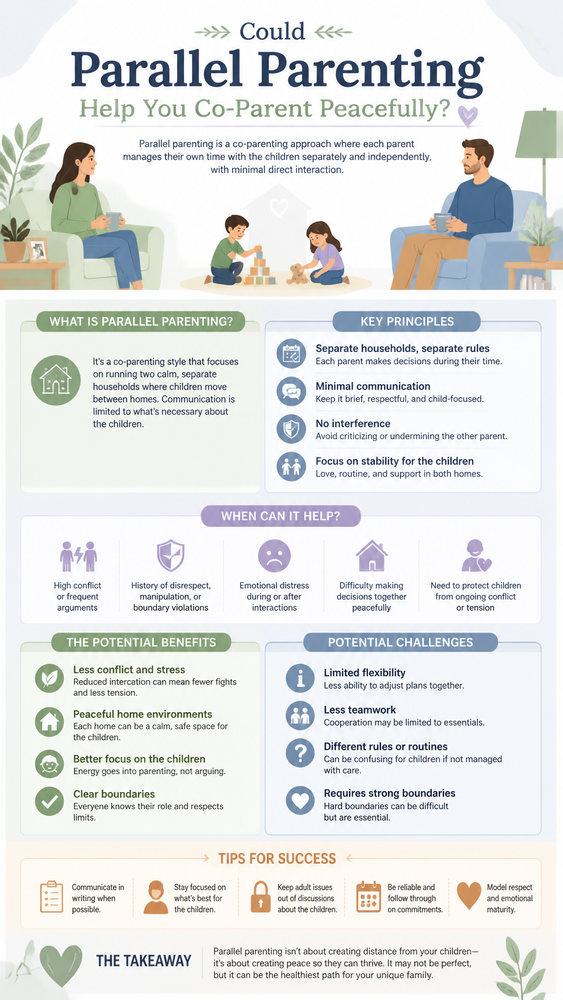
Parallel parenting is defined as a structured, low-contact co-parenting model where separated or divorced parents minimize direct interaction and focus exclusively on child logistics. It is not a compromise or a failure. It is a deliberate strategy for families where traditional co-parenting has broken down due to hostility, manipulation, or ongoing conflict. If every handoff turns into an argument and every email becomes a battleground, parallel parenting gives you a way to stay present in your child’s life without the constant emotional damage that comes from forced collaboration with a hostile ex.
What is parallel parenting and how does it differ from co-parenting?
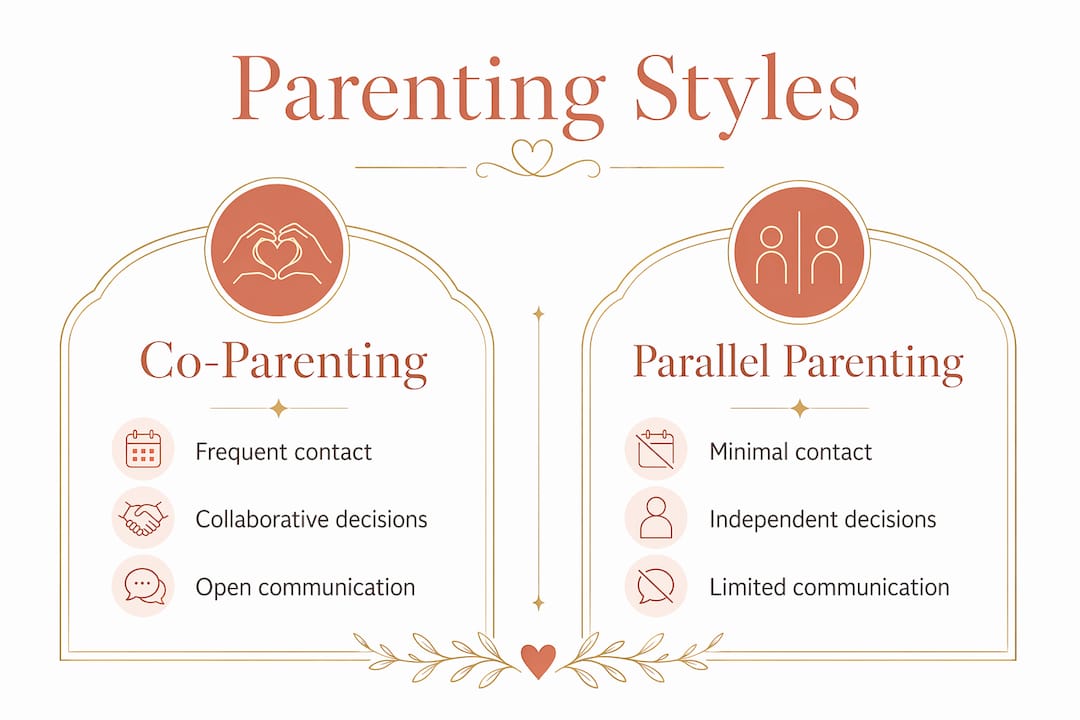
Parallel parenting treats parents as independent entities running separate but compatible tracks for their children’s lives. Each parent has full authority in their own home. Neither parent requires the other’s input on day-to-day decisions. That is the core structural difference from traditional co-parenting, which assumes both parents can communicate openly, make joint decisions, and present a unified front.
Traditional co-parenting works when both parents have resolved enough conflict to collaborate. Parallel parenting works when they have not, and may not for years. The goal shifts from cooperation to containment: contain the conflict, protect the child, and keep both parents involved.
| Feature | Traditional Co-Parenting | Parallel Parenting |
|---|---|---|
| Communication style | Open, frequent, verbal | Written only, limited to logistics |
| Decision-making | Joint, collaborative | Independent per household |
| Parent interaction | Regular, direct | Minimal, structured |
| Conflict exposure risk | Higher | Significantly lower |
| Best suited for | Low-conflict separations | High-conflict separations |
Pro Tip: If you find yourself dreading every text from your ex or rehearsing arguments before pickups, that is a clear signal that parallel parenting is the right structure for your family right now.
Communication in a parallel parenting arrangement is typically restricted to written channels only. Apps like Our Family Wizard are built specifically for this purpose. They create a neutral, documented record of all exchanges, remove the emotional charge of real-time messaging, and give both parents a buffer before responding.
Why do high-conflict parents need parallel parenting?
Parallel parenting is needed when co-parenting attempts consistently fail due to conflict, and when that conflict is actively harming your children. Children who witness repeated parental conflict suffer measurable emotional and psychological consequences. Protecting them from that exposure is not optional. It is the job.
High-conflict situations that call for parallel parenting include:
- Ongoing verbal hostility at exchanges or in written communication
- Manipulation or triangulation, where one parent uses the child as a messenger or informant
- Documented abuse or coercive control patterns
- Court-ordered restrictions on direct parental communication
- Failed mediation attempts where conflict persists despite professional intervention
Parallel parenting is not failure. It is a proactive choice that prioritizes the child’s emotional safety over an idealized model of post-divorce cooperation. The National Parents Organization frames it as a strategic decision, not a last resort.
Mediators and family law attorneys increasingly recommend parallel parenting as a formal structure when direct co-parenting has proven unworkable. A custody attorney can help you formalize the arrangement through court orders, which adds legal weight and reduces the chance of one parent unilaterally changing the terms.
Pro Tip: Before moving to parallel parenting, document at least three to five specific incidents where direct co-parenting contact caused measurable harm or conflict. That record supports your case if the arrangement needs court approval.
How does parallel parenting affect children at different ages?
Children benefit from reduced conflict exposure, but the way parallel parenting affects them depends heavily on their developmental stage. Age shapes what children need from their parents and how they process inconsistency between two households.
Early childhood (ages 2–6)
Young children need predictability above everything else. They cannot understand why rules differ between homes, but they can feel the stability or instability of each environment. In parallel parenting, the reduced conflict exposure is a genuine benefit at this age. A calm, consistent home with one parent is far better than a tense, conflict-saturated environment with two parents pretending to cooperate.
Middle childhood (ages 7–12)
Children in this range are more aware of the differences between households. They notice that bedtime is 8:30 at Mom’s and 10:00 at Dad’s. They may try to exploit those differences, or they may feel anxious about them. The key insight from the Minella Law Group is that consistency between homes matters less than ensuring a calm, low-conflict environment. One predictable, peaceful home is more protective than two homes with matching rules but constant tension.
Adolescence (ages 13–18)
Teenagers have the cognitive capacity to understand that their parents operate separately. Many actually prefer it. They can manage transitions between different household cultures more easily than younger children. The risk at this stage is emotional distance. If parallel parenting becomes so rigid that a teenager feels like a package being transferred between two strangers, the relationship with both parents can suffer.
The numbered priorities for supporting children across all ages are:
- Keep transitions calm and predictable, using neutral locations when needed
- Never use your child to relay messages or gather information about the other parent
- Validate your child’s feelings about having two different homes without criticizing the other parent
- Maintain your own household routines consistently, even if the other home operates differently
- Watch for signs of anxiety, withdrawal, or behavioral changes that may signal the child needs additional support
How do you build an effective parallel parenting plan?
Successful parallel parenting relies on hyper-detailed plans that specify schedules, decision-making protocols, and communication boundaries with enough precision that daily negotiation becomes unnecessary. The plan does the talking so the parents do not have to.
What a strong plan covers
A legally supported parallel parenting plan should address every predictable point of conflict before it arises. That means specifying:
- Holiday and vacation schedules covering every major holiday, school break, and birthday for at least two years in advance
- Decision-making authority for medical, educational, and extracurricular choices, including who has final say in each category
- Communication protocols, including the required channel (written only), response window, and acceptable topics
- Exchange logistics, including location, time, and who is responsible for transportation
- Contingency procedures for illness, school cancellations, and schedule changes
A 48-hour response window for non-urgent written communication is a proven protocol for reducing conflict. It removes the pressure of instant replies and prevents emotional escalation from reactive messaging.
Dedicated co-parenting apps like Our Family Wizard create neutral communication records with built-in response buffers. They also allow both parents to share calendars, track expenses, and document exchanges without any direct contact. That documentation protects both parents if disputes reach court.
Parallel parenting agreements are most effective when formalized by courts or mediators. A court order transforms the plan from a good-faith agreement into an enforceable document. That matters when one parent repeatedly violates the terms.
Pro Tip: Treat your parallel parenting plan like a business contract. Remove all emotional language, focus on logistics, and build in a review clause every 12 months so the plan can evolve as your children grow.
Regularly revisiting the plan is not a sign of instability. It is responsible parenting. Children’s needs change, schedules shift, and what worked when your child was seven may not work at twelve.
When does parallel parenting have limits?
Parallel parenting solves the conflict problem, but it introduces its own challenges. The most common is inconsistency between households. When two parents operate with full independent authority and no communication, children can experience jarring differences in rules, expectations, and emotional tone. That inconsistency is manageable for most children, but it requires each parent to provide enough stability within their own home to compensate.
Signs that parallel parenting may be creating problems include:
- Your child is showing persistent anxiety around transitions
- Your child is reporting confusion or distress about conflicting rules
- Communication has broken down so completely that urgent decisions about the child cannot be made
- One parent is using the structure to obstruct the other’s involvement rather than protect the child
When to consider moving toward cooperative co-parenting
Transition from parallel to co-parenting should be considered when conflict has genuinely reduced and both parents can communicate without triggering stress responses. That transition is not automatic. It requires deliberate steps.
Start by expanding written communication to include non-urgent topics. Then test brief, structured in-person exchanges. If those go well, consider a joint meeting with a mediator or family therapist present. The goal is gradual, tested expansion of contact, not a sudden return to full collaboration.
Experts advise exhausting cooperative co-parenting efforts before moving to parallel parenting, and applying the same patience in reverse when moving back. Rushing the transition because conflict has temporarily decreased is a common mistake. Wait for a sustained pattern of calm, not a single good month.
Key takeaways
Parallel parenting is the most effective structure for high-conflict families because it removes the conditions that generate conflict while keeping both parents actively involved in their children’s lives.
| Point | Details |
|---|---|
| Core definition | Parallel parenting limits direct contact and gives each parent independent authority in their own home. |
| Best use case | Use it when traditional co-parenting consistently produces conflict that harms your children. |
| Plan specificity | A detailed, court-formalized plan covering every schedule and protocol prevents daily negotiation. |
| Child impact by age | Younger children need calm environments most; teens can manage household differences but need emotional connection. |
| Transition readiness | Move back toward cooperative co-parenting only after a sustained, documented reduction in conflict. |

Why parallel parenting deserves more credit than it gets
By S.J.Howe
Most parents I work with arrive at parallel parenting feeling like they have failed. They wanted the amicable divorce, the shared birthday parties, the unified front. What they got instead was a co-parent who uses every interaction as an opportunity to relitigate the relationship. The guilt they carry about “not being able to co-parent properly” is often heavier than the conflict itself.
Here is what I want you to hear: parallel parenting is not the consolation prize. For families in genuine high-conflict situations, it is the only structure that actually protects children. The research from the National Parents Organization is clear. Children need a calm environment more than they need parents who agree on bedtime.
What I have seen work consistently is treating the parallel parenting plan like a legal document from day one. Not a wish list. Not a starting point for negotiation. A binding framework. Parents who approach it that way stop wasting energy on battles that the plan has already resolved.
The hardest part is accepting that you cannot control what happens in the other household. You can only control your own. That shift in focus, from monitoring the other parent to investing in your own home environment, is where real stability for your children begins. It takes time. It takes support. But it is absolutely possible.
— S.J.Howe
Support for parents navigating parallel parenting after betrayal
Parallel parenting after infidelity carries an extra layer of grief. You are not just managing a difficult co-parent. You are managing a co-parent who also betrayed you. The emotional weight of that combination is real, and it deserves structured support.
Aftertheaffair offers resources built specifically for this intersection of betrayal and parenting. The infidelity recovery checklist walks you through seven concrete steps for healing that include co-parenting strategies alongside personal recovery. For parents navigating parallel parenting after infidelity, Aftertheaffair provides guidance on when this structure becomes necessary and how to implement it without losing yourself in the process. You do not have to figure this out alone.
FAQ
What is the main difference between parallel and co-parenting?
Parallel parenting limits direct contact between parents and gives each independent authority in their own home. Traditional co-parenting requires ongoing communication and joint decision-making, which only works when conflict is low.
How do i start parallel parenting with a high-conflict ex?
Start by drafting a detailed written parenting plan that covers schedules, decision-making, and communication protocols, then have it formalized through a court or mediator. Use a dedicated app like Our Family Wizard to keep all communication written and documented.
Does parallel parenting hurt children?
Parallel parenting reduces children’s exposure to conflict, which research identifies as the primary harm in high-conflict separations. Inconsistent rules between homes can be challenging, but a calm, stable home environment in each household compensates for that inconsistency.
Can parallel parenting become traditional co-parenting later?
Yes. When conflict has genuinely and sustainably decreased, parents can gradually expand communication and collaboration. The transition should be tested in small steps, ideally with a mediator or therapist involved.
Do i need a lawyer to set up parallel parenting?
A lawyer is not legally required, but formalizing the plan through a court order makes it enforceable and reduces the risk of one parent unilaterally changing the terms. Legal support is strongly recommended for high-conflict situations.
Recommended
- Parallel Parenting Method – How It Supports Healing – After the Affair Series
- What is the parallel parenting method – After the Affair Series
- Parallel Parenting after infidelity – After the Affair Series