TL;DR:
- Betrayal trauma is a psychological injury caused by someone trusted violating your safety and trust.
- Healing typically takes 12 to 24 months of trauma-focused work, requiring patience and self-compassion.
- You Can't Erase the Betrayal. But You Can Transcend It
- How long does healing from betrayal take, and what does it involve?
- What proven strategies help you transcend betrayal and begin personal transformation?
- When and how is rebuilding or ending relationships possible after betrayal?
- Key Takeaways
- Structured support for your recovery from Aftertheaffair
- FAQ
Betrayal trauma is defined as the psychological injury that occurs when someone you depended on for safety violates that trust. You cannot undo what happened. The memory is permanent, the wound is real, and anyone who tells you to “just move on” does not understand how deeply this kind of harm reaches. What is possible, and what the clinical evidence supports, is transcendence. That means healing from betrayal not by erasing it, but by integrating it into a life that is fuller, clearer, and more authentically yours than before.
You Can’t Erase the Betrayal. But You Can Transcend It
Betrayal trauma is distinct from general trauma because the source of the harm is also your primary source of safety. A car accident is terrifying. A partner’s infidelity is terrifying and disorienting in a way that rewires how you understand yourself and the world. The wound is not just emotional. It is neurobiological.
When the person you trusted most becomes the source of your pain, your nervous system cannot easily categorize the threat. You cannot simply flee or fight. This creates a state of chronic activation, where your body stays on high alert long after the initial discovery. Common symptoms include intrusive thoughts, hypervigilance, emotional numbness, and a deep inability to trust your own perceptions.
“The betrayal does not just damage the relationship. It damages your relationship with your own reality.”
Recovery is non-linear and often involves setbacks or trigger days, which clinicians expect and view as part of integration. A good week followed by a devastating flashback is not failure. It is the nervous system doing the difficult work of processing what happened. Understanding this is the first step toward addressing betrayal trauma with patience rather than self-judgment.
- Intrusive thoughts and flashbacks that arrive without warning, often triggered by ordinary sensory details
- Hypervigilance toward your partner’s behavior, phone, schedule, and emotional tone
- Dissociation or emotional numbness as the nervous system’s protective response
- Shattered self-perception, including questioning your judgment and intuition
- Grief that cycles through anger, sadness, and disbelief without a predictable pattern
How long does healing from betrayal take, and what does it involve?
Healing from betrayal takes longer than most people expect and longer than most people are told. Rebuilding after betrayal trauma typically requires 12–24 months of consistent, trauma-focused recovery work. That timeline is not a sentence. It is a realistic map that prevents you from measuring yourself against an impossible standard.
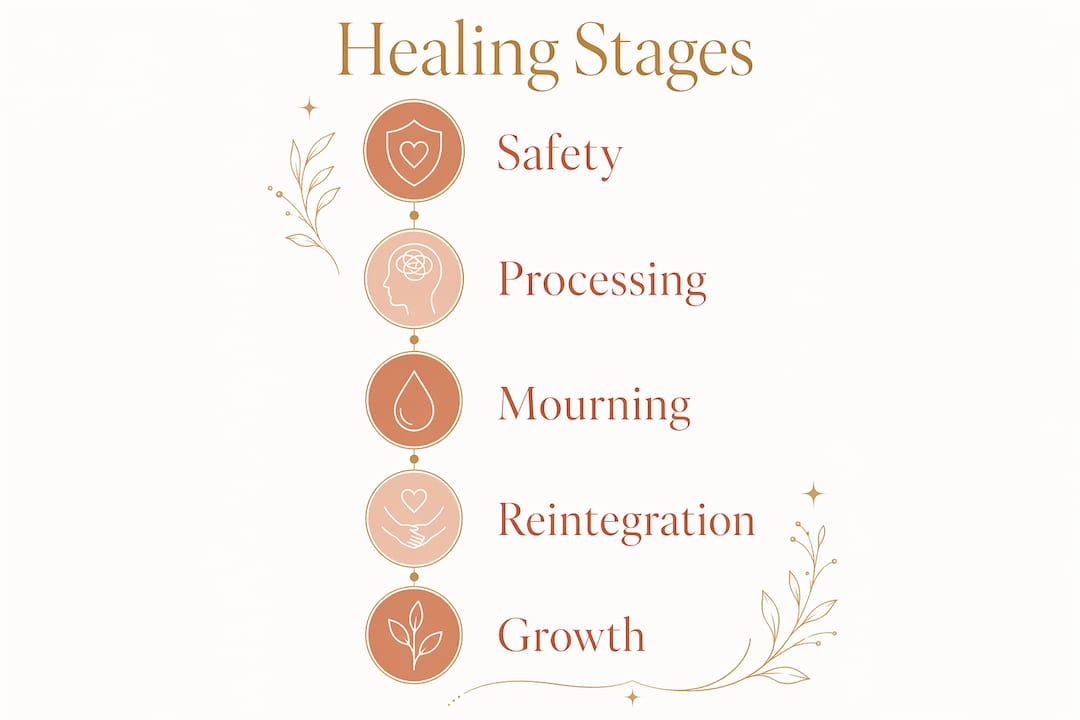
The stages of healing follow a general arc: establishing safety, processing the trauma, mourning what was lost, and eventually reconnecting with yourself and, if you choose, with others. These stages are not a straight line. You will revisit earlier stages. That is expected and healthy.
| Stage | What it involves | Approximate timeframe |
|---|---|---|
| Safety and stabilization | Regulating the nervous system, reducing acute crisis | Weeks 1–8 |
| Processing and remembrance | Facing the facts, expressing grief and anger | Months 2–9 |
| Mourning and meaning-making | Grieving the relationship you thought you had | Months 4–15 |
| Reconnection and integration | Rebuilding identity, trust, and future direction | Months 9–24 |
The biggest risk in early recovery is rushing. Premature forgiveness or permanent contempt both disrupt healthy integration. Forgiveness forced before you are ready is not healing. It is suppression. Permanent contempt keeps you locked in the wound. The goal is integration, which means holding both the love you felt and the harm you experienced as simultaneously true.
Pro Tip: Keep a recovery journal with dated entries. When you hit a hard week, reading entries from two months earlier often reveals real progress that is invisible in the moment.
What proven strategies help you transcend betrayal and begin personal transformation?
The most effective betrayal recovery tips combine body-based therapy with cognitive work and structured decision-making. No single approach is sufficient on its own.
Implement a decision moratorium. Trauma-informed therapists recommend waiting 30–90 days before making major irreversible decisions after betrayal. This window allows your nervous system to stabilize. Decisions made in acute traumatic panic frequently lead to regret, regardless of which direction you choose.
Seek trauma-informed therapy. Somatic modalities like EMDR and Brainspotting are clinically recognized as essential alongside cognitive therapies for betrayal trauma recovery. These approaches release fight-or-flight tension stored in the body, not just the mind. Standard talk therapy alone often cannot reach where the trauma lives.
Practice structured self-compassion. This means treating yourself with the same care you would offer a close friend in crisis. Journaling, mindfulness practices, and breathwork all support nervous system regulation. They are not luxuries. They are recovery tools.
Build a trusted support network. Isolation amplifies trauma. One or two people who can hold your experience without judgment are more valuable than a wide social circle offering generic advice. Support groups specifically for betrayal survivors, including those offered through platforms like Aftertheaffair, provide community with people who understand the specific texture of this pain.
Reclaim your intuition. Betrayal often makes you distrust your own perceptions. Rebuilding self-trust is not about becoming suspicious of everyone. It is about learning to listen to your body’s signals again, slowly and with practice.
Pro Tip: If EMDR or Brainspotting is not accessible in your area, Somatic Experiencing is another body-based modality with strong clinical support for trauma recovery and is increasingly available via telehealth.
When and how is rebuilding or ending relationships possible after betrayal?
The decision to stay or leave is one of the most personal choices you will ever make. Neither option is inherently right or wrong. What matters is that the decision comes from a regulated, informed place rather than from panic or pressure.
Rebuilding a relationship after infidelity requires specific conditions from the unfaithful partner. Without these, reconciliation is not healing. It is re-exposure to harm.
- Full accountability without minimizing, deflecting, or blaming the betrayed partner for the affair
- Radical transparency about whereabouts, communications, and ongoing behavior for an agreed period
- Emotional availability without defensiveness when the betrayed partner needs to process or ask questions
- Consistent, patient behavior over months, not just weeks, that demonstrates genuine change
These conditions protect you from further harm if you choose to stay. They are not punishments. They are the minimum requirements for psychological safety. If your partner cannot or will not meet them, that is important information.
Choosing to leave is equally valid. Moving on from betrayal is not giving up. It is recognizing that your healing cannot depend on another person’s willingness to change. Your recovery belongs to you regardless of what your partner does.
What does transcending betrayal look like in personal growth and self-reclamation?
Transcending betrayal is not about reaching a point where the past no longer exists. It is about reaching a point where the past no longer controls you. People who heal after betrayal redefine their self-trust, set clearer boundaries, and develop a resilience that was not available to them before.
Sacred Self-Belonging is the foundation of this reclamation. It means returning to yourself, your values, your body, and your sense of worth, before attempting to repair any external relationship. Healing that skips this step tends to be fragile.
“You are not healing back to who you were before. You are healing forward into someone who knows themselves more completely.”
Personal growth after betrayal includes several concrete shifts:
- Clearer personal boundaries based on lived experience rather than theory
- Deeper self-knowledge about what you need, what you will accept, and what you will not
- Authentic connection with others, built on honesty rather than performance
- Integrated identity that holds the experience of betrayal as part of your story without being defined by it
- Renewed self-trust that comes from surviving something you thought would break you
Healing rhythms resemble rebuilding a house room by room. You do not renovate everything at once. You stabilize the structure, then work inward. Some rooms take longer than others. That is not a flaw in the process. It is the process.
Key Takeaways
Transcending betrayal requires integration, not erasure. The most effective path combines trauma-informed therapy, structured decision-making, and a return to Sacred Self-Belonging before attempting any relational repair.
| Point | Details |
|---|---|
| Betrayal trauma is distinct | It damages your sense of reality and self-trust, not just the relationship. |
| Recovery takes 12–24 months | Consistent trauma-focused work over this period is clinically supported and realistic. |
| Wait before deciding | A 30–90 day moratorium protects you from choices made in acute traumatic panic. |
| Body-based therapy is essential | EMDR, Brainspotting, and Somatic Experiencing address trauma stored in the nervous system. |
| Self-reclamation comes first | Sacred Self-Belonging must precede any attempt at relational reconciliation or closure. |

What I’ve learned about healing that most articles won’t tell you
The part of betrayal recovery that surprises people most is how much of the work has nothing to do with the person who hurt them. Clients and readers often arrive expecting a roadmap for fixing the relationship or understanding the affair. What they discover is that the most urgent work is internal.
I have seen people rush toward forgiveness because they believed it was the spiritually correct or emotionally mature thing to do. Some of them paid for that rush with years of suppressed grief that eventually surfaced anyway. Forgiveness, when it comes, is a byproduct of integration. You cannot manufacture it on a schedule.
The other pattern I see is the opposite: people who hold onto contempt as a form of protection. The anger feels like armor. And for a while, it is. But armor is heavy. At some point, carrying it costs more than the protection it provides.
What actually works is slower and less dramatic than either extreme. It is showing up for yourself consistently, finding a therapist who understands trauma at the body level, and allowing the process to be as long as it needs to be. The people who come out the other side are not the ones who healed fastest. They are the ones who refused to abandon themselves along the way.
If you are in the middle of this right now, the most important thing I can tell you is this: your pain is proportionate to your capacity for love. That capacity does not disappear. It gets redirected, eventually, toward someone who deserves it most, which is you.
— S.J.Howe
Structured support for your recovery from Aftertheaffair
Healing from betrayal is not something you have to piece together alone from scattered articles and conflicting advice. Aftertheaffair provides structured, evidence-informed resources built specifically for people at every stage of infidelity recovery.
The 7 Steps Infidelity Recovery Checklist is a practical starting point that gives you a clear framework when everything feels chaotic. For those ready to go deeper, the After the Affair Series covers survival, decision-making, and personal growth after infidelity with the kind of clinical depth and compassion that fills the gaps traditional therapy often leaves open. Take your time. The resources will be there when you are ready.
FAQ
What is betrayal trauma?
Betrayal trauma is a specific form of psychological injury caused by a trusted person violating your safety and trust. It differs from general trauma because the source of harm is also your primary attachment figure, which disrupts your sense of reality and self-trust.
How long does healing from betrayal take?
Clinical research supports a 12–24 month timeline for consistent, trauma-focused recovery work. Recovery is non-linear, meaning setbacks and difficult trigger days are a normal part of the process, not signs of failure.
Should I forgive my partner after betrayal?
Forgiveness is not a requirement for healing and cannot be forced on a timeline. Premature forgiveness disrupts healthy integration and often leads to suppressed grief resurfacing later. Forgiveness, when it comes, is a natural outcome of genuine healing.
What therapy works best for betrayal trauma?
EMDR, Brainspotting, and Somatic Experiencing are the most clinically supported modalities for betrayal trauma because they address nervous system dysregulation stored in the body, not just cognitive patterns.
How do I know if my relationship can be rebuilt after infidelity?
Rebuilding is possible when the unfaithful partner demonstrates full accountability, transparency, and emotional availability consistently over time. Without those conditions, reconciliation does not create safety. It recreates risk.
Recommended
- Relationship Healing Process – After the Affair Series
- Understand betrayal blindness: recognize and heal in 2026
- Ways to Rebuild Trust After Betrayal: Real Steps That Work
- Choosing a Betrayal Trauma Book That Works – After the Affair Series