TL;DR:
- Many women initiate affairs due to emotional disconnection rather than physical desire.
- Understanding this root cause is essential for genuine healing and preventing future betrayals.
- Why do women initiate affairs? The emotional truth most people miss
- How do women’s affairs typically begin and evolve?
- How does female independence shape the decision to have an affair?
- Why are women less likely to return to their marriages after affairs?
- How can understanding these dynamics help couples heal after infidelity?
- Key Takeaways
- What I’ve learned about the emotional roots of women’s affairs
- FAQ
Many marriage-wrecking affairs are started by women driven not by lust, but by a hunger for emotional connection they stopped finding at home. Research shows that 67% of women seeking affairs cite a desire for more passion, and 34% report being in happy marriages when they cheat. That second number is the one that stops people cold. It means the absence of obvious marital problems does not protect a marriage. Women are initiating affairs for reasons that run deeper than opportunity or attraction, and understanding those reasons is the first step toward real healing. The conversation around Why Women Cheat is crucial for understanding these dynamics.
Why do women initiate affairs? The emotional truth most people miss
Women’s affairs are defined primarily by emotional disconnection, not physical desire. That distinction matters because it changes everything about how these affairs start, how they escalate, and how hard they are to recover from.
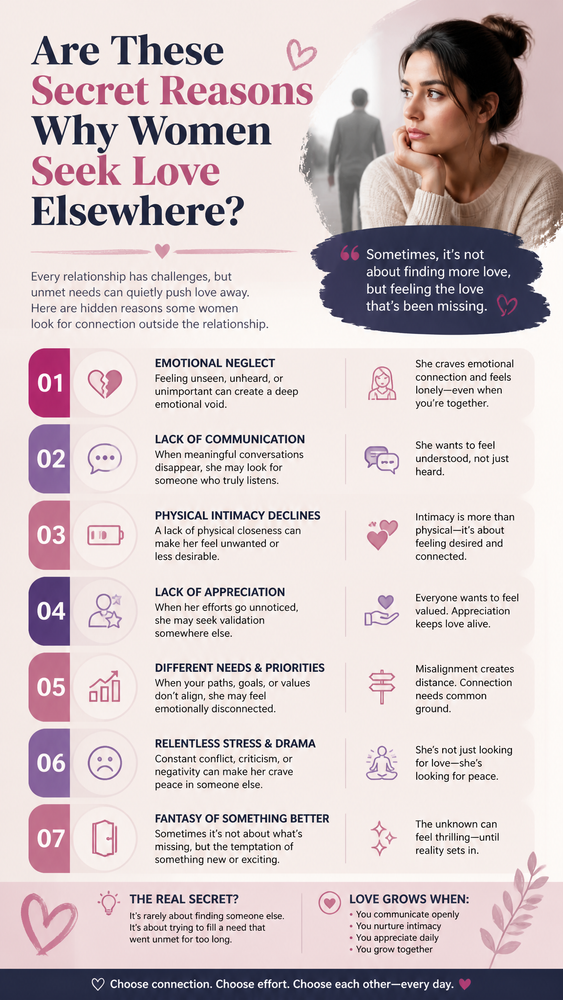
Women feel invisible in their marriages long before they act on it. The experience is cumulative. A woman stops being seen as a person with desires, ambitions, and an inner life. She becomes a function: mother, scheduler, household co-manager. That shift carries a weight that builds quietly over years.
Therapists and relationship coaches consistently identify emotional neglect as the primary driver behind women initiating affairs. This is not about a single argument or a bad week. It is about a sustained pattern where a woman’s emotional needs go unacknowledged. She stops feeling like a partner and starts feeling like a roommate with shared responsibilities.
Discussing Why Women Cheat can shed light on the emotional complexities involved in these relationships.
Women feeling unseen or having their individuality denied is a core unmet need that fuels affairs, and it is one of the most overlooked factors in traditional marriage counseling. The affair partner does not need to be exceptional. He simply needs to pay attention.
The key emotional triggers that push women toward affairs include:
- Chronic emotional neglect: Feeling unheard, unseen, or taken for granted over an extended period
- Loss of identity: Merging entirely into the role of wife and mother, with no space left for personal desires
- Absence of passion: Not just physical intimacy, but the feeling of being wanted and chosen
- Feeling like a co-manager: Running a household together without genuine emotional partnership
- Unspoken resentment: Years of swallowed frustrations that were never addressed directly
Pro Tip: If you are trying to understand a partner’s affair, ask what emotional need was going unmet, not just what happened physically. The answer to the first question explains far more.
How do women’s affairs typically begin and evolve?
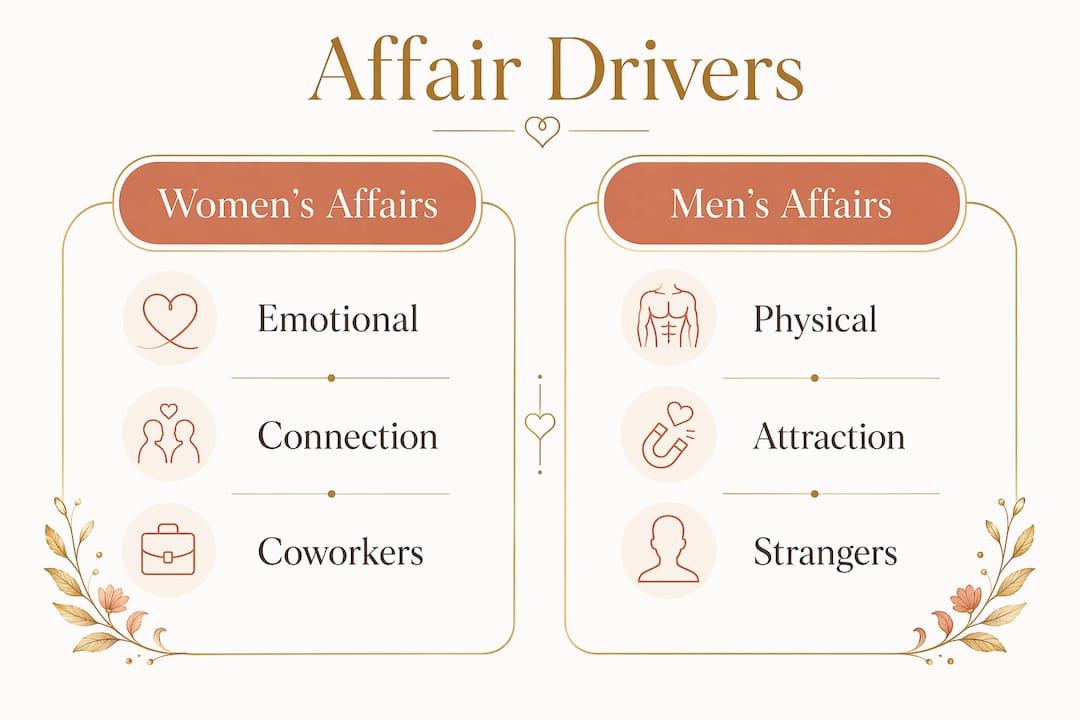
Women’s affairs almost never start with physical attraction. They start with conversation. A colleague who listens. An ex who reaches out. An online connection that feels refreshingly honest. Affairs begin as a sequence of boundary-blurring emotional detachment choices before physical intimacy ever enters the picture.
The typical progression follows a recognizable pattern:
- Emotional connection forms with someone outside the marriage, often a coworker, ex-partner, or online contact
- Private communication increases, with conversations becoming more personal and more frequent
- Emotional exclusivity develops, where the outside person becomes the primary source of emotional support
- Justification builds, as the woman begins cataloging her husband’s faults to rationalize the growing attachment
- Physical intimacy follows, often much later than most people assume, and sometimes not at all
31% of affairs involve coworkers, which reflects how proximity and shared purpose create the conditions for emotional bonding. The workplace provides daily contact, mutual respect, and adult conversation, all things that can feel scarce at home.
Women are also more likely than men to engage in emotional affairs with individuals their spouse already knows. That detail is often more painful for betrayed partners than the affair itself.
| Factor | Women’s affairs | Men’s affairs |
|---|---|---|
| Primary driver | Emotional connection | Physical attraction |
| Starting point | Conversation and intimacy | Opportunity and attraction |
| Common context | Workplace, ex-partners, online | Workplace, social settings |
| Physical involvement | Often delayed or secondary | Often earlier in the progression |
| Emotional investment | High, exclusive | Often compartmentalized |
How does female independence shape the decision to have an affair?
Women’s financial and social independence has fundamentally changed the calculus behind infidelity. Infidelity rates for women have held steady or slightly increased since the 1990s, while men’s rates have fallen. That shift tracks directly with women’s growing economic autonomy.
Historically, women stayed in unsatisfying marriages because leaving carried enormous financial and social risk. That constraint no longer applies in the same way. A woman who earns her own income, maintains her own social network, and has legal protections available to her faces a very different set of choices than her grandmother did.
Relationship coach Sharon Pope identifies a specific pattern: women often initiate affairs to “blow up” unhappy marriages rather than face the painful, drawn-out process of direct confrontation and separation. The affair becomes an exit strategy disguised as an impulse. It forces a crisis that the marriage could not otherwise survive long enough to resolve.
“Many women use affairs as a final avoidant act to end unhappy marriages rather than face painful separations directly.” — Sharon Pope, relationship coach
This is not a flattering portrait, but it is an honest one. The affair is not always about the affair partner. It is about escaping a life that no longer fits, without having to be the one who explicitly ends it.
Why are women less likely to return to their marriages after affairs?
The reconciliation gap between men and women after affairs is striking. 95% of cheating men eventually return to their primary families. Only 21% of women do the same. That gap reflects a fundamental difference in how men and women experience affair relationships psychologically.
Men tend to compartmentalize affairs. The affair partner occupies a separate emotional space that does not directly threaten the primary relationship in the man’s own mind. He can return to his family because, emotionally, he never fully left.
Women’s affairs involve stronger psychological devotion, making return to marriage far less likely compared to men’s more logistical approach to multiple relationships. When a woman forms an emotional bond with an affair partner, that bond tends to be exclusive and intense. Returning to a marriage that felt emotionally empty before the affair feels impossible once she has experienced what genuine emotional connection feels like.
Women’s emotional intensity in affairs creates a stronger psychological dependency than is typically seen in men. This is not weakness. It is the natural consequence of investing emotionally rather than physically. The deeper the emotional investment, the harder the withdrawal.
How can understanding these dynamics help couples heal after infidelity?
Healing after a woman’s affair requires a different approach than healing after a man’s. The physical act is rarely the core issue. The emotional disconnection that preceded it is. Rebuilding trust after a woman’s affair means addressing that disconnection directly, not just stopping the behavior.
Couples who recover successfully do several things consistently. They create structured space for emotional honesty, not just conflict resolution. The betrayed partner learns to ask different questions, moving away from “what happened” toward “what were you not getting here.” That shift is uncomfortable, but it is the one that actually produces answers worth having.
Therapies that address emotional attunement, such as Emotionally Focused Therapy (EFT), show strong results in these cases. EFT targets the attachment patterns that left one partner feeling unseen, which is the exact wound that drove the affair in the first place. Marriage counseling modalities that focus on emotional responsiveness tend to outperform those that focus only on communication skills.
The stages of healing after an affair are not linear. Couples move through shock, grief, anger, and negotiation in unpredictable sequences. Understanding that the process is nonlinear reduces the panic that comes when a couple feels they have gone backward.
Pro Tip: Recovery after a woman’s affair almost always requires both partners to examine what the marriage was providing emotionally before the affair. Skipping that step produces surface-level repair, not genuine reconnection.
Key Takeaways
Women initiate many marriage-wrecking affairs primarily because of chronic emotional disconnection, not physical desire, and recovery requires addressing that root cause directly.
| Point | Details |
|---|---|
| Emotional need is the core driver | 67% of women cite desire for more passion; 34% cheat even in self-reported happy marriages. |
| Affairs start emotionally, not physically | Emotional bonding precedes physical involvement, often by months or longer. |
| Independence changes the equation | Rising female autonomy means women face fewer barriers to leaving or pursuing affairs. |
| Women rarely return after affairs | Only 21% of women return to their marriages, compared to 95% of men, due to deeper emotional bonding. |
| Healing requires emotional repair | Addressing the emotional disconnection that preceded the affair is the only path to genuine recovery. |
What I’ve learned about the emotional roots of women’s affairs
The part of this topic that most people get wrong is the assumption that an affair is primarily about the affair partner. In my experience, the affair partner is almost incidental. He is a mirror. He reflects back something the woman stopped seeing in herself inside her marriage: her desirability, her intelligence, her individuality.
What strikes me most is how long the emotional withdrawal happens before anyone acts on it. Women do not wake up one morning and decide to cheat. They spend months or years feeling increasingly invisible, increasingly unheard, and increasingly like a supporting character in their own lives. The affair is the last chapter of a story that started much earlier.
The other thing I want to say plainly is this: understanding why women initiate affairs is not the same as excusing the harm they cause. Betrayal is real. The pain it creates is real. But if you want to heal from it, or prevent it, you need to understand what actually happened. Blaming opportunity or attraction keeps you focused on the wrong problem.
The couples I have seen recover most fully are the ones who got honest about the emotional state of the marriage before the affair. That conversation is hard. It requires the betrayed partner to hear things that are painful. But it is the only conversation that leads somewhere real. You can find structured support for that process through infidelity recovery resources that address both partners’ experiences with equal seriousness.
— S.J.Howe
Aftertheaffair resources for healing after female-initiated infidelity
Understanding why an affair happened is only the beginning. The harder work is knowing what to do next.
Aftertheaffair offers structured, evidence-informed guidance built specifically for the complexity of infidelity recovery. The 7-step infidelity recovery checklist gives you a clear framework for moving through the early stages without losing direction. For couples working on rebuilding connection, the trust rebuilding guide provides real steps grounded in how emotional repair actually works. If you are a therapist or coach supporting clients through this, the clinician guidance resource offers targeted frameworks for female-initiated affair cases specifically.
FAQ
Why do women cheat even in happy marriages?
34% of women who cheat report being in happy marriages at the time. Happiness in the conventional sense does not protect against emotional disconnection, which is the primary driver of women’s affairs.
Are women’s affairs more emotional than men’s?
Yes. Women are more likely than men to engage in emotional affairs, often with someone their spouse knows. Physical intimacy typically follows emotional bonding rather than preceding it.
Why don’t women return to their marriages after affairs?
Only 21% of women return to their primary relationships after affairs, compared to 95% of men. Women form deeper emotional bonds with affair partners, making the psychological pull away from the marriage much stronger.
What is the most common starting point for a woman’s affair?
31% of affairs begin with coworkers, making the workplace the single most common origin point. Emotional connection develops through daily proximity and shared adult conversation before anything physical occurs.
Can a marriage recover after a woman initiates an affair?
Recovery is possible but requires addressing the emotional disconnection that preceded the affair, not just the betrayal itself. Emotionally Focused Therapy and structured healing after infidelity programs show the strongest outcomes for couples willing to do that deeper work.
Recommended
- Four Behaviors That Cause Most Divorces Explained
- Can Couples Recover From Multiple Affairs? – After the Affair Series
- Does rebuilding trust prevent future affairs? Evidence & tips
- Why Couples Relapse After Affairs – After the Affair Series