TL;DR:
- A narcissistic mother prioritizes her needs over her children’s development through control and manipulation. Emotional neglect and role assignment create lasting psychological damage and fractured family bonds. Healing begins by accurately naming the trauma and engaging in trauma-informed recovery strategies.
A narcissistic mother is defined as a parent whose need for control, admiration, and emotional dominance consistently overrides her children’s developmental needs. Research confirms that narcissistic mothers cause six key types of psychological damage, including identity diffusion and sibling triangulation. The ways a narcissistic mother slowly breaks her family apart are rarely loud or obvious. The damage accumulates through emotional neglect, role assignment, and manipulation that fractures trust so gradually that family members often doubt their own perceptions. Understanding these mechanisms is the first step toward reclaiming your sense of self.
- How does emotional neglect by a narcissistic mother disrupt family bonds?
- In what ways does a narcissistic mother manipulate sibling relationships?
- What are the long-term psychological impacts on children raised by narcissistic mothers?
- How can adult survivors begin to reclaim their identity and heal?
- What I’ve learned about invisible trauma and why it’s the hardest to heal
- FAQ
How does emotional neglect by a narcissistic mother disrupt family bonds?
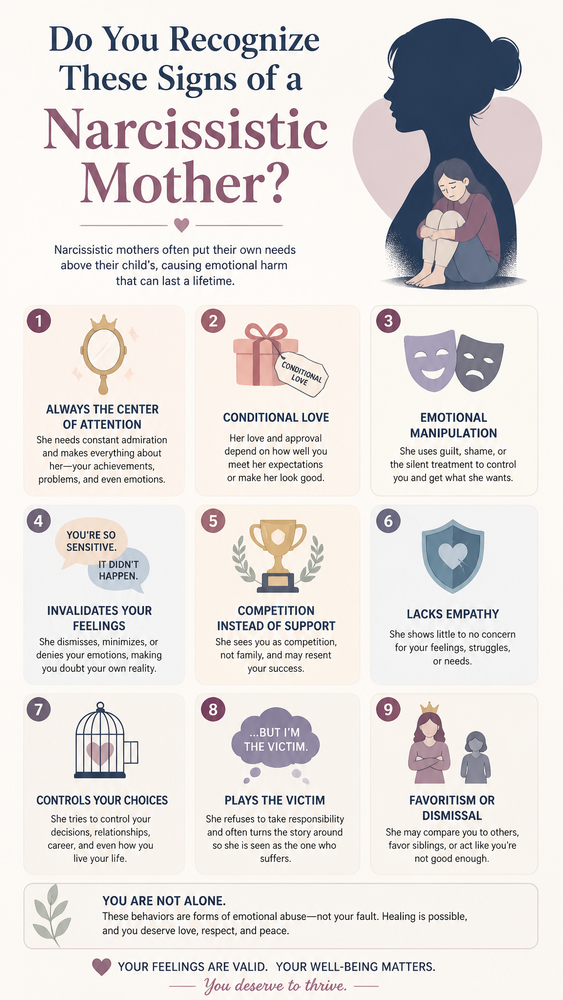
Emotional neglect is the most invisible and most damaging tool in a narcissistic mother’s pattern of behavior. A narcissistic mother may provide food, clothing, and school supplies while remaining completely emotionally unavailable. Chronic emotional unavailability causes long-lasting neurological and psychological harm, even when material needs are fully met. Children learn early that their inner world does not matter, and that lesson reshapes every relationship they form afterward.
The distinction between physical provision and emotional attunement is critical. Attunement means a parent notices and responds to a child’s emotional state. A narcissistic mother responds to her own emotional state instead. The child’s feelings become inconvenient, invisible, or actively punished. Over time, children stop expressing emotions at all, which is a survival adaptation that costs them deeply in adult life.
This neglect shows up in specific, recognizable ways:
- Dismissing a child’s sadness with “you’re too sensitive”
- Changing the subject to herself when a child shares a problem
- Withholding comfort after a child is hurt or frightened
- Reacting with anger when a child’s needs interrupt her plans
- Praising achievement while ignoring emotional distress
Pro Tip: If you grew up being told your feelings were dramatic or wrong, that is not a character flaw. That is the result of chronic emotional neglect, and it can be unlearned with the right support.
Higher perceived maternal narcissism correlates directly with lower emotional stability in daughters during early adulthood. That finding matters because it confirms the damage is measurable, not imagined. The family bond fractures because no one learns how to connect authentically when the central figure in the home punishes authentic emotion.
In what ways does a narcissistic mother manipulate sibling relationships?
A narcissistic mother does not treat her children equally, and that inequality is not accidental. She assigns roles that serve her need for control. The two most common roles are the “golden child” and the “scapegoat.” Role dynamics like these enforce conditional approval and create lasting sibling discord that often persists well into adulthood.
The golden child receives praise, protection, and preferential treatment. The scapegoat receives blame, criticism, and emotional punishment. Neither role is healthy. The golden child learns that love is conditional on performance and compliance. The scapegoat learns that they are fundamentally flawed. Both children are harmed, just in different directions.
Triangulation is the mechanism that keeps siblings from uniting against this dynamic. The narcissistic mother shares private information between siblings, pits them against each other with comparisons, and positions herself as the only reliable source of truth. Sibling mirroring dynamics enforced by narcissistic mothers actively hinder sibling reconciliation until each person addresses their individual trauma first.
| Sibling role | How the mother uses it | Long-term outcome |
|---|---|---|
| Golden child | Receives praise in exchange for loyalty and compliance | Struggles with perfectionism, fear of failure, and enmeshment |
| Scapegoat | Absorbs blame and criticism to protect mother’s image | Develops low self-worth, hypervigilance, and chronic shame |
| Lost child | Stays invisible to avoid conflict | Develops emotional numbness and difficulty asserting needs |
| Family mediator | Manages mother’s emotions and sibling tensions | Experiences burnout, codependency, and suppressed anger |
Recognizing which role you were assigned is not about labeling yourself permanently. It is about understanding why you relate to your siblings the way you do, and why conflict between you may have very little to do with either of you directly. Strategies for protecting children from manipulation apply equally when the manipulative parent is a mother rather than an ex-partner.
What are the long-term psychological impacts on children raised by narcissistic mothers?
Narcissistic parenting is a major cause of Complex PTSD in adult survivors. Unlike single-incident trauma, C-PTSD develops from cumulative relational harm over years. The symptoms include chronic emotional dysregulation, pervasive shame, difficulty trusting others, and a fragmented sense of identity. These are not personality traits. They are predictable responses to an unpredictable and emotionally unsafe childhood.
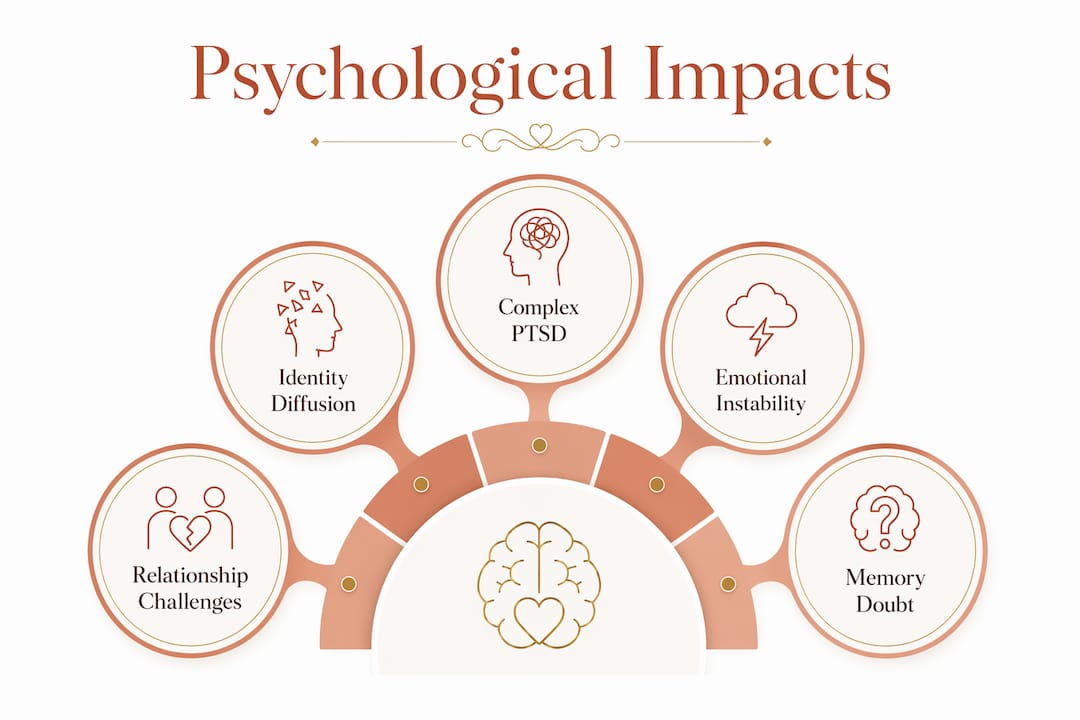
Identity diffusion is one of the most disorienting effects. When a child’s sense of self is constantly overridden by a mother who insists she knows what the child feels, wants, and needs, the child stops developing a stable inner identity. As an adult, that person may struggle to answer basic questions like “what do I want?” or “what do I actually believe?” without enormous anxiety. Healing is a non-linear process precisely because identity was never calibrated around the survivor’s own experience.
The social and occupational consequences are equally real. Adults raised by narcissistic mothers often cycle through relationships that replicate familiar dynamics, gravitating toward controlling or emotionally unavailable partners. At work, they may struggle with authority figures, conflict avoidance, or chronic self-doubt that undermines their performance. These patterns are not character weaknesses. They are maladaptive defense mechanisms built for survival in a chaotic home environment.
Pro Tip: If you find yourself constantly second-guessing your own memory of events, that is a recognized trauma response called self-doubt conditioning. It is common among survivors of narcissistic parenting, and naming it accurately is the first step toward reversing it.
Understanding the psychological consequences for adults raised in these environments helps survivors stop blaming themselves for struggles that were never their fault to begin with.
How can adult survivors begin to reclaim their identity and heal?
Recovery from narcissistic mother trauma begins with one specific act: naming the experience accurately. Survivors need to name the experience precisely to validate their trauma and begin healing. Calling emotional abuse “just how she was” or “not that bad” delays recovery. Calling it what it is, developmental trauma caused by a parent who consistently prioritized her own needs, creates the foundation for real change.
Structured healing steps include:
- Name the trauma accurately. Use language that reflects what actually happened. “My mother was emotionally neglectful” is more healing than “I had a difficult childhood.”
- Seek trauma-informed therapy. Look specifically for therapists trained in C-PTSD, attachment theory, or Internal Family Systems (IFS). Generic talk therapy often misses the relational roots of this damage.
- Rewire your nervous system. Therapeutic goals focus on rewiring the survivor’s nervous system, not on fixing or changing the narcissistic parent. Somatic therapies, EMDR, and breathwork all support this process.
- Set firm boundaries. Boundaries with a narcissistic mother are not punishments. They are requirements for your psychological safety.
- Consider temporary distance. Ceasing contact temporarily with a narcissistic parent can provide vital space for mental health recovery. This is not a permanent decision and does not require justification.
- Practice reparenting. Adult survivors must undertake reparenting work to break childhood survival scripts that persist into adulthood. This means learning to give yourself the validation, comfort, and consistency your mother never provided.
Healing sibling relationships is possible, but it requires a specific sequence. Successful sibling reconciliation requires each survivor to first recognize the narcissistic mother as the source of division before attempting to repair bonds with each other. Skipping that step usually results in siblings re-enacting the same roles the mother assigned them.
Resources on complex trauma can help survivors understand the specific type of harm they experienced and why standard approaches to grief or stress often fall short.

Key takeaways
A narcissistic mother fractures her family through emotional neglect, role assignment, and triangulation, and recovery requires naming that harm precisely before healing can begin.
| Point | Details |
|---|---|
| Emotional neglect is the core mechanism | Material provision does not cancel emotional unavailability; both cause lasting harm. |
| Sibling roles are assigned, not natural | Golden child and scapegoat dynamics serve the mother’s control, not the children’s wellbeing. |
| C-PTSD is a documented outcome | Cumulative relational trauma from narcissistic parenting causes measurable psychological damage in adults. |
| Naming the trauma accelerates healing | Accurate language about what happened counters self-doubt and validates the survivor’s experience. |
| Sibling healing requires individual work first | Each sibling must recognize the mother as the source of conflict before reconciliation becomes possible. |
What I’ve learned about invisible trauma and why it’s the hardest to heal
The cases that stay with me longest are not the ones involving obvious cruelty. They are the ones where the mother was charming in public, generous with gifts, and completely absent emotionally at home. Those survivors spend years wondering if they have any right to feel the way they feel. They were fed, clothed, and told they were loved. The harm was real, but it left no visible marks.
Mislabeling trauma as oversensitivity or ingratitude delays healing by years. That delay is not a personal failure. It is the direct result of a system designed to make the child doubt herself. The narcissistic mother’s greatest tool is not anger or control. It is the child’s own internalized voice saying “maybe I’m the problem.”
What I want survivors to understand is this: the non-linear nature of healing is not a sign that you are doing it wrong. Identity that was organized around someone else’s needs takes time to reorganize around your own. That process is slow, and it is not always forward-moving. Some weeks you will feel clear and grounded. Others will pull you back into old patterns. Both are part of the same recovery.
Trust your experience over external judgment. If something felt harmful, it was harmful. You do not need a clinical diagnosis or a dramatic story to deserve support.
— S.J.Howe
Aftertheaffair’s resources for trauma recovery and healing
Trauma rooted in family dynamics does not always fit neatly into conventional therapy frameworks. Aftertheaffair offers structured, evidence-informed resources built specifically for people navigating the aftermath of relational harm, including those recovering from narcissistic family systems.
Whether you are just beginning to name what happened or you are deep in the work of rebuilding your identity, the trauma recovery checklist at Aftertheaffair gives you a concrete, step-by-step framework for moving forward. For survivors who want to understand the full scope of what they experienced, the complex trauma guide explains the specific mechanisms of cumulative relational harm and what recovery actually looks like in practice.
FAQ
What defines a narcissistic mother’s behavior?
A narcissistic mother consistently prioritizes her own emotional needs over her children’s developmental needs, using control, emotional neglect, and manipulation to maintain dominance within the family system. Research identifies identity diffusion and sibling triangulation as two of the most documented outcomes.
Can siblings heal their relationship after a narcissistic mother?
Yes, but sibling reconciliation requires each person to first recognize the mother as the source of division rather than blaming each other. Attempting to repair sibling bonds before that recognition usually reactivates the original role dynamics.
Is C-PTSD a common outcome of narcissistic parenting?
C-PTSD is a well-documented outcome of narcissistic parenting, caused by cumulative relational trauma rather than a single incident. Symptoms include chronic shame, emotional dysregulation, and identity fragmentation.
Does temporary no-contact with a narcissistic mother help?
Temporarily ceasing contact provides vital space for nervous system recovery and identity rebuilding. It is not a permanent requirement and does not need to be justified to anyone outside your own therapeutic process.
How do I know if my mother’s behavior was actually narcissistic?
If your emotional needs were consistently dismissed, you were assigned a fixed role within the family, and your perception of events was regularly contradicted, those are recognized patterns of narcissistic parenting. Naming the experience accurately, rather than minimizing it, is the starting point for healing.
Recommended
- Co-Parenting With a Narcissist: the Parallel Parenting Guide
- Parallel Parenting With a Narcissist – After the Affair Series
- Stop Your Narcissistic Ex from Manipulating Your Kids
- How to Prepare for Custody Court with a Narcissist