TL;DR:
- Affair remorse is demonstrated through ongoing behavioral accountability, not just feelings or apologies. Managing it requires ending contact, practicing radical transparency, and taking full responsibility. Therapy and consistent actions are essential for rebuilding trust and healing after infidelity.
Affair remorse is defined as the sustained, demonstrated commitment to accountability and behavioral change that follows an act of infidelity. It is not a feeling. It is not an apology. Clinicians distinguish remorse from guilt by a single criterion: proof of work. Guilt is internal and self-focused. Remorse is external and other-focused, showing up in consistent actions over time. If you are asking how to manage affair remorse, you are already asking the right question. The path forward requires transparency, targeted therapy, and the patience to let your partner’s healing set the pace.
How to manage affair remorse: your first steps
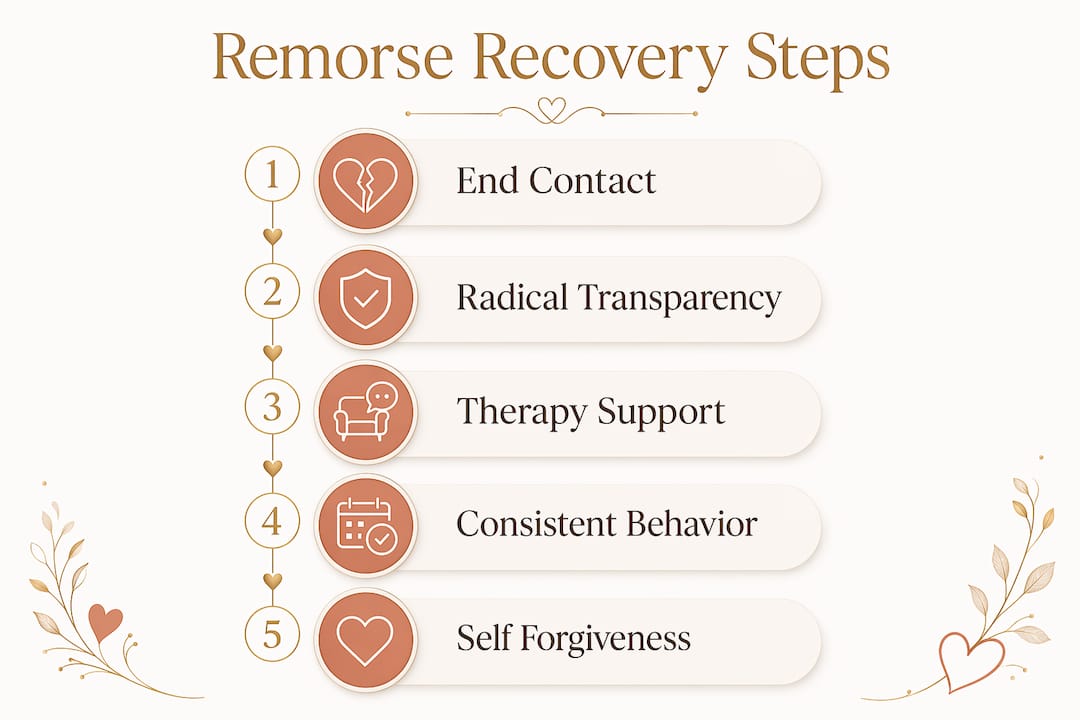
The first and non-negotiable action is ending all contact with the affair partner immediately. Therapeutic frameworks treat this cessation as 100% non-negotiable for affair recovery. Any continued contact, even “just to say goodbye,” signals to your partner that the affair still holds priority over the relationship.
After ending contact, begin radical transparency. This means giving your partner access to your phone, email, and social accounts without being asked twice. It means sharing your schedule and checking in without prompting. Clinical recommendations involve radical transparency regarding devices, whereabouts, and communications across a structured period. That structure matters because it converts a vague promise into a verifiable pattern.
Taking 100% responsibility is the third pillar. Do not explain the affair by referencing problems in the relationship, your stress, or your partner’s behavior. Those conversations may come later in therapy. Right now, any deflection reads as minimization. Your partner needs to hear that you alone made this choice.
Here are the core first steps in order:
- End all contact with the affair partner completely and permanently.
- Hand over device access and share your location without conditions.
- State clearly and without qualification that the affair was your choice.
- Book an appointment with an individual therapist who specializes in infidelity.
- Prepare to answer your partner’s questions repeatedly, on their timeline, not yours.
Pro Tip: Write down the answers to the questions your partner asks most often. Reviewing them before difficult conversations helps you respond with steadiness instead of defensiveness.
How can therapy support coping with affair remorse?
Individual therapy is not optional for the person who had the affair. Individual therapy helps the unfaithful process shame and internal triggers that drove the affair in the first place. Without that work, the same vulnerabilities remain active.
Couples therapy should come from a clinician who specializes in affair recovery, not general relationship counseling. Traditional marital counseling risks minimizing the betrayed partner’s trauma or skipping the accountability phase entirely. A specialist understands the difference between processing the relationship and processing the betrayal.
For intense guilt and shame, EMDR therapy creates new healing neural pathways without erasing the event. This is a critical distinction. EMDR does not rewrite what happened. It reduces the emotional charge enough that you can function, reflect, and take responsibility without being paralyzed. Understanding how to overcome shame through clinical tools is a skill that transfers directly to affair recovery work.
Key therapy goals for the person managing remorse include:
- Identifying the internal drivers and unmet needs that led to the affair.
- Learning to sit with shame without confessing repeatedly to your partner for relief.
- Developing emotional regulation so you can tolerate your partner’s anger without shutting down.
- Distinguishing guilt-driven impulses, like over-apologizing, from sustained behavioral change.
- Building the capacity to stay present during your partner’s most painful moments.
Pro Tip: Ask any prospective therapist directly: “Have you worked with the unfaithful partner in affair recovery?” Their answer will tell you whether they understand the specific clinical demands of this work.
What daily behaviors actually demonstrate true remorse?
Sincere apologies alone are insufficient. Consistent and patient behavioral effort is the core of true remorse. Your partner is not watching what you say. They are watching what you do, every day, without being reminded.
The behaviors that rebuild trust are quiet and repetitive. They are not grand gestures. A surprise trip or an expensive gift signals that you want to feel better. Showing up on time, answering your phone, and following through on small commitments signals that you are reliable. Consistent behavioral change rebuilds predictability more effectively than any single dramatic act.
The following table outlines the behaviors that demonstrate remorse versus the behaviors that undermine it:
| Demonstrates remorse | Undermines remorse |
|---|---|
| Answering questions patiently, every time | Sighing, eye-rolling, or saying “we’ve been over this” |
| Proactively sharing your schedule | Waiting to be asked where you are |
| Sitting with your partner’s anger without defending yourself | Redirecting to your own guilt or pain |
| Following through on every agreed action | Making promises and forgetting them |
| Checking in without being prompted | Going silent for hours without explanation |
Partners will ask repetitive questions during recovery, and tolerating this without defensiveness is a key part of authentic remorse. Each repeated question is not a sign that your partner is stuck. It is a sign that they are still testing whether the answer changes. Consistency is the only proof that it will not.
Engaging empathetically with your partner’s pain means staying in the conversation when it gets hard. You do not get to leave the room, go quiet, or pivot to your own feelings. The trust rebuilding guide from Aftertheaffair outlines how this steady, daily effort accumulates into genuine safety over time.
What emotional challenges arise when managing affair remorse?
The most common trap is confusing guilt with shame. Guilt says, “I did something wrong.” Shame says, “I am wrong.” Guilt that spirals into shame hinders healing. Shame produces paralysis, not accountability. When shame takes over, the person who had the affair becomes focused on their own suffering, which forces the betrayed partner into a caretaking role they did not ask for.
Repeated confession is one of the most counterproductive patterns in affair recovery. Confessing repeatedly to relieve your own guilt forces your betrayed partner to emotionally manage you. That is a second betrayal. The work is to tolerate shame internally and provide steadiness externally, not to seek absolution from the person you hurt.
Grief is another challenge that catches people off guard. Many people who had affairs grieve the end of that relationship, even while knowing it was wrong. Affair-related grief must be processed in individual therapy, not in conversations with the betrayed partner. Bringing that grief into the primary relationship causes further damage.
Authentic repair requires enduring patience with your partner’s questions and emotional reactions without defensiveness or minimization. The person who had the affair must learn to hold their own discomfort while remaining a steady, accountable presence for the person they hurt.
Common mistakes to avoid during this phase:
- Seeking “closure” meetings with the affair partner.
- Asking your partner to reassure you that you are a good person.
- Measuring your progress by how quickly your partner forgives you.
- Treating setbacks as proof that recovery is impossible.
Self-forgiveness is an outcome, not a prerequisite, to managing affair remorse effectively. It arrives after full responsibility is taken and behaviors change over time. Expecting it to come first inverts the process.
Key Takeaways
Managing affair remorse requires sustained behavioral accountability, not apologies, as the foundation for genuine healing and trust rebuilding.
| Point | Details |
|---|---|
| End contact immediately | Cutting all ties with the affair partner is the non-negotiable first step in recovery. |
| Radical transparency builds safety | Sharing devices, schedules, and communications consistently converts promises into verifiable patterns. |
| Therapy is not optional | Individual therapy processes shame and internal drivers; couples therapy requires an affair recovery specialist. |
| Daily behavior outweighs grand gestures | Steady, quiet follow-through on small commitments rebuilds trust faster than dramatic acts. |
| Shame must stay internal | Repeated confession to relieve personal guilt forces the betrayed partner into an unfair caretaking role. |

What I’ve learned about remorse that most articles won’t tell you
After working with people navigating infidelity recovery, the pattern I see most often is this: the person who had the affair wants to feel better faster than the process allows. They apologize, they cry, they make promises, and then they grow frustrated when their partner is still in pain three months later. That frustration is the real test of remorse.
Genuine remorse is boring. It looks like answering the same question for the fortieth time with the same patience you had the first time. It looks like checking in when you would rather not. It looks like sitting in a therapy session and saying the uncomfortable thing instead of the comfortable one. The stages of healing after an affair are not linear, and the person managing remorse has to accept that their partner’s timeline is the only one that matters.
The insight that changes everything for most people is this: apologies are the cherry on top of a very large cake. The cake is the daily, unglamorous work of being trustworthy. Most people want to skip to the cherry. The work is baking the cake, every single day, for as long as it takes.
Therapy transformed how I understand shame in this context. Shame tells you that you are irredeemable. That is a lie, but it is a convincing one. The goal is not to feel good about what happened. The goal is to feel clear enough about it that you can keep showing up for your partner without collapsing into your own pain. That clarity is what therapy builds, and it is what makes sustained remorse possible.
— S.J.Howe
Structured support for your recovery from Aftertheaffair
Knowing what remorse requires and actually doing it are two different things. Aftertheaffair provides structured, evidence-informed resources built specifically for this gap.
The infidelity recovery checklist from Aftertheaffair gives you a concrete, step-by-step framework to move from acknowledgment to accountability. For those working through the emotional complexity of rebuilding after betrayal, the emotional recovery workflow offers a structured path through the hardest phases. These resources are grounded in clinical practice and designed for people who are ready to do the actual work, not just read about it.
FAQ
What is the difference between guilt and remorse after an affair?
Guilt is an internal feeling focused on your own distress. Remorse is demonstrated through consistent, accountable behavior directed toward the person you hurt.
How long does managing affair remorse take?
There is no fixed timeline. Clinical frameworks often reference a structured 90-day transparency period as a starting point, but full trust rebuilding takes considerably longer and depends on both partners’ commitment.
Should I tell my partner everything about the affair?
Full disclosure is generally recommended by affair recovery specialists, though the timing and scope should be guided by a therapist to avoid unnecessary harm from graphic details.
Can I recover from affair remorse without therapy?
Individual therapy is strongly recommended for the unfaithful partner. Without professional support, shame often spirals into paralysis or repeated confession, both of which slow the healing process.
Is self-forgiveness part of managing remorse?
Self-forgiveness is an outcome of sustained accountability, not a starting point. It arrives after behavioral change is established and the betrayed partner’s healing has progressed.
Recommended
- Relationship Growth After Infidelity – After the Affair Series
- How to Cope After Infidelity – After the Affair Series
- How to Guide Clients After Infidelity for Healing – After the Affair Series
- Ways to Rebuild Trust After Betrayal: Real Steps That Work