TL;DR:
- Gaslighting in infidelity is a deliberate pattern of psychological manipulation intended to make the betrayed partner doubt their perceptions. This repeated tactic erodes self-trust, causes confusion, and creates a power imbalance that persists over time. Recovery involves recognizing the pattern, seeking external validation, and engaging in trauma-informed therapy to rebuild self-trust and clarity.
Gaslighting in infidelity is defined as a sustained pattern of psychological manipulation where a cheating partner systematically distorts reality to make the betrayed person doubt their own memory, perceptions, and sanity. This is not a single argument or a moment of defensiveness. It is a calculated strategy, repeated over time, that combines denial, blame-shifting, and minimization to protect the unfaithful partner from accountability. The Gottman Institute identifies repeated denial and blame-shifting as the defining features of gaslighting in relationships. If you are questioning your own memory after discovering or suspecting infidelity, you are not losing your mind. You may be experiencing a deliberate form of emotional abuse.
- What is gaslighting in infidelity, and how does it work?
- What are the signs and tactics of gaslighting used by cheating partners?
- How does gaslighting differ from normal defensiveness or guilt?
- What are the psychological effects of gaslighting after infidelity?
- How can you recognize and protect yourself from gaslighting?
- What steps support healing and recovery from gaslighting and infidelity?
- Key Takeaways
- The harm that gets overlooked most often
- FAQ
What is gaslighting in infidelity, and how does it work?
Gaslighting in infidelity is a form of psychological coercion, not a random reaction. The clinical term used by mental health professionals is “coercive control,” and gaslighting is one of its most damaging tools. The unfaithful partner uses it to rewrite shared reality so that the betrayed person becomes the problem, not the affair.
The manipulation works through repetition. One denial is easy to dismiss. Fifty denials, delivered with confidence and irritation, start to feel like evidence. The betrayed partner begins to wonder whether they misread a text message, misheard a phone call, or invented a suspicion. That creeping self-doubt is the goal.
Gaslighting also thrives on the emotional vulnerability that follows betrayal. When you love someone and want to believe the relationship is safe, your brain looks for reasons to trust them. A gaslighting partner exploits that instinct. They use your hope against you, framing your accurate perceptions as paranoia and your reasonable questions as attacks.
Understanding gaslighting as a pattern, not a personality quirk, is the first step toward clarity. The Gottman Institute describes it as strategic and persistent, designed to maintain control rather than resolve conflict.
What are the signs and tactics of gaslighting used by cheating partners?
Gaslighting signs in relationships follow recognizable patterns once you know what to look for. The tactics are not random. They are designed to destabilize your confidence and redirect your focus from the infidelity to your own perceived flaws.
Common gaslighting tactics used by cheating partners include:
- Flat denial: “That never happened.” Said with absolute certainty, even when you have evidence.
- Minimization: “You’re overreacting.” “It was nothing.” “You’re too sensitive.”
- Blame-shifting: “If you weren’t so jealous, I wouldn’t have to hide things from you.”
- Discrediting: “You’ve always had memory problems.” “You’re paranoid.”
- Feigned confusion: “I have no idea what you’re talking about.” Delivered to make you feel irrational.
- Withholding: Refusing to engage with your concerns at all, leaving you with no resolution.
- Weaponizing your emotions: Using your distress as proof that you are unstable rather than hurt.
Cleveland Clinic research confirms that phrases like “you’re crazy” and “you’re overreacting” are textbook gaslighting tactics, not just unkind responses. They serve a specific function: to make you distrust your own mind.
Physically and emotionally, gaslighting produces a distinctive fog. Victims report mental confusion and compulsive evidence-keeping as early warning signs. If you find yourself saving screenshots, replaying conversations, or writing down what was said so you can prove it later, that behavior is not obsessive. It is a rational response to someone systematically erasing your reality.
Pro Tip: Trust your body before you trust your logic. Gaslighting is often detected first as a physical sensation: a tightening in your chest, a persistent sense that something is wrong, or a feeling of walking on eggshells. Your nervous system registers manipulation before your conscious mind names it.
How does gaslighting differ from normal defensiveness or guilt?
Defensiveness and gaslighting look similar on the surface, but they operate very differently. A partner who feels guilty may snap, deny, or deflect in the moment. That is a shame response. It is uncomfortable, but it is not the same as gaslighting.
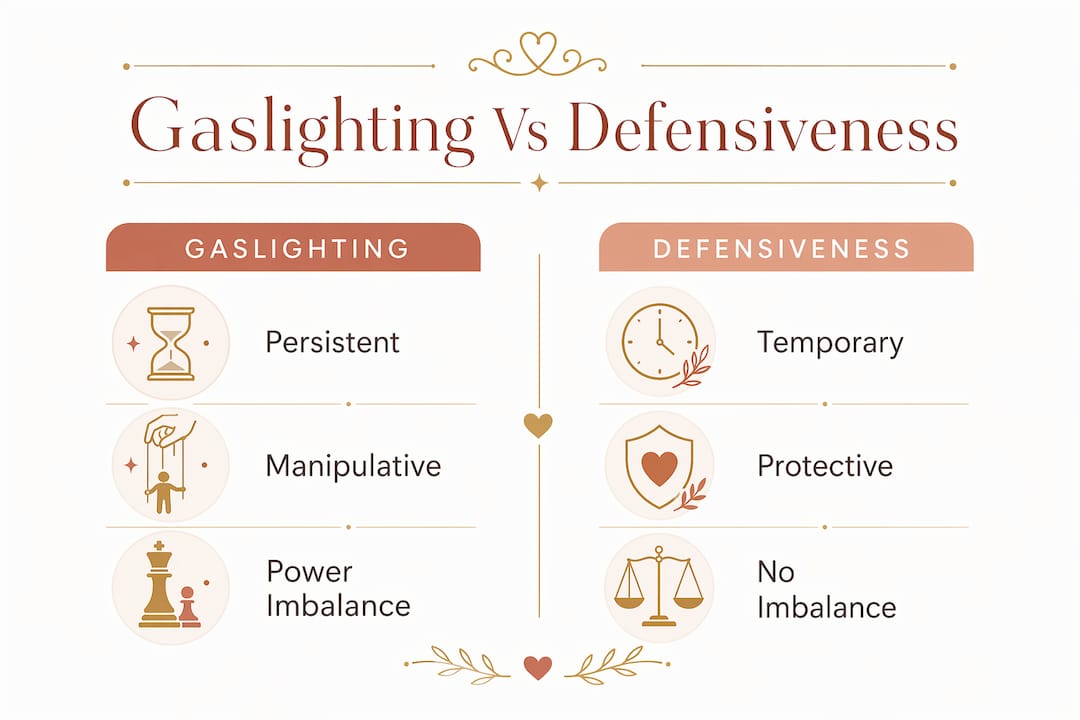
Gaslighting is distinguished by intent, duration, and impact. A defensive partner eventually backs down, apologizes, or acknowledges the truth when pressed. A gaslighting partner escalates. The more evidence you present, the more aggressively they reframe you as the problem. The pattern does not resolve. It intensifies.
The Gottman Institute draws a clear line: defensiveness arises from shame and is occasional, while gaslighting is persistent and aimed at invalidating the partner’s reality. That distinction matters because it changes what you need to do next.
| Feature | Normal defensiveness | Gaslighting |
|---|---|---|
| Duration | Temporary, situational | Persistent, ongoing pattern |
| Intent | Self-protection from shame | Control and accountability avoidance |
| Response to evidence | May acknowledge truth over time | Escalates denial or redirects blame |
| Effect on victim | Temporary hurt or frustration | Chronic self-doubt and confusion |
| Power dynamic | Relatively balanced | Shifts control to the manipulator |
Gaslighting also creates a power imbalance that defensiveness does not. Over time, the betrayed partner starts to defer to the gaslighter’s version of events. They stop trusting their own judgment. That shift in power is what makes gaslighting a form of infidelity and emotional abuse, not just a communication problem.
What are the psychological effects of gaslighting after infidelity?
The psychological damage from gaslighting compounds the trauma of infidelity itself. Betrayal alone causes significant emotional injury. Add systematic reality distortion on top of it, and the effects become severe and lasting.
The most common psychological effects include:
- Chronic self-doubt. You stop trusting your perceptions, your memory, and your instincts across all areas of life, not just the relationship.
- Diminished self-worth. Victims frequently report feeling demeaned and not good enough despite every effort they make to save the relationship.
- Emotional exhaustion. The constant effort to prove your reality is real depletes mental and physical energy.
- Anxiety and hypervigilance. You become alert to every shift in your partner’s mood, monitoring for signs of danger.
- Depression. Prolonged invalidation erodes hope and the sense that things can improve.
- Disrupted decision-making. Gaslighting causes victims to question their sanity and what is real, making even simple choices feel impossible.
Trauma bonding deepens these effects. When a gaslighting partner alternates between manipulation and warmth, the betrayed person becomes psychologically attached to the moments of kindness. That attachment makes it harder to leave and harder to trust their own assessment of the relationship. Aftertheaffair addresses this dynamic directly in its resources on trauma bonding signs and effects, which explains why victims often feel confused about why they cannot simply walk away.
The compliance trap is a related and underrecognized consequence. Victims begin modifying their behavior to avoid triggering the gaslighter. They suppress questions, soften their tone, and stop raising concerns. This shift signals that control has moved entirely to the manipulating partner.
How can you recognize and protect yourself from gaslighting?
Recognizing gaslighting while you are inside it is genuinely difficult. Gaslighting is often subtle, leaving victims unsure whether it is actually happening. That uncertainty is part of the design.
Practical steps to protect yourself include:
- Keep a private record. Write down conversations, dates, and your emotional state immediately after they happen. This is not paranoia. It is documentation that anchors you to your own reality.
- Trust your physical responses. If a conversation consistently leaves you feeling confused, ashamed, or at fault, that pattern is data.
- Seek an outside perspective. A trusted friend, family member, or therapist can reflect reality back to you when your own perception has been destabilized. Cognitive behavioral therapy (CBT) approaches, such as those used in couples therapy through CBT, are particularly effective at helping individuals identify distorted thinking patterns.
- Stop trying to win the argument. You cannot out-argue a gaslighter. The goal of the exchange is not truth. It is your submission. Engaging on those terms keeps you trapped.
- Name what is happening. Saying “this feels like gaslighting” out loud, even just to yourself, breaks the spell of confusion.
Pro Tip: Victims often apologize excessively and replay conversations looking for where they went wrong. If you catch yourself doing this repeatedly, the problem is not your memory or your behavior. Redirect that energy toward documenting what actually happened.
For support with obsessive thoughts after betrayal, Aftertheaffair offers targeted tools to help you manage the mental spiral that gaslighting creates.
What steps support healing and recovery from gaslighting and infidelity?
Recovery from gaslighting after infidelity requires rebuilding two things at once: your sense of reality and your sense of self. Both were targeted. Both need deliberate attention.
A practical healing roadmap includes:
- Individual therapy. A therapist who understands betrayal trauma can help you separate what is true from what was planted. Look for practitioners trained in trauma-focused approaches.
- Self-compassion practice. Gaslighting teaches you to be your own harshest critic. Deliberately practicing self-compassion counters that conditioning.
- Boundary-setting. Clear boundaries with the gaslighting partner, or distance from them, are not optional. They are the foundation of recovery.
- Rebuilding trust in yourself. Start with small decisions. Notice when your instincts are correct. Rebuild confidence in your own perception incrementally.
- Partner accountability conversations. If reconciliation is the goal, the gaslighting partner must acknowledge the behavior explicitly. Aftertheaffair’s partner accountability conversation guide provides a structured framework for this difficult but necessary step.
- Community and peer support. Connecting with others who have experienced betrayal reduces isolation and normalizes your responses.
For those considering whether to rebuild the relationship or leave, Aftertheaffair’s coping strategies after betrayal resource covers both paths with equal care. Recovery is not linear, and the goal is not to return to who you were before. It is to become someone who trusts themselves again.

Key Takeaways
Gaslighting in infidelity is a deliberate, repeated pattern of manipulation that erodes the betrayed partner’s sense of reality, self-worth, and trust, requiring both recognition and structured recovery to overcome.
| Point | Details |
|---|---|
| Gaslighting is a pattern, not a moment | It involves repeated denial, blame-shifting, and minimization over time, not a single argument. |
| Physical signals come first | Confusion, mental fog, and compulsive evidence-keeping are early warning signs before logical recognition. |
| It differs from defensiveness | Defensiveness is shame-based and temporary; gaslighting is strategic and persistent. |
| Psychological damage is serious | Chronic self-doubt, anxiety, depression, and the compliance trap are documented consequences. |
| Recovery requires rebuilding self-trust | Therapy, documentation, boundaries, and peer support are the core tools for healing. |
The harm that gets overlooked most often
What strikes me most, after working with people navigating betrayal, is how rarely gaslighting gets named for what it is. Betrayed partners come in convinced they are the problem. They have been told so many times, with such certainty, that they have started to believe it. The infidelity itself almost becomes secondary to the question of whether they are “too sensitive” or “too paranoid.”
The part that gets missed in most conversations about infidelity recovery is this: the gaslighting often does more lasting damage than the affair itself. An affair is a betrayal of trust. Gaslighting is a sustained attack on your ability to perceive reality. Those are different injuries, and they require different treatment.
Victims also tend to underestimate how long the effects linger. Even after leaving the relationship or achieving some resolution, the habit of doubting yourself does not disappear overnight. I have seen people second-guess clear, accurate perceptions years later because the gaslighting rewired their default response to their own instincts.
My strongest advice: get external validation early. Not because you need permission to trust yourself, but because gaslighting is specifically designed to make you feel like you do. A good therapist or a trusted person outside the relationship can serve as a reality anchor while you rebuild your own. Rebuilding after emotional affair trauma is possible. But it starts with naming what actually happened to you.
— S.J.Howe
Aftertheaffair resources for gaslighting and betrayal recovery
Recognizing gaslighting is one thing. Knowing what to do next is another. Aftertheaffair was built specifically for people at this exact crossroads: you know something is wrong, you are starting to understand what happened, and you need a clear path forward.
The 7-step infidelity recovery checklist is the most practical starting point. It walks you through the early stages of healing with structure that cuts through the fog gaslighting leaves behind. For those ready to go deeper, Aftertheaffair’s full series covers every phase of recovery, from the first weeks after discovery through rebuilding trust and personal growth after betrayal. You do not have to figure this out alone.
FAQ
What is gaslighting in infidelity?
Gaslighting in infidelity is a repeated pattern of psychological manipulation where a cheating partner denies reality, minimizes feelings, and shifts blame to make the betrayed person doubt their own perceptions and memory. It is a form of emotional abuse, not a communication style.
How do I know if my partner is gaslighting me?
If conversations consistently leave you feeling confused, at fault, or questioning your own memory, and your partner responds to your concerns with denial or accusations rather than accountability, those are recognized gaslighting signs in relationships.
Is gaslighting the same as lying about an affair?
No. Lying about an affair is a single act of deception. Gaslighting is a sustained campaign to make you distrust your own ability to detect the lie. Gaslighting involves repeated denial, discrediting your perceptions, and reframing your accurate observations as mental instability.
Can a relationship recover after gaslighting and infidelity?
Recovery is possible, but it requires the gaslighting partner to explicitly acknowledge the behavior and commit to accountability. Without that acknowledgment, the power imbalance that gaslighting creates remains intact and healing cannot begin.
What type of therapy helps most with gaslighting recovery?
Trauma-focused therapies, including cognitive behavioral therapy (CBT) and EMDR, are the most effective approaches for rebuilding self-trust and processing the emotional damage caused by gaslighting and infidelity trauma.
Recommended
- Signs Your Co-Parent Is Gaslighting You About the Kids
- Spotting the signs of infidelity: Key patterns and how to cope
- How to Guide Clients After Infidelity for Healing – After the Affair Series
- 7 Steps-Infidelity Recovery Checklist – After the Affair Series