Start with an attachment-informed, phase-based approach. That single decision, more than any other, determines whether treatment addresses what actually happened to the client: a trusted person or institution broke the rules of dependency, not just the rules of safety. Jennifer J. Freyd’s Betrayal Trauma Theory supplies the diagnostic lens; APSATS-style protocols, attachment-injury models drawn from Emotionally Focused Therapy, and somatic or polyvagal-informed work supply the clinical tools. Which one leads depends on who is in front of you.
The main frameworks this article covers:
- Betrayal Trauma Theory (Freyd): the conceptual foundation, explaining why betrayal produces dissociation and memory gaps rather than fear-based hyperarousal
- APSATS-style betrayal-specific treatment: structured protocols built for partner-infidelity and relational betrayal
- Attachment-injury models / Emotionally Focused Therapy: couples-focused repair work centered on the injury itself
- Somatic and polyvagal-informed interventions: nervous-system regulation techniques that stabilize before or alongside talk therapy
- EMDR and CBT adaptations: trauma processing modified for attachment-based injuries rather than single-incident threat
For quick triage: caregiver-child betrayal calls for attachment and stabilization work first. Partner infidelity responds best to attachment-injury and couples-based protocols. Institutional betrayal, such as a workplace or an organization protecting a wrongdoer, needs safety planning, systemic advocacy, and trauma-informed remediation before deeper processing begins.
Pro Tip: If a client insists “it wasn’t that bad” while describing chronic dependency-based harm, that minimizing language is often betrayal blindness at work, not an accurate read of severity.
- What Is Betrayal Trauma, and How Does It Differ From Fear-Based Trauma?
- How Do the Leading Betrayal Trauma Frameworks Compare?
- How Should Clinicians Screen and Assess for Betrayal Trauma?
- What Does Phase-Based Treatment for Betrayal Trauma Look Like?
- Which Interventions Actually Work Inside These Frameworks?
- What Does the Research Actually Support, and Where Are the Gaps?
- How Do These Frameworks Translate Into an Actual Treatment Plan?
- Why Attachment-Informed, Phased Care Beats a One-Size Protocol
- Where After the Affair Series Resources Fit Your Recovery Phase
- FAQ
Key Takeaways
Betrayal trauma requires attachment-informed, phase-based treatment that starts with nervous-system stabilization before any processing or relational repair work begins.
| Point | Details |
|---|---|
| Frameworks aren’t interchangeable | Match caregiver betrayal to attachment/stabilization work, partner infidelity to attachment-injury and couples protocols, institutional betrayal to safety and advocacy first. |
| Betrayal produces dissociation, not just fear | Watch for memory gaps, numbness, and constriction as core symptoms, distinct from fear-based hyperarousal and intrusion. |
| Screening tools guide triage | The Brief Betrayal Trauma Survey helps flag high-betrayal exposure early, but a betrayal-aware intake needs added context questions. |
| Phase order protects the client | Stabilization before processing before integration; skipping ahead risks re-traumatization, especially for dissociative clients. |
| Structured resources speed application | Aftertheaffair maps its checklist and program materials directly to each treatment phase, giving survivors and clinicians a practical next step. |
What Is Betrayal Trauma, and How Does It Differ From Fear-Based Trauma?
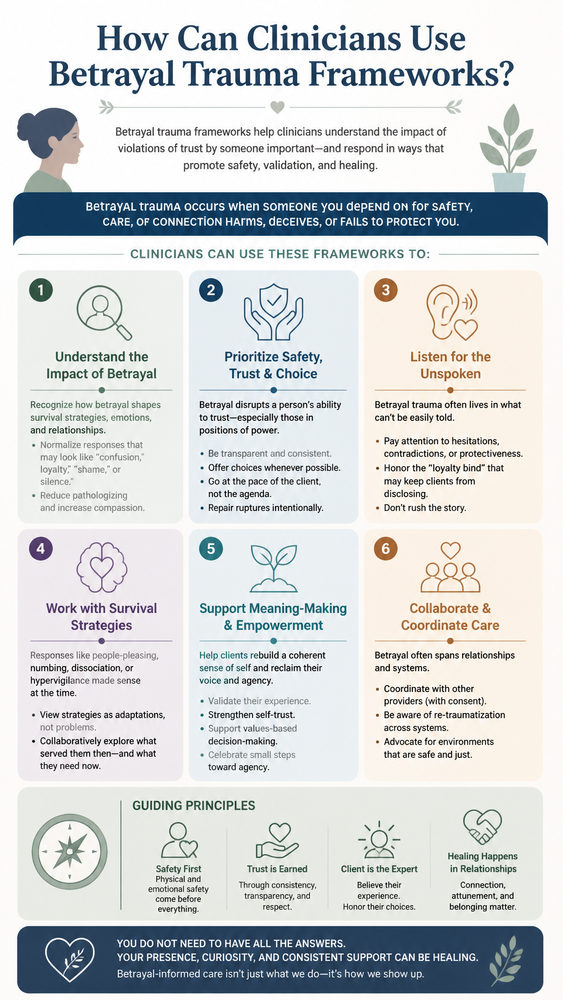
Betrayal trauma occurs when a person or institution someone depends on for survival, comfort, or basic functioning significantly violates that trust, according to Freyd’s original formulation. This is conceptually distinct from trauma driven by mortal fear, like a car accident or a natural disaster. The distinguishing feature isn’t the intensity of harm. It’s the relationship between the victim and the source of harm.
That distinction matters clinically because betrayal and fear produce different symptom profiles. Fear-based trauma tends to generate hyperarousal, intrusive memories, and a nervous system stuck in fight-or-flight. Betrayal trauma more often produces dissociation, emotional numbing, and constriction, along with gaps in memory that can confuse both client and clinician. Freyd’s research using Stroop tasks and directed-forgetting experiments found that survivors of caregiver-perpetrated abuse recall the abuse less completely than survivors of stranger-perpetrated harm, a pattern that supports the betrayal-memory hypothesis.
Here are the terms worth pinning down before you go further:
- Betrayal blindness: an unconscious protective process where a person minimizes or fails to register betrayal because full awareness would threaten a necessary attachment. Freyd describes this as adaptive in the short term and corrosive over time, since it can extend to institutions and bystanders as well as direct victims.
- Institutional betrayal: harm caused not by the original wrongdoing but by an institution’s failure to prevent or respond to it, whether that’s a workplace ignoring harassment complaints or a family system protecting an abuser.
- Attachment injury: a specific, identifiable event or pattern that violates an expected standard of care within a relationship, a concept operationalized in couples therapy through Emotionally Focused Therapy.
Survivors of high-betrayal trauma report elevated rates of physical illness, alexithymia, depression, and anxiety, and several samples show higher exposure reported by females to high-betrayal categories of trauma than men.
For intake purposes, it helps to phrase these concepts in language clients recognize. Instead of asking “was this traumatic,” ask whether someone they depended on broke a rule they didn’t know existed until it was broken. That framing surfaces betrayal dynamics that a standard PTSD checklist misses entirely.
How Do the Leading Betrayal Trauma Frameworks Compare?
No single framework covers every presentation. Freyd’s theory names the phenomenon and explains the memory and dissociation effects; the frameworks below turn that explanation into a treatment plan. Picking the wrong one first can slow recovery, especially with dissociative clients who need stabilization before they can tolerate any processing work at all.
| Framework | Primary focus | Typical client target | Evidence base | Setting & training | Core components |
|---|---|---|---|---|---|
| Betrayal Trauma Theory (Freyd) | Attachment and memory dynamics | All betrayal contexts; foundational lens | Strong on memory/dissociation mechanisms; foundational rather than a treatment protocol | Any setting; informs case conceptualization | Naming betrayal, explaining betrayal blindness, distinguishing from fear-based trauma |
| APSATS-style betrayal-specific protocols | Partner-infidelity and relational betrayal | Individuals and couples after discovered infidelity or deception | Growing clinical literature; specialized certification training exists | Individual and couples work; requires betrayal-specific clinician training | Disclosure processing, polygraph/psychoeducation issues, boundary work, trauma-informed couples repair |
| Attachment-injury models / Emotionally Focused Therapy | Relational repair through identifying and repairing the specific injury | Couples wanting to stay together after betrayal | Supported by a 2026 systematic review linking attachment injuries to complex-PTSD-like symptom clusters | Couples therapy; requires EFT or attachment-based training | Injury identification, softening events, accountability conversations, renewed bonding |
| Somatic / polyvagal-informed approaches | Nervous-system regulation and safety | Clients with high dissociation, hyperarousal, or body-based symptoms | Emerging but consistent clinical recommendation; used alongside other modalities | Individual work; requires somatic-specific training | Grounding, breath and vagal tone work, titrated exposure to bodily sensation |
| EMDR / CBT adaptations | Cognitive and memory reprocessing | Clients ready for structured processing after stabilization | Adapted protocols draw on established EMDR evidence for trauma generally | Individual work; requires EMDR certification or trauma-focused CBT training | Reprocessing target memories, cognitive restructuring around trust and self-blame |
A few patterns are worth calling out directly:
- Dissociative or highly avoidant clients generally need somatic regulation and attachment-informed stabilization before any narrative-processing work, regardless of which framework you eventually use for the deeper phase.
- Couples who want to stay together do better with attachment-injury and EFT-style repair layered on top of individual betrayal-trauma work, not instead of it.
- Institutional betrayal cases often need advocacy and systemic accountability steps that none of the individual-therapy frameworks address on their own.
Relational healing models argue that recovery ultimately depends on growth-fostering relationships and therapeutic mutuality, which is why almost every framework above eventually points back toward relational repair, even when the early work is individual and body-focused.
Reading this won’t change tomorrow’s message
You Know the Tactic Now. Do You Know What You’ll Actually Do When It Lands?
Understanding grey rock is not the same as doing it at 9pm when your phone buzzes. Most parents can explain the theory perfectly and still bite the bait every single time. The gap between the two is exactly what the free self-check measures.
Get Your Ex Out of Your Head →5 scenarios · scored result · 4 minutes · free
How Should Clinicians Screen and Assess for Betrayal Trauma?
The Brief Betrayal Trauma Survey remains the most widely used screening tool built specifically around Freyd’s framework, asking respondents to report exposure to categories of high-betrayal and low-betrayal trauma across the lifespan. It works well as a triage instrument early in intake, flagging clients whose presentations may need betrayal-specific attention rather than a generic trauma protocol.
A betrayal-aware intake goes beyond symptom counts. Useful questions include:
- What was the context of discovery? Sudden confrontation produces different acute symptoms than a slow, creeping realization.
- Was the client financially, emotionally, or practically dependent on the person who betrayed them?
- Are there gaps in memory around key events, or moments the client describes as “foggy” or “like it happened to someone else”?
- Does the client notice numbness or shutting down when the topic comes up, rather than anxiety or panic?
Diagnostic blind spots show up often. Clinicians trained primarily in fear-based trauma models can mislabel betrayal presentations as adjustment disorder or ordinary relationship distress, missing the dissociation and attachment rupture underneath. A client who seems “too calm” describing a partner’s affair isn’t necessarily coping well; they may be dissociated. Watch for minimizing language, unexplained memory gaps around the discovery period, and a pattern of returning to the relationship without being able to articulate why.
Pro Tip: When asking about memory gaps, avoid pressing for detail the client can’t access yet. Instead, name the pattern gently: “It’s common not to remember everything clearly after something like this. That’s not a failure of memory, it’s often how betrayal trauma works.” That single reframe reduces shame and keeps the door open for recognizing betrayal trauma symptoms without retraumatizing the intake process.
What Does Phase-Based Treatment for Betrayal Trauma Look Like?
Treatment unfolds in three phases, and skipping ahead is the most common clinical mistake. A client who hasn’t stabilized can’t do meaningful processing work, and processing without eventual integration just leaves someone re-traumatized on a loop.
Phase one: stabilization, safety, and regulation. The goal here is nervous-system safety, not insight. Typical duration ranges from a few sessions to several months depending on dissociation severity. Interventions include grounding techniques, polyvagal-informed breathing work, and psychoeducation about betrayal blindness so the client understands their own reactions aren’t malfunctions. Red flags for staying in this phase longer: ongoing dissociative episodes, active safety concerns, or ongoing contact with an unremorseful betrayer that keeps re-triggering the injury.

Phase two: trauma processing and meaning-making. Once regulation is reliable, clients can tolerate narrative work, adapted EMDR protocols, or sensorimotor processing that addresses the specific betrayal memory rather than generic fear-based content. This phase is where a 2026 framework synthesis of attachment injuries becomes clinically useful, since it maps symptom clusters (affect dysregulation, negative self-beliefs, relational difficulty, and classic PTSD symptoms) to specific intervention targets rather than treating betrayal trauma as one undifferentiated blob.
Phase three: integration and relational decision-making. Here clients decide what happens next, whether that’s repairing the relationship, restructuring it, or leaving it, and build relapse-prevention skills for the inevitable moments trust gets tested again. Couples work, if pursued, belongs here, not earlier. Boundary-setting and accountability structures also get built in this phase.
A few safety and ethical guidelines apply across every phase:
- Mandatory reporting obligations don’t pause for therapeutic rapport, especially with institutional or caregiver betrayal involving minors.
- Partner-accountability conversations need structure and, often, a third party present; unstructured confrontation frequently retraumatizes the injured partner.
- Ongoing contact with the person who betrayed the client should be assessed for safety on a rolling basis, not assumed safe just because time has passed.
- Institutional betrayal cases may require documentation practices suited for potential legal or HR proceedings, which shapes how notes get written.
A simple readiness check before moving phases: can the client stay present and regulated while discussing the betrayal for at least several minutes without dissociating or shutting down? If not, more stabilization work comes first.
Which Interventions Actually Work Inside These Frameworks?
Framework choice sets direction. These are the techniques that fill in the actual sessions.
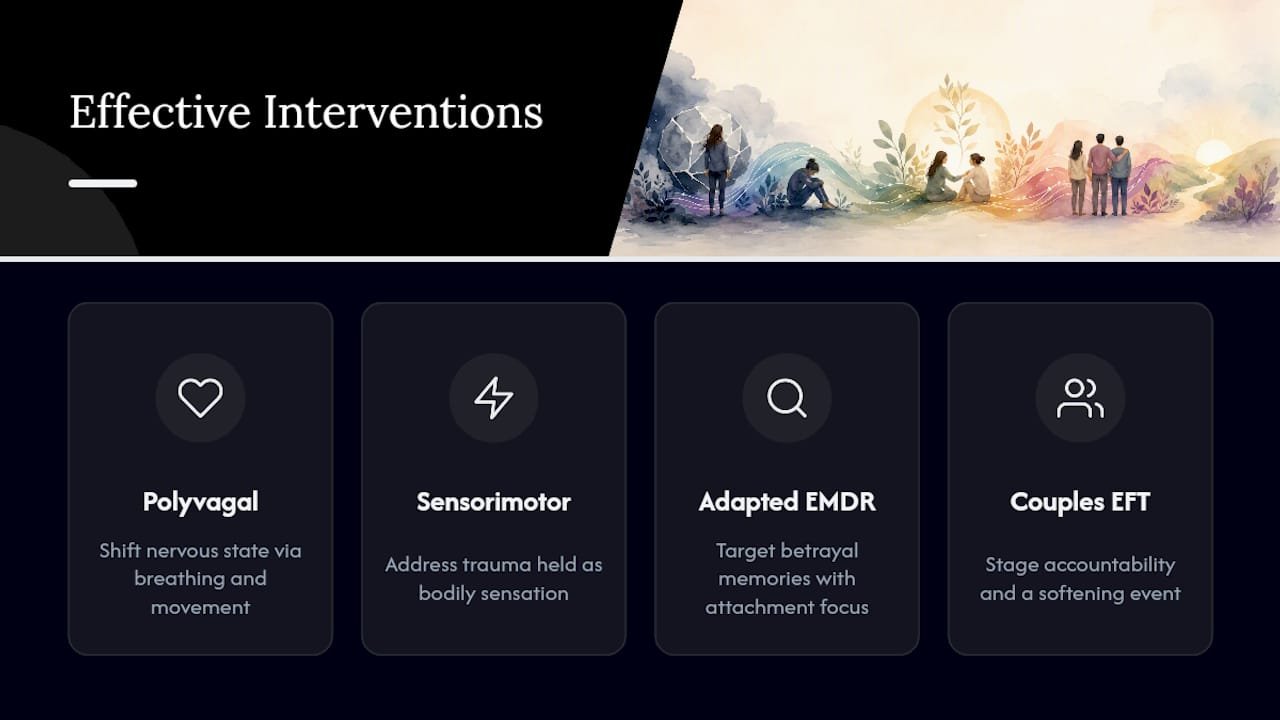
Polyvagal-informed regulation teaches clients to recognize and shift their own nervous-system state, often through paced breathing, orienting exercises, or simple movement that signals safety to the body. Clinical literature increasingly treats this as a prerequisite rather than an optional add-on, since betrayal frequently disrupts the nervous system’s basic capacity for safety.
Sensorimotor and somatic experiencing work addresses trauma stored in bodily sensation rather than narrative memory, useful for clients whose betrayal trauma shows up as chronic tension, gut symptoms, or numbness rather than clear memories.
Adapted EMDR protocols target the specific betrayal memory (the moment of discovery, a recurring image, a phrase overheard) using standard EMDR mechanics but with attachment-focused cognitive interweaves rather than generic trauma targets.
Trauma-informed couples work, drawing on Emotionally Focused Therapy techniques, walks partners through identifying the attachment injury explicitly, staging an accountability conversation, and building toward what EFT calls a softening event, a moment of genuine emotional reengagement.
Narrative exposure and written disclosure give clients structured space to construct a coherent account of what happened, countering the fragmentation betrayal trauma tends to produce.
On pharmacological support: psychiatric referral makes sense when comorbid depression, anxiety, or insomnia are severe enough to block engagement in therapy itself. Medication doesn’t treat betrayal trauma directly, but it can create enough stability for phase-one work to proceed.
Pro Tip: With dissociative clients, pace somatic work in small doses. Five minutes of grounding followed by check-in beats a full session of body-focused exercise that risks flooding.
Pro Tip: Script partner-accountability conversations in advance. A simple structure (acknowledge the specific injury, avoid defensiveness, state a concrete behavioral commitment) prevents the conversation from becoming another betrayal.
What Does the Research Actually Support, and Where Are the Gaps?
Freyd’s core claims about betrayal and memory rest on solid experimental ground, including Stroop and directed-forgetting studies that consistently show reduced recall for caregiver-perpetrated harm. The 2026 systematic review linking attachment injuries to complex-PTSD-like symptom clusters adds structured support for phase-based treatment, drawing on 12 qualitative studies with 207 participants.
The evidence base thins out fast once you move from “does betrayal trauma exist and function differently from fear trauma” to “which specific protocol produces the best outcomes.” Randomized controlled trials for APSATS-style and other betrayal-specific protocols remain limited, and most current recommendations rely on clinical consensus and phase-based reasoning rather than large trial data.
Sampling bias is a real limitation too. A lot of the foundational research skews toward specific gender and cultural samples, and long-term outcome data (five, ten years out) is thin across the board. In practice, that means using multimodal, individualized assessment rather than assuming one protocol fits every client, and documenting consent and risk decisions carefully given how much clinical judgment currently fills the gaps left by the trial evidence.
How Do These Frameworks Translate Into an Actual Treatment Plan?
A workable six-to-twelve session structure might run: two to three sessions on stabilization and psychoeducation, three to four on memory and meaning-making work, two to three on couples accountability if applicable, and a final block on relapse prevention and integration.
Client resources map directly onto each phase. Grounding and coping strategies support phase one. Guided practices like the meditation techniques for trauma recovery support regulation throughout. Trust-rebuilding material fits phase three integration work.
One recurring pattern in clinical case discussion: clients who initially present as “fine” after discovering betrayal, and only in week four or five start reporting memory gaps or emotional flooding, once stabilization work has made it safe enough for the nervous system to stop suppressing the reaction.
For a fuller resource collection built around these phases, the betrayal trauma hub organizes materials by stage rather than by topic, which tends to match how clients actually move through recovery.
Why Attachment-Informed, Phased Care Beats a One-Size Protocol
The conventional shorthand, treat betrayal like any other trauma and run standard exposure work, misses what actually stalls recovery: clients often don’t recognize their own experience as trauma at all, because they’re measuring it against a life-threat yardstick that doesn’t apply. Naming the attachment injury explicitly, rather than letting a client minimize it as “just” a relationship problem, is often the pivot that lets nervous-system work begin.
The ethical piece matters just as much as the technique. Betrayal-specific work demands cultural humility. Dependency looks different across family structures, immigration status, and economic circumstances, and a rigid protocol applied without that context can miss the actual power dynamics at play. Frameworks give structure; they shouldn’t override a clinician’s read of the specific person in front of them. Resources built around these phases, including the series here, work best as scaffolding for that judgment, not a replacement for it.
Where After the Affair Series Resources Fit Your Recovery Phase
Once you know which framework fits your situation, the harder part is finding material that actually walks you through it step by step instead of just explaining theory. That’s the gap the After the Affair Series is built to close: books and courses mapped to the exact phases covered above, so you’re not guessing which resource matches where you actually are.

If you’re in early stabilization, the 7 Steps Infidelity Recovery Checklist gives you a concrete action sequence for the first weeks after discovery, when clarity is hardest to find. Couples working on attachment-injury repair fit the Relationship Growth After Infidelity program, which operationalizes the accountability and reengagement work described in phase three. Clinicians who want structured client-facing material rather than building it from scratch can use the guide for supporting clients after infidelity alongside their own framework of choice.
Start with the checklist if you’re not sure where you land. It’s built to identify your current phase in the first few pages.
Sources
For deeper study, start with Freyd’s original definition of Betrayal Trauma Theory, which anchors the entire framework. Her 2008 paper on memory and dissociation supplies the experimental backing. The relational healing model explains why repair, not just processing, matters. The 2026 systematic review on attachment injuries offers the strongest recent evidence for phase-based treatment, and the original attachment-injury construct paper grounds the couples-therapy applications.
- Definition of Betrayal Trauma Theory – Freyd Dynamics Lab
- Attachment injuries in couple relationships: operationalizing the construct
This article is general information, not a substitute for advice from a qualified doctor. Consult a qualified healthcare professional about your own circumstances before acting on anything here.
FAQ
Is betrayal trauma the same as PTSD?
Not exactly. Betrayal trauma shares some symptoms with PTSD but is driven by violated dependency rather than life threat, and it tends to produce more dissociation and memory impairment than the hyperarousal typical of fear-based PTSD.
What are the stages of betrayal trauma recovery?
Most clinical frameworks describe three core phases: stabilization and safety, trauma processing and meaning-making, and integration with relational decision-making, though some models break these into finer steps.
What are the signs of betrayal trauma?
Common signs include dissociation, memory gaps around the discovery period, emotional numbing, minimizing language about the harm, and physical symptoms like fatigue or gut issues tied to nervous-system dysregulation.
How is betrayal trauma diagnosed or assessed?
Clinicians typically use screening tools like the Brief Betrayal Trauma Survey alongside a betrayal-aware intake that asks about dependency, discovery context, and dissociation indicators rather than relying on standard trauma checklists alone.
Where can I find structured tools for working through betrayal trauma?
The Aftertheaffair betrayal trauma hub organizes checklists, books, and programs by recovery phase, which makes it easier to match resources to where you currently stand.
Recommended
- Choosing a Betrayal Trauma Book That Works – After the Affair Series
- Explain Trauma Triggers: a Guide for Betrayal Survivors
- Benefits of Trauma-Informed Therapy for Survivors