- Step 1: Acknowledge and Manage Your Emotional Triggers
- Step 2: Establish Healthy Boundaries With Your Co-Parent
- Step 3: Communicate Clearly and Consistently About Children
- Step 4: Prioritize Self-Care and Emotional Recovery
- Step 5: Evaluate Progress and Adjust Your Approach
- Find Stability and Support in Co-Parenting After Betrayal
- Frequently Asked Questions
The sting of betrayal lingers long after the initial shock fades, especially when co-parenting means ongoing contact and shared responsibilities. For many parents, simple moments like hearing a song or facing a routine exchange with their co-parent can spark painful memories and anxiety. Learning to identify and handle these emotional triggers is a crucial first step in rebuilding trust and creating a safer environment for your children. This guide offers actionable strategies to support your healing and establish boundaries for a calmer, more resilient co-parenting journey.
Quick Summary
| Essential Insight | Detailed Explanation |
|---|---|
| 1. Identify Your Emotional Triggers | Acknowledge and document specific triggers to enhance emotional safety and reduce anxiety during co-parenting situations. |
| 2. Set Clear Boundaries | Establish firm communication and interaction guidelines to reduce conflict and maintain emotional stability for both parents and children. |
| 3. Communicate Child-Focused | Keep discussions centered on children’s needs and schedules, avoiding personal grievances to promote a healthy environment. |
| 4. Prioritize Self-Care | Invest in emotional and physical well-being to ensure you are resilient and capable of effective parenting amidst challenges. |
| 5. Regularly Evaluate Your Approach | Assess the effectiveness of co-parenting strategies periodically to adapt to changing dynamics and enhance cooperation. |
Step 1: Acknowledge and Manage Your Emotional Triggers
You likely know the feeling. A song plays, you see a familiar route, or someone mentions a detail, and suddenly your chest tightens. Your mind races. The pain floods back. These moments are emotional triggers, and they’re one of the hardest parts of co-parenting after infidelity.
Before you can manage triggers effectively, you need to understand what they actually are. Triggers aren’t character flaws or proof you’re weak. They’re your nervous system responding to reminders of betrayal. Your brain has linked certain sights, sounds, or situations to the trauma of discovery. When those cues appear, your body reacts before your conscious mind can intervene.
The good news? Managing emotional triggers is absolutely possible. Recovery after an affair happens in phases, and the first phase focuses on creating emotional safety and calming your reactivity. Start by identifying your specific triggers.
Here’s what to do:
- Write down situations that spike your anxiety or anger
- Note physical sensations before the emotional flood (rapid heartbeat, tension, nausea)
- Look for patterns (time of day, locations, conversations with your ex)
- Pay attention to what your children say or do that unsettles you
Once you recognize your triggers, you can plan for them. That’s the real power here. You shift from being ambushed by emotion to being prepared.
When a trigger hits during co-parenting, give yourself permission to pause. You don’t need to respond immediately. A 10-minute break—stepping outside, taking deep breaths, or sending a text later instead of reacting now—changes everything. Your children need a parent who can handle hard moments with some stability, not perfection.
Acknowledging your triggers isn’t weakness; it’s the foundation for managing them effectively during co-parenting.
Some triggers will fade naturally over time. Others may require consistent work. You might notice that a particular exchange location stops bothering you after three months. Or that conversations about school schedules become easier when you expect the anxiety instead of fighting it.
Pro tip: Create a simple trigger log on your phone where you note what set you off and how you responded, so you can identify patterns and celebrate moments when you handled a trigger differently.
Step 2: Establish Healthy Boundaries With Your Co-Parent
Boundaries aren’t walls. They’re guidelines that protect your emotional energy and create stability for your children. Without them, every interaction with your co-parent becomes a potential minefield of old wounds and unresolved feelings.
After infidelity, you need boundaries more than ever. They give you permission to step back from conflict and focus on what matters: parenting your kids. Clear boundaries reduce the emotional toll on you and create the predictable environment children need to thrive.
Start by identifying what you actually need. Do you need to keep conversations focused only on parenting topics? Should scheduling happen through a specific app? Do you need 24 hours to respond to non-emergency messages? These aren’t demands. They’re your survival strategy.
Here’s where to set firm lines:
- Communication method: Use email, text, or a co-parenting app instead of phone calls or unplanned conversations
- Discussion topics: Keep talks focused on schedules, school, health, and finances—nothing personal or accusatory
- Response timeframes: Establish that non-emergency messages get responses within 24 hours, not instantly
- Physical boundaries: Agree on drop-off and pick-up routines that minimize face-to-face conflict
- Decision-making process: Decide in advance how you’ll handle disagreements about major parenting choices
When you set a boundary, state it clearly and once. “I’m going to communicate about parenting matters through text only.” Then stick to it. Don’t explain yourself repeatedly or justify the boundary. That weakens it.
Your co-parent may test these limits. They might call instead of text or bring up the affair during a scheduling conversation. When this happens, communicating like business partners is your shield. Stay professional, redirect gently, and maintain your boundary without hostility.
Strong boundaries aren’t selfish. They’re the structure that allows you to parent effectively without being destroyed by ongoing conflict.
Remember that boundaries protect your children too. Kids feel the tension when parents argue or blur lines. They sense stability when interactions are predictable and respectful.
Here is a summary of how healthy boundaries improve co-parenting after infidelity:
| Boundary Type | How It Helps You | How It Helps Your Children |
|---|---|---|
| Communication guidelines | Reduces emotional fatigue | Less exposure to arguments |
| Focused discussion topics | Limits opportunities for conflict | Predictable, stable environment |
| Set response timeframes | Helps manage anxiety and expectations | Routine and consistency |
| Physical arrangements | Minimizes in-person friction | Drop-offs feel calmer and safer |
Pro tip: Save your boundary statements in a note on your phone so you can refer to them when your co-parent pushes back—this keeps you from making exceptions in the heat of the moment.
Step 3: Communicate Clearly and Consistently About Children
Your children don’t need to know about the affair, the anger, or the betrayal. They need to know what time pickup happens, whether they have soccer on Wednesday, and that both parents love them. That’s what this step is about.
After infidelity, communication can feel loaded with emotion. Every message about schedules might trigger memories of lies. Every conversation about decisions might feel like you’re negotiating with someone who hurt you. But your kids are watching. They need to see parents who can talk about their needs without dragging old pain into the conversation.
Accuracy, completeness, and timing are your foundation. Respectful communication means sharing all relevant information about your children, sharing it fully, and sharing it promptly. No surprises. No withholding details to punish your co-parent. Just the facts.
Structure your communication like this:
- Schedule regular check-ins: Weekly or biweekly conversations about upcoming needs, school events, health issues, and behavioral concerns
- Use a shared calendar: Post schedules where both parents can see them instantly
- Share important information immediately: School updates, doctor appointments, behavioral changes, and friendship drama shouldn’t wait
- Keep discussions child-focused: Talk about your kids’ needs, not your feelings about your co-parent
- Document big decisions: Write down what you agreed to regarding major parenting choices
When you need to discuss something difficult (like a discipline issue or a school concern), give yourself a chance to regulate first. Write it down. Sleep on it. Make sure your message focuses on the child’s needs, not blame.
Expect that some conversations will feel awkward. Your co-parent might get defensive. You might feel old hurt rise up. That’s normal. Your job is to push through it anyway because your children depend on you both staying functional.
Clear, consistent communication about children builds trust with your co-parent and gives your kids the security they need.
Remember that every email, text, or conversation about your children is a chance to model how adults handle responsibility even when things are hard.
Pro tip: Use a shared messaging app like OurFamilyWizard or Talking Parents that creates a record of all co-parenting conversations, which keeps discussions professional and gives you documentation if conflicts escalate.
Step 4: Prioritize Self-Care and Emotional Recovery
You cannot pour from an empty cup. Co-parenting after infidelity demands emotional energy you might not feel you have. If you don’t prioritize your own recovery, you’ll burn out, and your children will feel that collapse.
Self-care isn’t selfish. It’s the foundation that allows you to show up as a functional parent. When you’re depleted, every interaction with your co-parent becomes harder. Every parenting decision feels impossible. Every trigger hits twice as hard.
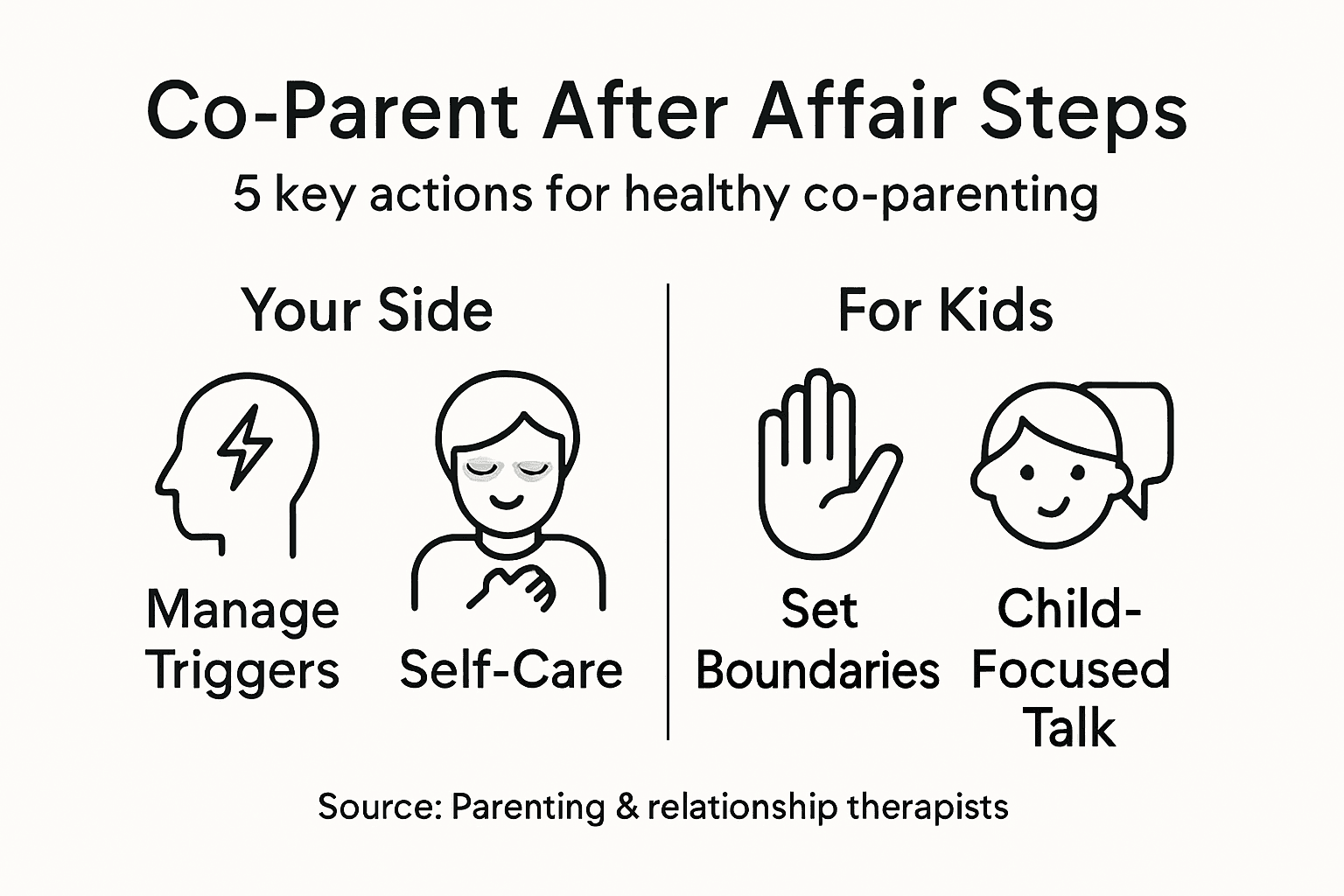
Start by recognizing that self-care strategies for trauma recovery include building supportive relationships, maintaining physical health, and practicing mindfulness. Betrayal trauma is real trauma. Your body and mind experienced a genuine shock. Treating yourself with the same care you’d give someone else who’s been hurt is not optional.
Here’s where to invest your energy:
- Build your support system: Connect with friends, family, or a therapist who understands infidelity
- Move your body: Exercise isn’t about appearance; it’s about releasing stress and regulating your nervous system
- Practice mindfulness: Meditation, deep breathing, or even quiet coffee time interrupt the trauma cycle
- Maintain basic health: Sleep, nutrition, and hydration are non-negotiable, even when you don’t feel like it
- Do activities that feel like you: Read, create, garden, or whatever reminds you that you exist beyond this pain
You might feel guilty prioritizing yourself. You might think you should be suffering more, or that self-care means you’re moving on too fast. That’s the betrayal talking. Your healing isn’t a betrayal of your pain. It’s respect for the person you still are.
Therapy isn’t a luxury. Whether you work with a counselor who specializes in infidelity trauma or join a support group, professional guidance helps you process what happened in ways your friends, no matter how supportive, simply cannot.
Your emotional recovery directly impacts your children’s stability. Taking care of yourself is taking care of them.
Small daily practices matter more than grand gestures. Ten minutes of intentional breathing before pickup is more valuable than occasional spa days if they don’t address the underlying trauma.
This table highlights self-care strategies and their unique impact on co-parenting resilience:
| Self-Care Strategy | Emotional Benefit | Parenting Outcome |
|---|---|---|
| Support network | Increases sense of belonging | Greater patience with children |
| Exercise | Lowers stress levels | More energy for daily tasks |
| Mindfulness practices | Enhances emotional regulation | Responds calmly to conflict |
| Professional therapy | Processes betrayal trauma | Models healthy coping for kids |
Pro tip: Schedule self-care like you schedule co-parenting responsibilities. Put it on your calendar with specific time blocks so it doesn’t get crowded out by crisis management and parenting duties.
Step 5: Evaluate Progress and Adjust Your Approach
Nothing you’ve put in place is permanent. Your co-parenting strategy from month two won’t work the same way in month twelve. Your children grow. Circumstances change. What worked when emotions were raw might feel different now.
Evaluation isn’t about failure. It’s about responsiveness. Effective co-parenting requires ongoing evaluation and adaptation to meet your family’s evolving needs. You’re not supposed to get this right once and never adjust. You’re supposed to pay attention, notice what’s working, and shift when something isn’t.
Set a regular review schedule. Every three months, ask yourself honest questions about your current approach. Not every adjustment needs to be major. Sometimes it’s small tweaks. Sometimes it’s a complete shift.
Evaluate these areas:
- Communication patterns: Are text exchanges becoming less heated? Are you able to discuss parenting issues without old anger surfacing?
- Boundary effectiveness: Are your boundaries actually protecting your peace, or are they creating new friction?
- Children’s adjustment: Are your kids showing signs of stability or stress? Are they talking about schedule changes?
- Your own triggers: Have some triggers faded? Have new ones emerged? Is your recovery progressing?
- Co-parent cooperation: Is your co-parent respecting agreements more consistently? Are there new areas of conflict?
When you notice something isn’t working, don’t judge yourself. That’s evidence you need to adjust, not proof you failed. Maybe your communication app isn’t reducing conflict the way you hoped. Maybe pickup at school is harder than pickup at home. Maybe your child needs more structured time with one parent for a few months.
Regularly assess your relationship dynamics and communication effectiveness, then adjust your strategies. This isn’t weakness. It’s maturity. It’s showing your children that adults can recognize what isn’t working and try something different.
Progress isn’t linear. Some months will feel easier, others harder. That’s normal, not a sign you’re going backward.
Bring changes up calmly with your co-parent. “I’ve noticed that weekend pickups feel rushed. What if we adjusted the time by 30 minutes?” Propose solutions, not complaints. Invite collaboration when possible.
Pro tip: Keep a simple log noting what worked, what didn’t, and what surprised you each month, so you can spot patterns over time and make informed decisions about bigger adjustments.

Find Stability and Support in Co-Parenting After Betrayal
Co-parenting after infidelity brings complex emotional challenges including managing triggers, setting healthy boundaries, and maintaining clear communication about your children. If you feel overwhelmed by these hurdles or want to protect your emotional well-being while fostering a stable environment for your kids, you are not alone. Our Co-Parenting Support – After the Affair Series offers practical guidance tailored exactly to these struggles.
Discover strategies to manage emotional triggers, establish strong boundaries, and communicate effectively with your co-parent. Don’t let unresolved pain control your parenting. Take control of your healing journey today by exploring expert advice and compassionate support in our full Recovery Strategies – After the Affair Series. Empower yourself and your family with resources designed for people reclaiming their lives after betrayal. Start your path to resilience now at our resource library.
Frequently Asked Questions
How can I identify my emotional triggers while co-parenting after an affair?
To identify your emotional triggers, take note of specific situations that spike your anxiety or anger, such as particular conversations or events. Write them down and look for patterns to understand your reactions better. Consider keeping a trigger log on your phone to track what sets you off and how you respond.
What boundaries should I set with my co-parent after infidelity?
Set boundaries around communication by determining the methods you’ll use, such as texts or a co-parenting app, and keep discussions focused solely on parenting topics. Make these boundaries clear and stick to them, as they are essential for protecting your emotional energy and fostering a stable environment for your children.
How can I communicate effectively with my co-parent about our children?
Communicate about your children by keeping discussions child-focused and timely, sharing relevant information without bringing personal emotions into the conversation. Schedule regular check-ins, use a shared calendar for important updates, and document any major decisions made, ensuring clarity and consistency.
What self-care strategies can help me cope while co-parenting after an affair?
Prioritize self-care by engaging in activities that promote your emotional recovery, such as exercising regularly, practicing mindfulness, and maintaining your health through proper nutrition and sleep. Build a support network of friends or professionals to help you process your feelings and manage stress more effectively.
How often should I reevaluate my co-parenting approach after an affair?
Regularly evaluate your co-parenting strategies every three months to assess their effectiveness and make necessary adjustments. Look for signs of improvement in your communication patterns, boundary adherence, and your children’s adjustment, and adapt your strategies accordingly to fit your family’s evolving needs.
Recommended
- How to Co-Parent Effectively After Infidelity (Without Losing Your Sanity)
- Co-Parenting After Betrayal: What Healthy Looks Like (And What It Doesn’t)
- Post-Infidelity Co-Parenting – After the Affair Series
- How to Transition From Parallel Parenting to Co-Parenting (Step-by-Step Guide)