Boundaries after betrayal often feel punitive, like rules imposed to control a wayward partner. Yet the most effective boundaries serve a different purpose entirely: they create the emotional safety necessary for genuine healing to begin. When trust shatters, your nervous system remains on high alert, scanning for threats and struggling to feel secure. Boundaries such as emotional limits and physical breaks help repair safety and trust after betrayal, offering structure during chaos. This guide provides clear, practical methods for establishing boundaries that foster healing, rebuild trust, and support your recovery journey.
Table of Contents
- Key takeaways
- Why boundaries matter after betrayal
- Effective methodologies for setting and enforcing boundaries
- Challenges and nuances in boundary setting after betrayal
- Practical application: establishing boundaries to foster healing and rebuild trust
- Explore expert infidelity recovery resources
- FAQ
Key Takeaways
| Point | Details |
|---|---|
| Boundary purpose | Boundaries create emotional safety that enables healing after betrayal and helps rebuild trust. |
| Boundary types | Emotional limits, physical breaks, and non negotiable rules such as complete cessation of contact with the affair partner guide recovery. |
| Enforcement and accountability | Consistent enforcement with clearly stated consequences builds accountability and supports incremental trust rebuilding. |
| Therapy supports boundary work | Therapists specializing in infidelity recovery help set boundaries, provide guidance, and support safe healing alongside the relationship. |
Why boundaries matter after betrayal
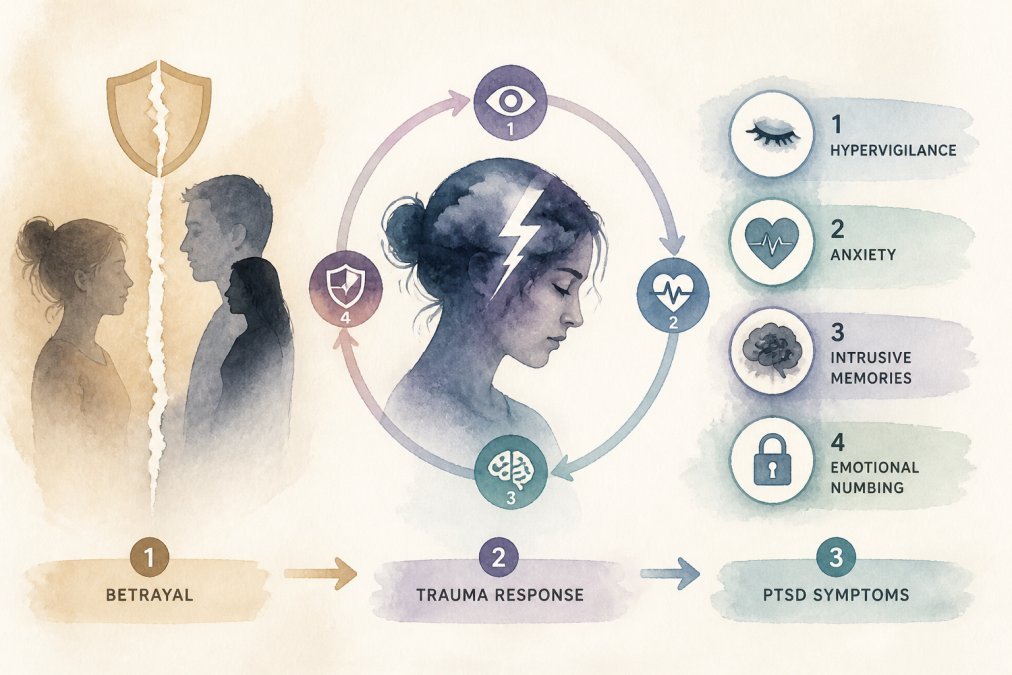
Infidelity creates psychological trauma that disrupts your sense of safety, predictability, and self-worth. Your mind replays painful images, your body tenses at triggers, and trust feels impossible to rebuild. This post-traumatic response isn’t weakness or overreaction. It’s your nervous system protecting you from further harm.
Boundaries address this trauma by establishing clear parameters that reduce uncertainty and create predictable safety. Emotional boundaries might limit conversations about the affair to specific times with a therapist present, preventing the escalation that leaves both partners drained and hopeless. Physical boundaries could include a temporary pause on intimacy while you process betrayal without pressure to perform connection you don’t feel. Non-negotiable boundaries set firm conditions, such as complete cessation of contact with the affair partner, rebuilding trust after infidelity by demonstrating commitment to the relationship.
These boundaries serve multiple functions in recovery:
- They communicate your needs clearly when emotions make verbal expression difficult
- They provide measurable actions your partner can take to demonstrate change
- They create space for you to heal without constant re-traumatization
- They establish accountability that rebuilds trust incrementally
Therapists specializing in infidelity recovery consistently incorporate boundary work as foundational to healing. Without clear limits, partners often fall into destructive patterns: the betrayed person interrogates endlessly seeking reassurance that never satisfies, while the unfaithful partner grows defensive and withdrawn. Boundaries interrupt these cycles, creating structure that allows genuine repair work to begin.
Pro Tip: Write your boundaries down and share them with your partner in a calm moment, not during conflict. This clarity prevents misunderstandings and creates a reference point you both can revisit.
The most effective boundaries balance firmness with flexibility, providing safety while allowing the relationship room to evolve. They’re not weapons to punish but tools to heal. When you establish boundaries after infidelity examples that reflect your genuine needs rather than reactive anger, you create conditions where trust can slowly, carefully rebuild.
Effective methodologies for setting and enforcing boundaries
Setting specific boundaries and regular check-ins combined with therapeutic models support boundary enforcement and trust rebuilding, providing structure that transforms abstract intentions into concrete actions. Vague statements like “I need you to be more honest” create confusion and conflict. Specific boundaries eliminate ambiguity: “You will share your phone passcode and location at all times” or “We will attend couples therapy every Tuesday at 6 PM.”
Follow these steps to establish enforceable boundaries:
- Identify your core needs for safety and healing, distinguishing between emotional reactions and genuine requirements
- Communicate each boundary clearly, explaining why it matters and what specific actions it requires
- Establish consequences for violations before they occur, ensuring your partner understands the stakes
- Schedule regular check-ins to assess how boundaries are working and adjust as healing progresses
- Document agreements in writing to prevent later disputes about what was actually decided
Therapeutic approaches like Gottman Method and Imago Relationship Therapy provide frameworks for boundary work that go beyond simple rule-setting. These models teach communication skills that help you express needs without attack and receive feedback without defensiveness. They also address the underlying attachment wounds and relational patterns that may have contributed to vulnerability before betrayal occurred.
Transparency measures form a critical component of effective boundaries. Shared access to phones, email accounts, and location tracking might feel invasive in healthy relationships, but after betrayal they provide the verification your nervous system needs to begin relaxing its hypervigilance. These aren’t permanent arrangements but transitional tools that demonstrate your partner’s willingness to prioritize your healing over their privacy.
Pro Tip: Set a timeline for reviewing transparency boundaries. Knowing that phone access won’t be forever helps the unfaithful partner accept it now, while giving you a target date creates hope that healing is progressing.
Consistent enforcement separates effective boundaries from empty threats. When you establish a consequence and then fail to follow through, you teach your partner that your boundaries are negotiable. This erodes the very safety you’re trying to create. Enforcement doesn’t require anger or punishment, just calm consistency. If the boundary was “no contact with the affair partner” and contact occurs, the predetermined consequence happens, whether that’s temporary separation, increased therapy frequency, or whatever you established.
Integrating trust building exercises for couples after betrayal alongside boundary work accelerates recovery by creating positive experiences that balance the necessary restrictions. Similarly, understanding the benefits of therapy after infidelity explained helps both partners commit to the process even when it feels uncomfortable. Research on post-infidelity stress disorder validates the trauma response you’re experiencing, making boundary needs less about control and more about legitimate healing requirements.
The goal isn’t creating a prison but building a container strong enough to hold the difficult work of recovery. When both partners understand boundaries as collaborative safety measures rather than unilateral punishments, they become tools for connection rather than division. Learning how to cope after infidelity naturally complements boundary work by addressing your individual healing alongside relational repair.
Challenges and nuances in boundary setting after betrayal
Boundaries may fail if the partner is unwilling or there is repeated infidelity, with gender differences affecting coping and boundary effectiveness. The most carefully crafted boundaries collapse when the unfaithful partner lacks genuine remorse or continues deceptive behavior. You cannot enforce boundaries on someone fundamentally unwilling to change.
Several challenges commonly emerge:
- Partner resistance framed as “you don’t trust me” deflects from the reality that trust was destroyed by their actions
- Repeated boundary violations signal deeper unwillingness to do recovery work
- Emotional exhaustion makes consistent enforcement feel impossible
- Fear of losing the relationship leads to accepting inadequate compliance
Repeated cheating requires stronger responses than first-time betrayal. When someone continues affairs despite established boundaries, you’re not dealing with a mistake but a pattern. Boundaries after serial cheating what works often includes separation as a necessary consequence, not as punishment but as recognition that proximity enables continued harm.
Research on gender differences in coping after betrayal reveals that men more frequently use avoidance strategies while women tend toward expressive processing. These differences affect boundary preferences and effectiveness. Men might need boundaries that limit affair discussion frequency to prevent shutdown, while women often require regular opportunities to process emotions verbally. Neither approach is wrong, but partners must recognize these differences when negotiating mutually acceptable boundaries.
| Challenge | Impact on Boundaries | Adaptive Response |
|---|---|---|
| Partner unwillingness | Boundaries fail regardless of clarity | Consider separation or exit |
| Repeated betrayal | Erodes boundary credibility | Implement stronger consequences |
| Gender coping differences | Creates conflicting boundary needs | Negotiate middle ground with therapy |
| Over-reliance on control | Prevents genuine healing | Balance boundaries with self-work |
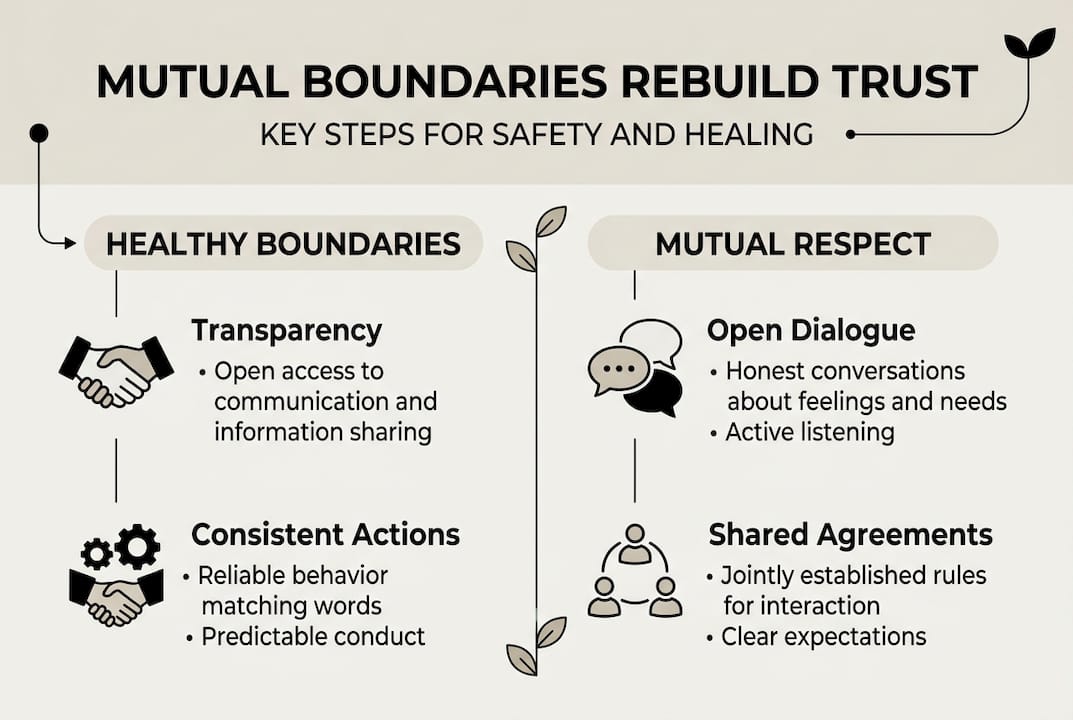
A critical nuance: boundaries are mutual agreements, not unilateral demands. When you impose rules without your partner’s input, you create parent-child dynamics that breed resentment rather than healing. Effective boundaries emerge from collaborative discussion where both partners’ needs receive consideration. Your partner doesn’t get to veto boundaries protecting your basic safety, but their perspective on implementation details helps create sustainable agreements.
Pro Tip: Distinguish between boundaries (protecting your wellbeing) and punishment (making your partner suffer). If a boundary’s primary purpose is causing pain rather than creating safety, it’s revenge, not recovery.
Over-reliance on external boundaries without internal healing work creates another trap. You might monitor every text message and track every movement, yet still feel anxious and untrusting because the real work of processing trauma and rebuilding self-worth remains undone. Boundaries provide necessary structure, but they can’t substitute for the emotional processing, self-reflection, and personal growth that genuine healing requires. When boundaries become your only tool, you risk creating a relationship built on surveillance rather than trust.
The goal is using boundaries as scaffolding during reconstruction, not as permanent architecture. As healing progresses and your partner demonstrates consistent trustworthiness, boundaries should gradually relax. If you find yourself unable to reduce restrictions despite months of compliance, that signals unresolved trauma requiring additional therapeutic support. Boundaries facilitate healing but cannot replace it.
Practical application: establishing boundaries to foster healing and rebuild trust
Boundaries aid renegotiation in recovery and foster safety when integrated thoughtfully with self-healing and therapy, transforming abstract concepts into daily practices that rebuild trust incrementally. Implementation determines whether boundaries become tools for healing or weapons that deepen division.
Begin with clear communication about expectations and needs:
- Schedule a dedicated conversation when both partners are calm and focused
- Use specific language describing observable behaviors rather than character judgments
- Explain the reasoning behind each boundary so your partner understands its purpose
- Invite questions and clarification to ensure genuine understanding
Structured exercises accelerate the boundary integration process. Create a written agreement documenting each boundary, its rationale, implementation details, and consequences for violations. Review this document weekly during the first month, then monthly as patterns stabilize. This regular attention prevents drift and provides opportunities to adjust boundaries as healing progresses.
Follow these implementation steps:
- Prioritize boundaries by urgency, starting with those addressing immediate safety concerns
- Introduce boundaries gradually rather than overwhelming your partner with simultaneous demands
- Celebrate compliance and progress, not just enforcing violations
- Maintain your own boundaries consistently, modeling the respect you expect
- Seek therapy support when implementation challenges arise

Consistent enforcement requires energy and resolve, especially when you’re exhausted from trauma. Build support systems that help you maintain boundaries when willpower falters. This might include a therapist who holds you accountable, a trusted friend who reminds you of your worth, or a recovery group that normalizes your experience.
Pro Tip: Create a boundary enforcement script for moments when your resolve weakens. Write down exactly what you’ll say and do if a violation occurs, then refer to it when emotions cloud judgment.
Integrate therapy and mindfulness practices alongside boundary work. Therapy provides the skills for implementing boundaries effectively while processing the emotions they stir. Mindfulness helps you stay present with discomfort rather than abandoning boundaries to escape tension. Together, these practices create the internal resources that make external boundaries sustainable.
Recognize boundaries as mutual agreements promoting healing for both partners. When your unfaithful partner accepts boundaries gracefully, they’re not just complying with demands but actively participating in repair. This shift from compliance to collaboration marks a turning point in recovery. Your partner moves from “I have to do this” to “I want to do this because healing our relationship matters.”
The step-by-step betrayal recovery healing trust process shows how boundaries fit within a larger recovery framework. Learning how to communicate after affair rebuild trust ensures that boundary conversations strengthen connection rather than creating distance. These skills transform boundaries from restrictive rules into collaborative tools that both partners use to create the relationship they want.
Real healing emerges when boundaries create enough safety for vulnerability to return. You begin sharing fears without your partner becoming defensive. They begin expressing needs without you interpreting every request as manipulation. The relationship develops new patterns built on transparency, accountability, and mutual respect. Boundaries don’t create this transformation alone, but they provide the foundation that makes it possible.
Explore expert infidelity recovery resources
Establishing effective boundaries represents just one component of comprehensive infidelity recovery. The After the Affair Series provides structured guidance through every stage of healing, from initial crisis management to long-term relationship transformation. You’ll find expert-compiled checklists that break overwhelming recovery work into manageable steps, ensuring you address critical healing tasks without missing essential elements.
Our infidelity recovery checklist 7 steps effective healing walks you through the complete recovery process with practical exercises and realistic timelines. Discover how relationship growth after infidelity rebuild trust transforms crisis into opportunity for deeper connection. Access proven trust building exercises for couples after betrayal that complement your boundary work with positive relationship experiences. These resources provide the comprehensive support you need to navigate recovery with clarity and confidence.
FAQ
What are examples of emotional boundaries after betrayal?
Emotional boundaries after betrayal include limiting discussions about the affair to scheduled therapy sessions rather than constant interrogation that exhausts both partners. You might establish that certain topics remain off-limits during particular times, such as no affair discussion during meals or before bed. Another example involves pausing conversations when they escalate into shouting or personal attacks, reconvening only after both partners calm down. These boundaries after infidelity examples protect your emotional capacity while creating structure for productive communication.
How can therapy help with setting boundaries after betrayal?
Therapy approaches like Gottman and Imago support boundary enforcement and communication after infidelity by teaching specific skills for expressing needs without attack and receiving feedback without defensiveness. Therapists help you identify which boundaries address genuine safety needs versus reactive punishment impulses. They facilitate difficult conversations where you negotiate boundaries collaboratively rather than unilaterally imposing demands. Understanding the benefits of therapy after infidelity explained reveals how professional support accelerates recovery beyond what couples can achieve alone.
What if boundaries don’t work after repeated betrayal?
Boundaries may fail if the partner remains unwilling or continues cheating, necessitating consequences or separation. Repeated boundary violations signal that your partner lacks the genuine remorse and commitment required for recovery. When someone continues affairs despite clear boundaries and stated consequences, you’re facing a pattern rather than a mistake. Separation becomes necessary not as punishment but as recognition that proximity enables ongoing harm. Exploring boundaries after serial cheating what works helps you determine when stronger action protects your wellbeing better than continued attempts at repair.
How long does it take to heal with boundaries after betrayal?
Healing timelines vary dramatically based on individual circumstances, ranging from months to years depending on betrayal severity, partner cooperation, and personal resilience. Consistent boundaries accelerate progress by reducing re-traumatization and creating predictable safety that allows your nervous system to gradually relax its hypervigilance. Active therapy participation and dedicated self-work significantly influence recovery speed. Most experts suggest noticeable improvement within six months of consistent boundary implementation and genuine repair efforts, though complete healing typically requires one to three years. Learning about healing after infidelity how long does it take provides realistic expectations that prevent discouragement during difficult recovery phases.
Recommended
- Boundaries That Actually Work – After the Affair Series
- Relationship Healing Process – After the Affair Series
- Relationship Growth After Infidelity – After the Affair Series
- Trust-Building Exercises for Couples After Betrayal – After the Affair Series