Discovering that your partner has been emotionally or sexually involved with someone online can hit just as hard as finding out about a physical affair. Many people expect the pain to feel smaller because nothing “really happened” in person, but that assumption is wrong. Digital infidelity is linked to significantly lower trust scores and relationship satisfaction, with affected couples scoring an average of 32.4 on trust measures compared to 40.7 for non-affected couples. If you are in that painful place right now, know that your feelings are valid, and that setting healthy social media boundaries is one of the most concrete steps you can take toward real recovery.
Table of Contents
- The emotional fallout of a digital affair
- Why social media boundaries matter after betrayal
- Healthy boundaries: transparency vs. privacy
- Action plan: steps to set and maintain healthy boundaries
- Red flags, setbacks, and what most people miss
- Support and resources for your next step
- Frequently asked questions
Key Takeaways
| Point | Details |
|---|---|
| Digital affairs hurt deeply | Online betrayals can erode trust and satisfaction as much as in-person infidelity. |
| Boundaries boost healing | Clear social media boundaries are linked to improved trust and relationship recovery. |
| Balance is key | Healthy boundaries should blend transparency with respect for individual privacy. |
| Adjust as you heal | Effective boundaries change over time and should be revisited as trust grows. |
| Support matters | Utilizing resources and seeking guidance accelerates the healing journey. |
The emotional fallout of a digital affair
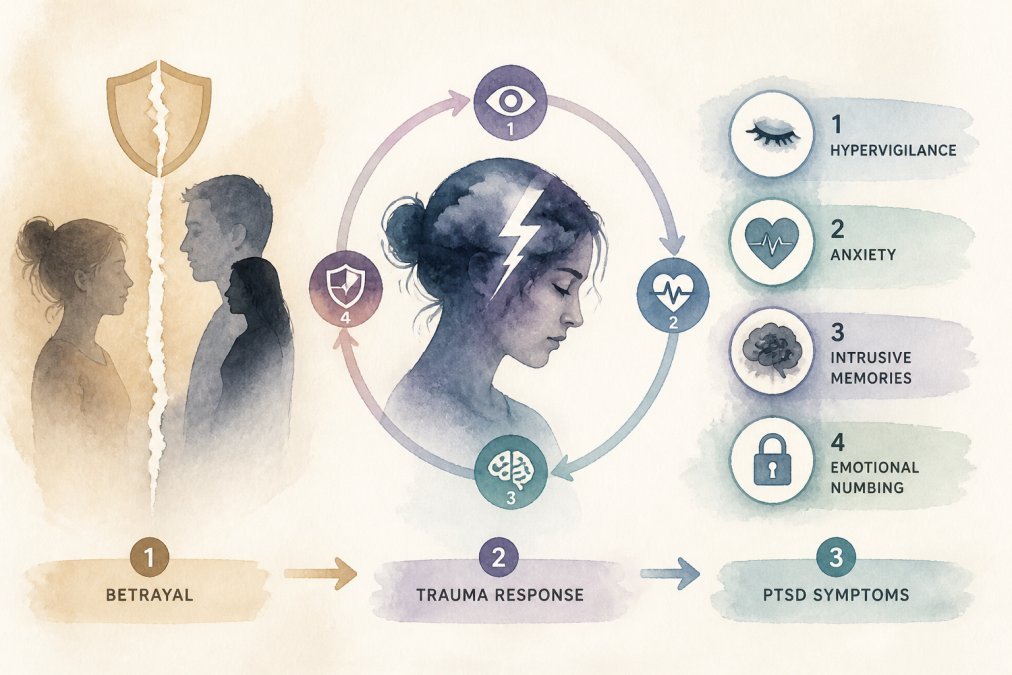
When you first discover a digital affair, the emotions rarely arrive in a neat, manageable order. Shock hits first, then confusion, then a wave of anger, jealousy, and self-doubt that can feel relentless. Many betrayed partners describe spending hours replaying conversations they were never meant to see, questioning their own worth and wondering what the other person offered that they could not.
These reactions are not overreactions. Research confirms that trust scores drop sharply after digital infidelity, with a statistically significant difference between affected and non-affected couples (t(118)=6.54, p<.001). The pain is measurable, not imagined. Working through it means starting with processing emotional trauma before rushing into decisions about the relationship.
“Digital infidelity can feel just as damaging as physical betrayal. The emotional fallout of digital infidelity is real, measurable, and deserves to be taken seriously, particularly among younger generations who view online disloyalty as a genuine breach of commitment.”
Common emotions after discovering a digital affair include:
- Shock and disbelief that someone you trusted could behave this way online
- Jealousy and obsessive thoughts about the other person
- Anger directed at your partner, yourself, or both
- Self-doubt and questions about your attractiveness or worth
- Confusion about whether what happened even counts as cheating
Generational attitudes matter here too. Gen Z, in particular, views digital disloyalty as equally serious as physical affairs, which reflects a broader cultural shift in how we define faithfulness. Rebuilding after this kind of betrayal often requires focused work on rebuilding self-esteem before anything else can move forward.
With the pain laid bare, the next logical step is to understand why digital affairs disrupt trust, especially through social media.
Why social media boundaries matter after betrayal
Social media is not a neutral space after an affair. It becomes a minefield. Every notification your partner receives, every late-night scroll, every new follower can trigger a fresh wave of anxiety. That is not irrational. Higher social media use correlates with lower relationship satisfaction and more conflict, with a correlation of r=-.34 (p<.01).
Without clear boundaries, that anxiety can escalate into unhealthy digital surveillance, where you find yourself checking your partner’s likes, followers, and direct messages compulsively. Jealousy-fueled social media use erodes trust over time and creates a cycle that is very hard to break. The surveillance feels like safety, but it actually deepens insecurity.
| Social media use level | Relationship satisfaction | Trust level | Conflict frequency |
|---|---|---|---|
| Low and boundaried | High | Strong | Low |
| Moderate, no agreements | Medium | Moderate | Moderate |
| High, unchecked | Low | Weak | High |
Setting boundaries around social media is directly tied to better outcomes. The r=-.34 correlation is a clear signal: the more unmanaged social media use is in a relationship recovering from betrayal, the harder relationship growth after infidelity becomes. Understanding the role of boundaries after betrayal is not about control. It is about creating a structure where both partners can feel safe enough to heal.
Knowing boundaries are crucial, how can you actually put them into practice in your relationship?
Healthy boundaries: transparency vs. privacy
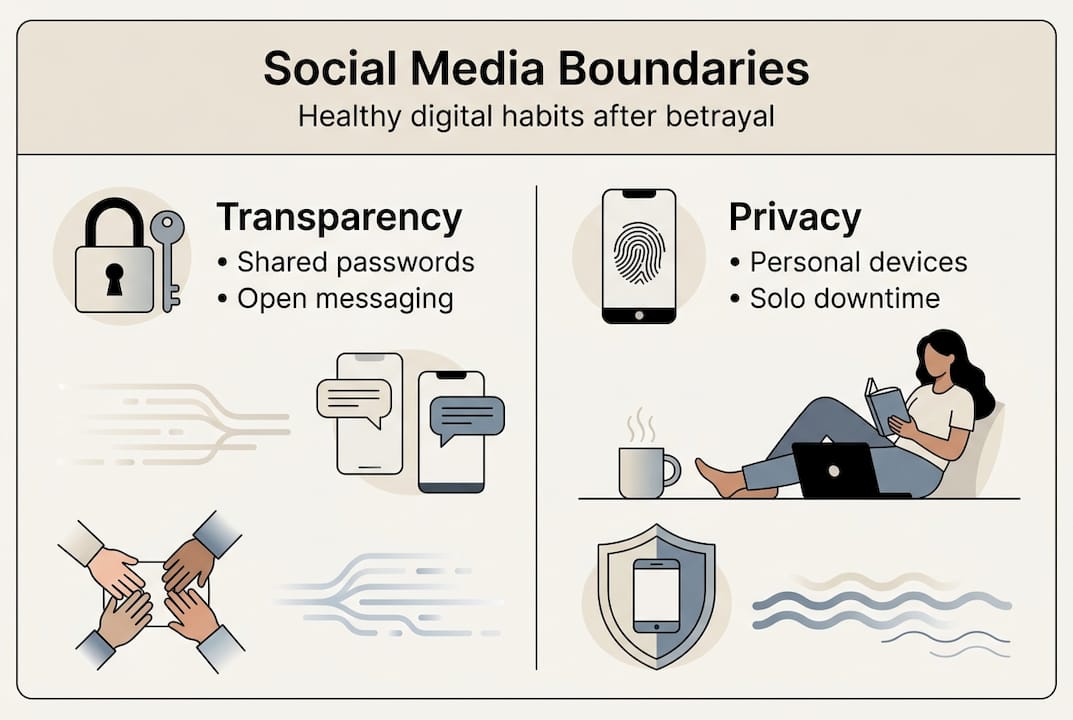
One of the biggest tensions couples face after a digital affair is the question of access. Should you have your partner’s passwords? Should they share their location? The two main approaches are radical transparency and layered privacy, and both have real trade-offs.
Radical transparency means full, open access to all devices, accounts, and messages. It can feel reassuring in the short term. Layered privacy means maintaining some personal digital space while agreeing on clear conduct rules. It respects autonomy but requires a higher level of trust.
| Approach | Pros | Cons |
|---|---|---|
| Radical transparency | Reduces immediate anxiety, builds short-term reassurance | Can feel punitive, may stall long-term healing |
| Layered privacy | Respects autonomy, models healthy trust | Requires existing goodwill, may feel insufficient early on |
Experts note that Gen Z views digital disloyalty as serious but also warns that erasing all privacy can damage trust in a different way, creating resentment rather than safety. Over-surveillance can stall healing just as much as secrecy can. Learning how to communicate after an affair is what makes the difference between a boundary that heals and one that controls.
Pro Tip: Instead of adopting a one-size-fits-all rule, sit down together and create a written framework that reflects your specific relationship needs. What feels safe to you? What feels respectful to your partner? The trust healing process works best when both people have genuine input.
It is clear boundaries need tailoring, so what practical steps help couples apply them effectively?
Action plan: steps to set and maintain healthy boundaries
Setting boundaries after a digital affair is not a one-time conversation. It is an ongoing process. Here is a practical framework grounded in relationship science:
- Reflect on your needs first. Before any conversation with your partner, get clear on what would actually make you feel safer. Write it down.
- Open an honest discussion. Share your needs without ultimatums. Use “I feel” statements rather than accusations.
- Set clear mutual agreements. Both partners should agree on what is and is not acceptable on social media going forward.
- Decide on device and account access. This might mean shared passwords for a defined period, agreed social media breaks, or simply agreeing not to follow certain people.
- Review regularly as healing progresses. What you need at week two is not what you will need at month six.
Specific examples of boundaries that work include taking a joint social media break for 30 days, agreeing not to message certain contacts, or committing to transparency about new online friendships. Boundary-setting after digital infidelity leads to measurably better relationship outcomes when both partners engage with the process honestly.
Pro Tip: Revisit your agreements every four to six weeks. Boundaries are not permanent rules. They are living agreements that should reflect where you both are in the healing process. Pair this with trust-building exercises to reinforce progress.
Common pitfalls to avoid:
- Moving too fast and setting boundaries before emotions have settled
- Using boundaries as a form of punishment rather than protection
- Refusing to adjust agreements even when trust has genuinely improved
- Letting one partner dictate all the terms without the other’s real input
For a structured path through this process, the step-by-step betrayal recovery guide offers a clear framework to follow.
With healthy boundaries in place, you will also want to watch for pushbacks and warning signs that could stall recovery.

Red flags, setbacks, and what most people miss
Even well-intentioned boundaries can break down. Knowing the warning signs early gives you a chance to course-correct before resentment takes hold.
Watch for these red flags:
- Escalating secrecy despite agreed transparency, such as new private accounts or deleted messages
- Digital surveillance cycles where checking your partner’s activity becomes compulsive and anxiety-driven
- Resentment about new rules that one partner feels were imposed rather than agreed upon
- Boundary creep, where small violations are ignored until they become patterns
“Tension arises and trust can erode if there is too much or too little digital privacy. Over-correction in either direction, total transparency or total withdrawal, can stall the healing process rather than support it.”
If your boundaries keep causing conflict rather than reducing it, that is a signal to revisit the agreements, not abandon them. Sometimes the issue is the specific rule. Sometimes it is the underlying wound that has not yet been addressed. In those cases, professional support is not a last resort. It is a smart next step.
Self-compassion matters here too. Healing after a digital affair is not linear. You will have good weeks and hard weeks. The goal is not perfection. It is progress. Exploring online affair recovery resources can help you navigate the uneven terrain without losing momentum.
These tools and insights empower you to recover your sense of safety, and for personalized support, the following resources offer a clear next step.
Support and resources for your next step
Recovery from a digital affair is real work, and you do not have to figure it out alone. The right resources can make the difference between spinning in confusion and moving forward with clarity.
At aftertheaffair.uk, you will find structured, compassionate guidance built specifically for people in your situation. Start with the infidelity recovery checklist to get a clear picture of where you are in the process. If you are still in the early, disorienting phase, the navigating infidelity guide walks you through the first months step by step. And when you are ready to look at the bigger picture of healing, the stages of healing guide offers a roadmap for what comes next. Reaching out for support is not weakness. It is the most practical thing you can do.
Frequently asked questions
What are healthy social media boundaries after a digital affair?
Healthy boundaries balance mutual transparency and respect for privacy, with clear agreements on social media access and conduct that both partners genuinely agree to.
Should I have access to my partner’s social media after betrayal?
Access can help rebuild trust for some couples, but over-monitoring may slow recovery. The tension between transparency and privacy is best resolved through open discussion and tailored agreements rather than blanket rules.
Why do I feel so anxious about social media after my partner’s digital affair?
That anxiety is a normal response to real harm. Higher social media use is linked to lower relationship satisfaction and trust after betrayal, so your nervous system is responding to a genuine threat pattern.
What should I do if boundaries around social media keep causing fights?
Repeated conflict is a sign the current agreements are not working for both partners. Revisit the terms together or consider couples counseling to get support from a neutral professional.
How quickly should boundaries change during recovery?
There is no fixed timeline. Boundary-setting works best when reviewed regularly as healing occurs, with both partners checking in every few weeks to ensure the agreements still feel fair and effective.
Recommended
- How to communicate after affair: rebuild trust in 2026 – After the Affair Series
- Qué es la infidelidad digital: guía para sanar en 2026 – After the Affair Series
- Digital Age Infidelity-Micro Cheating – After the Affair Series
- Online Affair Recovery for Couples – After the Affair Series