TL;DR:
- Trauma triggers activate your nervous system before rational thought can intervene, causing involuntary reactions. Recognizing subtle internal and external triggers through journaling and using grounding techniques can help manage their impact. Trauma-focused therapies like PE and EMDR are proven effective for long-term healing and reducing trigger sensitivity.
Your body reacts before your mind catches up. A song plays in a coffee shop, and suddenly you’re shaking, heart pounding, struggling to breathe. You weren’t thinking about the affair. You weren’t trying to go there. But your nervous system went anyway, in milliseconds, without asking for permission. To explain trauma triggers is to explain why this happens and, more importantly, what you can do about it. If you’ve experienced infidelity or betrayal, this guide is written specifically for you.
- Key takeaways
- What trauma triggers are and how they work in your brain
- Types of trauma responses and their effects on your daily life
- How to identify your trauma triggers effectively
- Practical coping strategies for managing trauma triggers
- Long-term healing: therapy options that address triggers directly
- Betrayal trauma and the specific triggers it creates
- My perspective on healing trauma triggers after betrayal
- FAQ
Key takeaways
| Point | Details |
|---|---|
| Triggers bypass logic | The amygdala fires survival responses faster than rational thought can intervene, making reactions feel involuntary. |
| Triggers can be hidden | Many triggers are subtle and internal — thoughts, smells, tones of voice — not just obvious reminders of trauma. |
| Four responses exist | Fight, flight, freeze, and fawn are all normal nervous system adaptations, not personal failings. |
| Avoidance slows healing | Avoiding triggers provides short-term relief but expands fear over time, making recovery harder. |
| Evidence-based therapy works | Prolonged Exposure and EMDR are proven approaches that help the brain learn present-day safety. |
What trauma triggers are and how they work in your brain
A trauma trigger is any stimulus, internal or external, that activates a survival response in your nervous system. The word “trigger” often gets misused to mean something mildly upsetting. In the clinical and lived sense, it means something far more specific. It means your brain has flagged an input as dangerous based on a past experience, and it’s now responding accordingly, whether or not actual danger exists.
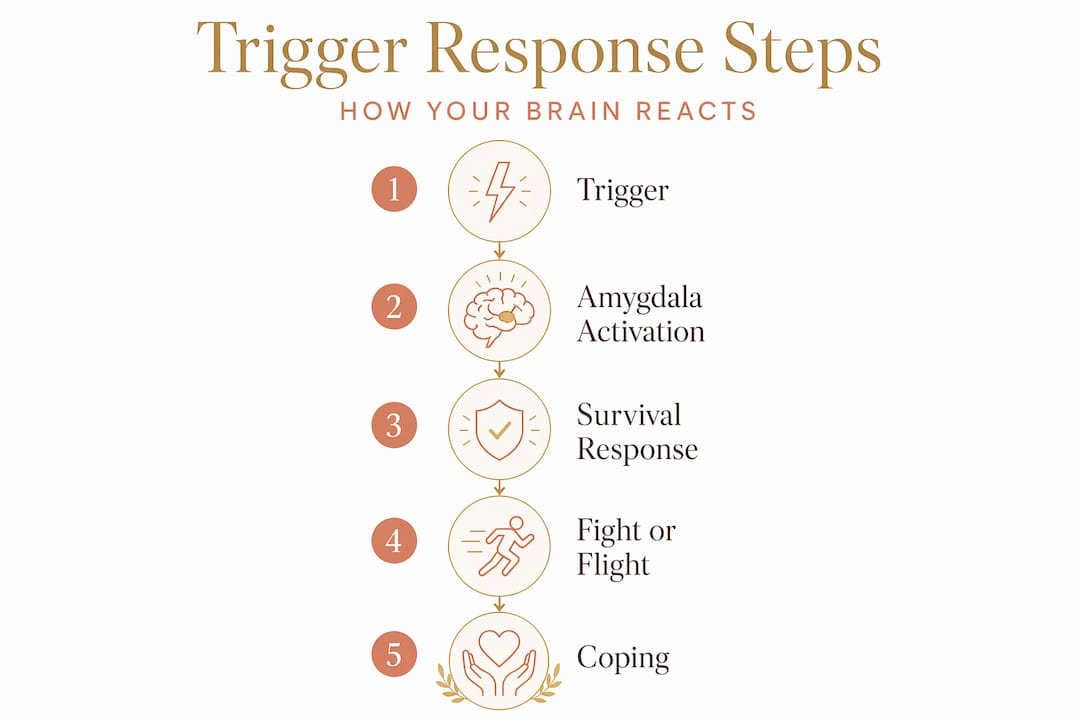
Here’s the neuroscience in plain terms. The amygdala, your brain’s threat-detection center, prioritizes survival over reasoning. It scans incoming sensory data constantly, and when it detects something associated with past trauma, it fires an alarm before your prefrontal cortex, the thinking, reasoning part of your brain, has time to evaluate the situation. That’s why a scent, a phrase, or a particular time of day can send you into emotional overwhelm before you’ve had a single conscious thought about it.
What makes this especially disorienting is that trauma memories lack clear time stamps. Your brain doesn’t store them the way it stores ordinary memories. They can surface without context, without a “this was then” label, making the past feel like the present.
Triggers come in two broad categories:
- External triggers: Sensory inputs from the world around you. For betrayal survivors, these often include songs that played during the affair period, a specific restaurant, someone who resembles the affair partner, a notification sound on a phone, or the smell of a particular cologne or perfume.
- Internal triggers: Feelings, thoughts, or physical sensations that activate the survival response from within. Feeling lonely, experiencing a moment of trust, or noticing physical arousal can all become internal triggers after betrayal trauma.
Your nervous system then responds through one of four patterns: fight (anger, confrontation), flight (fleeing, avoiding), freeze (shutting down, dissociating), or fawn (people-pleasing to neutralize perceived threat). These responses are intelligent survival adaptations, not signs of weakness or irrationality. They protected you once. The problem is that they continue firing in safe situations.
Pro Tip: If you’ve ever been told “you’re overreacting,” remember that your nervous system is not overreacting. It’s doing exactly what it was trained to do. The goal of healing is to retrain it, not shame it.
Types of trauma responses and their effects on your daily life
Understanding your trauma response pattern matters because it shapes how triggers affect your relationships, your sense of self, and your capacity to trust. Each of the four responses looks and feels different, and recognizing yours is a meaningful step in recovery.
- Fight response: You become reactive, defensive, or prone to anger. After betrayal, this might look like explosively confronting your partner over small things, hypervigilance about their whereabouts, or an inability to let perceived threats pass.
- Flight response: You withdraw, get busy, or physically or emotionally remove yourself from closeness. This can feel like restlessness, an urge to end the relationship impulsively, or burying yourself in work.
- Freeze response: You go numb, lose the ability to speak or act, or feel paralyzed during conflict or intimacy. This is often described as “going blank” or feeling disconnected from the body.
- Fawn response: You override your own needs to prevent perceived abandonment or conflict. After betrayal, this might mean minimizing your own pain to avoid upsetting your partner, even the one who caused the harm.
“Trauma responses activate automatically even when current danger is absent, interfering with relationships and work.” Source
The concept of the window of tolerance is worth knowing here. This is the emotional zone where you can process feelings without being overwhelmed or shutting down completely. Trauma triggers narrow this window significantly. Something that might be a manageable conversation for someone without trauma becomes impossible when your nervous system is already activated. The effects of trauma triggers on trust, emotional intimacy, and self-esteem are profound, not because you are broken, but because your nervous system is doing overtime work it was never meant to sustain indefinitely.
How to identify your trauma triggers effectively
Most people know their big triggers. What they miss are the subtle ones. Recognizing emotional triggers at a granular level is what separates reactive suffering from active recovery.
The most effective tool for how to identify triggers is a trigger journal. Every time you notice a strong emotional or physical reaction, write down:
- What was happening in the moments before it started
- What you were feeling physically (chest tightness, shallow breathing, heat in the face)
- What emotion you noticed first
- What the context was (who was present, what was said, what you saw or heard)
Recording context and sensations over time reveals patterns you cannot see in the moment. You might discover that evenings between 8 and 10pm consistently activate you, or that a certain tone of voice is the actual trigger rather than the words being said.
Common pitfalls in recognizing emotional triggers include:
- Avoidance: Assuming you know your triggers and deliberately staying away from them without ever examining them
- Shame: Judging yourself for being triggered by something that seems “small” and therefore not investigating it
- Mislabeling: Calling a trigger response “mood swings” or “anxiety” without connecting it to the underlying trauma
- Cognitive override: Telling yourself “I shouldn’t feel this way” and talking yourself out of tracking the experience
Sensory, emotional, and interpersonal cues all function as triggers. A subtler but common example in betrayal trauma: feeling genuinely cared for can trigger panic. If care preceded betrayal in your history, the nervous system learns to flag warmth as a threat signal.
Pro Tip: Set a two-week journaling window before drawing conclusions about your trigger patterns. One entry gives you data. Fourteen give you a map.
Practical coping strategies for managing trauma triggers
Coping with trauma triggers doesn’t mean making them disappear. It means creating enough space between stimulus and reaction to make a deliberate choice about what happens next. Grounding techniques are the most researched and widely applicable starting point.
The 5-4-3-2-1 technique is a structured sensory grounding method that engages the parasympathetic nervous system to interrupt the fight-or-flight cycle:
- Name 5 things you can see right now, in detail
- Name 4 things you can physically touch, and press your hands into them
- Name 3 things you can currently hear
- Name 2 things you can smell (or recall a scent you find grounding)
- Name 1 thing you can taste
The purpose here is to shift attention from internal trauma material to the present sensory environment. Importantly, grounding is a focus shift, not a relaxation method. You’re not trying to feel calm. You’re trying to anchor yourself in the present moment.
Other evidence-backed approaches include:
- Splashing cold water on your face, which activates the dive reflex and slows heart rate
- Carrying a personal grounding object with a strong sensory quality (a smooth stone, a specific scent)
- Using a phrase you’ve pre-decided on, such as “I am safe right now” stated aloud
Pro Tip: Grounding is deeply individual. If the 5-4-3-2-1 method increases your anxiety rather than reducing it, try a single strong sensory input instead, like holding ice, rather than assuming grounding doesn’t work for you.
Long-term healing: therapy options that address triggers directly
Grounding stabilizes you in the moment. Therapy is what changes the underlying pattern. Two treatments have the strongest evidence base for treating trauma triggers at the source.
| Therapy | How it works | What to expect |
|---|---|---|
| Prolonged Exposure (PE) | Guided, gradual revisiting of trauma memories to reduce their emotional charge | 8 to 15 weekly sessions, approximately 90 minutes each |
| EMDR | Bilateral stimulation (eye movements or tapping) while holding trauma memories to reprocess them | Variable session count, often shorter than PE for single-incident trauma |
PE has the strongest randomized controlled trial support among PTSD treatments, which is significant. The mechanism matters: by carefully approaching trauma memories rather than avoiding them, the brain gets updated information. It learns that the memory, while painful, does not signal current danger. Triggers gradually lose their power as a result.
The most common barrier to seeking trauma therapy is the fear that revisiting trauma will make things worse. This fear is understandable and very common. But the research is clear: avoidance of triggers expands fear, contracting your world over time. Gradual exposure, done properly with a trained therapist, does the opposite. It systematically updates your brain’s threat predictions.
If you’re exploring therapy for infidelity trauma, know that not all therapy approaches are equally effective for trauma. Trauma-focused modalities like PE and EMDR are specifically designed to work with the nervous system, not just the narrative you tell about what happened.
Betrayal trauma and the specific triggers it creates
Betrayal trauma is a specific category of trauma that carries its own trigger profile. What makes it distinct is that the source of harm was also a source of safety. This creates a disorienting double bind that shapes how triggers function.
When a partner’s infidelity is the traumatic event, the triggers are woven into the fabric of ordinary relationship life. Common examples specific to betrayal trauma include:
- A partner being on their phone, especially with the screen angled away
- Your partner coming home later than expected without explanation
- Hearing a song associated with the period of the affair
- Physical intimacy, which can feel both desired and threatening simultaneously
- Your partner expressing affection in ways that mirror behaviors during the deception period
Triggers in betrayal trauma strongly affect trust and emotional closeness, which are the exact foundations needed for relationship repair. This is why healing from infidelity is so much more complex than healing from a single traumatic event with a clear external cause. The physical symptoms of betrayal alone, including nausea, sleep disruption, and hypervigilance, are signs of how deeply the body registers this kind of wound.
Rebuilding safety after betrayal requires both individual trauma work and, where relevant, a partner who understands the impact of triggers on the relationship. If your partner responds to your triggered reactions with frustration rather than understanding, that response itself becomes a trigger. Education, for both of you, is part of the recovery process.
My perspective on healing trauma triggers after betrayal
I’ve worked with and alongside people rebuilding after betrayal for years, and the single most consistent misunderstanding I encounter is this: people believe their triggered reactions mean they are not healing, or that they’ve failed somehow. They haven’t. Triggers don’t disappear in a straight line. They show up less often, with less intensity, and become easier to recognize and manage. That is healing.
What I’ve also seen is that the people who make the most meaningful progress are the ones who get curious about their triggers rather than ashamed of them. When you approach a triggered reaction with “what just happened in my body and what did it remind me of?” rather than “why am I like this?”, everything shifts.
Avoidance is so understandable I never judge it in anyone. It works in the short term. It keeps you from the pain. But I’ve watched people shrink their lives around their triggers for years, and the result is a world that keeps getting smaller. Healing is not about becoming trigger-free. It’s about building the capacity to move through triggers without being destroyed by them.
If you’re in the middle of betrayal recovery right now, please extend yourself the same compassion you would offer a close friend who had just experienced what you experienced. And if you haven’t yet connected with professional support, that step matters more than any technique in this article.
-S.J.Howe

Resources to support your recovery from betrayal trauma
If you’ve recognized yourself in this guide, the next step is having a structured path forward rather than trying to piece together your healing alone.
Aftertheaffair has developed practical, evidence-informed resources specifically for people navigating what you’re navigating right now. The 7-step infidelity recovery checklist gives you a clear framework for the stages of healing, including understanding and working with your triggers. For those further into the process, the trauma recovery checklist offers structured steps tailored specifically to betrayal trauma. These aren’t generic wellness guides. They are built for exactly what you’ve experienced, by people who understand the specific weight of it.
FAQ
What does it mean to explain trauma triggers?
Trauma triggers are stimuli that activate your nervous system’s survival response based on a past traumatic experience. The amygdala fires before logical thought can intervene, producing reactions that feel involuntary and overwhelming.
What are common trauma trigger examples after infidelity?
Common examples include a partner’s phone behavior, specific songs, familiar smells, certain tones of voice, and physical intimacy. These inputs become associated with betrayal and activate the nervous system as if the threat were current.
How do I start identifying my personal triggers?
Keep a trigger journal for at least two weeks, noting the physical sensations, emotions, and context immediately surrounding each strong reaction. Patterns in timing, sensory inputs, and interpersonal dynamics will emerge.
Can trauma triggers ever go away completely?
Triggers typically become less frequent and less intense with trauma-focused therapy and grounding practice. Complete elimination is less common than building the resilience to move through them without being overwhelmed.
What is the most effective therapy for trauma triggers?
Prolonged Exposure therapy and EMDR both have strong clinical support. PE involves gradual, guided exposure to trauma memories across 8 to 15 sessions, while EMDR uses bilateral stimulation to reprocess traumatic material.
Recommended
- Betrayal Trauma Hub – After the Affair Series
- Recognize betrayal trauma symptoms for healing after infidelity
- Choosing a Betrayal Trauma Book That Works – After the Affair Series
- How to address betrayal trauma: steps for healing